

Home > News > 2019+ 6.7L Cummins Delete vs Repair: The Three Timing Question

2019+ 6.7L Cummins Delete vs Repair: The Three Timing Question
The answer to “should I delete my 2019+ 6.7L Cummins” isn’t a yes or no — it’s a when. Three separate timing calls sit between you and the decision, and each one changes both the cost and the risk. Get any of the three wrong and you either overpay, lose a warranty you needed, or sit on a repair loop that never ends.
This guide walks through all three, on top of the one thing that makes the 2019+ generation different from every Cummins before it: the locked ECM.
For off-road / competition use only. Not legal for on-road use in emissions-regulated areas. Check your local, state, and federal laws before modifying any emissions-related component.
Know the Generation Before You Time Anything
You can’t time a decision you can’t price, and the 2019–2024 6.7L Cummins is really two trucks wearing one badge. The split is the ECM, not the engine.
| Generation | ECM access | What it means for cost |
|---|---|---|
| 2019–2021 | SGW (Security Gateway) lock, bypassed with a ~$85 cable | OBD flash, same-day tune, DIY ~$2,200–$3,500 |
| 2022–2024 | Locked ECM (CM2450B) | Historically needed an ECM swap or bench flash ($1,000–$3,000) |
The 2022–2024 trucks have been the expensive ones — the ECM was encrypted to the point that tuners couldn’t flash through the OBD port. That’s the single biggest reason a “2019+ delete” quote swings from roughly $3,000 to $7,000 depending on the exact year.
Here’s the Timing Insight: This Is Moving
Tuners are now flashing 2022–2024 trucks directly through the OBD port with devices like EZ Lynk, no ECM swap required. The same job that cost $1,000–$3,000 more a year ago is closing the gap. If you’re on the fence about a 2022+, the cost of waiting has been dropping — which is itself a timing factor most guides miss.
Source: owner installs and vendor pricing, 2026 — unlock availability changes frequently; confirm your exact year before budgeting.
What a 6.7L Cummins Delete Actually Changes
Before you commit to any timing, know what you’re actually buying — most of what a delete delivers is invisible on a spec sheet, and the biggest “gain” people expect isn’t real.
The Horsepower Comes From the Tune, Not the Pipe
A delete does not add horsepower by itself. Removing the DPF and EGR drops restriction, but the power you feel comes from the tuner changing fueling and timing. A tuned, deleted 6.7 pulls hard — but a tuned, emissions-intact 6.7 does too. The pipe’s real job is removing the failure points and the regen cycle, not adding power.
Fuel Economy: Real, but Modest
Owner-measured gains are real, but they’re single-digit, not the fantasy numbers some listings float. One owner on a 4-position tune recorded roughly 23 MPG at 60 mph on the low setting and 27–28 MPG on the high setting, and 19 MPG at 70 mph climbing to 24–25 MPG on the top tune. That’s on 37-inch tires and winter diesel, so treat it as directional, not a guarantee.
Source: owner road-test video; single truck, 37" tires, winter fuel — numbers vary.
What You’ll Actually Feel
The three things owners consistently notice after a delete:
- Sharper throttle response. No more regen-induced lag; the engine feels lighter on its feet.
- A cleaner, more consistent idle. No more surging when a regen kicks in at a stoplight.
- The sound. A 5-inch straight pipe has real cab drone; add a muffler and it’s a deep rumble without the fatigue. That’s a comfort call, not a performance one.
The Three 2019+ Failures a Delete Can’t Fix
This is the part the “delete = reliability” crowd skips, and it’s exactly why Timing Question #1 exists. The 2019+ 6.7L Cummins has three known failures that are completely unrelated to the emissions system — a delete touches none of them.
1. The Hydraulic Lifter Problem
The lifters on the 2019+ engines are a documented weak point. When one collapses or wears out, it takes the cam with it, and the repair runs $7,000–$8,000. This is a bottom-end/top-end mechanical issue — deleting the DPF and EGR doesn’t change the lifters one bit. It’s the single biggest reason owners with warranty left choose to wait.
Source: shop and owner reports; community-established figure, not an OEM spec.
2. The Grid Heater Bolt
The grid heater sits in the intake, and its mounting bolt is famous for corroding and dropping into cylinder #6 — which destroys the piston and scores the cylinder. It’s a “when you’re unlucky you’re doing a whole engine” failure. A DPF delete doesn’t touch the grid heater; the fix is a dedicated grid-heater delete plate or an aftermarket intake horn, done as a separate job.
3. The CP4 Fuel Pump (2019–2020)
The 2019–2020 trucks shipped with the CP4.2 high-pressure pump — the same one that’s a $10,000–$15,000 metal-shredding failure on Ford and GM. Ram issued a recall (Y78) to convert back to the CP3, and if your truck is in scope you should take the free fix regardless of delete plans. A delete does nothing for the fuel pump; clean fuel and the recall are what protect you here.
Timing Question #1: Delete in Warranty, or Wait Until It Expires?
This is the question that divides owners most sharply, and the 2019+ generation makes it genuinely hard — because these trucks have a specific, expensive, non-emissions failure waiting in the wings.
The Case for Waiting (Keep the Warranty):
-
Lifter failure is real on 2019+. The hydraulic lifters are a known weak point on this generation, and a failure runs $7,000–$8,000 to fix. That’s not an emissions problem a delete touches — it’s a bottom-end/top-end mechanical issue the factory warranty actually covers.
-
The grid heater bolt is the other one. The grid heater’s stud can corrode and drop into cylinder #6, and “if you’re unlucky you’re doing a whole engine.” In warranty, that’s Ram’s problem. Deleted, it’s yours.
-
Deleting voids the powertrain warranty. Stellantis pulls the ECM status report on any warranty claim, and a flashed computer is a flag the dealer will see.
The Case for Deleting Now (Don’t Wait):
-
The thing most likely to strand you is the thing you’re deleting. The #1 failure mode on these trucks — is the aftertreatment system: DPF, DEF, EGR, and their sensors. You can’t use a powertrain warranty on an aftertreatment problem after the emissions warranty lapses anyway.
-
A deleted truck doesn’t need the parts the warranty covers. The regen fuel dilution, the EGR soot, the DEF pump freeze — all gone. What’s left is a simpler engine with fewer ways to fail.
The honest middle: if your truck is still under powertrain warranty and you’re not chasing big power, the lifter and grid-heater risk is real enough to wait for the warranty clock to run out. Most owners who wait aren’t waiting to delete — they’re waiting for the free coverage on the mechanical failures a delete can’t fix.
Source: owner and shop reports; the $7,000–$8,000 lifter figure and grid-heater bolt are community-established 2019+ failure modes, not OEM specs.
Timing Question #2: Delete Now, or Repair Until Something Breaks?
The second call is about whether you delete proactively or reactively.
The Reactive Argument (Repair First):
A Cummins-certified mechanic’s take, and it’s worth sitting with: the aftertreatment is the #1 problem, but it’s not a death sentence. The two biggest things that extend these systems are running the truck hard and hot and limiting idle. A truck that gets up to full operating temperature and completes its regens will have far fewer DPF and EGR problems than one that does five-mile cold trips every day.
If your driving keeps the system healthy, the “delete now” urgency drops. You repair a sensor for $200 and keep driving.
The Proactive Argument (Delete Before it Breaks):
Every repair buys time, not a fix. A NOx sensor is $200–$500 — and there are two of them. The DEF pump is $400–$900. The EGR cooler is $1,000–$2,000. The DPF itself is $2,000–$5,000. That’s not a list of one-off expenses; it’s a sequence.
The repair-first path makes sense only if you’re staying emissions-compliant anyway (street truck, inspection state, still financed). If you’re already committed to going off-road eventually, deleting before the first $1,000 repair lands is usually cheaper than deleting after the second one.
The rule that resolves it: if you’ve already paid for one major aftertreatment repair and the truck is out of warranty, the math has already tipped. Delete now. If nothing’s broken yet and you drive it hard enough to keep the system clean, you have the luxury of waiting.
Timing Question #3: The Cost — What Each Path Actually Costs
Here’s the number nobody gives you up front: the delete and the repair loop are priced in different currencies — one-time hardware + tune vs. an open-ended repair schedule.
| Path | Upfront | Ongoing / hidden | What you actually get |
|---|---|---|---|
| Repair loop | $200–$5,000 per failure | Repeats on a schedule | Temporary fix, stays legal |
| Delete (2019–2021) | ~$2,200–$3,500 DIY | Tune support, plugs, filter kit | Permanent, off-road only |
| Delete (2022–2024) | ~$3,500–$4,500 DIY (dropping) | Same | Permanent, off-road only |
The delete hardware itself is the small part of the bill. A 4" DPF delete + EGR kit is a few hundred dollars; the tuner and the tune are where the money goes — and on 2022+, historically, the ECM unlock. The repair loop, by contrast, looks cheap per incident but has no ceiling.
The honest breakeven:
If your truck has already cost you $2,000+ in aftertreatment repairs and you plan to keep it, the delete pays for itself the moment you stop paying for the next sensor, pump, and filter. If the truck is clean and you’re still covered, there’s no breakeven to chase yet — that’s why Questions #1 and #2 come first.
Two Ways to Delete, Priced for Your Timing
The kit you pick should match where you are in the timing — a budget EGR-only delete if you’re easing in, or a full downpipe-back system if you’re doing it once and done.
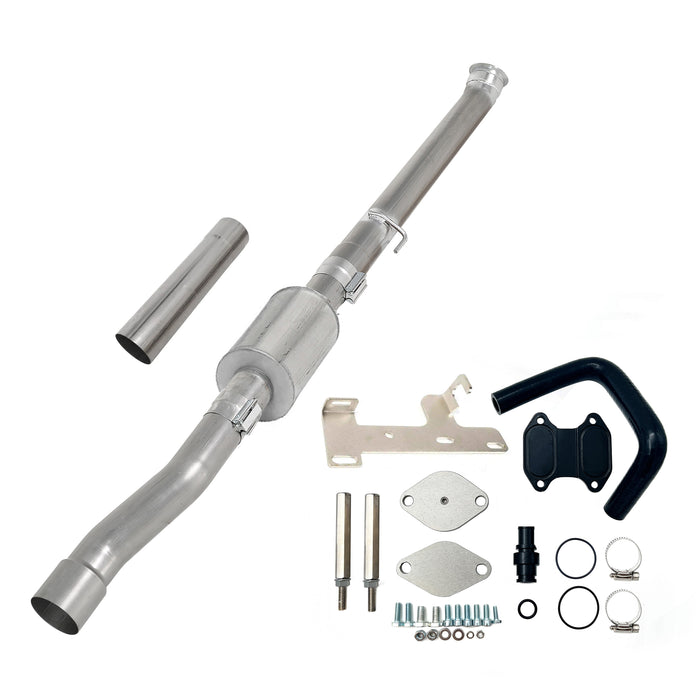
2019-2024 6.7L Ram Cummins 4"/5" DP-Back DPF/EGR Delete kit
This is the 6.7L Cummins complete delete kit in one box: EGR valve/cooler delete plus a mandrel-bent 4" or 5" downpipe-back exhaust.
-
What it’s made of. A straight-through stainless pipe with no internal honeycomb —steel pipe doesn’t hold soot, doesn’t crystallize, and doesn’t have a “full” state.
-
What it does. Two things the factory system was actively working against: it removes the EGR cooler and valve (stopping hot soot from being recirculated into the intake and deleting the internal coolant-leak point that can hydrolock a cylinder), and it removes the DPF/SCR (ending the regen cycle, the fuel dilution, and the backpressure that keeps the turbo working harder than it needs to).
-
Why buy this one. It’s the “do it once and be done” choice — the kit for the owner who’s already answered Timing Question #2 and decided they’re deleting, not staging. One box, one teardown, every failure point gone at once.
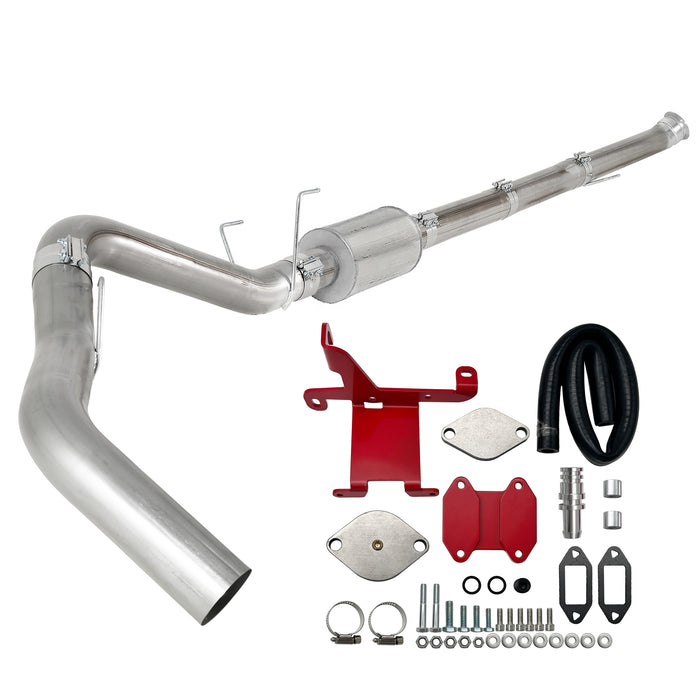
2019-2024 6.7L Ram 4"/5" DPF Delete Dp-Back pipe & EGR Delete Kit
If you want to buy exactly the depth you need — including an EGR-only delete for $128.88 — this is the same build broken into pieces.
-
Same material, same job. Identical straight-through stainless pipe and the same EGR cooler/valve removal, just sold in modular steps so you’re not paying for pipe you don’t want yet.
-
Performance, by stage. The 2019–2024 6.7L Ram 4"/5" DPF & EGR Delete Kit lets you pick your entry point.
-
Why buy this one. It’s for the owner still deciding — the one who wants the EGR failure point gone now but hasn’t fully committed to the whole job. The honest caveat from Timing Question #2 still applies. But if your budget or your uncertainty is the constraint, this is the kit that lets you stage it without buying a second product.
Both kits are hardware: the tuner is a separate purchase and is non-negotiable — without a delete tune the truck throws codes and derates within miles.
The Two Things You’ll Still Buy After a Delete
Deleting doesn’t end the shopping list. Two items belong in every 2019+ delete, and they’re the difference between a clean job and a truck that bites you later.
The Tuner Harness Plug Kit
When you unplug the DPF, DEF, and EGR sensors, you leave a row of open connectors exposed to moisture and road salt. Water in the harness throws phantom codes down the road — and if you ever reinstall the factory system to sell the truck, corroded connectors won’t work. A 2019–2024 6.7L Ram Cummins Tuner Harness Plug Kit caps every orphaned connector. It’s the cheapest insurance in the whole delete, and it’s the part most first-timers skip.
The Filter Kit
A deleted truck still needs oil, fuel, and air filters — arguably more carefully, since there’s no dealer doing the maintenance anymore. A 2019–2024 6.7L Dodge Ram Fuel, Oil, Air & Cabin Filter Kit keeps the fuel system (and the CP4 on 2019–2020 trucks) alive. Clean fuel is the one thing standing between you and the $10,000–$15,000 CP4 failure.
The Install Reality: What Trips People Up
The timing of the delete matters, but so does the execution — and the 2019+ trucks have a couple of gotchas that cost people a re-tune or a bricked ECM.
The Tune Comes First, Always
Flash the delete tune before you unbolt anything. Remove the hardware first and the truck throws a wall of codes and derates within miles. On the 2019+ trucks this rule matters even more because of the ECM work involved — you want the tune confirmed live before you’re committed.
The Transmission You Have Changes the Job
The 2019+ trucks come with one of two transmissions, and they’re not the same for tuning:
- 68RFE — the tuning covers it, and you want the trans tune to handle the added torque. Note that on these trucks the ECM and TCM are one unit, so flashing the engine also wipes the transmission’s learned shift points — drive it gently for the first stretch so it can relearn.
- Aisin AS69RC — no trans tuning available; the torque management stays factory. That’s fine, just don’t expect the same tune headroom.
The 2022+ ECM Workflow
For the 2022–2024 trucks, the flash path that’s now working goes through a device like EZ Link. The practical notes that save people a bricked computer:
- Read the EC number (the calibration ID) off the ECM first — the tune has to match it.
- Keep a battery charger on it (10A or better) for the whole flash. A voltage dip mid-flash is how ECMs get bricked.
- Unplug the EGR and throttle valve, but leave the MAP sensor alone — it’s easy to unplug the wrong connector in the engine bay and chase a ghost code after.
- Cap every orphaned connector with a harness plug kit, or you’ll be diagnosing phantom codes and corrosion a year from now.
Source: 2022–2024 owner install videos; flash tooling and workflow change, so confirm against your tuner’s current instructions.
The Legal Reality (Read This Before You Commit)
Removing or disabling emissions equipment on a road-driven truck violates the federal Clean Air Act (42 U.S.C. § 7522), with individual penalties up to $5,911 per violation — and the EPA has actively pursued defeat-device enforcement against Ram trucks specifically. Delete parts are for off-road, competition, and closed-course use only; the “off-road” label does not create a legal exemption for a truck that ever touches a public road.
Your warranty is gone the moment the ECM is flashed. If you’re still covered, that’s the single biggest reason to defer — see Timing Question #1.
Get the Right Kit for Your Timing
The 2019+ 6.7L Cummins delete isn’t one decision, it’s three: when relative to the warranty, when relative to the first failure, and what the numbers say once you’ve decided. Answer the first two honestly — are you covered, and has it already broken? — and the third one almost answers itself.
Whatever your timing, Trucktok 2019–2024 6.7L Cummins delete kits let you buy exactly the depth you need — from a $128.88 EGR delete to a full 5" downpipe-back system — and the harness plug kit and filter kit to finish the job right.
Related Blogs:
-
6.7L Cummins EGR Cooler Leak: Why Is Coolant Disappearing
- 6.7L Cummins DPF Clogging: How to Spot It Before Limp Mode
- 2019-2024 Cummins P2463: Why the Regen Code Won’t Clear
- 6.7L Cummins CCV Delete: The Crankcase Vent You're Ignoring
- 2019-24 Cummins Delete: DIY vs Shop — What You'll Actually Pay
- 2010-2024 6.7L Cummins EGR Delete: What Ram 2500 Owners Should Know
For off-road / competition use only. Not legal for on-road use in emissions-regulated areas. Check your local, state, and federal laws before modifying any emissions-related component.
Frequently Asked Questions
Is a 2019+ 6.7L Cummins delete more expensive than older trucks?
Yes — the locked ECM is the difference. 2019–2021 needs only a ~$85 SGW bypass cable, but 2022–2024 historically required an ECM swap or bench flash. Tuners are now flashing 2022+ through the OBD port, so the gap is closing, but confirm your exact year before budgeting.
Should I delete while my truck is still under warranty?
Usually no. The 2019+ lifter failure ($7,000–$8,000) and grid-heater bolt are mechanical problems a delete doesn’t fix, and the factory warranty covers them. Most owners wait for the warranty clock to run out, then delete.
What actually fails on a 2019+ 6.7L Cummins?
Aftertreatment first — DPF, DEF, EGR, and their sensors — because those are what the regen cycle and soot loading stress the most. EGR and the VGT turbo come next. On 2019–2020 models, the CP4 fuel pump is the big one (there’s a recall to swap it back to a CP3), and that failure has nothing to do with emissions.
Does a delete add horsepower?
Not by itself — the horsepower comes from the tune. The delete removes restriction and the regen cycle; the tuner is what changes fueling and timing. A tuned 6.7 will pull noticeably harder, but don’t credit the pipe for the tune’s work.
Can I delete just the EGR and leave the DPF?
Technically yes, but it’s the wrong order. Deleting the EGR without the DPF leaves the DPF loading soot faster with no regen logic matched to it. Do both together, or do the DPF first.
How much does the delete cost all-in?
Roughly $2,200–$3,500 DIY for a 2019–2021, and $3,500–$4,500 for a 2022–2024 (though that’s dropping). The hardware is a few hundred dollars; the tuner and tune are the real expense. On 2022–2024 trucks, the historical ECM unlock was the other big line item, but OBD flashing is now bringing that down.
What happens if I delete without a tune?
The truck throws a wall of codes and derates within miles. The tune is not optional — it’s the other half of the delete. This is why you flash the tune before unbolting any hardware: you want the computer confirmed live before you’re committed to the mechanical work.
Does deleting void my warranty?
Yes. Stellantis reads the ECM flash history on any powertrain claim, and a modified computer is an automatic flag. This is the main reason to wait out the warranty first.
Do I still need to change filters after a delete?
Yes — more carefully, since there’s no dealer doing the maintenance anymore. The fuel, oil, and air filters still need regular service on the same schedule. Clean fuel is especially important because it’s what protects the 2019–2020 CP4 pump from its metal-shredding failure.
Is a deleted truck harder to sell?
Yes. Dealers mostly won’t take it, and informed private buyers discount it for the legal liability they’re inheriting. Keeping the factory parts makes reversing the delete possible if you ever sell.
Is deleting a 2019+ 6.7L Cummins legal on the road?
No. It violates the federal Clean Air Act, with penalties up to $5,911 per violation. Delete parts are for off-road and competition use only, and there’s no legal exemption for a truck that touches public roads.