

Home > News > 6.7L Cummins DPF Clogging: How to Spot It Before Limp Mode


6.7L Cummins DPF Clogging: How to Spot It Before Limp Mode
A clogged DPF almost never fails overnight. It degrades in stages, and each stage sends a signal you can read — if you know what to look for. Catch those signals early and the fix is a $250 cleaning. Miss them and you’re facing a $3,500 dealer replacement, or worse, a 5-mph limp-mode crawl on the side of the highway. This guide is about reading the signals before the truck makes the decision for you.
Disclaimer: Removing or tampering with emissions equipment may violate the federal Clean Air Act and state regulations. Delete pipes and tuners are sold for off-road, race, and competition use only. Check your local and state laws before modifying any emissions component.
The One Distinction That Explains Everything: Soot vs. Ash
Every DPF problem traces back to two substances that behave completely differently — and confusing them is how owners misdiagnose the whole thing.
-
Soot (carbon) is what the filter catches. It burns. A regeneration cycle raises exhaust temperature past roughly 1,000–1,100°F and incinerates the soot into a small amount of ash.
-
Ash is the residue that’s left behind — metal oxides from oil additives and engine wear, plus the leftover from every burned regen. Ash does not burn. It accumulates in the ceramic channel walls permanently, shrinking the space available for soot.
The consequence is direct and measurable: a filter at 70% ash fill triggers regenerations at roughly 70% shorter intervals, because the same amount of soot now fills the remaining space much faster. A clogged DPF isn’t “dirty” — it’s running out of channel volume. That volume never comes back without physical cleaning or replacement.
The Early Signs: Catch It While You Still Can
These are the signals that show up while the DPF is still saveable. Learn them and you’ll never be surprised by limp mode.
Regeneration Cycles Keep Getting Closer Together
On a healthy 6.7L Cummins, active regeneration triggers roughly every 300–500 miles in mixed driving. When ash has consumed channel volume, that interval collapses:
- Regens firing every 50–100 miles instead of 300–500
- “Exhaust Filter Overloaded — Drive to Clean” messages that don’t clear even after a highway run
- Regens that take longer to complete — the ECU keeps post-injecting fuel, but the soot isn’t burning off as fast as it should
If you’ve gone from a regen every tank to a regen every trip to town, the filter isn’t “just dirty” — it’s running out of room.
The Oil Level That Rises On Its Own
This one sounds like a parlor trick, but it’s a known failure signature called fuel dilution. During regen, the ECU injects fuel on the exhaust stroke to push raw diesel into the exhaust and raise DPF temperatures. Not all of it combusts — some washes past the piston rings and ends up in the oil pan. When regens fail repeatedly, that unburned fuel accumulates:
- Oil level creeping up between changes
- A diesel smell in the engine oil
- Thinned oil that accelerates bearing wear — damage that never shows up on the repair estimate
A rising oil level is the single most counterintuitive early warning, and one of the most ignored.
A Throttle That Goes Lazy
A clogged DPF is a physical obstruction. The engine pushes exhaust through a ceramic wall, and when that wall is packed, it’s pushing against a restriction:
- Noticeable lag rolling into the throttle from a stop
- Reduced passing power on the highway
- Slower boost build from low RPM, because the turbo is fighting downstream backpressure
A healthy DPF holds 0.5–1.5 psi of backpressure at cruise. A clogged one can push 5–10+ psi — and every psi is horsepower the engine can’t use.
Fuel Economy That Keeps Dropping
Every regen burns fuel solely to heat the exhaust, not to move the truck. A normal regen costs maybe 0.5 MPG over a tank. When regens fire every 50 miles, that compounds into a 2–4 MPG drop that never recovers after a highway drive.
The Late Signs: You’re Running Out of Time
When these appear, you’re past “clean it” and into “replace or delete it” territory.
Black Smoke From the Tailpipe
The DPF captures 99%+ of particulate matter. If you see black smoke — especially under hard acceleration — one of two things has happened: the filter is cracked (soot bypassing through a breach), or it’s so severely overloaded that regen can’t keep up.
- Puffs of black smoke on hard acceleration
- A visible haze in the headlights behind you at night
- Smoke that wasn’t there 10,000 miles ago
Important: black smoke can also come from a failing injector, a sticking VGT actuator, or a boost leak. But black smoke + shrinking regen intervals is the fingerprint of a DPF in trouble.
Check Engine Light With DPF Codes
The ECU watches the DPF through two inputs: the differential pressure sensor (pressure drop across the filter) and the EGT sensors (inlet/outlet temperature). When readings fall out of range, specific codes set:
| Code | Meaning | What It Tells You |
|---|---|---|
| P2463 | DPF Soot Accumulation — Excessive | Loaded past the regen threshold; standard regen can’t clear it |
| P2459 | DPF Regeneration Frequency — Too High | Regens firing too often; ash is consuming channel volume |
| P2002 | DPF Efficiency Below Threshold | Soot passing through — likely a cracked substrate |
| P244A | DPF Differential Pressure Too Low | Cracked DPF, disconnected hose, or sensor failure |
| P246C / P242F | DPF Ash Accumulation — End of Life | Ash reached the service limit; filter is worn out |
P2002 is the one you don’t want to see — it means physical damage. A TDR Auto tech working a 2019 Ram 2500 with P2002 pulled the filter and found large holes blown through the substrate, his best guess being contaminated diesel (gas mixed into the tank). That’s a replace-or-delete, not a clean.
The Derate Ladder: What Limp Mode Actually Looks Like
On the 6.7L Cummins, derate isn’t a single event — it’s a structured five-level ladder, and you climb it before the final lockout:
| Level | Power Restriction | Typical Cause |
|---|---|---|
| Level 0 | None — full power, CEL on | Fault active, warning only |
| Level 1 | 25–40% reduction | Persistent emissions fault |
| Level 2 | 50–60% reduction, reduced top speed | Extended fault persistence |
| Level 3 | 75%+ reduction, limited to ~40 mph | Max derate before lockout |
| Level 4 | 5 mph crawl or no-start | DEF stage 4 lockout or critical fault |
The rule most owners miss: clearing a code without fixing the root cause does not reset the derate counter. The ECM progresses by drive cycles. On 2019+ trucks, aggressively clearing codes without repairing the underlying fault can actually accelerate your climb to a Level 4 lockout.
The Root Cause Is Usually Not the DPF
This is the single most important idea in this guide, and it’s the one the forums hammer hardest: a clogged DPF is a symptom, not a disease.
The most common culprit is a stuck-open EGR valve. The EGR dumps exhaust back into the intake, and when it sticks open it produces constant black smoke and heavy soot — which the DPF then has to swallow. An owner who only cleans the DPF and ignores the EGR is back in the same situation within a few thousand miles.
Other upstream causes that load the DPF faster than it can burn:
- A failing injector that dumps too much fuel and makes excess soot
- A boost leak or sticking VGT that upsets combustion
- Short trips and idling that never let the exhaust reach regeneration temperature
- Wrong engine oil — anything not low-ash (CJ-4/CK-4 rated) leaves residue the regen can’t burn
The 6.7L Cummins has been in Ram trucks since 2007.5, and the 2007.5–2012 trucks have no DEF/SCR — they run richer and produce more soot, which is why that generation is notorious for DPF clogging in a repeating loop. Fix the root cause and the filter stops loading.
How to Slow It Down: Prevention That Actually Works
A DPF doesn’t have to clog fast. Most premature failures trace back to habits and maintenance, not the filter itself. Here’s what actually keeps a 6.7L Cummins DPF healthy.
Give It a Weekly Highway Run
The single biggest cause of DPF clogging is short trips that never let the exhaust reach regeneration temperature. A regen needs 20–40 minutes of sustained heat, and city driving never provides it. One dedicated 30–45 minute highway run a week — at steady speed, no idling — lets the filter complete a passive regen and burn off the week’s soot. Think of it as cardio for the engine.
Stop Interrupting Regens
When the truck starts an active regen, let it finish. Shutting the engine off mid-cycle leaves the soot half-burned, and each interrupted regen stacks more residue that’s harder to clear next time. The same goes for excessive idling — it keeps the exhaust cool, prevents regen, and piles on soot.
Use the Right Oil — Low Ash Only
Engine oil is the biggest source of the ash that permanently clogs a DPF. Anything not rated CJ-4, CK-4, or FA-4 leaves metallic residue that regen can’t burn. Using the correct low-ash spec is the single cheapest way to slow ash accumulation and stretch the filter’s life.
Feed It Good Fuel
Low-quality or high-sulfur diesel burns dirtier and loads the filter faster. Buy from high-turnover stations where truckers fuel up — fresher fuel means less water and sediment. In cold weather below about 10°F, an anti-gel additive keeps the fuel flowing and the combustion clean.
Service the EGR System On Schedule
The EGR valve is the DPF’s upstream enemy. The book says clean the EGR system every 67,500 miles, but owners who work their trucks hard pull and clean the valve as often as every 20,000 miles. A stuck-open EGR is the fastest way to soot-load a filter, so keeping it clean is DPF prevention in disguise.
Watch the Soot Load, Not Just the Dashboard
An aftermarket monitor (Edge, Banks, or a phone app on the OBD-II port) shows the live soot-load percentage. When it climbs toward 70–80%, you know a highway run is due before the truck warns you. Waiting for the dash light means you’re already reacting instead of preventing.
Three Paths Once You’ve Confirmed the Clog
Once you know the DPF is the problem, you have three choices, and they scale in both cost and permanence.
- Force a regen + professional clean. If the substrate is intact and the issue is soot, a forced stationary regen followed by a professional cleaning (pneumatic blow-out $200–$350, or thermal oven bake $400–$600) can restore it. Limitation: cleaning can’t remove fused ash or reverse cracking. Past 150,000 miles with no prior cleaning, expect it to buy you 30,000–50,000 miles at best.
- Replace the DPF. OEM runs $2,500–$4,000 plus labor; aftermarket $800–$1,800. Either way you’re installing a new filter that starts accumulating ash from day one. This is the path for trucks that must stay emissions-compliant.
- Delete the DPF. The filter, regen cycles, ash accumulation, and post-injection fuel dilution all disappear. For off-road, race, and competition trucks, it’s the permanent fix — and the clock on your next $3,500 replacement stops forever.
How to Choose Between the Three Paths
All three options work — the question is which one fits your truck. Two facts decide it: what’s actually clogging the filter, and whether the truck has to stay street-legal.
Choose Cleaning If…
- The substrate is intact and the problem is soot, not ash — no P2002, no P246C
- The truck is under 150,000 miles and has never been cleaned
- You’re seeing early signs (frequent regens, rising oil, lazy throttle) but no black smoke or cracked-filter codes
- You want the cheapest fix that buys you 30,000–50,000 more miles
Cleaning is the “catch it early” path. It only makes sense while the filter still has structural life left in it.
Choose Replacement If…
- The truck must stay emissions-compliant — still under warranty, registered in an emissions-testing state, or headed for resale
- The filter is cracked or ash-loaded past its service limit (P2002 / P246C), so cleaning won’t fix it
- You’re willing to pay $2,500–$4,000 now, knowing the same countdown clock restarts from zero
Replacement is the honest “keep it legal” path. It doesn’t solve the underlying design — you’re buying a fresh start with the same clock.
Choose Deletion If…
- The truck is a genuine off-road, race, or competition build, never on public highways
- You’re tired of the regen cycle, the fuel dilution, and the recurring repair bills
- You accept the legal and warranty trade-off
- You want the problem gone permanently, not just reset
Deletion is the only path that removes the clock entirely. It’s also the only one that’s flatly illegal on the road — so it’s a decision about how the truck is actually used, not just how much you want to spend.
The short version: soot + intact filter + early catch → clean it. Cracked or ash-dead but must stay legal → replace it. Off-road only and done with the cycle → delete it.
The Products: A Delete Pipe for Every Generation
The 6.7L Cummins has spanned three distinct generations since 2007.5, and each one has a different emissions layout — which is why a one-size-fits-all delete pipe doesn’t exist. If your truck is an off-road or competition build, the right hardware is the one matched to your year.
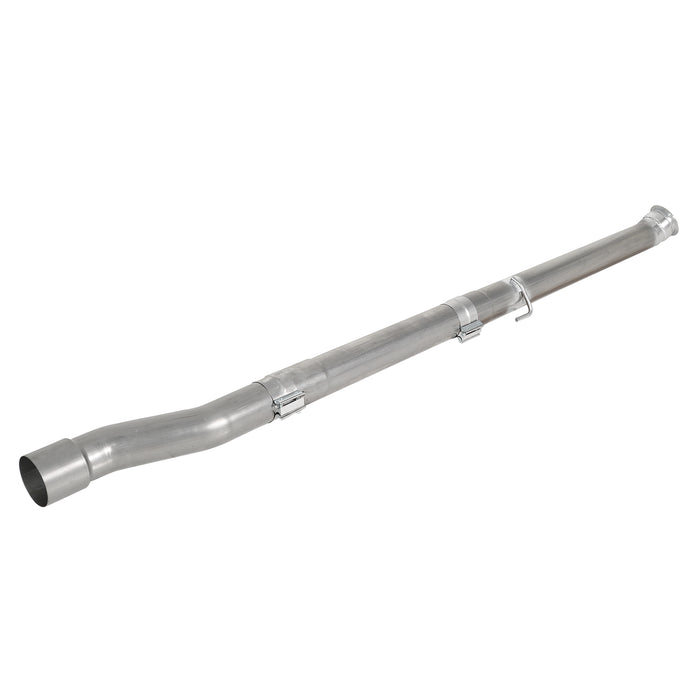
2007.5–2012 (no DEF) — the first-generation 6.7L runs richer and has no SCR, so its DPF loads fast and regens constantly. The 4" DPF delete race pipe replaces the exhaust from the turbo outlet to just before the factory muffler, killing the regen cycle and the oil-dilution that comes with it:
2013–2018 (DEF/SCR era) — this generation added the DEF heater and NOx sensors that fail in pairs and trigger derate. The 4" exhaust tube pipe kit removes the DPF and SCR section in a single install while keeping the factory muffler, eliminating the most failure-prone parts without the full noise.
2019–2024 (fifth-gen) — the most powerful and refined Ram diesel, but the same emissions weaknesses. The 4" Cat & DPF delete pipe drops the restrictive mid-section while preserving the tailpipe, ending the P20EE SCR codes and false derate events.
All three are T-409 stainless. None of them fit commercial Cab & Chassis (4500/5500) trucks, and all of them still require a supporting delete tuner — the hardware alone won’t stop the check engine light or the derate.
Conclusion:
A 6.7L Cummins DPF doesn’t die suddenly — it warns you for thousands of miles first. Regens that creep closer together, an oil level that rises on its own, a throttle that goes lazy, and fuel economy that won’t recover: those are the four signals that say “look now, while a $250 cleaning still works.”
For the full lineup of 6.7L Cummins delete pipes and supporting hardware built for your exact year, head to TruckTok.com. If you have any other questions about the 6.7L Cummins engine, you can refer to these blogs:
-
6.7L Cummins EGR Throttle Valve Delete — The Bottleneck You Didn’t Know
- 2007.5-2009 6.7L Cummins Delete vs Repair: the Math Might Surprise You
- 6.7L Cummins EGR Cooler Leak: Why Is Coolant Disappearing
- 6.7L Cummins DPF Clean vs Delete: Ash No Regen Burns
- 2013-2018 Ram 6.7L Cummins Maintenance Kit: Fuel Oil Air Filter Guide
- 2013-2018 6.7L Ram Cummins Maintenance & Upgrades: Fuel, Exhaust, Tun
Frequently Asked Questions
Q: What’s the first sign my 6.7L Cummins DPF is clogging?
A: Regeneration cycles that fire closer and closer together — from every 300–500 miles down to every 50–100. It means ash has permanently consumed channel volume and soot is filling the remaining space faster than the ECU can burn it off.
Q: Can a regen burn off the ash in a clogged DPF?
A: No. Regen only burns soot. Ash is metal oxide residue from oil additives and wear metals that never combusts, so it has to be removed by physical cleaning or filter replacement. This is the distinction that explains why a truck that “just regened” can still be permanently clogged.
Q: Why is my oil level going up instead of down?
A: That’s fuel dilution. During regen, fuel injected on the exhaust stroke washes past the piston rings into the oil. When regens fail repeatedly, the unburned fuel accumulates and the oil level rises — while the oil itself thins and loses its ability to protect the bearings.
Q: Is a clogged DPF always the DPF’s fault?
A: No — usually not. A stuck-open EGR valve is the most common root cause, producing constant soot the filter can’t keep up with. Failing injectors, boost leaks, and short-trip driving load it too. Clean the filter without fixing the upstream cause and it clogs again in a few thousand miles.
Q: What does P2002 mean, and why is it serious?
A: P2002 is “DPF Efficiency Below Threshold” — soot is passing through the filter, which usually means a cracked substrate. A cracked DPF can’t be cleaned, only replaced or deleted, and combined with black smoke it’s the fingerprint of structural failure.
Q: Can I keep driving with a clogged DPF?
A: Briefly, but the risk compounds. The ECU will derate power to protect the engine, and pushing past the warnings raises backpressure that overheats the turbo, stresses the head gasket, and in extreme cases damages pistons. On the 6.7L, derate climbs a five-level ladder to a 5-mph lockout.
Q: Does clearing the DPF code reset the derate counter?
A: No. The derate progression is based on drive cycles, not the presence of a stored code. Clearing a code without repairing the root cause doesn’t reset the counter — and on 2019+ trucks, aggressive code-clearing can actually accelerate the climb to a full lockout.
Q: How much does a professional DPF cleaning cost vs. replacement?
A: Professional off-vehicle cleaning runs about $250–$600, and a forced regen is $150–$300. An OEM DPF replacement runs $2,500–$4,000 plus labor. Cleaning makes sense when the substrate is intact and the problem is soot; replacement is unavoidable once the filter is cracked or ash-loaded past its service limit.
Q: Will a DPF delete make my truck louder?
A: It depends on how much you replace. A mid-section delete that keeps the factory muffler stays close to stock — slightly deeper, no highway drone. A full downpipe-back delete that removes the muffler delivers a louder, deeper Cummins tone with a pronounced turbo whistle.
Q: Is a DPF delete legal for street use?
A: No. Removing or defeating emissions equipment on a road-driven truck violates the federal Clean Air Act, and deleted trucks will fail emissions testing in states that require it. These parts are for off-road, race, and competition use only — check your local laws.
Disclaimer: Removing or tampering with emissions equipment may violate the federal Clean Air Act and state regulations. Delete pipes and tuners are sold for off-road, race, and competition use only. Check your local and state laws before modifying any emissions component.