

Home > News > 6.7L Cummins DPF Clean vs Delete: Ash No Regen Burns

6.7L Cummins DPF Clean vs Delete: Ash No Regen Burns
A plugged 6.7L Cummins DPF comes down to one question most owners never get a straight answer on: is it full of soot, or is it full of ash? The answer decides everything, because regeneration only burns soot. Once the filter is packed with ash — the metallic residue left behind after every regen — no amount of “cleaning exhaust filter” cycles will ever clear it. That’s the fork in the road: clean it, or delete it.
For off-road / competition use only. Not legal for on-road use in emissions-regulated areas. Check your local, state, and federal laws before modifying any emissions-related component.
Soot vs Ash: The Difference That Decides Everything
This is the part that gets skipped in every delete-versus-clean argument, and it’s the whole ballgame.
-
Soot is the black carbon the filter traps from incomplete combustion. It burns — that’s exactly what regeneration is for. Passive regen (sustained highway heat) or active regen (fuel injected to spike exhaust temps past 600°C) turns soot into gas and clears the filter.
-
Ash is what’s left after the soot burns. It’s non-combustible — fine metallic and mineral residue that heat cannot remove. Every regen converts a little soot into a little permanent ash.
The trap is that ash doesn’t come from the fuel — it comes from the oil. Engine oil carries metal additives (for lubrication and heat resistance), and on a direct-injection diesel, a small amount of oil always burns. Those metal additives don’t combust; they form ash, which rides the exhaust straight into the DPF. That’s why the filter keeps filling even on a perfectly maintained truck, and why it eventually hits “end of life”.
What Cleaning Can Actually Do
Cleaning is a real option — and it’s the legal one — but it’s important to know what it can and can’t fix.
Professional Cleaning (Baking and Flushing)
A shop removes the filter, bakes it to loosen hardened soot and ash, then flushes it with forced air or a liquid cleaner. A good clean restores roughly 85–95% of original flow capacity. It costs $300–$800, a fraction of the $2,000–$5,000 an OEM DPF replacement runs on a 6.7L Cummins (and the 5th-Gen 2019+ units push toward the top of that range because they’re more integrated).
The honest limit:
Cleaning doesn’t stop the ash from coming back. The oil that produces the ash is still burning, so the filter slowly fills again. A properly cleaned DPF typically goes another 100,000–150,000 miles before it needs service again — real time, but not forever.
The Two-Stage Chemical Reality
This is where the “clean it yourself” crowd often goes wrong. A single cleaning product can’t dissolve everything, because soot and ash need opposite chemistry:

-
Ash dissolves in acid. A breakdown test of nine chemicals on a real filter core found that hydrochloric acid, oxalic acid (the active ingredient in some alloy wheel cleaners), and even vinegar ate through the red ash deposits fastest — some took the ceramic back to “like new” in under two hours.
-
Oily soot dissolves in base. Dishwasher detergent and caustic soda (drain cleaner) were far better at lifting the black, oil-soaked soot — but did almost nothing to the ash.
It’s that a proper clean is two-stage — a degreasing pre-wash to break down the oily soot, then an acid stage to dissolve the ash. Skip either half and you leave half the blockage behind. This is also why “DPF cleaner” fuel additives (which can’t be both alkaline and acidic at once) are better at maintaining a filter.
The Maintenance Additive (Prevention, Not a Cure)
Fuel additives that claim to clean the DPF work best as prevention on a still-healthy filter, not a rescue for a plugged one. They help keep ash and soot from building up so the filter never reaches the point where it needs physical cleaning. On a filter that’s already packed, they’re a Band-Aid.
Why Cleaning Is a Bridge, Not a Cure
The reason owners keep circling back to “should I just delete it” is that cleaning doesn’t change the underlying problem. Three real owners tell the story:
-
A 2015 F-350 6.7L Powerstroke owner got a $4,400 dealer quote for a full DPF — the truck threw a “maintenance required” wrench on a short errand and never recovered.
-
A 2012 Chevrolet 2500 LML owner hit “engine power reduced” while towing 300 miles from home at 97,000 miles — DPF clogged mid-trip.
-
A 2020 Ram 2500 owner had his DPF fail at 34,000 miles, then again at 64,000 miles — the second failure hit the moment the warranty expired, and the dealer wanted another $4,000.
That last one is the killer argument. It’s not “cleaning is bad” — it’s that the DPF, its regen cycles, and its ash accumulation are a recurring cost center on the 6.7L Cummins. Clean it, replace it, or nurse it — the ash keeps coming back, because the oil keeps burning, and the filter keeps dying on a schedule. Cleaning buys you another 100k miles; it doesn’t buy you out of the problem.
Can’t Delete Yet? How to Keep the DPF Healthy
If warranty, inspection, insurance, or the law keeps you on the stock system for now, the goal shifts to stretching the filter’s life and slowing the ash buildup. A few habits make a real difference:
Drive It Hot, and Drive It Often
-
Short trips are the #1 DPF killer. If the exhaust never reaches regen temperature, the soot never gets a chance to burn off — it just accumulates. Stop-and-go duty is how a filter that should last 150,000 miles dies at 60,000.
-
Run it on the highway once a week. A 20–30 minute sustained-speed run gets the exhaust hot enough for a passive regen to complete naturally. This is the cheapest, most effective DPF maintenance there is, and it costs nothing.
-
Understand the two regens. Passive regen happens on its own when you drive long and hot; active regen is the truck burning extra fuel to force the burn. If you’re always short-tripping, the truck keeps falling back on active regen, which wastes fuel and still leaves the ash behind.
Fix the Root Cause Before It Loads the Filter
-
A soot-clogged filter is usually a symptom, not the disease. The real cause is often an EGR valve that’s sticking, a failed glow plug, a leaking boost hose, or a turbo problem — all of which make the engine burn dirty and dump extra soot into the DPF.
-
Catch those early and the DPF clears itself with its normal regen cycle. Ignore them for a few months and the filter loads up to the point where only a bake-out will touch it.
Use Low-Ash Oil and Change It on Time
-
Ash comes from oil, so the oil you choose matters. A low-ash (CJ-4 spec) diesel oil minimizes the metallic additives that turn into DPF-clogging ash when a little oil burns. It’s a small choice that directly slows the filter’s end-of-life clock.
-
Don’t stretch the oil interval. More miles between changes means more soot and more metal in the oil, which means more ash headed for the filter.
Maintain With Additives Between Cleanings
- DPF maintenance additives work best as prevention on a still-healthy filter, not a rescue for a plugged one. Used regularly, they help keep ash and soot from building so the filter never reaches the crisis point.
- This is the “an ounce of prevention” play — cheap, no disassembly, and it keeps the filter out of the failure zone.
Schedule a Professional Clean Before It’s Critical
-
Clean it at 100,000–150,000 miles rather than waiting for a warning light. A $300–$800 clean while the filter is still salvageable beats a $2,000–$5,000 replacement once it’s fully ash-plugged.
-
A filter that’s cleaned on schedule can be serviced two or three times before replacement is the only option.
When Delete Becomes the Honest Answer
That’s the legitimate case for delete, and it’s not about horsepower. It’s about removing the failure point.
Remove the Whole Ash-and-Regen Equation At Once:
No filter to fill with ash, no regen cycles to burn fuel and spike EGTs past 1,200°F, no backpressure baking the turbo and head gasket, no “cleaning exhaust filter” interruptions. The engine stops fighting a filter that was never going to stop filling.
The Performance Reality is Worth Stating Plainly:
The pipe itself is worth roughly 7% on a dyno — that’s the honest, measured figure for removing the DPF restriction. The big horsepower numbers you see quoted (30–50+ HP) come from the tune you pair with it, not the pipe. And on a 68RFE-equipped Ram, that extra torque is exactly where the transmission becomes the limiting factor — so a responsible delete is a pipe plus a conservative tune plus transmission tuning, not just a loud exhaust.
The economics still favor it. A single OEM DPF replacement on a 5th-Gen Ram runs $4,000–$5,000, and owners are hitting that multiple times. A delete pipe costs a fraction of one replacement and ends the cycle permanently.
The Products: Two Pipes, Matched to Your Year
The 6.7L Cummins delete pipe comes in two generations, and they don’t interchange — match your truck’s year before you order.
For 2019–2024 (4" Mid-Section, Reversible)
The 2019–2024 6.7L Ram Cummins 4" Cat & DPF Delete Pipe is the cost-effective middle path at $279.00.
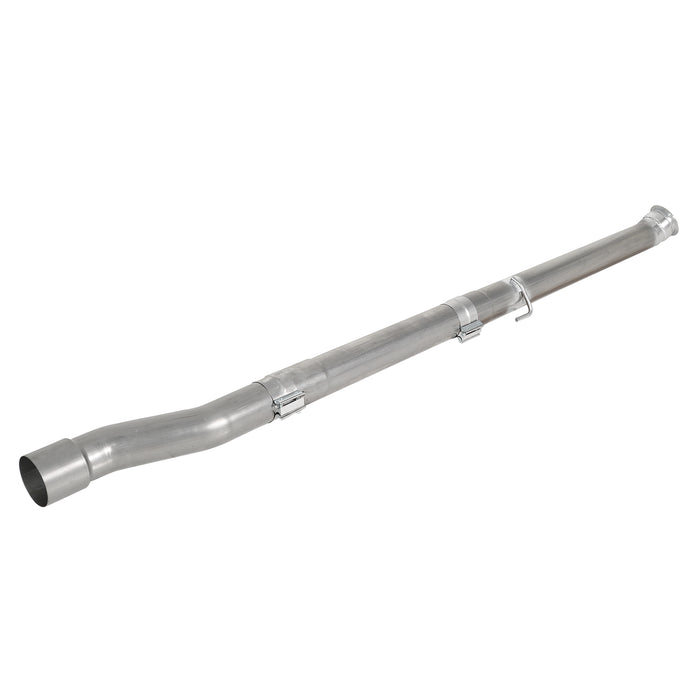
- Mid-section swap — replaces only the failure-prone DPF and CAT canisters, bolting straight into your stock downpipe and rear exhaust.
- Reversible by design — because it’s a precise mid-section replacement, you can bolt your intact factory DPF and CAT back on if you ever sell or trade the truck. You don’t tear apart the whole undercarriage.
- Mandrel-bent T-409 stainless, 4" throughout, dropping the backpressure that the 1,200°F regen heat was baking into your turbo and head gasket.
- Fits 2019–2024 2500/3500 pickups (Crew Cab short/long bed and Mega Cab); not Cab & Chassis.
For 2013–2018 (5" Turbo-Back, Full Replacement)
The 2013–2018 6.7L Ram Cummins 5" Turbo Back DPF Delete Pipe is the complete path at $658.00.
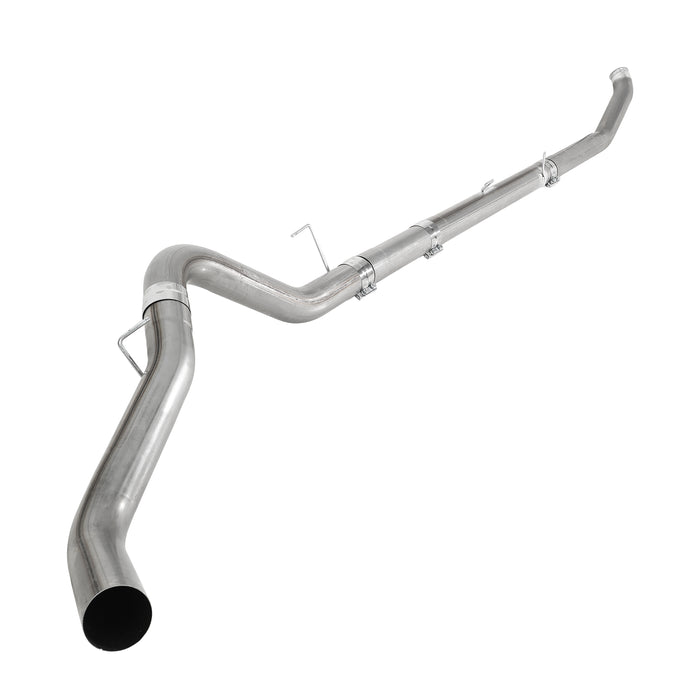
- Turbo-back design — replaces the entire exhaust train from the turbo flange to the rear, deleting the muffler and the full catalytic stack.
- Over 60% more flow area than stock, for maximum power on a tuned truck.
- Deeper, lower-frequency exhaust note and an aggressive Holset VGT turbo whistle — with the caveat that a 5" straight pipe will drone at certain highway RPMs, since the muffler is gone.
- Fits 2013–2018 2500/3500 pickups with standard leaf-spring suspension; not Rear Air Suspension or Cab & Chassis.
The choice between the two is a matter of how far you want to go: the 4" mid-section is cheaper, quieter, and reversible — the sensible pick for a truck you might one day return to stock. The 5" turbo-back is the full send for a dedicated off-road build that wants maximum flow and maximum sound.
What a Delete Won’t Fix
Delete removes the DPF, but it doesn’t remove the reasons you should think before you commit.
-
The 68RFE transmission is the real torque ceiling. The 6.7L Cummins can make more power than the stock 68RFE can reliably hold. If you delete and then run a hot tune on the stock transmission, the overdrive clutches are the first thing to slip. Responsible tuning — including TCM (transmission control module) tuning for line pressure and shift timing — is non-negotiable.
-
It doesn’t fix an oil-burning engine. If your truck is producing excess ash because the oil is burning faster than it should (blow-by, a tired turbo seal, worn rings), deleting the DPF just vents that oil and soot straight out the tailpipe. You’ve removed the symptom, not the cause.
-
It doesn’t fix a lying sensor or a dead ninth injector. A regen problem caused by a bad sensor or injector is a separate fault — delete removes the regen system, but if the underlying engine issue remains, it’ll surface somewhere else.
After the Delete: How to Maintain It
A delete isn’t “install it and forget it.” Once the DPF is gone, you own a different set of responsibilities — and the main one is that you’re now the one managing heat and torque, because the emissions system isn’t quietly doing it for you anymore.
Run a Mild Tune, Not a Hot One
- The pipe itself is worth about 7% on a dyno; the big numbers come from the tune. But a hot tune pushes torque straight into the 68RFE transmission’s limits.
- A mild tune plus TCM tuning (for line pressure and shift timing) is the safe combination. A hot tune on a stock 68RFE is how overdrive clutches start slipping.
- Don’t drag a heavy trailer up a grade on the highest power level — that’s the exact scenario that cooks a stock transmission.
Watch EGTs Under Load
- With the DPF gone, there’s no regen cycle managing exhaust heat for you. An EGT gauge is the first thing to add after a delete.
- Keep an eye on exhaust gas temperatures when towing or pulling hard, and back off if they’re climbing toward the limit. The engine can’t tell you it’s too hot anymore.
Keep the Stock Parts
- Don’t throw the factory DPF and CAT away. They’re expensive ($2,000–$5,000) and heavy (70–90 lbs).
- You’ll want them if you sell the truck, trade it in, move to an emissions-testing state, or need to return it to stock. Store them clean and dry.
Normal Maintenance Still Applies
- Deleting the DPF removes DPF-specific upkeep, but it doesn’t remove the basics. Oil changes, fuel filter service, transmission care, and turbo checks are still on you.
- In fact, they matter more now — there’s no emissions system masking a tired injector or a weak turbo. A deleted truck lives or dies on how well you maintain the engine underneath it.
The Legal Reality
Be clear-eyed about this before you spend a dollar: deleting a DPF is not a criminal felony, but it is a civil violation of the federal Clean Air Act’s anti-tampering provisions. The EPA can assess civil penalties against owners who remove or disable emissions controls, historically in the $2,500–$5,000+ range per violation, with higher amounts for repeat offenders.
The practical consequences are what matter most:
- Emissions inspection states fail deleted trucks every time. States running OBD-II readiness checks, visual inspection, or opacity testing (California, New York, Colorado, and the Section-177 states) will flag a deleted DPF — there’s no workaround.
- Warranty goes away. A dealer can read non-stock hardware and ECM flash history, and will deny emissions-related coverage.
- Resale and insurance get harder. A deleted truck shrinks its buyer pool, and some insurers won’t cover illegally modified emissions equipment.
If your truck is a daily driver on public roads, the honest answer is that cleaning or replacing the DPF is the practical path. Delete is for a dedicated off-road rig, a farm truck that never sees pavement, a competition puller, or an export build.
Get the Right Fix for Your 6.7L Cummins
Start with the diagnosis: figure out whether the filter is holding soot (fix the regen blocker and let it burn clean) or ash (which regen will never touch). If it’s ash and you’re staying on the road, a professional clean buys you another 100,000 miles for a few hundred dollars. If the truck is off-road and you’re done feeding the ash-and-regen cycle, a delete pipe removes the whole problem at once — and the right pipe depends on your year.
For 2019–2024, grab the 4" Cat & DPF Delete Pipe (DP-0292) — the reversible mid-section fix. For 2013–2018, the 5" Turbo Back DPF Delete Pipe (DP-0272) is the full-flow path. Both in T-409 stainless, both built to end the regen fight for good.
Related Blogs
-
2007.5-2009 6.7L Cummins Delete vs Repair: the Math Might Surprise You
- 6.7L Cummins EGR Cooler Leak: Why Is Coolant Disappearing
-
2013-2018 6.7L Ram Cummins Maintenance & Upgrades: Fuel, Exhaust, Tun
- How to Finally Eliminate Carbon Buildup in Your 6.7L Cummins?
Frequently Asked Questions
Q1: Can regeneration burn the ash out of my 6.7L Cummins DPF?
A: No. Regen only burns soot. Ash is non-combustible metal and mineral residue left behind after soot burns, and no amount of regen cycles will remove it. Once the filter is ash-plugged, the only options are cleaning, replacement, or delete.
Q2: Where does the ash in a DPF come from?
A: Mostly from engine oil. Oil carries non-combustible metal additives, and on a direct-injection diesel a small amount of oil always burns — those additives form ash that rides the exhaust into the DPF. That’s why the filter fills even on a well-maintained truck.
Q3: Is DPF cleaning worth it on a 6.7L Cummins?
A: Yes, if you’re staying road-legal. A professional clean restores 85–95% of flow for $300–$800 and typically buys another 100,000–150,000 miles. But it doesn’t stop the ash from returning, so it’s a recurring cost, not a permanent fix.
Q4: How much does an OEM DPF cost to replace on a 6.7L Cummins?
A: Typically $2,000–$3,500 in parts, and 5th-Gen 2019+ units run $4,000–$5,000 because they’re more integrated. Labor adds $400–$800 on top. That’s the number that pushes many owners toward delete.
Q5: Is a DPF delete a felony?
A: No. It’s a civil violation of the Clean Air Act’s anti-tampering rules, not a criminal felony. The EPA can assess civil penalties of roughly $2,500–$5,000+ per violation, with more for repeat offenders.
Q6: How much horsepower does a DPF delete actually add?
A: The pipe itself is worth roughly 7% on a dyno — the honest, measured figure. The 30–50+ HP numbers come from the tune you pair with it, not the delete pipe.
Q7: Do I need transmission tuning after a 6.7L Cummins delete?
A: If you’re running more than a mild tune, yes. The 68RFE transmission is the torque ceiling, and a hot tune on a stock 68RFE will slip the overdrive clutches. Responsible TCM tuning for line pressure and shift timing is part of a proper delete.
Q8: What’s the difference between the 4" and 5" delete pipes?
A: The 4" mid-section pipe replaces only the DPF/CAT, keeps your stock downpipe and rear exhaust, and is reversible. The 5" turbo-back replaces the entire exhaust from the turbo back, deletes the muffler, and flows over 60% more — but it’s louder and drones at highway RPM.
Q9: Can I put the factory DPF back on later if I sell the truck?
A: With a mid-section pipe like the 4" DP-0292, yes — it bolts in place of the DPF/CAT and your intact factory parts can be reinstalled. A full turbo-back system is harder to reverse.
Q10: Will deleting my DPF fix a regen problem?
A: It removes the regen system entirely, along with the ash and backpressure. But if the original problem was a bad sensor or a dead injector, that fault is separate and won’t be fixed by a delete — it’ll surface elsewhere.
Q11: Is a DPF delete legal on the road?
A: No. Removing emissions equipment is a civil Clean Air Act violation, fails emissions inspection, voids warranty, and complicates resale and insurance. These parts are for off-road and competition use only.