

Home > News > LML Duramax DPF Regen Failure: Why It Won't Regenerate

LML Duramax DPF Regen Failure: Why It Won't Regenerate
Your LML Duramax keeps trying to regen, won’t finish it, and now it’s down on power with a check-engine light. Here’s the thing most owners never hear: the DPF is almost never the actual problem. The engine’s computer refuses to run a regen unless a long list of conditions are met — and when one sensor lies or one component dies, it quietly stops trying, often without ever setting the code that tells you why.
For off-road / competition use only. Not legal for on-road use in emissions-regulated areas. Check your local, state, and federal laws before modifying any emissions-related component.
Why Won’t It Regenerate? The Answer Is Almost Never the Filter
A Regen Failure Is a Symptom, Not a Diagnosis
This is the reframe that saves people thousands. The filter itself is a passive ceramic brick — it doesn’t “fail to regen.” What fails is the system around it that’s supposed to create the conditions for the burn:
- The DPF just sits there collecting soot. It has no way to “refuse” a regen on its own.
- What actually breaks is the sensor, injector, or temperature condition the ECM needs before it’ll even start the burn.
- So “my DPF won’t regen” almost always translates to something upstream is blocking the regen — not “the filter is bad.”
The $4,300 Lesson: One Owner’s Six-Month Nightmare
The clearest proof is a documented LML case: a 2015 Sierra Denali with 146,000 miles spent six months unable to complete a regen, throwing a persistent P0420 code. The owner — and two separate professional diesel shops — worked through the entire parts cannon:
- Replaced the DPF pressure switch, the ninth injector, the DEF tank heater, and the DEF injector
- Replaced both NOx sensors
- Had the DPF ultrasonically cleaned
- Total spent: over $4,300
The real culprit was a fuel temperature sensor stuck at 32°F — a part that costs about $40. The ECM compares fuel temp against coolant temp to decide whether a regen is safe, so a frozen fuel-temp reading meant the truck would never regen. And it never set the P008F code that would have pointed straight at the sensor.
The Code That Doesn’t Tell You Anything: P0420
That’s the pattern to memorize:
- P0420 is the “I don’t know” code. It fires when the ECM can’t pin down the real fault.
- It sends owners chasing expensive parts in the wrong direction — the filter, the sensors, the injector — while the actual cause goes unflagged.
- When you see P0420 on an LML, treat it as a placeholder, not a diagnosis, and go looking for the real fault hiding behind it.
What a Regen Needs Before It’ll Even Start
The ECM is a gatekeeper with a long checklist. Miss any one item and it simply won’t initiate the burn — no matter how clogged the filter gets. The most common blockers, in rough order of how often they get overlooked:
-
Engine temperature. A regen won’t start on a cold engine. LML owners report the truck needs coolant temperature up around 80°C (176°F) before the ECM will authorize the burn. A stuck-open thermostat that keeps the engine at 75°C on the highway can block regen for months.
-
Enough fuel. Most trucks won’t regen below a quarter tank — some need a third. The ECM won’t start a burn it can’t afford to finish.
-
No pending fault codes. This is the sneaky one. Glow-plug codes, a sensor plausibility fault, even a service reminder that was never reset — any of them makes the ECM say “I’m not raising exhaust temps to 1,100°F while I think something’s wrong,” and it blocks the regen to protect itself.
-
No active PTO or elevated-idle setting. If the truck runs a PTO or stationary elevated idle, the regen can be held off until that’s disabled.
-
Sustained heat for long enough. Passive regen needs real exhaust heat — sustained highway speed and RPM, not stop-and-go. Short trips never get there.
Here’s the catch that makes diagnosis hard: the truck often doesn’t tell you which condition failed. It just doesn’t regen, and eventually it throws P0420 or a soot-load code as the filter fills up behind the real problem.
The Lying Sensors That Block Regen
Once you’ve ruled out the conditions above, the next layer is sensors that are reading wrong. A regen is a temperature game, and the ECM trusts its temperature inputs absolutely.
-
Fuel temperature sensor (the $40 trap). This is the documented LML killer. The ECM compares fuel temp against coolant temp to confirm the engine is genuinely warmed up. A fuel-temp sensor stuck at 32°F makes the ECM think the fuel is ice-cold forever, so it never authorizes a regen.
-
Coolant temperature sensor. Reads low, and the ECM thinks the engine is still cold. Same effect — no regen, no code pointing at the sensor.
-
EGT sensors. The exhaust-gas-temperature probes feed the ECM the “did it get hot enough” signal. A drifting EGT sensor (the #2 probe, after the turbo, should read around 220 ohms) will make the ECM abort a regen mid-burn because it never sees the target temperature.
-
Differential-pressure sensor. This is the one that lies about the filter itself. A blocked pressure line or a faulty delta-P sensor falsely reports the DPF as clogged — or falsely reports it as clean — and the ECM reacts to the wrong number either way.
The frustrating part is that these sensors can fail without setting their own code. The ECM just uses the bad reading to make a bad decision, and the only code you see is the generic P0420 that doesn’t tell you which sensor to look at.
The Ninth Injector: LML’s Unique Failure Point
The LML Duramax has a part most people have never heard of, and it’s the second big cause of “won’t regen.”
Unlike the 6.4L Powerstroke, which dumps fuel into the cylinders during the exhaust stroke to heat the exhaust, the LML uses a dedicated ninth injector — officially the exhaust aftertreatment fuel injector, also called the hydrocarbon injector. It sits on the passenger-side valve cover and sprays raw diesel at roughly 30 PSI into the downpipe, where the heat of the exhaust flashes it and drives EGTs up to the 1,100–1,200°F needed to burn soot.
When that ninth injector fails, the regen has no fuel to make heat. The giveaway is in the EGT readings during an attempted regen:
- EGT sensor 1 (before the injector) should read around 500°F.
- EGT sensor 2 (after the injector) should jump to 1,100–1,200°F.
If the injector is being commanded on, has fuel pressure, and sensor 2 still won’t climb past ~570°F, the injector is dead. The fix is an OE injector (they’re not expensive, and the quick-connect tool to remove it is under $20 on Amazon).
Soot vs Ash: The Difference That Ends the “Just Clean It” Hope
There’s one more distinction worth knowing, because it decides whether a regen can ever fix your truck.
A regen burns soot into ash. Soot is the black carbon that the filter catches and that heat can burn off. Ash is what’s left after the soot burns — a fine, non-combustible residue that heat cannot remove. Every regen converts a little soot into a little permanent ash.
Here’s what that means for a truck that won’t regen:
- If the truck can’t regen because a sensor is lying or the ninth injector is dead, the filter is filling with soot — and once the real fault is fixed, a regen can still clean it.
- But if the filter has simply accumulated too much ash over 150,000+ miles, no amount of regen will ever clear it. The ash is permanent. This is the point where “cleaning” means a physical, professional process — cutting the filter open, baking it, and flushing the ash out — or outright replacement.
This is also why one owner’s “professionally cleaned” DPF didn’t help: the truck’s real problem was a lying fuel-temp sensor, not the filter. The filter was cleaned, the sensor stayed broken, and the truck kept right on not regenerating.
The Diagnostic Order: Test, Don’t Guess
Put it all together, and the path to actually fixing an LML that won’t regen is a sequence, not a guess. Work through it in this order and you won’t repeat the $4,300 mistake.
-
Read the dash and the codes — but don’t trust P0420. It’s the catch-all. Look for the other codes hiding behind it: glow-plug codes, EGT plausibility, P008F (the fuel/coolant temp correlation that points at the fuel-temp sensor).
-
Check the free conditions. Is the engine actually reaching 80°C? Is there more than a quarter tank? Is a PTO or elevated idle holding the regen off? Is the service reminder reset?
-
Watch live data during an attempted regen. EGT sensor 1 vs sensor 2 is the ninth-injector tell. Fuel temp vs coolant temp is the sensor-correlation tell. Soot load and delta-P are the filter tell. A $100 scan tool shows all of it.
-
Fix the root cause, not the symptom. A $40 sensor, a $200 thermostat, or an OE ninth injector fixes the truck for good. A forced regen without fixing the root cause is a band-aid — it’ll fail again.
-
Only then decide on the filter. If the root cause is fixed and the filter is still genuinely ash-plugged past the point of cleaning, that’s when the bigger decision comes in.
When Diagnosis Points to Delete
For a lot of LML owners, the honest conclusion of all this is: the emissions system is the problem, and it’s a recurring one. The ninth injector, the NOx sensors, the DEF heater, the EGR cooler, the ash-plugging DPF — it’s a long list of parts that each fail in turn and each cost money to chase.
That’s the legitimate case for delete, and it’s not about horsepower. It’s about removing the failure points permanently. When you pull the DPF and CAT, you remove the regen cycle, the ash problem, the ninth injector, and the backpressure — the entire list of things that were keeping the truck down on power and up on fuel.
The economics tell the same story. One LML owner ran the numbers after months of failed repairs: a clogged DPF drops a healthy LML to 13–14 MPG from constant regen, and a delete restores it to 18–19 MPG on the highway. The delete pipe itself costs less than a single dealer DPF cleaning.
Off-road / competition use only. Deleting emissions equipment is not legal for on-road use in emissions-regulated areas.
The V-Band vs 3-Bolt Flange Split
If you go the delete route, there’s one LML-specific trap that trips people up more than anything else, and it’s worth getting right before you order.
The LML comes in two different exhaust connections, split mid-2015:
- 2011 through 2015.5 trucks use a V-band clamp at the turbo downpipe connection.
- 2015.5 through 2016 trucks use a 3-bolt flange instead.
These are not interchangeable. A V-band pipe will not bolt to a 3-bolt-flange truck, and vice versa. The only way to know which one you have is to physically look under the truck at the downpipe connection — the year alone doesn’t tell you, because the split happened in the middle of 2015.
The Products: Two Pipes, Matched to Your Flange
Once you’ve confirmed which connection your truck has, the delete pipe is a straightforward mid-section swap that keeps your factory muffler and tailpipe.
For 2011–2015.5 (V-Band Clamp)
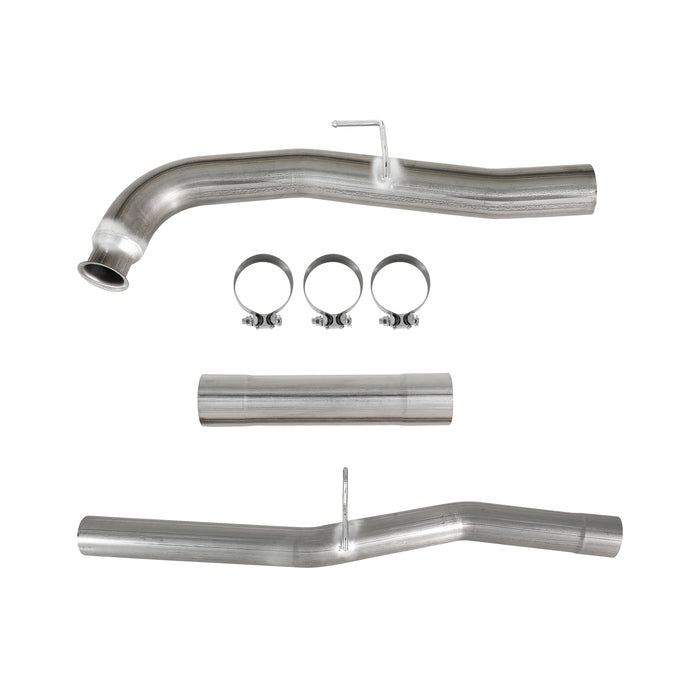
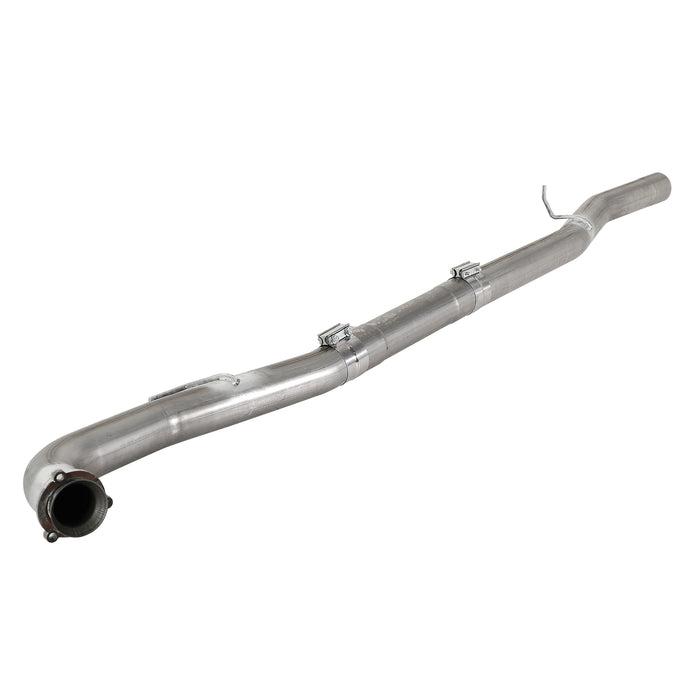
The 2011–2015.5 LML 4" DPF & CAT Delete Pipe (DP-0274) replaces the choked DPF and CAT sections with a mandrel-bent 4" T-409 stainless pipe at $234.90.
- Direct bolt-on for the V-band-clamp trucks — no cutting, no welding.
- No bungs to interrupt the flow, and it keeps your stock muffler and tailpipe, so the sound stays near-stock with zero highway drone.
- Kills the regen cycle and the backpressure, which is what recovers the fuel economy and drops EGTs under load.
For 2015.5–2016 (3-Bolt Flange)
The 2015.5–2016 LML 4" DPF & CAT Delete Pipe (DP-0276) is the same idea for the late-model trucks, with a CNC-machined 3-bolt flange to match their connection, at $235.90.
- Precision 3-bolt flange for a direct, leak-free seal to the 15.5–16 downpipe.
- Same mandrel-bent 4" T-409 construction, no bungs, retains the factory muffler.
- Muffler option available — if your decade-old stock muffler is rusting, the all-in-one version swaps in a high-flow muffler at the same time.
Two things to remember when you’re shopping this: first, match the flange — that’s the whole ballgame. Second, the delete pipe solves the exhaust side, but it won’t fix the intake side on its own. An LML that’s been running rich soot into the intake still benefits from pairing the pipe with an EGR delete and a CCV reroute to stop the oil-vapor-plus-soot sludge that cakes the intake manifold.
Get the Right Fix for Your LML
An LML that won’t regen is a puzzle with a real answer. Read the codes behind the P0420, check the free conditions, watch the live EGT and temperature data, and fix the $40 sensor or the ninth injector that’s actually blocking the burn. Only when the filter is genuinely ash-plugged past the point of cleaning does delete become the honest fix — and when it does, the pipe that removes the regen cycle, the ash, and the backpressure is the cheapest and most permanent end to the whole problem.
For the pipe matched to your exact flange, head to TruckTok’s LML collection — the 4" DPF Delete Pipe for 2011–2015.5 (V-band), the 4" DPF Delete Pipe for 2015.5–2016 (3-bolt flange), both in T-409 stainless and built to drop EGTs and end the regen fight for good.
If you have any further questions, you can contact us or read the related blogs:
-
LML Duramax Delete Guide: Do It Now or Wait Until It Breaks
- 2011-2016 Duramax Air and Oil Filter Kit Guide (A3141C / PF2232)
- 2011-2016 LML Duramax DPF & EGR Delete Kit — End the 55 MPH Limp Mode
- Why Does Your 2011-2016 LML Duramax End Up in Limp Mode?
Frequently Asked Questions
Q1: Why won’t my LML Duramax finish a regen?
A: Almost always a lying sensor or a dead ninth injector, not the DPF itself. The ECM needs correct temperature readings to authorize a regen, and a stuck fuel-temp or coolant-temp sensor — or a failed ninth injector — silently blocks it.
Q2: What does P0420 mean on an LML?
A: It’s the “I don’t know” catch-all code. The ECM throws it when it can’t pin down the real fault, which is why owners chase expensive parts in the wrong direction while the actual cause (often a $40 sensor) goes unflagged.
Q3: What is the ninth injector on an LML Duramax?
A: A dedicated exhaust aftertreatment fuel injector that sprays diesel into the downpipe to raise EGTs for regen. When it fails, EGT sensor 2 won’t climb past ~570°F during a regen even though the injector is commanded on.
Q4: How do I tell if my regen problem is soot or ash?
A: Soot burns off in a regen; ash is permanent and can’t be removed by heat. If a fixed sensor or injector lets the truck regen again, it was soot. If the filter is still clogged after a good regen, it’s ash and needs physical cleaning or replacement.
Q5: Why did cleaning my DPF not fix the regen problem?
A: Because cleaning the filter doesn’t fix whatever was blocking the regen in the first place. If a sensor is still lying, the truck still won’t regen — it just has a clean filter it still can’t use.
Q6: What’s the difference between the V-band and 3-bolt flange on the LML?
A: 2011–2015.5 trucks use a V-band clamp at the downpipe; 2015.5–2016 trucks use a 3-bolt flange. They’re not interchangeable, and you have to look under the truck to know which one you have.
Q7: Will a DPF delete fix my regen problem?
A: It removes the regen cycle entirely, along with the ash, the ninth injector, and the backpressure. But delete is the last step — you should confirm the root cause first so you’re not masking an unrelated sensor or injector fault.
Q8: How much fuel economy does an LML lose to a clogged DPF?
A: A healthy LML that drops into constant regen can fall to 13–14 MPG. Removing the regen cycle typically restores it to 18–19 MPG on the highway.
Q9: Do I need to replace the factory downpipe with the delete pipe?
A: Not mandatory, but recommended. The factory downpipe is “pancaked” to clear the firewall, and that crush is a big source of backpressure. Pairing a round downpipe with the delete pipe completes the exhaust-side fix.
Q10: Is a DPF delete legal on the road?
A: No. Removing emissions equipment is not legal for on-road use in emissions-regulated areas. These parts are for off-road and competition use only.
For off-road / competition use only. Not legal for on-road use in emissions-regulated areas. Check your local, state, and federal laws before modifying any emissions-related component.