

Home > News > LB7/LLY Downpipe: The Bottleneck Driving EGTs Up Towing


LB7/LLY Downpipe: The Bottleneck Driving EGTs Up Towing
Your LB7 or LLY Duramax tows fine until the grade gets steep, then EGT climbs to 1350–1400°F and you have to back out of it. The factory downpipe is a real bottleneck — but it’s not the only one, and it’s not the most important one. Here’s what’s actually driving the temps up, and what fixes it.
For off-road / competition use only. Not legal for on-road use in emissions-regulated areas. Check your local, state, and federal laws before modifying any emissions-related component.
What Is a Downpipe, and Where Does It Live?
Before the “why,” a quick word on what this part actually is, because the name gets thrown around loosely.
Where is the Downpipe Located
A downpipe is the section of exhaust that connects the turbocharger’s outlet down to the rest of the exhaust system — the catalytic converter (or a delete pipe) and everything after it. On the Duramax, the turbo sits high in the valley between the cylinder banks, and the downpipe is the first piece of pipe the exhaust hits the moment it leaves the turbo.
Its Location is What Makes It a Problem
The downpipe has to drop from the turbo outlet, thread through the narrow gap between the firewall and the back of the engine, and head down toward the frame rail. That gap is tight — which is exactly why GM flattened the factory pipe to squeeze it through. The downpipe is the single most cramped piece of the exhaust system, and the place where both airflow restriction and heat concentrate.
That’s the key to the whole article: because the downpipe is the first restriction the exhaust hits after the turbo, any pinch in it becomes back pressure that works against the turbo’s spool — and back pressure under load is what drives EGT up.
What’s Wrong With the Factory Downpipe?
The factory downpipe on the LB7 and LLY is a known airflow restriction, and it comes down to how the pipe is shaped to fit the truck.
The Airflow of the Original Factory Downpipe Is Blocked
The stock pipe is what the Duramax community calls a “crushed-oval” or “pancake” downpipe. To squeeze the exhaust between the firewall and the engine, GM flattened the tube — the pipe pinches down to clear the tight gap, and that flat section is exactly where exhaust flow chokes.
There Is a Bellows-Style Flex Section
The factory downpipe also carries a bellows-style flex section that’s a guaranteed failure point. That thin corrugated section thermal-cycles and cracks over time, creating an exhaust leak that shows up as black soot on the firewall and a drop in turbo response.
The result is two problems in one part: a crushed bend that restricts flow and a flex section that eventually leaks. Both push EGTs up under load.
Downpipe vs Up-Pipe: Two Different Bottlenecks
This is the distinction that clears up half the confusion on the forums, and it matters because the two parts do opposite jobs.
-
The up-pipe is pre-turbo. It carries hot exhaust from the manifold to the turbo inlet, under high “drive pressure.” A leak here — and the factory bellows cracks constantly — bleeds off drive pressure before it ever spins the turbo. That’s turbo lag, lost boost, and black soot on the back of the block.
-
The downpipe is post-turbo. It carries exhaust away from the turbo outlet. A crushed or restrictive downpipe creates back pressure that pushes against the turbo’s spool, which is what heats everything up under sustained load.
So the two parts attack EGT from opposite directions: fix the up-pipe and the turbo spools; fix the downpipe and the turbo breathes.
LB7 vs LLY: Not the Same Downpipe
The title says “LB7/LLY,” but these are not the same downpipe, and buying the wrong one is the fastest way to waste money.
-
LB7 (2001–2004) runs a wastegated, fixed-geometry turbo, and the downpipe bolts to the turbo with bolts.
-
LLY (2004.5–2005) and later run a variable-geometry (VGT) turbo, and the downpipe attaches with a V-band clamp.
The attachment method is different because the turbos are different. An LB7 downpipe won’t bolt to an LLY’s VGT turbo, and vice versa. Before you order, confirm which generation you have — it’s not a “fits all Duramax” part.
How Much Does a Downpipe Actually Drop EGTs?
Here’s the honest answer, because the marketing numbers and the real-world numbers don’t match.
The marketing claim is that a downpipe drops EGTs by “up to 100°F” and adds 15–40 horsepower. The real-world consensus from owners who actually installed one is more measured:
- A downpipe alone drops EGTs roughly 50–100°F under load — real, but not a transformation.
- Some owners report no EGT change at all from the downpipe on its own, just a deeper exhaust note and quicker turbo spool.
- The gains compound when you pair the downpipe with an up-pipe and a tune — the parts work together, not in isolation.
The honest summary: a downpipe is a cheap, worthwhile first step, not a magic bullet. Expect better sound, faster spool, and a modest EGT drop — not a 150°F miracle.
Before and After: What the Swap Actually Changes
To make the numbers concrete, here’s what a downpipe changes on an LB7 or LLY, measured against the stock part.
| Metric | Factory | After Downpipe | Source |
|---|---|---|---|
| Towing EGT (steep grade) | 1350–1400°F, backing out | 50–100°F lower | Owner dyno / forum reports |
| Horsepower | Baseline | +5–10 hp (pipe alone) | Product spec |
| Turbo spool | Lags, feels lazy | Faster, crisper throttle | Owner reports |
| Exhaust note | Harsh WOT screech | Deep, throaty rumble | Owner reports |
| Back pressure | Crushed-oval restriction | Full 3" mandrel flow | Product spec |
| Flex-section leak | Bellows cracks over time | Rigid, no flex to crack | Product spec |
Two things stand out in that table.
- The EGT drop is real but modest — 50–100°F, not the 150°F some sellers imply.
- The biggest wins are spool and reliability, not peak power.
A truck that spools faster and stops leaking at the flex section feels stronger everywhere, even if the dyno number barely moves.
The Real Fix: RPM First, Pipe Second
This is the part most downpipe write-ups skip, and it’s the most important thing in the whole article. One owner towing a 9,000-lb fifth wheel in the mountains asked how to drop EGTs, and a veteran gave the answer that actually matters:
“The fuel is not being matched with air. Dumping fuel in at 1800 RPM is what’s giving you such high EGT.”
Here’s what that means. A Duramax makes peak torque around 2,300 RPM. Towing at 1,800 RPM in a tall gear feels economical, but the engine is lugging — injecting fuel into a cylinder that doesn’t have enough air and RPM to burn it cleanly. The unburned fuel heats the exhaust, and EGT spikes.
The fix isn’t a part — it’s shift down and keep the RPM up around 2,300 under load. Owners who do this report EGTs that “almost never pass 1,100” even towing hard, because the engine is operating at its torque peak where the fuel matches the air.
So the honest order is:
- Fix the RPM first. Downshift and hold 2,200–2,400 RPM on grades. This is free and does more than any bolt-on.
- Fix the up-pipe. Stop the pre-turbo drive-pressure leak so the turbo actually spools.
- Fix the downpipe. Remove the crushed-oval post-turbo restriction so the exhaust can leave.
Skip the RPM and you’re throwing parts at a driving-habit problem. Do all three and the EGT that was forcing you to back out of the throttle on every grade comes down for good.
The Products: Up-Pipe and Downpipe, the Two Sides of the Fix
These two parts attack the exhaust bottleneck from both ends of the turbo.
The Downpipe: Remove the Crushed-Oval Restriction
The 2004.5–2010 LLY/LBZ/LMM 3" Downpipe (DP-0185) replaces the factory crushed-oval pipe with a true mandrel-bent 3" tube at $134.99.
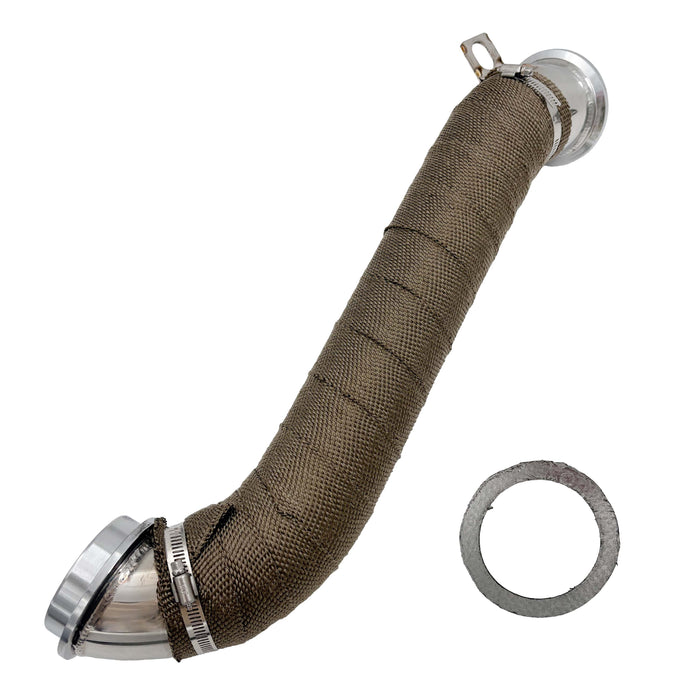
- T304 stainless construction, mandrel-bent to hold a full 3" bore through every bend instead of the factory crush-bend that shrinks at the turns.
- Eliminates the bellows failure point — the rigid design replaces the crack-prone factory flex section, using the turbo’s V-band clamp to absorb normal engine movement.
- Clean bung-less design that matches the factory setup — the 04.5–10 engines carry no sensors on the downpipe itself, so there’s nothing to plug.
- Standalone-friendly: it bolts to the factory connection point, so you can run it with the stock exhaust as a pure reliability upgrade, or pair it with a delete pipe and tune for more.
How the Install Goes
The downpipe and up-pipe are both back-of-the-engine jobs. The downpipe is the harder of the two; the up-pipe is usually done at the same time since you’re already in there.
Tools You’ll Need
- 8mm, 10mm, 11mm, 12mm, 13mm, 14mm sockets and wrenches, plus an 11mm deep socket for the V-band clamp
- Ratcheting gear wrench for the tight firewall access
- A ratchet strap — the trick that breaks the stubborn top bolts loose
- Penetrating oil, a flathead screwdriver, and a swivel adapter
The Downpipe
The downpipe is the harder of the two jobs because the bolts are seized from heat cycling and the access is tight. Give yourself 2–3 hours, and soak every bolt in penetrating oil the night before.
-
Prep. Disconnect both battery negatives, then pull the passenger-side wheel-well shroud (it’s held by locking tabs) to reach the lower section.
-
Clear the top. If the truck still has its resonator box, remove it — a clip and an Allen bolt. Then pull the turbo’s top heat shield (two bolts) so you can reach the last downpipe heat-shield bolt from above.
-
Remove the downpipe heat shield. It’s held by three 11mm bolts — two reachable from below through the wheel well, one from the top. Rotate and twist the shield as you lift it out.
-
Move the transmission dipstick tube. Loosen the two 13mm nuts on its bracket — you don’t have to pull the tube all the way out, just loosen it enough to swing the heat shield past. This is the step most people forget, and the dipstick tube blocks the heat shield from dropping if you skip it.
-
Break the turbo-side bolts loose — this is the hard part. The top bolts are seized, and rounding them turns a 2-hour job into a nightmare. The proven trick is a ratchet strap: loop the strap around the wrench handle, run the other end to a firm point (the torsion bar or frame rail), and tighten slowly until the bolt cracks. On the LB7 the downpipe is bolt-on (the turbo is wastegated), so you’re removing bolts; on the LLY and later the downpipe is V-band — loosen the 11mm deep-socket V-band clamp and the 14mm bolt instead.
-
Drop the pipe out. Work it down through the fender side, or on an LB7 twist it out through the top. It’s a tight fit against the firewall — rotate it patiently rather than forcing it, and a flathead screwdriver helps pop rust-welded clamps loose.
-
Install the new downpipe. Reverse the order — seat the V-band clamp (or bolts) so the pipe is properly aligned, snug the 14mm bolt, and reinstall the dipstick tube and heat shield. Leaving the heat shield off is optional and won’t hurt anything.
-
Check for leaks. Spray the flanges with soapy water and rev the engine — bubbles mean a leak at the clamp that needs reseating.
Get the Right Pipe for Your Duramax
High EGTs towing on an LB7 or LLY aren’t a mystery — the exhaust side has two bottlenecks, and the driving habit is a third. Shift down and hold 2,300 RPM first, then fix the up-pipe bellows that leaks drive pressure, then replace the crushed-oval downpipe that chokes the exhaust. Do it in that order and the temps come down without throwing money at the wrong problem.
For the pipes, head to TruckTok’s Duramax exhaust collection for the passenger-side up-pipe and the 3" downpipe — built in T304 stainless, matched to your exact generation, and engineered to drop EGTs the right way: by fixing the leak and the restriction, not by masking the symptom.
Frequently Asked Questions
Q1: Why does my Duramax run high EGTs when towing?
A: Two exhaust bottlenecks — a crushed-oval downpipe that restricts flow and an up-pipe bellows that leaks drive pressure — plus the real cause, lugging below peak-torque RPM. Fix the RPM first, then the pipes.
Q2: How much does a downpipe drop EGTs?
A: Real-world reports range from 50–100°F under load, with some owners seeing little change on its own. The gain compounds when paired with an up-pipe and a tune.
Q3: What’s the difference between an up-pipe and a downpipe?
A: The up-pipe is pre-turbo, carrying exhaust from the manifold to the turbo under high drive pressure — a leak there kills spool. The downpipe is post-turbo, carrying exhaust away — a restriction there creates back pressure.
Q4: Are the LB7 and LLY downpipes the same?
A: No. The LB7 uses a wastegated turbo with a bolt-on downpipe; the LLY and later use a VGT turbo with a V-band clamp. They don’t interchange.
Q5: Does a downpipe add horsepower?
A: Modestly — about 5–10 hp on its own. The bigger gains come from pairing it with a tune and an up-pipe, where the freer flow lets the tune deliver more.
Q6: What’s the single biggest thing I can do to lower EGTs towing?
A: Downshift and hold 2,200–2,400 RPM. Lugging at 1,800 RPM injects fuel into a cylinder with too little air, and that unburned fuel is what spikes EGT.
Q7: Do I need a tune for an up-pipe or downpipe?
A: No. Both are mechanical exhaust parts with no sensors on these model years, so they won’t trigger a check-engine light on a stock truck.
Q8: Why does the factory downpipe have a flex section?
A: To absorb engine movement. But the thin bellows thermal-cycles and cracks over time, creating an exhaust leak — which is exactly why aftermarket pipes replace it with a rigid design.
Q9: Can I install a downpipe with the stock exhaust?
A: Yes. The 3" downpipe bolts to the factory connection point, so you can run it as a standalone reliability upgrade without touching the rest of the exhaust.
Q10: How hard is the downpipe install?
A: The heat shield and the seized top bolts are the hard parts. The ratchet-strap trick breaks the bolts loose without rounding them, and most DIYers finish in 2–4 hours.
Legal Disclaimer
For off-road / competition use only. Not legal for on-road use in emissions-regulated areas. Check your local, state, and federal laws before modifying any emissions-related component.