

Home > News > LML Duramax Delete Guide: Do It Now or Wait Until It Breaks


LML Duramax Delete Guide: Do It Now or Wait Until It Breaks
Here’s the answer most LML owners actually need, and it’s not “delete everything” or “leave it stock.”
The power and fuel-economy gains you’ve heard about come from the tune — not the pipe. A well-tuned emissions-intact LML will dyno within about 10 horsepower of a deleted one. What a delete actually buys you is the removal of three failure-prone emissions systems and clean oil, not a magic horsepower button. So the real question isn’t “should I delete” — it’s “when.”
For off-road / competition use only. Not legal for on-road use in emissions-regulated areas. Check your local, state, and federal laws before modifying any emissions-related component.
What a Delete Actually Changes (and What It Doesn’t)
The single biggest misconception in the LML world is that the delete pipe is what makes the truck faster and more efficient. It isn’t.
The Horsepower Comes From the Tune
The 6.6L LML leaves the factory at 397 hp and 765 lb-ft. When Dark Iron Diesel ran a bone-stock LML (with just an aftermarket intake) on the dyno, it made 309 hp and 554 lb-ft at the wheels. After a full delete and re-flash — even on the kit’s lowest “stock” power setting — the same truck made 381 hp and 678 lb-ft. That’s roughly a 70-horsepower gain, and the owner credited it to the delete.
Here’s the honest breakdown: That gain is the recalibration working, not the pipe flowing air. The tune re-baselines fueling, timing, and torque management for a truck that no longer runs EGR, DPF, and DEF logic.
The Fuel Economy Comes From the Tune
Nick Priegnitz, who dynos deleted and emissions-intact trucks side by side, put it bluntly: “Tuning is the main contributor to improved mileage.” His shop’s emissions-equipped test truck — with a stock turbo and just their tuning — dynoed 520 horsepower through all its emissions hardware. Most deleted trucks that come through his shop dyno between 515 and 530 hp. His conclusion: on an 8,000-pound truck, you will not feel the difference between 10 horsepower.
What the Delete Actually Does
Three things, and none of them is a horsepower claim:
-
It removes three failure-prone systems. The EGR cooler cracks, the DPF plugs with unburnable ash, and the DEF heaters, pump, and NOx sensors fail. A delete takes all of them off the table permanently.
-
It keeps your oil clean. This is the benefit you can see with your own eyes. One owner who deleted his LML at 36 miles showed his dipstick after 4,000 miles — the oil was still amber, not the instant-black you get on a stock LML. The soot that recirculates through the EGR is what turns the oil black; stop the EGR and the oil stays clean.
-
It stops the regen cycle and its fuel waste. Once the DPF and its regeneration strategy are gone, the truck stops burning extra diesel just to torch the filter.
The Three Systems That Fail on the LML
The LML (2011–2016) is the most complex pre-L5P Duramax, and it carries all three of these at once:
The EGR Cooler
The EGR cooler recirculates exhaust gas back into the intake to cut NOx. On the LML it’s a chronic failure point — heat cycling cracks the internal core, which lets coolant into the intake. That shows up as white smoke, unexplained coolant loss, and in the worst case, hydrolock.
The DPF — and the Ash Problem
The DPF traps soot and burns it off during regeneration. But regeneration only turns soot into ash, and ash never burns away. By 150,000 to 200,000 miles, most LML DPFs are physically packed with ash that no regen or cleaning can remove. At that point the filter is permanently blocked, and your only real choices are a new OEM DPF ($2,500–$3,000) or a delete pipe ($1,200–$1,500).
But before you spend either way, confirm the DPF is actually ash-loaded and not a cheaper root cause. Our DPF upgrade vs. diagnosis breakdown walks through the full cost-versus-root-cause math.
The DEF / SCR System
The LML added a full DEF and selective catalytic reduction system. It has three DEF heaters (tank, pump, and supply line), two NOx sensors, and a DEF pump — and all of them fail. The dashboard “Bad DEF Quality” message is a classic LML red herring: the truck has no sensor that actually measures DEF fluid quality. That message is almost always a failing NOx sensor or DEF pump, not bad fluid.
The one mechanical note that sets the LML apart from the older 6.4L Powerstroke:
The LML uses a dedicated ninth injector (the hydrocarbon injector) that sprays fuel into the exhaust to support regeneration. It’s a cleaner design than in-cylinder post-injection, which is why the LML doesn’t suffer the same severe fuel-dilution problem as the older platforms — but a leaking or failing ninth injector can still wash fuel past the rings.
The “Wait Until It Breaks” Trap
The most common advice in forums is “just drive it until something fails, then delete it.” On the surface that sounds sensible — don’t spend money until you have to. But waiting has three hidden costs that make it more expensive, not cheaper.
Ash Is Irreversible
This is the trap most people don’t see until it’s too late. Soot burns off in a regen. Ash does not. Every regen converts a little more soot into ash that stays trapped in the filter honeycomb forever. You can’t regen it clean, and professional cleaning can’t remove structural ash loading. Your only options are a $2,500–$3,000 OEM filter or the delete pipe.
Waiting doesn’t make the ash go away — it just guarantees you’ll hit the wall at high mileage, when the truck’s book value is lowest and spending $3,000 on a filter makes the least sense.
The EGR Cooler Can Fail Catastrophically
An EGR cooler doesn’t always fail gracefully. When the internal core cracks, coolant enters the intake — and if enough of it gets into a cylinder, you get hydrolock, which bends rods and turns a $200 EGR delete into a $8,000–$12,000 engine rebuild. Waiting for “something to break” can mean waiting until the expensive version of the failure shows up.
The Engine Keeps Eating Its Own Soot While You Wait
One owner’s experience is instructive. His LML’s EGR was failing, and it was choking the engine so badly he was getting 5–10 mpg — the truck was running rich and lazy because the EGR was sticking. He deleted it and jumped to 20–25 mpg city. The point isn’t the exact number; it’s that a failing EGR was actively hurting the truck every mile he waited.
And the failure you’re waiting for rarely announces itself politely — it usually shows up as limp mode, leaving you stranded or crawling home. This thread on LML limp mode is full of owners walking through exactly what dropped their truck into reduced power.
The “Do It Now” Trap
The other side of the coin is just as real. Deleting a truck the day you buy it — one owner did his at 36 miles — has costs you need to accept before you turn a wrench.
Warranty Is Gone, and the Dealer Will Know
This isn’t a “maybe” — it’s a “definitely.” The LML’s ECM records that it has been reflashed. Even if you put the stock tune back before a dealer visit, the dealer can see the ECU was touched, and that flags any powertrain claim. The Magnuson-Moss Warranty Act means a dealer can’t blanket void your entire warranty, but in practice they will deny any powertrain-related claim.
If your truck is still under a factory or extended powertrain warranty, the math says wait. Deleting now throws away coverage you already paid for.
The CP4.2 Doesn’t Care That You Deleted
Here’s the detail a lot of delete marketing skips: deleting the EGR and DPF does nothing to protect the CP4.2 fuel pump. The CP4.2 is the LML’s real Achilles’ heel — it’s lubricated only by diesel fuel, and one bad tank can grind it into metal shavings that travel through the entire fuel system. The repair is $10,000+.
In fact, deleting can make the CP4 more vulnerable if you then load a high-horsepower tune. The stock CP4.2 only flows enough fuel for about 450 wheel horsepower. Run a +200 hp race tune on an old CP4 and you’re asking a worn, fragile pump for fuel it can’t deliver.
It’s Illegal on the Road, and Resale Gets Harder
Deleting emissions equipment on a road-driven truck violates the federal Clean Air Act. It also makes the truck harder to sell later — most dealerships won’t take a deleted truck on trade, and you’ll be selling privately to a narrower pool of buyers.
The Three Variables That Actually Decide It
Strip away the noise and the decision comes down to three questions. Answer them honestly and the timing is obvious.
1. What’s Your Warranty Status?
- Under warranty → Wait. Let the warranty absorb the DEF heater, NOx sensor, and other failures. Delete when coverage ends.
- Out of warranty → The main reason to wait is gone. Move on to the next two questions.
2. How Many Miles — and How Much Ash?
- Under 100,000 miles → The DPF still has life. If the truck runs fine, there’s no mechanical urgency yet — the decision is about preference and reliability, not necessity.
- 150,000–200,000+ miles → The DPF is likely ash-loaded past the point of no return. This is the “high mileage is the best reason to delete” scenario: spending $3,000 on a new filter for a truck worth that much is bad ROI.
3. Is the CP4.2 Still Stock?
- Stock CP4.2 → If you delete, do it conservatively. Run a tow or economy tune (+30 to +60 hp), and plan for a lift pump or a CP3 conversion. Do not delete and then immediately chase big horsepower on a stock pump.
- Already converted to CP3 (or planning to) → You’ve removed the other time bomb. A deleted LML with a CP3 swap is about as reliable as this platform gets.
The short version: if you want horsepower and mileage, tune first and leave the hardware alone. If you want reliability and you’re out of warranty with a high-mileage truck, delete — and respect the CP4 while you’re at it.
What the Dyno and Mileage Numbers Actually Show
Real numbers, from trucks that were actually measured, not marketing copy.
Horsepower
| Setup | Wheel HP | Wheel Torque |
|---|---|---|
| Stock LML (intake only) | 309 hp | 554 lb-ft |
| Deleted + “stock” tune level | 381 hp | 678 lb-ft |
| Emissions-intact + tune (Nick Priegnitz) | 520 hp | — |
| Deleted trucks (same shop, range) | 515–530 hp | — |
The takeaway is in the last two rows: an emissions-intact truck with good tuning dynos the same as a deleted truck. The pipe isn’t the horsepower source — the calibration is.
Fuel Economy
| Scenario | Stock | Deleted / Tuned |
|---|---|---|
| 60 mph cruise | 19–20 mpg | 23–24 mpg |
| 70 mph cruise | 16 mpg | 21–22 mpg |
| Highway (daily driver) | ~15 mpg | 22–24 mpg |
| City | ~12 mpg | 19–20 mpg |
| Towing an open trailer | 8–9 mpg | 17–18 mpg |
| Ash-clogged DPF (worst case) | 13 mpg | 18–19 mpg |
These gains are real, but again — most of them come from the tune recalibrating how the truck runs, and from eliminating the regen cycle. The biggest single win is on towing, where a deleted LML can nearly double its mileage under load.
The Products: Match the Pipe to Your Flange
The LML has a fitment split you have to get right before ordering. GM changed the turbo downpipe connection midway through the 2015 model year:
- 2011–2015.5 uses a V-band clamp connection
- 2015.5–2016 uses a 3-bolt flange connection
These two are not interchangeable. Before you order, physically look under the truck at the downpipe connection and confirm which style you have.
For 2011–2015.5 (V-band clamp)
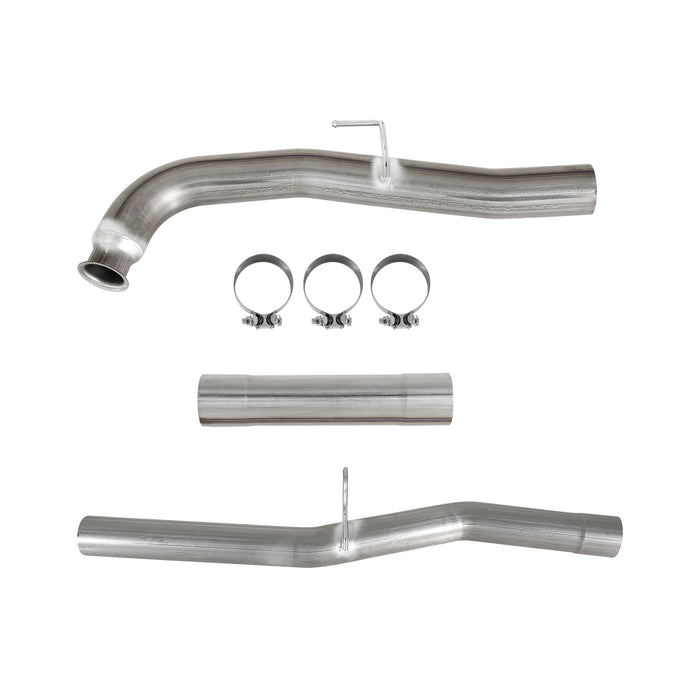
- The TruckTok 4" DPF & CAT Delete Pipe is a mid-section race pipe that replaces the CAT + DPF + SCR assembly with a single 4" mandrel-bent T-409 stainless section.
- It keeps the factory muffler and tailpipe, so the truck keeps a near-stock sound with no highway drone.
- It stops the regen cycle and drops EGTs under load — and it’s the piece that fixes the ash-clogged DPF at high mileage.
Pair it with an EGR delete and a CCV reroute for a complete reliability cure, since the pipe alone frees the exhaust but won’t stop PCV oil mist from mixing with EGR soot in the intake.
That “pair it” advice isn’t optional — a partial delete that removes the DPF but leaves the EGR (or vice versa) is exactly where owners hit trouble.
For 2015.5–2016 (3-bolt flange)
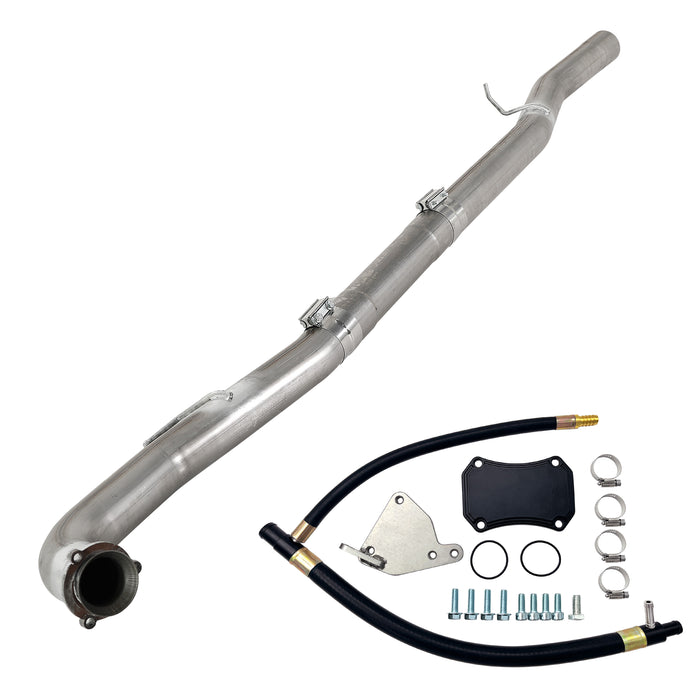
The TruckTok 4" DPF & CAT Delete Pipe & EGR Cooler Delete Kit bundles the race pipe and the EGR cooler delete in one box. It’s engineered for the late 3-bolt flange geometry, removes both the DPF restriction and the EGR cooler’s soot-and-coolant-leak risk, and is a direct bolt-on for the 2015.5–2016 trucks.
Three Parts That Make the Delete Actually Hold Up
The delete pipe removes the emissions systems, but it doesn’t touch three other things that matter on an aging LML. These are where “do it right” and “do it cheap” split:
-
Up-pipe — the passenger-side up-pipe has fragile factory bellows that crack under heat and drive pressure. A leaking up-pipe kills boost, spikes EGTs, and leaves soot on the firewall. It’s a mechanical, no-tune-needed fix, and it’s one of the most-overlooked weak points on these trucks.
-
Tuner Harness Plug Kit — when you delete, you unplug a pile of sensors (EGT, NOx, DEF, EGR, ninth injector) and leave open connectors hanging under the truck. Weatherproof block-off plugs keep water, mud, and salt out so the wiring survives — and so you can return the truck to stock later without corroded pins.
-
CP3 Injection Pump Conversion Kit — the one part that addresses the LML’s real time bomb. It swaps the fragile CP4.2 for the heavy-duty CP3 architecture used in the older, more reliable Duramax generations, eliminating the $10,000+ metal-shaving failure. It needs a CP3 conversion tune, but it’s the single biggest reliability upgrade you can make to an LML.
The Install, in Brief
The order matters more than the tools. Tune first, then unbolt.
- Flash the delete tune before you touch any hardware. Removing the DPF or EGR without recalibrating the ECM first throws a wall of codes and can put the truck in limp mode.
- Disconnect the three required connectors — front EGR valve, throttle valve, and rear EGR valve.
- Work the exhaust from the rear forward: unplug every sensor, disconnect the DEF injector and lines, drop the heavy DPF/SCR assembly (support it — it’s heavy).
- Remove the EGR valve and cooler, then install the block-off plates.
- Re-route the coolant after the EGR cooler comes out — this is the step people skip, and a kinked or un-routed coolant line will overheat the engine.
- Refill coolant, bleed the air out, and road-test while watching for leaks and codes.
Plan on a full day for a first-timer, and budget extra patience for the firewall-side fasteners on the EGR cooler — they’re the tightest part of the job.
The Legal Reality
Let’s be direct about this, because it’s the one downside that never goes away.
Removing or disabling the EGR, DPF, DEF, or SCR systems on a truck driven on public roads violates the federal Clean Air Act (42 U.S.C. § 7522). Delete kits are sold strictly for off-road, competition, or closed-course use — the “off-road” label does not create a legal exemption for a truck that returns to public roads.
The 2026 DOJ enforcement memo narrowed criminal prosecution priorities, but it did not change the underlying law, and EPA civil enforcement continues. If your truck is a daily driver, registered, financed, or inspected, delete is not a compliant path — that’s a decision you make with your eyes open, not something a parts listing can wave away.
Get the Right Kit for Your LML
The decision isn’t “delete or don’t” — it’s “when, and with what supporting parts.”
If you’re under warranty, wait and let GM cover the failures. If you’re out of warranty with a high-mileage truck and a DPF that’s ash-loaded past saving, the delete is the financially sound move — but do it right: match the pipe to your flange (V-band vs 3-bolt), add the EGR delete, and give the CP4.2 the respect it demands with a lift pump or a CP3 conversion. Do that, and you trade three systems that will fail for an engine that’s genuinely strong — the LML block, pistons, and rods were all upgraded over the LMM and LBZ, and the bottom end is good for 300,000–400,000 miles once you stop feeding it soot and stressing the fuel pump.
Browse the full LML lineup at TruckTok.com — delete pipes, EGR kits, up-pipes, harness plugs, and the CP3 conversion, all matched to your exact year and flange style.
Frequently Asked Questions
Q1: Does an LML delete actually add horsepower?
A: The pipe itself doesn’t make the power — the tune does. A deleted LML re-flashed on a “stock” tune level gains roughly 70 hp over factory, but an emissions-intact truck with good tuning can dyno the same. The delete removes restriction and failure points; the recalibration is what adds power.
Q2: Will deleting improve my fuel economy?
A: Yes, but mostly through the tune and the elimination of regen cycles. Real-world gains run from about 16 mpg to 21–22 mpg at 70 mph, and towing can nearly double from 8–9 mpg to 17–18 mpg. A badly tuned delete, on the other hand, can burn more fuel than stock.
Q3: Should I delete while the truck is still under warranty?
A: No. The ECM records the reflash, so the dealer will know even if you flash back to stock, and powertrain claims will be denied in practice. Wait until the warranty expires and let GM cover the DEF heater, NOx sensor, and other failures in the meantime.
Q4: Does deleting fix the CP4.2 fuel pump problem?
A: No — that’s the key thing delete marketing often omits. The CP4.2 fails independently of the emissions systems, and a high-horsepower delete tune can actually stress it further. A lift pump or a CP3 conversion is the real fix, and it’s separate from the delete.
Q5: What’s the difference between 2011–2015.5 and 2015.5–2016 LMLs?
A: The turbo downpipe connection. Early trucks use a V-band clamp, and late trucks (mid-2015 onward) use a 3-bolt flange. The delete pipes are not interchangeable, so confirm the connection under your truck before ordering.
Q6: What does the “Bad DEF Quality” message actually mean?
A: It’s almost never the fluid. The LML has no sensor that measures DEF quality — that message is triggered by a failing NOx sensor or DEF pump. Diagnose those components before assuming the fluid or the whole system is the problem.
Q7: Why does my LML’s oil turn black so fast?
A: EGR recirculates soot back into the intake, and that soot ends up in the oil. Once you delete the EGR, the oil stays dramatically cleaner — owners report amber oil after 4,000 miles instead of instant-black.
Q8: What’s the ninth injector on the LML?
A: It’s the hydrocarbon injector that sprays fuel into the exhaust stream to support DPF regeneration. It’s a cleaner design than in-cylinder post-injection, but if it leaks or fails it can still contribute to fuel dilution, so it’s worth understanding before assuming the LML is immune.
Q9: Can I just delete the DPF and leave the EGR?
A: You can, but it leaves a failure point in place. The EGR will keep feeding soot into the intake and can still crack its cooler. For a complete reliability fix, do the DPF and EGR together — and add a CCV reroute to stop the oil-vapor half of the intake sludge.
Q10: Is a delete legal on the road?
A: No. Removing emissions equipment on a road-driven truck violates the federal Clean Air Act, and states with inspections will fail it. Delete kits are for off-road, competition, or closed-course use only, and the “off-road” label does not create a legal exemption.
For off-road / competition use only. Not legal for on-road use in emissions-regulated areas. Check your local, state, and federal laws before modifying any emissions-related component.