

Home > News > 2013-2018 6.7L Cummins DPF Delete — Stop the 5-MPH Limp Mode

2013-2018 6.7L Cummins DPF Delete — Stop the 5-MPH Limp Mode
The 5-MPH limp mode is the 6.7L Cummins owner’s worst fear: a dashboard countdown that ends with the truck limited to walking speed on the side of a highway. It almost always traces back to the DEF/SCR system — and a 2013-2018 DPF and EGR delete removes that failure point, plus the DPF and EGR faults behind it, in one pass.
For off-road / competition use only. Not legal for on-road use in emissions-regulated areas. Check your local, state, and federal laws before modifying any emissions-related component.
What Is the 5-MPH Limp Mode, and Why Is It Different From a Derate?
Most people use “limp mode” as one catch-all term, but on a 2013-2018 6.7L Cummins there are two very different punishments, and they come from different systems.
A Derate (Reduced Power)
It is the mild one. It pulls torque and boost so the engine protects itself, but you can still limp to a shop. This is what a clogged DPF triggers as soot load climbs.
The 5-MPH “Speed Limited” Countdown
It’s specific to the DEF/SCR system. When the ECM loses confidence in the DEF dosing or the NOx sensors — a failed DEF heater, a bad quality sensor, a dead NOx sensor, or lost communication with the reductant control module — the truck throws a countdown on the cluster and, when it hits zero, caps you at roughly 5 mph.
The key takeaway: the 5-MPH limp mode is a DEF/SCR problem, not a DPF-clogging problem. If you don’t know which system is failing, you’ll spend money on the wrong fix.
What Happens Before the 5-MPH Limp Mode Hits
A 5-MPH countdown rarely comes out of nowhere — most trucks warn you first, if you know what to look for. There are two ways it arrives, and they give you very different amounts of notice.
The Gradual Path: Warning Signs You Can Catch
Most DEF/SCR failures degrade slowly, and the truck tells you well before the countdown starts:
-
A “Service DEF System” or “See Dealer” message — the first flag, and it usually shows up before any drivability change.
-
A check-engine light with emissions codes — P20EE (NOx conversion below threshold), P208A (DEF pump circuit), or U010E (lost communication with the reductant module) are all early warnings, not end-stage failures.
-
White DEF crystallization around the tank filler, the injector, or the lines — crystallized urea means the system is leaking or dosing incorrectly.
-
DEF consumption that’s suddenly wrong — burning through it far faster or slower than normal points to a dosing or sensor problem.
-
A countdown warning on the cluster — “Speed Limited in XX miles” is the last, loudest warning. One owner reported a 150-mile countdown that let him keep driving as long as he didn’t shut the truck off — but it’s borrowed time.
The takeaway: treat any emissions code as a diagnostic prompt, not a nuisance. The earlier you catch it, the more likely the fix is a $20 wire or a fresh set of batteries instead of a stranded truck.
Why the 2013-2018 Generation Is the First to Face This
The 5-MPH countdown didn’t exist on the earlier trucks. Here’s the year split that matters:
| Year Range | Emissions Hardware | 5-MPH Countdown? |
|---|---|---|
| 2007.5–2012 | EGR + DPF (no DEF/SCR) | No — DEF doesn’t exist yet |
| 2013–2018 | EGR + DPF + SCR/DEF | Yes — DEF faults trigger it |
| 2019+ | EGR + DPF + SCR/DEF (revised) | Yes, and it hits harder and faster |
Starting in 2013, Ram added the selective catalytic reduction (SCR) system with a DEF tank, DEF injector, and NOx sensors upstream and downstream of the catalyst. That added an entire second set of failure points — and the “speed limited” derate logic that comes with them.
The Three Systems That Put You in Limp Mode
A 5-MPH countdown is the end of a chain, not the start. Three emissions systems feed it, each with its own failure mode.
The DEF/SCR System — the Direct Trigger
The DEF pump, DEF heater, quality sensor, injector, and NOx sensors all have to cooperate for the truck to keep dosing correctly. When one fails, you get codes like:
- U010E (lost communication with the reductant control module)
- U040F (implausible data from the reductant module)
- P208A (reductant pump control circuit).
The frustration is that the root cause is often not the emissions part itself. A 2016 3500 owner on the forums chased U010E and U040F through two DEF-system failures and five total breakdowns before the dealer finally found the real culprit: the power wires to the control module had been rubbed through and corroded by a front driveline that had failed years earlier.
“No amount of money spent will make up for poor design, low quality components, or lack of proper service training… 137k miles should not be the end of the road for this truck.”
The lesson:
Before you assume the DEF pump is dead, check the wiring, the connectors, and the battery voltage. A $20 wire repair or a fresh set of batteries can clear a code that looks like a $1,500 pump job.
The DPF — the Slow Trigger
The diesel particulate filter traps soot and burns it during regeneration. On a truck that idles on jobsites or runs short trips, the filter never gets hot enough to complete a passive regen, so soot loads up and active regens fire constantly. Eventually the filter plugs with ash — the metallic residue that regen can’t burn — and backpressure climbs until the ECM derates you.
The DPF is rarely the source of a 5-MPH countdown, but it’s the slow-burn problem that makes the truck feel lazy long before it throws a hard code.
The EGR System — the Quiet Soot Generator
The EGR valve and cooler recirculate hot, soot-laden exhaust back into the intake to cut NOx. Over time that coats the intake manifold with carbon, restricts airflow, and — worst case — the EGR cooler cracks and dumps coolant into the intake. EGR faults throw P0401/P0402 codes and contribute to the intake fouling that makes a high-mileage truck feel tired.
The point:
These three systems are not independent. A delete that only removes the DPF leaves the DEF countdown and the EGR soot problem in place. A delete that removes all three is the only way to guarantee the truck can’t strand you on emissions hardware again.
What a DPF Delete Actually Stops
A proper 2013-2018 delete removes the DPF, the SCR/DEF hardware, and the EGR system — and pairs them with a tune that tells the ECM those systems are gone. Here’s what that actually changes:
-
The 5-MPH countdown is gone. No DEF dosing to fail, no NOx sensors to drift, no reductant module to lose communication with. The single most frightening failure mode on this platform simply can’t happen.
-
The regen cycle is gone. No more post-injection fuel dumps that raise exhaust temps, waste fuel, and dilute the oil.
-
The EGR soot source is gone. The intake manifold stops accumulating carbon, and the EGR cooler can’t crack and dump coolant.
-
Backpressure drops. The DPF and SCR canister are the biggest restriction in the exhaust path. Removing them lowers EGT under load and lets the Holset VGT spool faster.
What a delete does not do is add horsepower on its own. The power comes from the tune you pair with the hardware — the pipe just removes the restriction the tune exploits. That distinction matters, because a lot of delete marketing blurs it.
The Products: Three Ways to Delete the Exhaust Side
The exhaust side of a 2013-2018 delete comes down to how much of the factory pipe you replace. TruckTok carries three tiers, all in heavy-duty T-409 stainless for Rust Belt salt, and all fitting 2013-2018 2500/3500 pickups (they do not fit rear air-ride or Cab & Chassis trucks).
The Mid-Section Race Pipe — the Budget Play
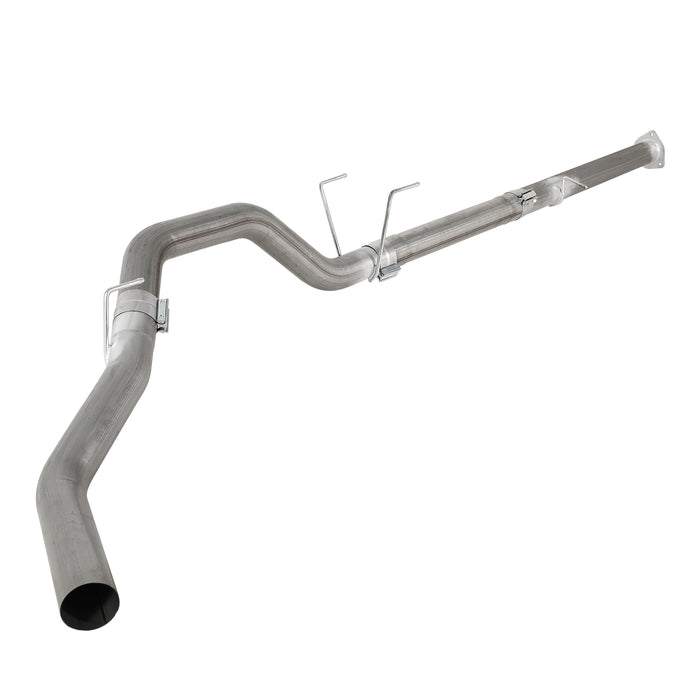
TruckTok 2013-2018 6.7L Ram 4" Exhaust Tube Pipe Kit replaces the DPF and SCR section with a straight 4" pipe while keeping the factory downpipe and tailpipe. It’s the lowest-cost way to eliminate the DPF/DEF failure points and end the regen cycle — the $192.31 entry point if your goal is purely to stop the countdown and the clogging, not to chase exhaust tone.
The 4" Downpipe-Back — Deletes the Muffler Too
TruckTok 2013-2018 6.7L Ram Cummins 4" Downpipe-Back DPF Delete Pipe at $578.00 goes further: it replaces the DPF, the CAT, and the factory muffler with a 4" pipe, unlocking the inline-six growl and a sharper turbo whistle while still fitting the factory downpipe. This is the sweet spot for most owners who want the delete and the sound without jumping to a full 5" system.
The 5" Turbo-Back — the Full Flow Path
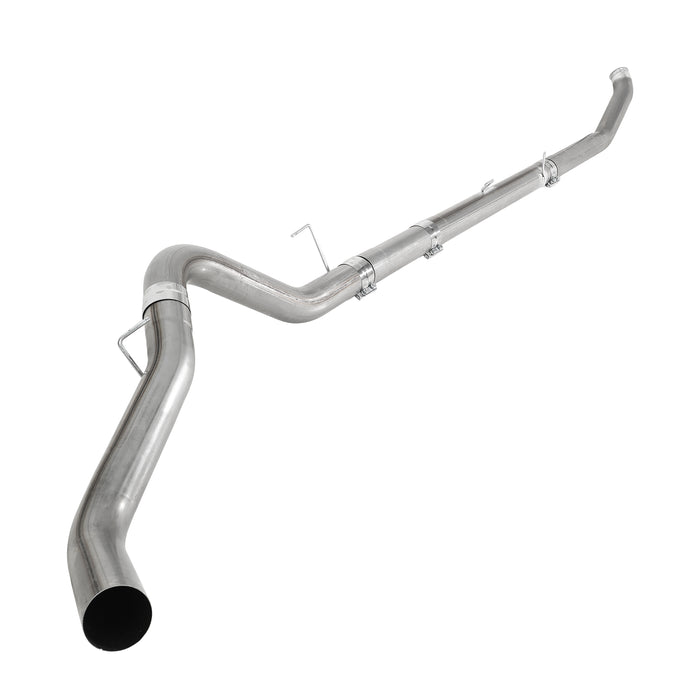
TruckTok 2013-2018 6.7L Ram Cummins 5" Turbo-Back DPF Delete Pipe at $658.00 replaces everything from the turbocharger flange back — the largest flow area, over 60% more than stock, for maximum EGT reduction and the deepest exhaust note. It’s the pick for trucks that tow heavy or run aggressive tunes, where every bit of exhaust flow and thermal headroom matters.
The three pipes break down cleanly by how much of the factory exhaust they replace:
| Dimension | 4" Mid-Section (DP-0213) | 4" Downpipe-Back (DP-0270) | 5" Turbo-Back (DP-0272) |
|---|---|---|---|
| Coverage | DPF/SCR section only | DPF + CAT + muffler | Everything from the turbo flange back |
| Price | $192.31 | $578.00 | $658.00 |
| Keeps factory | Downpipe + tailpipe | Downpipe | Nothing |
| Sound | Near stock | Deep inline-six growl | Deepest tone + turbo whistle |
| Best for | Pure failure-point removal on a budget | Daily driver that wants sound | Heavy towing / aggressive tunes |
All three require a delete tuner to suppress the DPF, EGR, and DEF codes — the hardware alone will throw codes and derate within miles. The tuner is non-negotiable, and it’s flashed before you unbolt anything.
The Install: A Full Step-by-Step Walkthrough
The single most common mistake on this platform is unbolting the hardware before flashing the tune. The ECM is watching DPF differential pressure, EGR flow, and DEF dosing in real time — pull the parts without a delete calibration and it throws a wall of codes and drops you into limp mode.
Tools You’ll Need
- 10mm, 13mm, and 15mm sockets, plus a deep socket for the sensor bosses and pipe clamps
- A swivel socket and a curved/ratcheting wrench — the EGR cooler’s rear nuts are the tightest part of the whole job
- Torque wrench — the exhaust manifold and turbo flanges have real torque specs
- Penetrating oil (PB Blaster) — soak the exhaust hardware a day ahead
- A ratchet strap — the DPF/SCR canister is heavy, and the strap both supports it and helps separate the slip-fit sections
- Coolant catch pan and fresh coolant — the EGR cooler is full of it
- A battery charger — you flash the tune before anything else, and a low battery mid-flash can brick the ECM
- Electrical tape and zip ties — every orphan connector gets taped shut and tied to the frame
- An impact wrench and a cutoff tool — the exhaust bolts are often seized to the point of cutting
Step 0: Flash the Tune First (Do Not Skip This)
Hook the battery charger up, key the truck on, and load the delete calibration while the emissions hardware is still in place.
- 2013–2017 trucks tune straight through the OBD-II port with a Mini Maxx V2 or similar. Follow the on-screen sequence: select the vehicle, confirm the year, and let it write — it’ll shut down and reboot when it hits 100%.
-
2018 trucks add one step: the Security Gateway (SGW) module sits between the OBD-II port and the ECM, so you install a bypass cable first, or the tuner can’t communicate. Confirm your PCM calibration part number is one the tuner supports before you start.
Phase 1: Drop the Exhaust
- Label and unplug every connector on the exhaust. You’ll find the DEF injector, NOx sensors, EGT sensors, and pressure lines along the DPF/SCR assembly. Label each one, unplug it, tape the connector shut against water, and zip-tie it to the frame rail.
- Support the DPF/SCR canister with a ratchet strap before you loosen the hangers. It’s the heaviest single piece in the system, and it’ll swing the moment the clamps come off.
- Loosen the flanges and clamps. Soak them with penetrating oil a day ahead. Bolts that are rusted solid usually need heat or an impact; if they strip, cut them.
- Separate the slip-fit joints. The delete pipe often uses the same slip-fit connection as the factory assembly. A ratchet strap hooked to the frame rail will pull a stuck section apart with steady pressure instead of hammering.
Phase 2: Install the Delete Pipe
Which pipe you install depends on how much you’re replacing:
- The mid-section 4" pipe bolts into the factory downpipe on the front and the tailpipe on the back — the simplest, most direct swap.
- The 4" downpipe-back replaces the DPF, CAT, and muffler, joining the factory downpipe at the front.
- The 5" turbo-back replaces everything from the turbocharger flange rearward — the most flow, and the most connections to line up.
Slide the sections together, leave the clamps just snug, get the whole pipe hung and the hangers loaded, then tighten everything front-to-back. Don’t fully torque one joint before the rest of the pipe is in place — a pipe that’s bound at one end won’t seat at the other.
Phase 3: Remove the EGR Hardware
The EGR cooler sits high on the driver side and is the slowest part of the job.
- Disconnect the EGR valve and the crossover piping. The valve has an electrical connector; the cooler has two coolant lines feeding it.
- Unbolt the cooler. The front bolts come out with a standard socket, but the two rear nuts — the ones everyone dreads — need a swivel or a curved ratcheting wrench to reach.
- Install the block-off plates on both the exhaust and intake sides of the EGR path.
- Reroute the coolant. The EGR cooler is on a coolant circuit, so when you remove it, you have to either cap the ports or splice the lines so coolant keeps flowing. Leave an air pocket here and the rear cylinders can overheat — which is exactly the failure a delete is supposed to prevent.
Phase 4: Refill, Bleed, and Verify
- Refill the coolant to the level you drained, then bleed the system — run the heater and cycle the engine to temperature with the cap off until air stops bubbling.
- Start the truck and let it idle while you check every new joint for exhaust leaks and every coolant connection for drips.
- Scan for codes. A clean install should leave the truck running without a check-engine light. Any lingering code usually points to a connector you didn’t tape off or a sensor you left unplugged.
The Three Mistakes That Come Back to Bite You
- Flashing the tune after the hardware. It’s the fastest way to strand the truck in limp mode — the ECM sees missing DPF flow and DEF dosing and derates on the spot.
- Skipping the coolant reroute. Trapped air in the EGR coolant circuit cooks the rear cylinders, and you won’t notice until it’s already hot.
- Not labeling the sensors. You’ll reinstall a connector into the wrong boss, chase a ghost code for a week, and then have to go back under the truck anyway.
How to Fix the 5-MPH Limp Mode Without Deleting
If the truck is street-driven, the compliant fix isn’t a delete — it’s finding and repairing the one DEF component that failed. And the most common culprit, the DEF pump, is a genuinely doable DIY job that most owners can knock out in about 30 minutes plus the part.
The DEF Pump Swap, Step by Step
- Pull the access panel. On the front of the fuel tank there’s a small panel held by two 13mm bolts — remove them and the DEF pump is right there.
- Check the wiring first. Before you order a pump, look at the harness connector for corrosion. A corroded or chafed wire will mimic a dead pump, and replacing the pump won’t fix a wiring fault. This is the single most skipped step.
- Disconnect the harness. The green locking tab releases with a small flathead — be gentle, you don’t want to crack it. Cover the connector because DEF will drip.
- Pop the DEF fluid line. Squeeze the two white tabs together and pull the line off.
- Unlock the tank ring. This is the hard part, and it’s the reason people break tanks. The locking ring turns counterclockwise and it is stuck. If it won’t budge, use the floor-jack trick: set a board on the jack, apply gentle upward pressure under the ring, and it’ll rotate a click at a time. Going back on is just as tight.
- Swap in the new pump and orient it the way the old one sat. The new pump has what it needs inside — if you find a little metal tube left in the old pump’s nipple, that’s an old-component remnant, not something you transfer over.
- Refill with DEF, a little at a time, and check for leaks before dumping in the whole jug.
- Prime it without a scan tool. Turn the key to the run position (don’t start) and leave it for about 3 minutes, then off for a minute. Repeat that cycle five times to purge air from the pump.
- Drive it. A 20-minute run above 55 mph lets the system complete its self-check.
- Clear the code. A cheap handheld scanner (an Anova SD05-class unit) clears the P208A code — and with it, the check-engine light and the limp-mode countdown both disappear.
That’s the honest reality of the 5-MPH limp mode:
More often than not it’s a $150 pump and a 30-minute swap, not a five-figure disaster. The delete is the permanent answer for an off-road truck that keeps eating DEF parts; the repair is the answer for a street truck that just needs to be legal and running.
How to Prevent the 5-MPH Limp Mode
Whether you keep the truck stock or plan to delete it later, the same habits keep the 5-MPH countdown from catching you off guard.
-
Keep the DEF fresh and certified. DEF has a shelf life and degrades with heat and age — stale or contaminated fluid is the fastest way to kill a DEF pump and trigger a quality-sensor code. Use ISO 22241-certified fluid, and don’t top off from a jug that’s been sitting open.
-
Don’t let the DEF tank run dry. A low DEF level is a guaranteed warning, and running it empty repeatedly is hard on the pump. Refill before the low-level light becomes a habit.
-
Check for white crystallization. Crystallized urea around the filler neck, the injector, or the lines means the system is leaking or dosing wrong — catch it before it throws a code.
-
Keep the batteries healthy. The ECM treats low voltage the same as a dead DEF module. A weak or corroded battery is a surprisingly common trigger for U010E-style communication faults — clean the terminals and test the batteries before chasing a $1,500 part.
-
Inspect the wiring and connectors. The 2016 3500 case is the lesson here: the real culprit was chafed, corroded power wires, not a failed emissions part. A quick visual check of the harness costs less than any repair.
-
Don’t ignore the check-engine light. An emissions code is the earliest and cheapest warning you’ll get. A $20 wire or a fresh sensor now beats a 5-MPH countdown on the highway later.
-
Run the truck hot and long enough. Short trips and long idles keep the DPF from regenerating and the DEF system from completing its self-checks. A regular 20-minute run above 55 mph does the aftertreatment a favor.
None of these guarantees the system never fails — the 2013-2018 DEF hardware has real, documented weak points. But they stack the odds in your favor, and they cost nothing compared to a stranded truck.
What a Delete Won’t Fix — and What You Still Need to Watch
A delete removes the emissions failure points, but it is not a magic wand for the rest of the truck.
- It doesn’t fix a worn engine. Worn injectors, a slipping 68RFE, or low compression are still there after the delete.
- It doesn’t add horsepower by itself. The power is in the tune, not the pipe.
- It doesn’t fix a dying VGT turbo. The 6.7’s variable-geometry turbo is one of the platform’s most common failures — the VGT actuator sticks (often seizing around 60% travel), and the truck loses boost and feels gutless even though nothing is wrong with the emissions system.
- You don’t need CP4 insurance — because you don’t have a CP4. This is the quiet advantage of the 2013-2018 generation: it runs the reliable Bosch CP3 pump.
That last point is worth repeating: the 2013-2018 is the sweet spot for a delete precisely because it carries the CP3 pump, not the CP4. You’re removing the emissions headaches without inheriting a fuel-pump time bomb.
The Legal Reality (Read This Before You Commit)
Removing or disabling DPF, EGR, or SCR/DEF equipment on a road-registered truck is illegal under the federal Clean Air Act, 42 U.S.C. § 7522.
Delete hardware is sold and intended for off-road, competition, and closed-course use only; that designation does not create a legal exemption. If your truck is street-driven, registered, inspected, or financed, the compliant path is to repair the factory system — and as the forum case above shows, a $20 wiring repair sometimes fixes what looked like a $1,500 emissions part.
Get the Right Kit for Your 2013-2018 Cummins
If you’re done with the 5-MPH countdown and the regen cycle, the cleanest fix is a year-matched delete that removes the DPF, the DEF/SCR system, and the EGR hardware together — paired with a tune so the truck runs clean instead of throwing codes.
Match the kit to your exact year (2018 needs the Security Gateway bypass), confirm pickup vs. Cab & Chassis fitment, and don’t skip the tune. For the full lineup of 2013-2018 6.7L Cummins delete pipes, EGR hardware, and tuners — built for this exact generation and ships free — head to TruckTok.com. If you still want to know more about the 6.7L Cummins engine, you can check out these blogs:
- 6.7L Cummins EGR Cooler Clogging — Why It Happens and How to Prevent It
- 2013-2018 Ram 6.7L Cummins Filter Kit Buyer’s Guide (Fuel, Oil, Air)
-
2013-2018 6.7L Cummins EGR & DPF Delete: 4" Exhaust & Cooler Kit Buyer's Guide
Frequently Asked Questions
Why does my 6.7L Cummins say “speed limited” and cap me at 5 mph?
That’s the DEF/SCR system’s severe derate. When the ECM loses confidence in DEF dosing or the NOx sensors, it starts a countdown that ends at a 5-mph cap. It’s triggered by DEF faults, not DPF clogging — so a dead DEF pump, a bad NOx sensor, or lost communication with the reductant control module are the usual causes.
Is a 5-MPH limp mode the same as a derate?
No. A derate pulls torque and boost but lets you limp to a shop, usually from DPF soot load. The 5-MPH countdown is specific to the DEF/SCR system and caps your speed entirely. They’re two different punishments from two different systems.
Does a DPF delete stop the 5-MPH countdown?
Yes, when it’s a complete delete. A full 2013-2018 delete removes the DPF, the SCR/DEF hardware, and the EGR system, and the tune disables their monitoring — so the DEF faults that trigger the countdown can’t happen. A DPF-only delete leaves the DEF system in place and won’t stop it.
Can I just replace the DEF pump instead of deleting?
Yes, if the truck is street-driven that’s the compliant path — and it’s often cheaper than you’d think. A DIY DEF pump swap runs under an hour plus the part, and clearing the P208A code resets the countdown. But if the truck keeps eating DEF components, a delete is the permanent fix for an off-road build.
Do I need a tuner to delete a 2013-2018 6.7L Cummins?
Yes, every time. The ECM monitors DPF differential pressure, EGR flow, and DEF dosing, and it will throw codes and derate within miles of removing the hardware without a delete calibration. The tuner is the mandatory half of the job.
Does a delete add horsepower?
The pipe alone doesn’t. Removing the DPF and SCR cuts backpressure, but the real power comes from the tune that takes advantage of the freer exhaust. Hardware removes the restriction; the tune turns that into power.
What’s the difference between a 4" race pipe and a 5" turbo-back?
A mid-section 4" pipe replaces only the DPF/SCR canister and keeps the factory downpipe and tailpipe. A 4" downpipe-back also deletes the muffler. A 5" turbo-back replaces everything from the turbo back for the most flow and the deepest tone — it’s the pick for heavy towing and aggressive tunes.
Does a 2013-2018 Cummins delete kit fit a Cab & Chassis?
Usually not. The standard pickup delete pipes are built for leaf-spring 2500/3500 pickups and don’t fit rear air-ride or Cab & Chassis (4500/5500) trucks, which use different frame rails and body mounting. Confirm fitment before ordering.
Does a 2013-2018 Cummins need a CP4 disaster-prevention kit?
No — that’s the point of this generation. The 2013-2018 runs the Bosch CP3 pump, not the CP4. The CP4 disaster kits are for 2019-2020 Cummins owners and 2011+ Ford 6.7 Powerstroke owners. Your fuel-system duty is simpler: keep the fuel filter fresh to protect the CP3 and injectors.
What’s the biggest mistake during a 6.7L Cummins delete?
Unbolting the hardware before flashing the tune. The ECM is actively monitoring the emissions systems, and pulling the parts without a delete calibration throws codes and drops you into limp mode. Always flash the tune first, on a battery charger.
Will a deleted truck pass emissions inspection?
In most emissions-regulated areas, no. A deleted truck will fail visual inspection, OBD readiness checks, or emissions testing. Delete hardware is for off-road and competition use only — it’s not a street-legal fix.
Can I reverse a delete later?
In many cases, yes, if you kept the original DPF, DEF, and EGR parts and the truck can be returned to factory calibration. Reversal requires the original emissions hardware, sensors, and ECU programming — which is why owners who delete are told to store the stock parts.