

Home > News > LM2 3.0L Duramax DPF & EGR Delete: The Half-Ton Fix


LM2 3.0L Duramax DPF & EGR Delete: The Half-Ton Fix
The 3.0L LM2 Duramax is a genuinely good engine wrapped in a fragile emissions stack. A DPF and EGR delete removes the two parts of that stack that fail the most predictably — the EGR cooler that can hydrolock the engine, and the SCRF canister that permanently plugs with ash — and it does it for a fraction of what a single dealer repair costs. But “the half-ton fix” is a reliability and cost-of-ownership decision, not a horsepower upgrade, and it doesn’t touch the engine’s other well-documented weak points. Here’s the honest breakdown.
For off-road / competition use only. Not legal for on-road use in emissions-regulated areas. Check your local, state, and federal laws before modifying any emissions-related component.
What’s Actually Wrong With the 3.0L Duramax?
A Good Engine, on Its Own Merits
GM calls the 3.0L Duramax “the most reliable diesel they’ve ever put in a truck,” and on the engine’s own merits, that’s close to true. It’s a smooth, quiet inline-six that returns highway mileage in the high 20s, pulls a meaningful trailer, and doesn’t rattle the cabin apart. Owners who run them hard and long report far fewer problems than those who idle them around town.
The Catch: The Aftertreatment Ages, Not the Engine
The catch is what GM had to bolt on to make it pass emissions. The engine itself is a well-executed piece of engineering; the aftertreatment wrapped around it is the part that ages poorly. That distinction — a good engine, a fragile emissions stack — is the entire reason a delete exists for this platform.
A Full Emissions Kit on a Half-Ton Truck
The LM2 carries the full modern diesel emissions kit: EGR, DPF, SCR, DEF, and a DOC. Every one of those is a potential failure point that has nothing to do with the engine’s mechanical health. And on a half-ton truck that most people buy as a fuel-efficient daily driver, those systems get worked in exactly the wrong way — more on that below.
Why the LM2’s EGR Is Different From Every Other Diesel You Know
This is the thing that trips people up, and it’s worth getting right before you spend a dime. The LM2 runs a low-pressure EGR system, and it’s fundamentally different from the high-pressure EGR on the 6.6L HD Duramax or a Cummins.
Low-Pressure vs High-Pressure: The Core Difference
A traditional high-pressure EGR taps exhaust right off the manifold and feeds it back into the intake after the turbo. A low-pressure system, like the LM2’s, draws the gas from downstream of the DPF and routes it back into the intake before the turbo compressor.
Why GM Did It This Way
There’s real logic to it. Gas pulled from after the DPF is cleaner, so it doesn’t foul the EGR valve and cooler as aggressively as manifold-tapped gas does. And feeding it in before the turbo lets the engine run a more precise air-fuel mix — that’s a big reason the 3.0L posts the fuel-economy numbers it does.
The Trade-Off That Bites Back
Instead of staying contained in the intake manifold, low-pressure EGR sends soot through the turbo compressor and the entire intake tract — the very places that should only ever see clean, filtered air. Over tens of thousands of miles, that soot mixes with oil vapor from the crankcase ventilation and forms a sticky, tar-like sludge that coats the intake and the plastic intake manifold. On a long enough timeline, that combination is a recipe for the plastic manifold to crack.
So the low-pressure EGR is a clever emissions trick with a nasty long-term cost — and it’s the reason the LM2’s failures play out the way they do.
Know Your Engine: LM2 vs LZ0
The 3.0L Duramax isn’t one engine — it’s two, and they don’t share emissions parts. Getting this wrong is the single most common way people order the wrong kit.
| Spec | 2020–2022 LM2 | 2023+ LZ0 |
|---|---|---|
| Power | 277 hp | 305 hp |
| Torque | 460 lb-ft | 495 lb-ft |
| Compression | 15.0:1 | 15.2:1 |
| Emissions stack | EGR + DOC + SCRF + DEF | Revised EGR + exhaust routing |
| Fitment | The parts in this guide | Different flange geometry, won’t bolt on |
The 2023+ LZ0 got a redesigned exhaust routing and different flange geometry. An LM2 delete pipe physically will not bolt to an LZ0. When a listing says “3.0L Duramax” without specifying the year range, treat it as a warning sign.
There’s one more wrinkle: the 2019 3.0L was a late-availability first-year truck that sits in a gray area. Some kits list it, most specify 2020–2022. If you have a 2019, confirm against the kit’s fitment list rather than assuming.
What Does a Delete Actually Fix?
A delete touches the emissions systems only. It’s precise about what it removes, and being precise about that is the whole point of this guide.
The EGR Cooler — the Hydrolock Risk.
It runs hot exhaust and engine coolant through the same heat exchanger, separated by a thin wall of brazed metal. After enough heat cycles, that wall can crack. Coolant seeps into the intake side and gets drawn into a cylinder, where liquid doesn’t compress. The result is hydrolock — a bent connecting rod, or worse.
The first symptom is a slow coolant loss with no puddle, then white smoke on a cold start that clears as it warms. Removing the cooler and its coolant path makes that specific failure mode disappear entirely.
The Carbon Sludge
No exhaust gas fed back into the intake means no soot mixing with oil vapor in the first place. The sticky sludge that coats the intake and works against the plastic manifold stops being produced.
The SCRF Canister — the Ash Problem
GM calls the LM2’s aftertreatment an SCRF — Selective Catalytic Reduction on Filter, a DPF and SCR catalyst combined into one sealed canister. The DPF half traps soot and burns it off through active regeneration. But ash — the non-combustible residue left behind after regen — builds up permanently. No amount of regen removes it. Once ash loading hits the limit, the filter is done. A straight pipe removes the clogging, the regen fuel waste, and the eventual replacement all at once.
The DEF system
Removing the hardware takes the LM2’s most winter-fragile component out of the equation — the DEF tank heater that fails in cold weather and the injector that crystallizes and clogs, either one throwing a code that derates the truck miles from a dealer.
What a Delete Can’t Fix — The Half-Ton’s Other Weak Points
Here’s where it pays to be clear-eyed, because a delete is not a magic fix for every LM2 problem. The 3.0L has a cluster of well-documented issues that have nothing to do with emissions, and none of them go away when you remove the EGR and DPF.
The Oil Pump Belt
This is the LM2’s biggest mechanical quirk. The oil pump is driven by a rubber belt mounted behind the crank, submerged in oil, and GM’s replacement interval is around 150,000 miles — which means pulling the transmission to get at it. A delete doesn’t touch this. If the belt lets go, the oil pump stops pumping and the engine goes “boom” in seconds or minutes.
Oil Consumption
The LM2 is famous for burning oil, to the point that GM’s own service bulletin 21-N272 states an “acceptable” rate of one quart per 2,000 miles for personal use, and one quart per 1,000 miles when towing. On a truck towing daily with 5,000-mile oil changes, that’s five quarts added between changes — and GM would still call it acceptable.
Some Minor Issues
- The timing chain. It’s at the back of the engine, and replacing it means pulling the transmission and the cab — a job that can run toward $10,000. It’s a wear item, not an emissions part.
- Rear main seal and oil leaks. The LM2 and LZ0 both have known oil-leak spots — rear main seal, oil pan, engine oil plugs — and fixing any of them means dropping the transmission.
- Long crank / no-start. The camshaft position exciter wheel is a known culprit, and replacing it on a Silverado means pulling the cab — a 40-to-50-hour job.
The honest framing is this: a delete removes a specific, well-documented set of emissions failure points. It doesn’t turn the LM2 into something it isn’t, and it doesn’t remove the maintenance and known weaknesses the engine itself still has.
Why Short Trips Are This Engine’s Kryptonite
This is the half-ton-specific angle that most diesel delete guides miss, and it’s the most important context for understanding why LM2 owners end up here.
A Diesel Being Used Like a Gas Car
The LM2 is a half-ton diesel, which means a huge share of its owners buy it as a fuel-efficient daily driver — commuting, school runs, errands. The problem is that a diesel driven five miles at a time, idled in traffic, and shut down before it warms up is being used in one of the hardest possible ways for its aftertreatment.
What the DPF Actually Needs
A DPF needs heat, load, and uninterrupted run time to regenerate. Short trips interrupt regen before it finishes; long idling makes soot without useful exhaust heat; low-load city driving keeps exhaust temperature too low for passive cleaning. The result is more frequent regen, climbing soot load, and eventually a filter that loads faster than the truck can clean it.
Why Low Miles Can Mean More Problems
This is why a low-mileage LM2 can have more DPF stress than a high-mileage highway truck, and why the owners who run theirs hard and long — towing, hauling, steady highway miles — report a fraction of the emissions problems that short-trip commuters do. If your LM2 lives a short-trip, idle-heavy life, the emissions stack is working overtime against you, and that’s precisely the scenario where owners start doing the delete math.
The Product: One Box, Both Systems
The cleanest way to do a full delete on the LM2 is to get the EGR delete and the DPF delete pipe together, because the two systems are one job — they share the same sensor network and the same teardown.
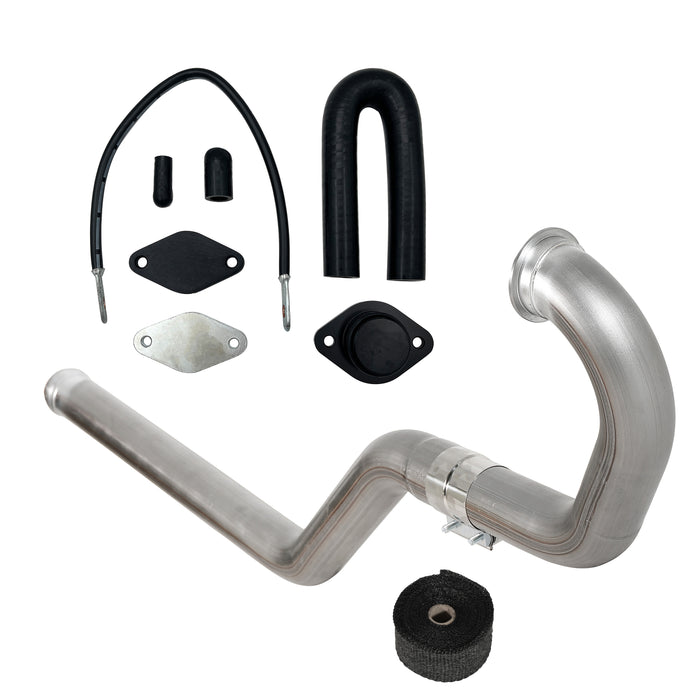
2020-2022 3.0L LM2 Duramax 3" Turbo Back DPF Delete Pipe & EGR Delete kit is the combined kit, at $549. It bundles the two pieces that remove the most common failures:
-
The EGR valve and cooler delete — billet T6-6061 block-off plates seal the open intake and exhaust ports, and a U-shaped silicone bypass hose closes the coolant loop the cooler used to occupy. This removes the hydrolock risk and stops the carbon sludge at its source.
-
The 3" turbo-back DPF delete pipe — mandrel-bent T-409 stainless that starts at the turbo’s exhaust outlet and replaces the restrictive downpipe section and the SCRF canister. It reconnects to the factory rear muffler and tailpipes, so the truck stays surprisingly quiet.
The 3" diameter is deliberate. The 3.0L is a light-duty inline-six, and a 3" pipe is the sweet spot — it opens more than enough volume to eliminate the DPF restriction while keeping exhaust gas velocity high enough to preserve low-end towing torque and crisp off-idle response. A 4" pipe on this displacement would just cost more and drone more without a real gain.
If you only want half the job, the pieces are available separately — the EGR valve cooler delete kit at $189, and the 3" turbo-back DPF delete pipe at $359.
How the Install Goes
A full LM2 delete is a moderate job — not a weekend for a first-timer, but within reach for someone comfortable with hand tools and patient enough to work around the intake plumbing. Budget for a couple of days, especially in a driveway.
Tools You’ll Need
- 10mm deep socket and hand ratchet — battery terminal and most hardware
- 13mm socket and ratchet — EGR cooler and downpipe brackets
- 7mm socket and a small hand ratchet — fuse box fasteners (no power tools)
- T15 Torx bit — fender liner
- Pick tool or clip tool — connectors and push clips
- Coolant catch pan — you’ll drain the system
- A second set of hands — the DPF canister is heavy and comes out through the hood
Step 0 — Flash the Tune First
This is non-negotiable, and it comes before any hardware comes off.
- Scan for codes first. Pull the codes so you know what you’re starting with. A pre-existing turbo underboost code, for example, is worth documenting before you touch anything.
- Hook up a battery charger. A voltage dip during a flash can corrupt the write. Watch the voltage and don’t start until it’s stable — around 12.4V at a minimum, and it’ll read higher once the charger is on.
- Flash the delete tune. Plug the tuner into the OBD port, confirm it’s talking to the right vehicle (the LM2 runs the E46 ECM), select the delete profile, and install. The dash will cycle lights on and off as it writes — that’s normal. The whole flash takes around ten minutes, and you’ll be prompted to cycle the ignition off and back to run a few times. Do not start the truck, and do not press the brake pedal on a push-start vehicle.
Step 1 — Disconnect and Drain
Disconnect the negative battery terminal, then drain the coolant — you’re about to open the loop at the EGR cooler, and you don’t want it dumping everywhere.
Step 2 — Clear the Engine Bay
Getting to the EGR cooler and downpipe means moving a lot of stuff out of the way:
- Remove the battery and the battery tray.
- Remove the fuse box cover and separate the top half from the bottom — the 7mm fasteners are soft and easy to strip, so use a hand ratchet and be gentle.
- Pull the fender liner (T15 Torx screws and a couple of push clips) to open up access from the wheel well. A lot of this job is only reachable from underneath.
Step 3 — Remove the EGR Valve and Cooler
This is the more involved half. Work the EGR cooler out by disconnecting its coolant lines, unplugging its connectors, and unbolting it from its brackets. Remove the turbo heat shield to get to the downpipe’s V-band clamp.
Step 4 — Install the Block-Off Plates and Coolant Bypass
Seal the open intake and exhaust ports with the block-off plates — reuse the factory bolts and replace the gasket. Route the coolant bypass hose to close the loop the cooler used to occupy. Get this wrong and you’ll have an air pocket in the cooling system — a gurgling sound behind the dash and a truck that runs hot.
Step 5 — Drop the DPF and Hang the Pipe
Unbolt the factory downpipe and SCRF canister. The canister is heavy and has to come out carefully — have a second set of hands to lift it out through the hood without snagging wiring. Hang the new 3" pipe from the turbo outlet back, reconnect the tail section to the factory muffler, and tighten the V-band. Leave it a touch loose until the lower section is aligned, then snug it down.
Step 6 — Install the CAN Bus Plugs
Unplugging the under-bed emissions modules breaks the digital CAN-bus loop, which trips codes and limp mode on its own. The LM2 needs three CAN bus plugs — two underneath, one in the engine bay — to complete the circuit. Many owners report the L5P 17–19 or 20–22 plugs work on the 20–22 3.0L, but confirm compatibility with your exact truck.
Step 7 — Refill, Bleed, and Verify
Refill the coolant, bleed the air out, and key the truck on without starting to confirm no check engine light — that tells you the tune took. Then start it, watch the coolant level, and check every joint for leaks once it’s warm. Take it for a short shakedown drive and re-check.
The Legal Reality
Removing or disabling the DPF, EGR, or SCR/DEF systems on a vehicle operated on public roads is a violation of the federal Clean Air Act (42 U.S.C. § 7522), and carries penalties up to $5,911 per violation for individuals, with higher amounts for commercial operations. There is no “off-road” exemption that makes a delete legal on a highway-certified truck — the EPA has stated plainly that dedicated off-road or racing use does not create a compliance carve-out.
If you live somewhere with regular emissions testing, or the truck is your daily on public roads, a delete isn’t the move. If it’s an off-road, competition, or private-land truck, understand your local rules before you start.
Get the Right Kit for Your Half-Ton
The LM2 is a genuinely good engine held back by an emissions stack that ages badly — and on a half-ton that most people drive short and idle long, that stack gets worked in exactly the wrong way. A delete removes the two parts that fail most predictably: the EGR cooler that can hydrolock the engine, and the SCRF canister that permanently plugs with ash. It also ends the regen cycle, the DEF winter failures, and the carbon sludge choking the intake.
What it doesn’t do is fix the oil pump belt, the oil consumption, the timing chain, or the oil leaks — those are the LM2’s other, separate weak points. Go in with that understanding, and a delete is a sound cost-of-ownership decision on a truck you plan to keep.
The 3" Turbo-Back DPF Delete Pipe & EGR Delete kit is the full delete in one box. If you’re still deciding, check the fitment for your exact model year — 2020–2022 LM2 only, not the 2023+ LZ0.
More LM2 Duramax Reading
If you still have any doubts, you can also check out these blogs:
For off-road / competition use only. Not legal for on-road use in emissions-regulated areas. Check your local, state, and federal laws before modifying any emissions-related component.
Frequently Asked Questions
What’s the difference between deleting the EGR and deleting the DPF on an LM2?
They address two different failure points. The EGR delete removes the cooler (the hydrolock risk) and stops the soot that creates carbon sludge in the intake. The DPF delete removes the restrictive SCRF canister and ends the regen cycle, the ash-loading problem, and the eventual filter replacement. You can do one without the other, but a “full delete” does both.
Will a delete add horsepower?
No — a delete is a reliability and cost-of-ownership decision, not a performance decision. The horsepower people attribute to a delete actually comes from the tune. Removing the emissions hardware frees up airflow and lowers EGTs, but it doesn’t add power on its own.
Do I need a custom tune after a delete?
Yes, and it’s mandatory. Removing the EGR valve or DPF will trigger a check engine light and put the truck into a derated limp mode unless you flash a delete tune that disables the EGR software and its sensors. The hardware and the tune are one job; doing half of it is worse than doing none of it.
What’s the difference between an LM2 and an LZ0?
The LM2 (2020–2022) makes 277 hp and 460 lb-ft, while the LZ0 (2023+) makes 305 hp and 495 lb-ft with a redesigned exhaust routing and different flange geometry. LM2 delete parts physically won’t bolt to an LZ0, so you have to match the kit to your exact model year.
Does a delete fix the oil pump belt problem?
No. The LM2 drives its oil pump with a rubber belt mounted behind the crank, with a replacement interval around 150,000 miles that means pulling the transmission. A delete doesn’t touch this — it’s a separate service item you budget for regardless of what you do with the emissions hardware.
How much louder will the truck be after a delete?
Not much, if the pipe keeps the factory muffler and tailpipes. You’ll notice a crisper throttle response and a little more turbo whistle outside, but the cabin stays relatively quiet — no heavy drone. That’s the main reason to choose a pipe that retains the rear muffler.
Will deleting improve my fuel economy?
Owners frequently report better real-world fuel economy after a delete, mostly because the active regen cycle — which literally injects fuel to burn off soot — is gone. But results vary with driving conditions and tuning, and the more honest framing is that you stop paying the regen tax rather than promising a specific mpg gain.
How do I know if my EGR cooler is starting to fail?
The early signs are subtle. The first is usually a slow coolant loss with no visible leak, then white smoke on a cold start that clears as it warms, and sometimes a faint sweet smell from the exhaust. If you catch it at the coolant-loss stage you have options; once it’s dumping coolant into a cylinder, the window for a cheap fix is closing.
Why does the LM2’s low-pressure EGR matter?
The LM2 draws EGR gas from downstream of the DPF and feeds it in before the turbo compressor, unlike the high-pressure EGR on HD diesels. It’s a clever fuel-economy trick, but it sends soot through the turbo and the entire intake tract instead of keeping it contained in the manifold — which is why carbon sludge is such a problem on this engine.
Is deleting emissions equipment legal for on-road use?
No, generally not. Removing factory emissions equipment takes the vehicle out of compliance with state and federal regulations for on-road use. These kits are intended for off-road, competition, or other permitted applications only, and you should check the regulations that apply to your vehicle and use before making any change.
Will a delete void my warranty?
It can. A manufacturer generally can’t void your entire warranty under the Magnuson-Moss Act, but they can deny a specific claim if they can show the modification caused the failure — and removing emissions hardware is exactly the kind of change that gets pointed to. Expect emissions-related and engine claims to be at risk.