
Home > News > L5P Duramax EGR Delete: How to Beat a $2,500 Cooler Repair


L5P Duramax EGR Delete: How to Beat a $2,500 Cooler Repair
Here’s the situation in one sentence: a dealer EGR cooler repair on a 2017–2023 L5P runs $1,550 to $3,000, replaces your failed cooler with an identical OEM unit, and leaves you watching for the same failure to come back. An EGR delete costs less in hardware — but the L5P’s locked ECM adds a tune that can cost more than the kit itself. The “which is cheaper” answer isn’t as simple as the forums make it sound.
This guide walks the real math, the honest reliability picture, and when a delete actually beats a repair.
For off-road / competition use only. Removing or disabling emissions equipment on a street-driven vehicle violates the federal Clean Air Act. This article is for trucks used off-road, on private land, or in competition where local law permits.
The L5P EGR Isn’t the Time Bomb the Forums Claim
Start by correcting the folklore. If you’ve read diesel forums, you’ve absorbed the LML/LMM narrative: the EGR cooler is a ticking time bomb, it’ll crack and hydrolock your engine, delete it yesterday.
That reputation belongs to the older Duramax generations, not the L5P. When GM moved from the LML (2011–2016) to the L5P (2017+), the EGR cooler and valve hardware got a genuine redesign for improved durability, and the calibration leans less hard on aggressive recirculation. But there’s a second, quieter problem the forums rarely separate out: carbon fouling is real and universal, and it starts on day one.
The 22,000-Mile Teardown That Tells the Real Story
A 2024 teardown of a 22,000-mile L5P — owned carefully, never abused, good fuel — found:
- The Y-bridge interior coated in black, crusty carbon, visibility into the ports near zero.
- Both MAP sensors completely caked with soot, enough to silently bias readings and drag down fuel economy.
- The EGR valve and cooler assembly layered in carbon — despite the truck never throwing a single code.
- The whole assembly — valve, cooler, heat shields, piping, and trapped coolant — weighed over 23 pounds.
Twenty-two thousand miles is under two years of average driving. The carbon isn’t waiting for 100,000 miles. The only question is when it crosses from “present but manageable” to “causing measurable problems.”
What the EGR Actually Does (The Chemistry Forums Get Backwards)
The popular explanation — “EGR burns off NOx by recirculating it” — is scientifically backwards. NOx forms when you have heat above ~2,200°F, oxygen, and nitrogen in the same place. Your diesel combustion chamber has all three in abundance.
EGR doesn’t destroy NOx — it prevents NOx from forming.
It routes inert exhaust (its oxygen already consumed) back into the intake, displacing fresh air and lowering the oxygen concentration. The result is lower peak combustion temperature, which means less NOx gets created in the first place. SAE research pegs the reduction at roughly 75–80% at full load.
The trade-offs are real:
More soot, more carbon monoxide, more hydrocarbons, slightly less power, and more oil contamination. None of these are catastrophic on their own — but they’re why the intake eventually looks like the inside of a chimney.
What a Cooler Repair Actually Costs — and Why It Comes Back
When the EGR cooler does fail, the bill is what drives owners to research a delete.
The Dealer Numbers
- EGR cooler/valve parts: $800–$1,500 (OEM)
- Labor: $750–$1,500 (4–7 hours at dealer rate — the cooler is buried behind the turbo and intake plumbing)
- Total: $1,550–$3,000
That’s the “clean” range. Real owner reports skew higher:
| Report | Truck | Quote |
|---|---|---|
| Docwagner (forum) | 2013 GMC HD2500, 125k mi | $4,200 (EGR valves + glow plugs + thermostats) |
| BoiseRob (forum) | 6.6L Duramax | $4,500 (EGR R&R alone) |
| kirkkoh (Reddit) | 2023 L5P | $5,600 (EGR + DOC delete, ~30 hrs labor) |
The Part Nobody Budgets For: It Comes Back
Here’s the catch that tips the math: a factory cooler replacement swaps in the same OEM part — same design, same thermal stress, same eventual failure mode. On a truck that tows or works hard, a cooler that failed once at 100,000–150,000 miles is a strong signal it’ll fail again a few years later.
You’re not stopping the clock. You’re resetting it. High-mileage owners who’ve done one cooler replacement and are now watching the same coolant-loss-and-white-smoke symptoms return are exactly the ones who start doing the delete math.
What a Delete Costs — and Why the Tune Is the Real Line Item
Here’s where the L5P differs from every older Duramax, and it reshapes the entire equation.
The ECM Lock: The Cost Multiplier
GM shipped the L5P with a significantly more locked-down ECM than the LML ever had. That single fact changes the economics:
- Tuning is the most expensive line item in any L5P delete. An ECM unlock plus calibration runs $800–$1,400 — more than the cost of all the physical EGR delete hardware combined.
- You only want to pay it once. An EGR-only delete is one tune. A DPF delete later is a second tune. A full delete from the start is one tune.
- Support varies by model year. 2017–2019 trucks have the broadest tuning support. 2020+ trucks use a harder-to-access ECM. 2023–2024 trucks have extremely limited support — only a handful of tuners at time of writing.
The Honest Breakdown
| Cost category | Dealer cooler replacement | EGR delete (hardware + tune) |
|---|---|---|
| Parts | $800–$1,500 (OEM cooler/valve) | $132 (block-off kit) |
| Labor | $750–$1,500 | 2–4 hrs DIY, or $400–$800 shop |
| Tune | N/A | $800–$1,400 (ECM unlock + calibration) |
| Total upfront | $1,550–$3,000 | $1,330–$2,600 |
| 5-year outlook | Same cooler may fail again; carbon fouling continues; DEF costs accrue | No EGR failures; but DPF/DEF problems remain |
Read that table honestly: the repair path looks cheapest this week, but it replaces a failed part with an identical one. The delete is cheaper in hardware but carries a tune cost that dwarfs the kit.
A Delete Does Not Add Horsepower
This is the point that matters more than it sounds, because the marketing never says it plainly.
The Power Comes From the Tune:
Adjusting injection timing, fuel quantity, and boost to take advantage of cooler, cleaner intake air is what makes power. An EGR delete without a tune produces no power gain — and may actually run worse, because the stock ECM isn’t calibrated for the altered airflow.
Same Story On Fuel Economy:
The delete itself doesn’t change MPG. A quality tune typically delivers 1–3 MPG by optimizing for the cleaner intake. An improperly tuned truck can burn more fuel than stock. The tune quality is what determines the result — not the block-off plates.
EGR-Only vs Full Delete: How to Decide
Given the L5P’s improved EGR reliability, the carbon timeline, the ECM-lock cost, and the counterarguments, the right path depends on how you actually use the truck.
| Your situation | Recommended path | Why |
|---|---|---|
| EGR cooler already failed | Full delete | You’re paying the ECM tune tax anyway. Delete everything in one job and eliminate DPF/DEF as future failure points. |
| No failure, keeping truck 5+ years, towing heavy | Full delete | Long-term reliability and lower EGTs under sustained towing justify the upfront cost. One tune, done. |
| No failure, keeping 2–4 years, moderate use | Maintain + induction clean | A $6K full delete vs $1K/year maintenance doesn’t close in your ownership window. |
| No failure, strict emissions state, sell within 3 years | Keep stock | Legal risk + resale penalty outweigh the reliability benefit. |
| No failure, competition/off-road only | Full delete | No legal constraint. Maximum reliability. Delete everything. |
| Budget-constrained, EGR problems starting | EGR-only delete | Better than doing nothing until failure. Plan for full delete later. |
A Full EGR Delete for the L5P
If the delete path fits your situation, the hardware matters — the L5P’s EGR runs at high exhaust temperature and pressure, and a thin stamped-steel budget kit is not where you save $50.
The 2017–2023 L5P EGR Valve & Cooler Delete Kit ($131.99) addresses the platform’s failure points:
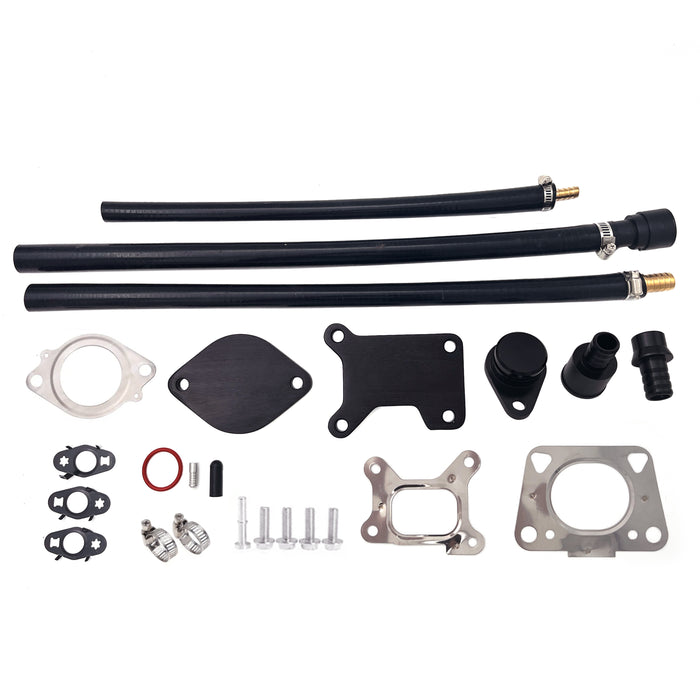
- Full delete, not a block-only plate. It removes the bulky EGR valve and cooler assembly entirely — no leaving a half-disabled cooler in place as a future leak point.
- 6061-T6 billet aluminum block-off plates with stainless steel hardware. Aluminum doesn’t warp under exhaust-gas thermal cycling the way thin stamped steel does — and a warped plate means an exhaust leak.
- Restores clean airflow. Blocking the recirculation loop keeps the sticky soot-and-carbon sludge out of the intake manifold and valves.
- Fits 2017–2023 Silverado/Sierra 2500HD and 3500HD. Does not fit Cab & Chassis.
One thing the product page says that needs the honest qualifier: the “noticeable fuel economy increase” comes from the tune you pair with it, not from the plates themselves. Budget the ECM tune ($800–$1,400) separately — it’s the real cost of this job.
A Full Delete Is More Reliable — but the Risk Is Higher
If you’ve already decided to remove the EGR, there’s a strong case for going further and deleting the entire emissions stack — DPF, EGR, and CCV together — rather than stopping at the EGR alone.
Why Full Deletion Is the More Reliable Path
-
It removes every emissions failure point, not just one. An EGR-only delete solves the cooler and carbon-fouling problem, but the DPF still regenerates, the DEF system still has a heater and injector that fail in cold weather, and the CCV still feeds oil vapor into the intake. A full delete eliminates all of them in a single job.
-
One tune, one teardown. The L5P’s locked ECM is the most expensive line item — paying for a second tune and a second install later is poor economics. The intake and exhaust both require the Y-bridge off and turbo access; doing it once is far cheaper than doing it twice.
-
Cleaner air in, freer exhaust out. With the EGR gone and the restrictive factory downpipe and DPF replaced, the engine runs cooler and cleaner across the board — lower EGTs under load, no regen heat spikes, no soot being pumped back through the intake.
-
The math tips in your favor the longer you keep the truck. A full delete is a bigger upfront spend, but it removes the systems that produce the most owner frustration and the most recurring repair bills on a high-mileage, hard-worked L5P.
But the Risk Is Real, and It’s Not Small
Full deletion is not a free lunch, and pretending otherwise would be dishonest:
-
It’s federally illegal on public roads. Removing emissions equipment from a street-driven truck violates the Clean Air Act. Fines start around $5,000 per violation for individuals; shops face six-figure penalties. This is the single biggest reason to think hard before committing.
-
Your warranty is gone. Any failure a dealer can tie to the modification — and dealers can read the ECM flash history — will not be covered.
-
Resale and trade-in take a hit. Dealers won’t take a deleted truck, and informed private buyers discount it for the legal liability they’re inheriting.
-
Tuning support is a moving target. U.S.-based delete tuners are being fined and shut down at an accelerating rate. If your tuner disappears, you’re left without updates or troubleshooting. A full L5P delete runs $6,000–$7,000 all-in, and there’s no guarantee of ongoing support.
-
Emissions-testing states will fail you. Any state with visual or OBD diesel emissions checks means a deleted truck can’t be registered or inspected.
Match the Decision to Your Situation
There’s no universal answer — only the one that fits how you actually use the truck:
-
Genuinely off-road, competition, or private-land only → full deletion is the most reliable path, and the legal question largely disappears. Delete everything.
-
Street-driven, especially in an emissions-testing state → the legal risk is too high. Keep it intact and maintain it, or you’re betting your registration and resale value on not getting caught.
-
Selling within 3–4 years → a full delete’s reliability benefit won’t outrun the resale penalty and the $6,000–$7,000 upfront cost.
-
Keeping it long-term and working it hard → a full delete pays for itself in avoided repair bills and fewer regen/DEF headaches — if you can tolerate the legal and warranty exposure.
If L5P full delete kit fits your situation, the complete kit is the cleanest way to do it in one job — DPF, CCV, and EGR delete plus a high-flow downpipe and the CAN bus plugs the L5P requires
The Install, Step by Step
A competent DIY mechanic can do this in 4–6 hours; budget a full weekend if it’s your first L5P deep-dive. The Y-bridge must come off for access, which means moving the AC compressor, throttle body, intercooler piping, and multiple harnesses.
Tools You’ll Need
- 10mm, 13mm, and 15mm sockets, plus a 1/4" and 1/2" torque wrench
- Universal swivel joints and extra-long extensions (for the firewall-side bolts)
- Flathead screwdriver, pry bar, hose clamp pliers
- Clean coolant drain pan and fresh 50/50 Dex-Cool coolant
- Shop rags (you’ll be covering open intake ports)
Step 0: Tune First
Flash the delete calibration into the ECM before you remove any hardware. Removing the EGR without a supporting tune triggers fault codes, a check engine light, and limp mode. On 2020+ trucks, confirm your tuner supports your exact ECM version before you order hardware.
Step 1: Drain and Access
- Disconnect the negative cables from both batteries.
- Remove the passenger-side inner fender liner.
- Drain the coolant from the radiator petcock at the lower passenger-side corner. Note: the coolant reservoir cap is reverse-threaded — leave it on at first so the coolant drains slower.
- Pull the airbox and intake tube to clear the top passenger side.
Step 2: Clear the Top of the Engine
- Remove the EGR hot-side pipe (six 13mm bolts) and its heat shield.
- Pull the turbo intake horn (two 13mm bolts — use a swivel socket and long extension) and unclip the PCV hose.
- Disconnect the harness and clips on the Y-bridge, release the belt tensioner, and remove the AC compressor bracket.
- Unbolt the AC compressor (four 15mm bolts) and slide it forward toward the fan shroud — you do not disconnect the refrigerant lines.
- Remove the eight 10mm bolts holding the Y-bridge. Cover the open intake ports immediately with shop rags so nothing drops in.
Step 3: Remove the EGR Valve and Cooler
- Remove the short hot-side pipe (four 13mm bolts) and its heat shield.
- Disconnect the coolant hoses at the upper EGR valve.
- Remove the lower EGR valve (four 13mm bolts/nuts) from the exhaust manifold.
- Remove the large steel coolant pipes from the thermostat housing to the cooler (four 10mm bolts + one 13mm bolt + spring clamps).
- Remove the five 13mm bolts holding the EGR cooler and lift the assembly out.
Step 4: Install the Block-Off Plates and Coolant Reroute
- Line up the exhaust manifold block-off plate using the factory bolts and torque to 25 ft-lbs for a leak-free seal.
- Run the coolant reroute hose across the bypass ports to bridge the circuit the cooler left open. Secure with the supplied clamps.
- Plug any unused sensor or vacuum ports with the supplied billet plugs (grease the O-ring first).
Step 5: Reassemble and Burp
- Reinstall the Y-bridge (torque to 89 in-lbs), turbo, serpentine belt, intake horn, PCV hose, and airbox.
- Refill coolant. Leave the cap off, start the engine, and let it idle while air pockets bubble out. Top off as it reaches operating temperature.
- Recheck the coolant level after a few heat cycles — it’s normal to top off once or twice.
Where DIY Installers Get It Wrong
The #1 post-delete problem across Duramax platforms isn’t a bad plate — it’s a Y-bridge that wasn’t seated properly, and it shows up as a hissing noise under load.
-
The hiss is usually the Y-bridge, not the block-off plates. Under the Y-bridge, where it mates to the up-pipe, sits a large O-ring. If the up-pipe bolts aren’t torqued properly — or the assembly was pulled into alignment with bolt tension instead of seated by hand — that O-ring doesn’t seal.
-
Seat it by hand first. Push the Y-bridge and up-pipe together until they seat fully before tightening any bolts. The bolts hold the seal; they don’t pull parts into alignment.
-
Wiggle-test it. After torquing, grab the up-pipe and try to move it. Any movement means the O-ring isn’t sealed and you’ll be pulling it apart again.
-
The coolant system needs a real burp. The EGR cooler holds meaningful coolant volume. Run the engine with the cap off, heater on full, until the thermostat opens and the level stabilizes — air pockets here cause overheating complaints no exhaust part will fix.
-
Clean the MAP sensors. If you’re not replacing them, clean them thoroughly before reinstalling. A contaminated MAP sensor feeds bad data to the ECM, and on a tuned truck that’s a recipe for drivability problems.
The Legal Reality
Be clear about this before you spend a dollar: deleting an EGR system is not legal for street use. Under the federal Clean Air Act (42 U.S.C. § 7522), removing or disabling emissions equipment on a road-driven vehicle is a violation. Fines start around $5,000 per violation for individuals, and shops face far larger penalties.
The practical consequences matter:
- Warranty is gone for anything the dealer can tie to the modification.
- Emissions-testing states will fail you at inspection, and some are adding visual checks for diesel emissions hardware.
- Resale and trade-in take a hit — dealers won’t take a deleted truck, and informed buyers discount it.
- Keep your stock parts. If you ever sell, trade, move to a testing state, or return to stock, you’ll need the factory EGR and cooler — and they’re not cheap to replace.
These parts are for off-road, competition, and private-land use only. Check your local laws before turning a wrench.
Get the Right Fix for Your L5P
Whether you delete or repair, the decision should come from your actual situation — how long you’re keeping the truck, whether you tow, and where you live — not from diesel folklore.
If a $2,500 cooler repair that’s likely to repeat doesn’t make sense for your truck, the TruckTok 2017–2023 L5P EGR Valve & Cooler Delete Kit removes the failure point once, with billet block-off plates and a full valve-and-cooler delete — just remember the ECM tune is the real cost of the job, and it’s for off-road use only.
Related Blogs:
-
L5P vs LML Duramax Delete: Which Platform Costs More
- L5P Duramax Delete Install: The ECM Unlock You Can’t Skip
- Is Deleting L5P Duramax DPF, EGR and CCV Worth It? The Ultimate Kit Guide
- L5P Duramax Delete Guide: EGR Kit, 3.5" Downpipe & CAN Plugs
Frequently Asked Questions
Q1: Does the L5P really need an EGR delete, or is that forum hype?
Less urgently than older Duramax trucks. The L5P’s EGR system is more reliable — catastrophic early cooler failures are rare. But carbon fouling is real and universal, starting from day one. Whether deleting is worth it depends on your ownership timeline and willingness to do induction cleaning as maintenance.
Q2: Can I just unplug the EGR valve instead of deleting it? No — that’s the worst compromise. Without a tune you’ll trigger a check engine light and likely limp mode. Even with a tune, exhaust backpressure can force the valve open under high boost, and the cooler stays in place as a failure point. If you’re tuning anyway, install the block-off plates and remove the hardware.
Q3: Will an EGR delete improve my L5P’s fuel economy?
Only with a proper tune — the delete itself doesn’t change MPG. A quality tune typically delivers 1–3 MPG by optimizing injection timing and boost for cooler intake air. An improperly tuned truck can burn more fuel than stock. The tune quality determines the result.
Q4: Why is a full delete often recommended over an EGR-only delete?
Three reasons. First, tuning the locked ECM is the most expensive step, and paying for it twice is poor economics. Second, the DPF/DEF/SCR system causes most L5P owner frustration. Third, the aftermarket has consolidated around full solutions because one tune plus one install beats piecemeal work.
Q5: Does the CP4 fuel pump factor into this decision?
Indirectly. The L5P uses the CP4.2 pump — failure rates are lower than the LML, but a CP4 failure can still destroy the entire fuel system for $10,000+. It’s a separate concern from the EGR, but worth knowing about before you invest in any emissions modification.
Q6: Is deleting my L5P’s EGR legal?
For off-road and competition use only. Under the Clean Air Act, tampering with emissions equipment on street vehicles is a federal violation, with fines starting around $5,000 per violation for individuals. States with diesel emissions testing enforce this at inspection. Check your local regulations before purchasing.
Q7: How much cheaper is a delete than a cooler repair?
In hardware, much cheaper — $132 for a block-off kit versus $800–$1,500 for an OEM cooler. But the L5P’s ECM tune ($800–$1,400) closes most of the gap, bringing a delete to roughly $1,330–$2,600 all-in. The real savings come over years, since a delete doesn’t repeat the way a cooler replacement can.
Q8: Do I need to upgrade the downpipe at the same time?
Not required, but recommended. The EGR delete cleans the intake side, but the factory downpipe — which necks down to feed the DOC — remains an exhaust restriction. Doing both in one job shares the labor, since both need the Y-bridge off and turbo access.
Q9: What’s the most common mistake after an EGR delete?
A Y-bridge that wasn’t seated properly, showing up as a hissing noise and boost loss under load. The fix is seating it by hand until it bottoms out before tightening, then wiggle-testing the up-pipe for movement. A loose O-ring there is the #1 source of post-delete boost leaks.
Q10: How long does the install take?
Four to six hours for an experienced DIY mechanic, a full weekend if it’s your first L5P deep-dive. The Y-bridge removal — which means moving the AC compressor, throttle body, and intercooler piping — is the bulk of the time.