

Home > News > L5P Duramax Delete Install: The ECM Unlock You Can’t Skip



L5P Duramax Delete Install: The ECM Unlock You Can’t Skip
The first step in an L5P Duramax delete isn’t the DPF — it’s unlocking the ECM. General Motors locked the L5P’s E41 and E42 control modules at the factory, and skipping the unlock to bolt on hardware first is the single most reliable way to strand a truck in limp mode with a wall of codes. This guide walks the three ECM generations, the tune-first sequence, and the CAN bus plugs that finish the job.
For off-road / competition use only. Not legal for on-road use in emissions-regulated areas. Check your local, state, and federal laws before modifying any emissions-related component.
Why the ECM Is the First Thing You Touch
The L5P is not a “bolt on a pipe and drive” platform. Every emissions system on the 6.6L Duramax — DPF, DOC, SCR, DEF injection, and EGR — is monitored in closed loop by the ECM through NOx sensors, EGT probes, differential-pressure sensors, and DEF-quality sensors. Pull the hardware without a matching calibration and the ECM sets a cascade of diagnostic trouble codes, then derates the truck within miles.
That’s why the unlock is the gatekeeper:
You cannot flash a delete tune until the ECM is unlocked, and you cannot safely remove hardware until the delete tune is in. The unlock isn’t an optional step you can work around — it’s the first link in the chain.
The Three ECM Generations: Know Which One You Have
The L5P spans 2017–2025 across two physically different control modules, and the unlock path changes completely between them. Matching your year to the right path is the difference between a clean afternoon and a truck that sits for two weeks.
| Generation | ECM | Unlock path | Tune credits | SOTF tuning | CAN bus plugs |
|---|---|---|---|---|---|
| 2017–2019 | E41 | OBD unlock via fuse 57 | 6 (4 ECM + 2 TCM) | 5 levels (0/50/75/100/150 hp) | Required |
| 2020–2023 | E41 | OBD unlock via fuse 78 | 6 (4 ECM + 2 TCM) | 5 levels (0/50/75/100/150 hp) | Required |
| 2024–2025 | E42 | Ship ECM to HP Tuners (bench unlock) | 8 | Single calibration only | Not available |
The 2024–2025 E42 is the curveball. GM moved to tighter encryption that no OBD device can crack in place — the ECM has to come out of the truck and go to HP Tuners. That’s a hard two-week downtime commitment, and it’s the single biggest reason a 2024+ L5P delete costs and stalls more than an earlier one.
How the E41 Unlock Works (2017–2023)
For the majority of L5P trucks, the unlock happens in the driveway with an unlock cable, an HP Tuners device (the MPVI family), and a Windows laptop. The sequence is the same whether you’re on a 2017 or a 2023 — only the fuse you tap changes.
Find the Fuse First
- 2017–2019 trucks use fuse 57, a three-blade TCM/ECM fuse. The unlock cable’s red blade goes in the middle position, white toward the firewall.
- 2020–2023 trucks use fuse 78, a 15-amp ECM fuse. On these, the red blade runs toward the engine bay and white toward the fender.
Getting this backwards means the unlock cable never talks to the ECM. It’s the most common “it won’t read my truck” mistake on the E41.
Read the Stock File Before You Write Anything
With the unlock box and MPVI device connected, open VCM Editor (the beta build for L5P), select read entire for the ECM, and — critically — do not read the TCM. Save the stock read plus the info log before anything else. That stock file is your only path back if a flash goes wrong, and it’s what a custom tuner builds from.
Flash, Then Clear
The delete tune itself flashes in five to ten minutes. Keep a battery charger on the truck and the laptop the whole time — a voltage dip mid-flash is how ECMs get bricked. Once written, fire up VCM Scanner, read the DTCs, and clear the legacy codes left over from the swap. Shift-on-the-fly levels are triggered through the cruise-control cancel button, with the current level shown on the tach or glow-plug light.
The E42 Path: Your Truck Sits for Two Weeks
If you own a 2024–2025 L5P, the unlock is a physical process, and it has no shortcut.
Removing the ECM
The ECM lives behind the driver-side front fender liner. Disconnect both negative battery terminals and give it about 15 minutes to discharge, then pull the fender liner (six T10 Torx screws plus a plastic push pin). The ECM is held by four bolts — the two at the back are the awkward ones, and a swivel socket is what gets them out without stripping the heads.
The connectors are the delicate part: push the red locking tab up, then press the black release button and the plug slides free. Work slow, and if there’s grime in the terminals, blow it out with compressed air rather than forcing anything.
The Shipping Rules That Catch People
HP Tuners only accepts your original ECM — a spare or a junkyard unit gets sent back. The red lines on the shipping instructions exist because people miss them every time:
- Fill in the VIN on the attached PDF and put it in the box.
- Write your order number on the outside of the box.
- ECMs with broken tabs or connectors are rejected. Double-wrap in bubble wrap and pad the sides.
Processing is three to five business days once it arrives. Door-to-door, most owners see about 11 days of downtime, so plan two weeks and line up a second vehicle.
The Golden Rule: Tune First, Then Unbolt
Real Experience Tells Us:
One 2024 AT4 owner, waiting on his ECM to come back from HP Tuners, decided to “save time” by pulling the factory exhaust and starting on the EGR and downpipe while he waited. When the tuned ECM arrived, he had to put the factory exhaust back under the truck to plug the sensors in — the truck was already throwing a check-engine light and service-emissions warning because nothing was flashed yet.
The Rule Is Simple:
Do not remove anything until the unlocked ECM is back in the truck and the tune file is flashed. The vendor’s own instruction is to hold off on the entire teardown until that moment. Getting this backwards doesn’t just waste an afternoon — it creates rework, extra codes, and a truck that won’t run until everything is reconnected and re-flashed in the correct order.
CAN Bus Plugs: The L5P’s Other Can’t-Skip
The L5P is the only Duramax generation that needs a CAN bus plug kit, and it’s a hard requirement on 2017–2023 trucks. When the NOx and DEF sensors come out, their spots on the J1939 network go dark — and the ECM flags the missing modules as communication faults. The plugs terminate those network branches so the truck doesn’t drown in ghost codes.
There are four plugs, and their placement is specific:
- Inside the frame rail, toward the rear — the first NOx sensor connector.
- Outside the frame rail — the second NOx sensor.
- Under the hood, driver-side, along the firewall — the third.
- Under the truck, opposite the DEF tank — the DEF tank plug.
The black plugs are interchangeable across the NOx positions; only the DEF plug is keyed differently. A dab of dielectric grease on each connector keeps water and road salt out of the open terminals — the exact failure that leaves a deleted truck with corroded, shorted sensor wiring six months later.
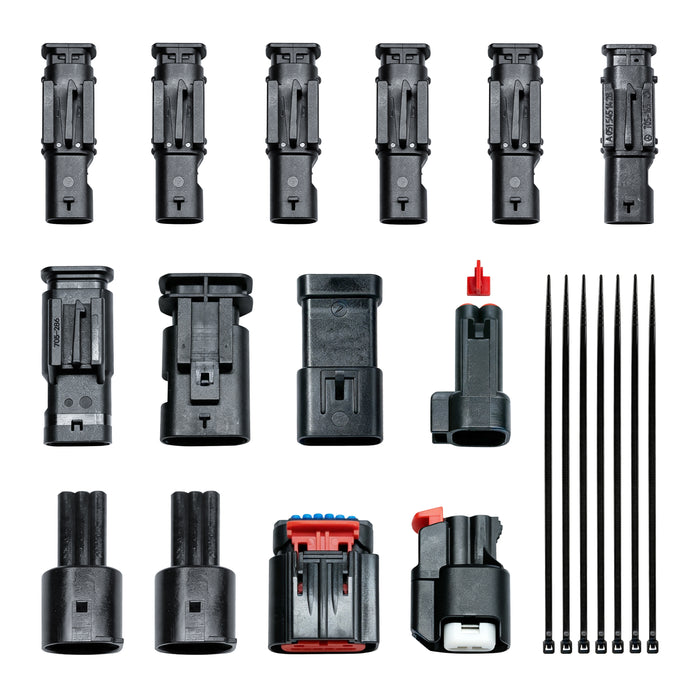
The 2017–2023 L5P Tuner Harness Plug Kit is the companion piece here. It’s a set of passive, weatherproof caps — no resistors, no electronics — that seal the disconnected sensor terminals against water, mud, salt, and high-pressure washes. They’re keyed to the L5P’s specific connector geometry, so a plug only seats into its correct factory mate.
The Full Install: Step by Step
With the unlock and the network plugs explained, here’s the whole job in order. The sequence matters — every step below assumes the one before it is done, and skipping ahead is where installs go wrong.
Tools You’ll Need
- 10mm and 13mm sockets with a 3/8 ratchet — the EGR and exhaust hardware is almost all these two sizes.
- An 18-inch 1/2-inch-drive extension and an 11/16 deep well — slipped over the ratchet handle, this is the leverage trick that breaks the top EGR bolts loose.
- Swivel socket — for the rear ECM bolts (E42 removal) and the tight firewall fasteners.
- T10 Torx bit and a drill — the fender liner screws come out by hand first so you don’t strip the heads.
- Torque wrench — the EGR block-off plate wants 25 ft-lbs, and guessing is how bolts snap.
- Battery charger — non-negotiable during the flash; a voltage dip mid-write bricks the ECM.
- Drain pan and coolant, plus dielectric grease and penetrating oil.
Step 0: Unlock and Flash the Tune First
Everything else waits on this. On 2017–2023, tap the correct fuse (57 or 78), read the stock file, write the delete tune, and clear the legacy codes — all before a single bolt comes off. On 2024–2025, ship the ECM to HP Tuners, get it back unlocked, and flash the single calibration. Only when the truck runs clean on the flashed tune do you touch hardware.
Step 1: Disconnect and Drain
Disconnect both negative battery terminals and let the system discharge. Drain the coolant from the radiator so the EGR cooler doesn’t dump it everywhere when it comes out. Give the exhaust fasteners a soak in penetrating oil now — the heat-cycled bolts at the top of the EGR pipe are the ones that fight back later.
Step 2: Remove the EGR System
- Pull the EGR heat shield (two 10mm bolts).
- Remove the EGR pipe — six bolts total, with the last two on the top side tucked hard against the firewall at 13mm.
- The top two are the hard ones. Get a 3/8 ratchet with a 13mm socket in there, then slide the 18-inch extension and 11/16 deep well over the handle for leverage. Work it loose slowly rather than snapping it.
- Do this cold. The engine bay is brutal when warm — let the truck sit if you can.
- Bolt the block-off plate to the Y-bridge at 25 ft-lbs, reusing two of the stock bolts and two of the new supplied bolts. Even, gradual torque — not one corner cranked down first.
Step 3: Drop the Aftertreatment
Remove the DPF/SCR assembly. On 2024+ trucks this is the aggravating part — the factory exhaust is double-walled and doesn’t slide out in one piece. Cut it in two places (behind the SCR and behind the DPF), remove the exhaust hanger bracket at the side of the transmission, and jack the cab up a few inches on the passenger side to clear the downpipe behind the turbo. A sawzall with a long blade plus a side grinder to work the weld seams gets it done.
Step 4: Install the Downpipe and Delete Pipe
Bolt in the high-flow downpipe, then the delete pipe that replaces the DPF/SCR section. If you ordered a downpipe-back system, follow the front-to-back sequence and leave clamps loose until everything is aligned, then tighten from the turbo back.
Step 5: Install the CAN Bus Plugs and Harness Caps
On 2017–2023, seat the four CAN bus plugs (two NOx on the frame rails, one on the driver-side firewall, one opposite the DEF tank) with a dab of dielectric grease on each. Cap every other disconnected sensor terminal with the harness plug kit so the wiring doesn’t corrode.
Step 6: Refill, Burp, and Road Test
Refill the coolant, bleed any air from the system, and start the truck. Watch for codes on the first key-on before driving. Once it runs clean, take it through a short drive, re-check for leaks at the block-off plate and exhaust joints, and re-scan for any lingering DTCs.
Where Installers Get It Wrong
These are the specific ways an L5P delete goes sideways — and each one is avoidable if you know it’s coming.
- Pulling hardware before the tune is flashed. The most expensive mistake, and the one the 2024 AT4 owner proved firsthand: remove the exhaust early and you’ll be reinstalling it to plug sensors back in. Nothing comes off until the flashed tune is in and the truck runs clean.
- Flashing without a charger. A voltage dip mid-write is how ECMs get bricked. Charger on the truck and the laptop, every time.
- Reversing the unlock cable blades. On the E41, the red and white blade positions are year-specific (fuse 57 vs fuse 78), and getting them backwards is the #1 “it won’t read my truck” complaint. Check your exact year.
- Mis-keying or skipping a CAN bus plug. Leave one network branch open and the ECM floods with communication codes. The black plugs are interchangeable across NOx positions, but the DEF plug is keyed — don’t force it.
- Fighting the top EGR bolts without leverage. They’ll snap if you muscle them. The extension-and-deep-well trick over the ratchet handle is what gets them out clean.
- Working the engine bay hot. The EGR pipe is brutal when warm. Let the truck cool first.
- Over-torquing the block-off plate. 25 ft-lbs, even and gradual. Crank one corner first and the plate lifts, gasket leaks, and the bolt’s next stop is snapped.
- Leaving sensor terminals bare. The delete removes the sensors but not the wiring. Unprotected terminals corrode and short within months — the harness caps are cheap insurance, not a upsell.
The Products: The Three Pieces That Complete the Unlock
An L5P delete install is really three purchases, and they map directly to the steps above.
The Tune File (The Software)
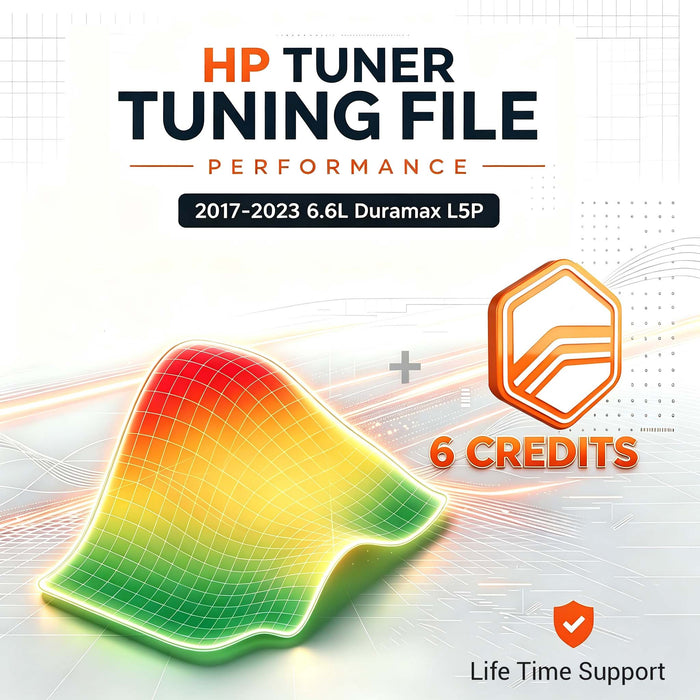
The HP Tuner Tuning File + 6 Credits for 2017–2023 L5P is the digital half of the job — the piece that actually disables DPF, EGR, and SCR and prevents forced speed-limitation. The six Universal Credits are pre-loaded (four to license the E41 ECM, two for the TCM), so you skip the separate licensing step. It’s a Windows-PC-only process: read the stock file, email it in, and the custom calibration comes back within a day, with the final flash taking about 30 minutes. Transmission tuning is a separate add-on — worth remembering if you’re planning real power.
The Delete Kit (The Hardware)
The L5P DPF/CCV/EGR Delete & Downpipe w/Can Bus kit is the mechanical side, and it’s modular for a reason: you pick the intake-side delete (EGR, CCV, both, or neither), the exhaust coverage (4" race pipe, 4" or 5" downpipe-back), whether you want a muffler, and which CAN bus plug set your year needs. A complete EGR + CCV + 4" race pipe + downpipe + plugs build lands right around $950; stepping up to a full 5" downpipe-back with muffler and the 2020–2023 plugs tops out near $1,530. The key is matching the CAN bus plug option to your exact year — 2017–2019 and 2020–2023 use different plug sets.
The Harness Plugs (The Protection)
Covered above, the harness plug kit seals the disconnected terminals so the delete doesn’t rot your wiring harness out from under you.
The Legal Reality (Read This Before You Commit)
Removing or disabling emissions equipment on a road-driven vehicle violates the federal Clean Air Act (42 U.S.C. § 7522), with individual fines up to $5,911 and no exemption for off-road or competition labeling. Warranty coverage on the powertrain is gone, and a deleted truck is a liability at resale and inspection. Everything in this guide applies to off-road, race, and competition use only — check your state’s rules before you touch a wrench.
For off-road / competition use only. Not legal for on-road use in emissions-regulated areas. Check your local, state, and federal laws before modifying any emissions-related component.
Conclusion: Get the Right Kit for Your L5P
The unlock is the part nobody budgets for and everybody has to do — so get it right the first time. Match your year to the correct ECM path (E41 fuse 57/78 versus E42 bench unlock), flash the tune before a single bolt comes off, and finish the job with the CAN bus plugs and harness caps that keep the wiring alive. The three pieces above — tuning file, delete kit, and harness plugs — cover the software, the hardware, and the protection in one pass.
Trucktok specializes in high-quality upgrades for pickup trucks. If you have any further questions, you can browse our product range and blog:
- Is Deleting L5P Duramax DPF, EGR and CCV Worth It? The Ultimate Kit Guide
- L5P DPF & CAT Race Pipe vs Full Exhaust Delete — the Honest Comparison
- 2020-2025 Duramax L5P Fuel, Oil and Air Filter Buyer’s Guide (TP1015 / PF26 / A3248C)
Frequently Asked Questions
Q1: Can I skip the ECM unlock and just bolt on the delete hardware?
No. The ECM actively monitors every emissions sensor, and hardware alone trips a cascade of codes and derates the truck within miles. The unlock is the first step, not an optional one.
Q2: What’s the difference between the E41 and E42 ECM?
The E41 (2017–2023) unlocks over OBD through a fuse tap (fuse 57 or 78) with shift-on-the-fly tuning. The E42 (2024–2025) is encrypted tighter and must be shipped to HP Tuners for a bench unlock, with a single calibration and no SOTF.
Q3: Why do I need 6 credits for a 2017–2023 L5P?
GM’s E41 encryption requires four Universal Credits to license the engine ECM and two more for the transmission computer. The six credits are bundled so you don’t have to buy them separately.
Q4: How long does a 2024+ E42 unlock take?
Door-to-door is typically about 11 days — roughly three to five business days of processing once the ECM arrives, plus shipping both ways. Plan two weeks of downtime and a second vehicle.
Q5: Can I ship a spare ECM to HP Tuners instead of my original?
No. HP Tuners only accepts your original ECM, and units with broken tabs or connectors are rejected. Double-wrap it and fill in the VIN on the attached PDF.
Q6: Do I remove the exhaust before or after the tune?
After. Remove nothing until the unlocked ECM is back in the truck and the tune file is flashed. Pulling hardware early forces you to reinstall it to plug sensors back in and clear the resulting codes.
Q7: Are CAN bus plugs required on every L5P?
They’re required on 2017–2023 trucks to terminate the J1939 network branches where NOx and DEF sensors were removed. 2024–2025 trucks have no plug option, so those sensors stay physically connected.
Q8: Do the harness plugs turn off the check-engine light?
No. The harness plugs are passive caps with no resistors — they seal the terminals against corrosion. Clearing codes and preventing limp mode is the tune’s job, not the plugs’.
Q9: Does deleting add horsepower?
Not by itself. The power comes from the tune. The delete removes failure points and stops regen cycles; the factory bottom end and Allison transmission are the real power ceiling.
Q10: Is an L5P delete legal on the street?
No. Removing emissions equipment on a road-driven vehicle violates the Clean Air Act, carries individual fines up to $5,911, and voids powertrain warranty. It’s off-road, race, or competition use only.