
Home > News > L5P DPF & CAT Race Pipe vs Full Exhaust Delete — the Honest Comparison

L5P DPF & CAT Race Pipe vs Full Exhaust Delete — the Honest Comparison
Ask any L5P Duramax owner what they’d change first, and the answer is almost always the same: the exhaust. The 6.6L L5P is a genuine towing monster — 445 hp and 910 lb-ft from the factory — but it’s carrying a triple-layer emissions stack (DPF + SCR + CAT) bolted right under the cab that robs flow. So the question isn’t whether to open up the exhaust. It’s which route to take — a DPF/CAT race pipe that swaps just the filter blocks and leaves your factory tailpipe alone, or a full downpipe-back exhaust that replaces everything from the downpipe to the tip.
Here’s the honest answer most forums won’t give you straight: the race pipe gets you roughly 80% of the benefit for about a third of the cost. The full system is real — it’s not a scam — but its extra payoff is mostly sound and heat management under sustained load, not a big horsepower jump. Let’s break it down with actual numbers instead of forum speculation.
Why the DPF Is the #1 Bottleneck
To understand why one exhaust path does so much for so little, you have to understand where the restriction actually is.
Why is DPF the biggest obstacle?
The L5P’s diesel particulate filter is a dense ceramic honeycomb designed to trap soot. That’s its job — but it also makes it the single most restrictive component between your turbo and your tailpipe. In real-world terms:
- Cruise backpressure: roughly 3–5 psi
- Heavy-load backpressure: up to 8–10 psi
That backpressure is wasted energy.
Your turbo has to push against it, which raises exhaust gas temperatures, robs spool response, and makes the engine work harder for every horsepower it makes. And unlike a muffler — which adds only mild restriction — the DPF loads up over time, so its backpressure climbs as the miles and ash accumulate.
The factory 3.5" downpipe and the stock muffler behind it? Those are adequate for moderate power levels. They’re not the enemy. The DPF is.
This is why the race pipe wins on value: it removes the one thing that’s actually strangling the engine, and leaves the stuff that was never really hurting it alone.
Two Options, One Goal: What You’re Actually Buying
Now that you know where the restriction lives, here’s exactly what separates these two paths — because a lot of listings blur them together.
Option A — DPF & CAT Delete Race Pipe
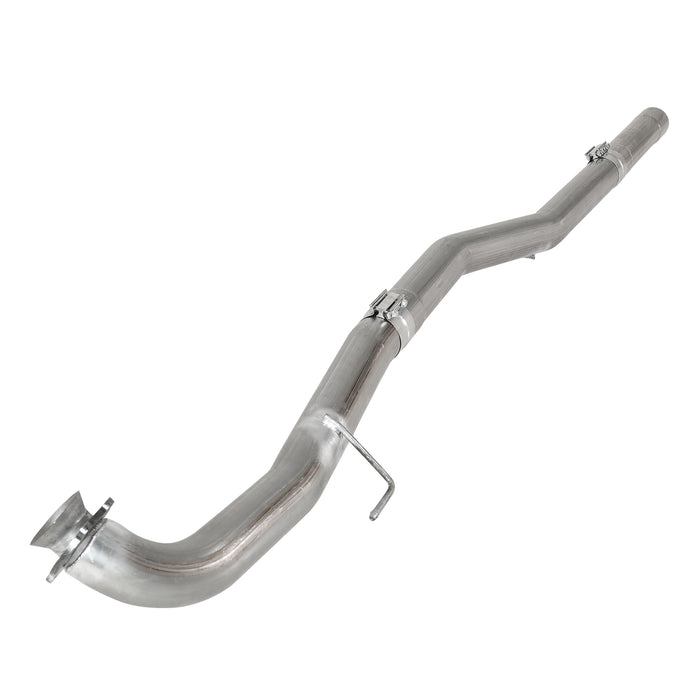
A race pipe replaces only the DPF and CAT filter blocks — the two big ceramic “barrels” under the cab — with a straight section of mandrel-bent tubing. From the race pipe back, your factory intermediate pipe, muffler, and tailpipe all stay in place.
- Eliminates the DPF restriction — the single biggest flow bottleneck in the entire system
- Eliminates CAT backpressure
- Ends regeneration cycles completely
- Factory muffler and tailpipe stay — sound change is moderate, not dramatic
- Installation: 1–2 hours, basic hand tools, direct bolt-in to factory flange positions
Option B — Full Downpipe-Back Exhaust
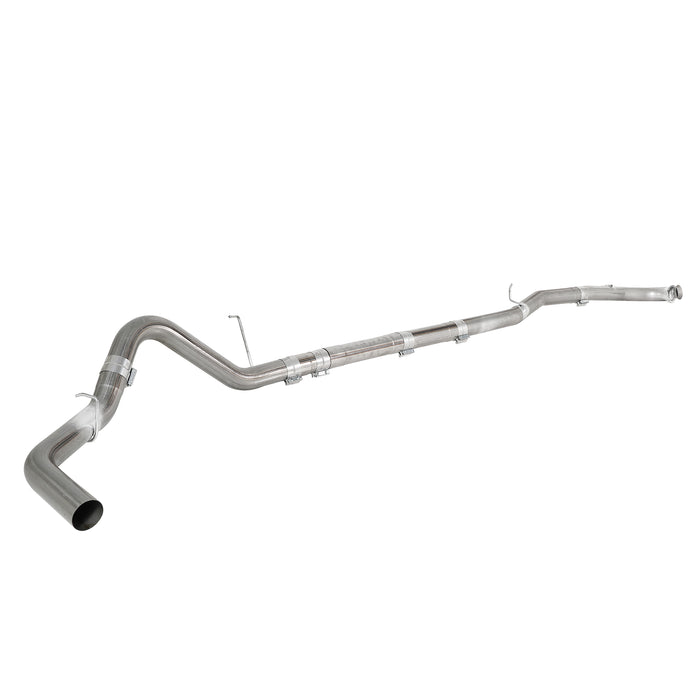
A downpipe-back system replaces everything from the downpipe’s rear flange all the way to the exhaust tip — the DPF, DOC, SCR, factory muffler, and all the stock piping — with larger-diameter 4" or 5" tubing.
- Everything the race pipe does, plus:
- Larger diameter tubing from downpipe to tip (4" or 5" vs the stock 3.5" downpipe)
- Deletes the factory muffler — or swaps in a high-flow performance muffler
- Complete sound transformation — significantly louder, deeper tone
- Additional EGT reduction from backpressure relief across the entire system
- Installation: 3–5 hours, more involved, may require wrestling the full factory assembly out
The short version: a race pipe is a surgical fix. A full system is a replacement. Both delete the DPF; only the full system touches everything behind it.
The Honest Math: Where the Gains Actually Come From
Here’s the part most marketing won’t tell you, laid out plainly.
The Truly Beneficial Data
Deleting the DPF alone removes roughly 70–80% of the total exhaust restriction. That’s where the bulk of your power gain comes from — not from the pipe diameter, not from the muffler, but from getting that ceramic filter out of the airflow path.
The factory tubing behind the DPF is adequate for moderate builds. Going to a 4" or 5" full system reduces flow restriction further, but the gains diminish sharply once the DPF is gone. In real terms:
| Metric | Race Pipe Only | Full Exhaust System |
|---|---|---|
| Parts cost (TruckTok) | $290 | $654 (4") / $715 (5") |
| Installation time | 1–2 hours | 3–5 hours |
| HP gain (with tune) | +40–60 hp | +50–80 hp |
| EGT reduction | 100–150°F | 150–250°F |
| Sound increase | Moderate (stock muffler stays) | Significant (muffler gone or high-flow) |
| Turbo spool improvement | Noticeable | More pronounced |
| Keeps factory look | Yes (tailpipe unchanged) | No (new tip visible) |
Notice the pattern:
The jump from stock to race pipe is dramatic. The jump from race pipe to full system is incremental — real, measurable on a dyno, but an extra 10–20 hp you won’t feel seat-of-the-pants the way you feel the initial delete.
The full system genuinely earns — EGT under sustained load.
If you tow heavy at highway speeds — long grades, a 10k+ lb trailer, high ambient heat — the larger-diameter full system drops exhaust gas temperatures another 100°F or so on top of what the race pipe already did. That’s the difference between towing at a comfortable 800°F and creeping toward 1,300°F where you’re flirting with melted pistons and a shortened turbo. That’s the real reason to go full — not the last few horsepower.
Sound: The Real Reason People Choose Full Systems
Let’s be honest about what’s actually driving a lot of these decisions, because it’s rarely the dyno sheet.
Race Pipe + Factory Exhaust
The factory muffler is surprisingly effective at taming noise. With just the DPF/CAT deleted:
- Idle: noticeably deeper, but still civilized — you’ll hear the turbo whistle more clearly through the exhaust
- Light throttle / cruise: moderate rumble, no drone with the factory muffler intact
- Wide open: loud, but still quieter than a full straight pipe
Best for: daily drivers who want the power and reliability without announcing it to the whole neighborhood.
Full 4" or 5" System
- Idle: deep, authoritative diesel rumble — the larger pipe acts as a resonance chamber, so it’s deeper, not just louder
- Light throttle / cruise: noticeable exhaust note in the cab; highway drone becomes a real variable
- Wide open: this is where a full system earns its reputation — aggressive, prominent turbo whistle, heads turn
The 4" vs 5" Sound Difference Is Tone
- The 4" tends toward a raspier, sharper note with more turbo whistle.
- The 5" gives a deeper, bass-heavy rumble.
Neither is inherently “better” — it’s preference. If drone is a concern, add a quality straight-through muffler or resonator; a straight-through design flows like a straight pipe but takes the edge off the high-frequency rasp.
4-Inch vs 5-Inch: Don’t Overthink It
One of the most common mistakes buyers make is assuming bigger pipe = more power. Here’s the honest truth:
-
For trucks under roughly 600 hp, 4-inch is plenty. The cross-sectional area jump from the stock 3.5" downpipe to 4" is already ~30% more flow area — more than enough for any street, tow, or mild-tune build.
-
5-inch is for sound and for 600+ hp competition builds. It doesn’t add towing torque, it doesn’t magically drop EGTs below what 4" already achieves at moderate power — it gives a deeper tone and maxes out flow headroom for builds chasing big numbers.
There’s also a practical catch:
5" fitment is tighter. The larger tubing is less forgiving around crossmembers, spare tires, and the frame on some cab/bed configurations, and it can rub over time. The 4" system is the safe, sane default for the vast majority of trucks.
Bottom line: pick 4" unless you specifically want the deeper 5" sound or you’re building for real power. For 90% of L5P owners, 4" is the correct answer.
Material: Why T-409 Stainless Is the Smart Default
Exhaust pipes live in a hostile environment — extreme thermal cycling, road salt, moisture, and mud. The material choice is where a lot of cheap kits fall apart.
-
Aluminized steel is the budget option. It’ll work fine in dry climates for a while, but it will surface-rust, and in the salt belt it can rot through in a few years. You’ll be buying the system twice.
-
T-409 stainless (what TruckTok uses on all three of these pipes) is the industrial sweet spot — specifically engineered to expand and contract through intense heat cycles without cracking, warping, or scaling. It resists corrosion far better than aluminized and holds up to road salt.
-
T-304 stainless is the premium step up — even more corrosion resistance — but it costs more and the extra benefit is marginal for most owners unless you live in an aggressive salt environment.
If you plan to keep the truck long-term, stainless is worth it. All three TruckTok pipes here are T-409 mandrel-bent, which is the right default for a truck that actually works for a living.
The One Thing You Can’t Skip: The Tuning
Here’s the non-negotiable rule that applies to every L5P exhaust delete, race pipe or full system alike: the tune comes first, and it’s not optional.
If You Do Not Tune
The L5P’s ECM constantly monitors the DPF through differential-pressure and EGT sensors. Physically remove the filter without a matching tune, and the ECM sees the missing filter, sets fault codes, commands regenerations that can’t complete, and drops the truck into derate/limp mode — sometimes severe enough to crawl home at idle speed.
A proper DPF-off tune tells the ECM the filter is gone, disables regen, and shuts off the related monitors so the truck runs clean and code-free.
The L5P Is One of The Harder Duramax Platforms to Tune
The 2017–2023 trucks run the encrypted E41 ECM, which requires an unlock step (HP Tuners unlock workflow, tune credits, and a tuning device) before any delete calibration can be flashed. This is why the tune is usually the biggest single line item in an L5P delete budget, and why tuning compatibility should drive your buying decision as much as the hardware.
Delete pipe or full system, the rule is identical: tune first, then unbolt. Skip it and you’ve bought yourself a very expensive, very loud lawn ornament that won’t leave first gear.
Know Your Generation: 2017–2023 Fitment
The L5P spans 2017–2023, and fitment isn’t “one size fits all.” Here’s what to confirm before ordering:
-
2017–2019 vs 2020–2023: both run the E41 ECM, but the unlock/tuning workflow differs slightly across the range. The exhaust hardware fitment is consistent, but confirm your tune source matches your exact year.
-
Cab & bed config: these pipes fit Crew Cab, Double Cab, and Regular Cab in Standard or Long Bed. They do NOT fit 3500/4500/5500 Cab & Chassis commercial models — those have different exhaust routing.
-
What stays, what goes: the race pipe replaces the DPF/CAT mid-section and reuses your stock tailpipe. The downpipe-back systems replace everything behind the factory downpipe’s rear flange — but neither replaces the factory turbo downpipe itself. The stock 3.5" downpipe stays in both cases.
Confirm the pipe is listed for your exact year and cab/bed before ordering. A fitment-filtered listing beats a generic “fits 6.6L Duramax” every time.
The Cost Math: Three Paths, Three Price Points
Here’s how the three TruckTok options stack up, apples to apples:
| Path | Price | What It Replaces |
|---|---|---|
| 4" DPF & CAT Race Pipe | $290 | DPF + CAT only (mid-section); stock tailpipe stays |
| 4" Downpipe-Back | $654 | DPF + DOC + SCR + muffler + piping to tip |
| 5" Downpipe-Back | $715 | Same as 4" DP-Back, but 5" diameter |
The math is simple:
-
The race pipe gets you the delete, the flow, and the regen elimination for $290.
-
Stepping up to the 4" downpipe-back more than doubles the price to $654 — and what you’re really buying for that extra $364 is the full exhaust sound, the muffler delete, and roughly another 100°F of EGT headroom under sustained towing.
-
The 5" is another $61 on top of that for the deeper tone and maximum competition flow headroom.
There’s no wrong answer — just the right one for your use case, which we’ll get to next.
1. 2017-2023 6.6L Chevy GMC Duramax L5P 4" DPF & CAT Delete Race Pipe
This is the value play in the lineup. The 4" DPF & CAT Delete Race Pipe strips out the two biggest restrictions for a fraction of the full-system price, leaving your factory tailpipe — and the neighbors’ sleep — intact.
- What it is: a mid-section delete pipe that swaps the bulky DPF and CAT blocks for continuous 4" CNC mandrel-bent T-409 stainless, matched to factory flange positions so it reuses your stock tailpipe.
- Why it’s the value play: it removes the two biggest restrictions in the system for a fraction of the full-system cost. You keep the factory muffler and tailpipe, so the sound stays reasonable.
- Best for: daily drivers, tow rigs on a budget, and anyone who wants the delete benefits without the full-system noise or price tag.
- Fitment: 2017–2023 Silverado/Sierra 2500HD/3500HD (Crew/Double/Regular Cab, Standard/Long Bed). Not for Cab & Chassis.
2017-2023 6.6L GM DURAMAX L5P 4" Downpipe Back DPF Delete Pipe
For the owner who tows heavy and wants the complete package, the 4" Downpipe-Back DPF Delete Pipe replaces everything from the downpipe to the tip, shedding the rusted factory sections and adding real EGT headroom under sustained load.
- What it is: a full downpipe-back overhaul that deletes the DPF, DOC, SCR, and factory muffler, replacing everything to the rear tip with continuous 4" T-409 stainless.
- Why it earns the premium: it drops backpressure to near zero across the entire system and sheds the rusted factory rear sections, with meaningful extra EGT headroom for sustained towing.
- Best for: owners who tow heavy, want the complete package, or simply want the full diesel sound and a clean sweep of the old factory exhaust.
- Fitment: same 2017–2023 2500HD/3500HD range; not for Cab & Chassis.
2017-2023 6.6L GM DURAMAX L5P 5" Downpipe Back DPF Delete Pipe
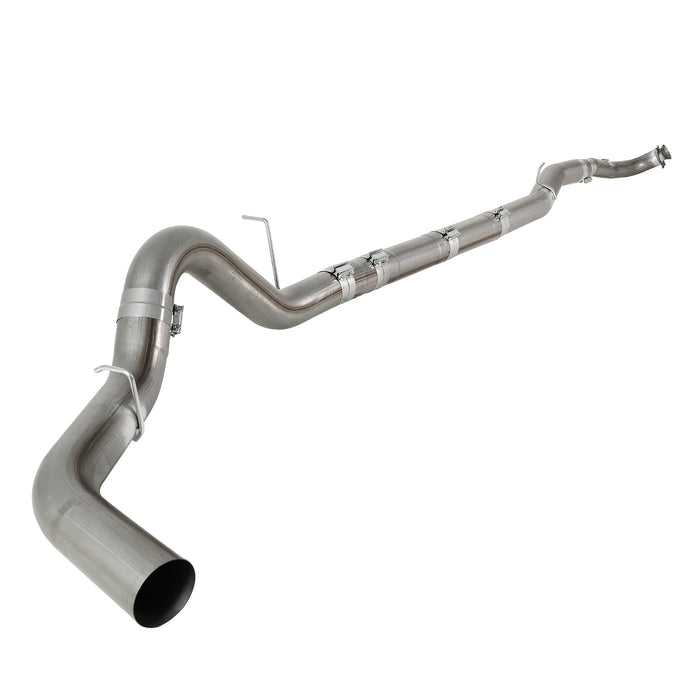
If you’re building for real power or just want the deepest, loudest straight-pipe roar, the 5" Downpipe-Back DPF Delete Pipe is the competition-grade step up.
- What it is: the same full downpipe-back delete, but in 5" competition diameter with a heavy-duty flat-machined 4-bolt flange sealing against the factory turbo output.
- Why go 5": maximum high-RPM flow headroom, the deepest bass-heavy straight-pipe roar, and the most aggressive sound profile of the three.
- Best for: high-horsepower competition builds and owners who want the loudest, deepest tone and are willing to accept the fitment and drone trade-offs.
- Fitment: same 2017–2023 2500HD/3500HD range; not for Cab & Chassis.
All three are built from industrial-grade T-409 stainless, mandrel-bent with zero internal neck-downs or restrictive bungs, and engineered specifically for the L5P’s unique under-cab emissions packaging.
Installation: A Step-by-Step Walkthrough
Whether you’re dropping in the race pipe or the full downpipe-back system, the process follows the same sequence. Here’s the full walkthrough, with the tool list and the gotchas you’ll actually hit on a real L5P.
Tools You’ll Need
- Floor jack and jack stands — never work under a truck supported only by a jack
- Socket set with 10mm, 13mm, 15mm and a 1/2" drive breaker bar
- V-band clamp pliers or a pry bar for stubborn clamps
- Penetrating oil (PB Blaster or similar) — applied the night before
- Torque wrench
- Ratchet strap — the DPF/CAT assembly is heavy and fights you on the hangers
- Catch pan and shop rags
- Marker or tape + a phone camera for labeling connectors
Step 0: Flash the Tune First
This is the one rule you cannot skip, and it comes before any wrench touches a bolt.
- Flash the DPF-off tune first, while the truck is complete and running normally.
- Confirm the calibration matches your exact model year and ECM.
- Let the flash finish completely and verify no pending codes before you unbolt anything.
Step 1: Prep the Truck
- Park on level ground, set the parking brake, and let the exhaust cool completely — the aftertreatment assembly holds heat long after shutdown and will burn you.
- Disconnect both batteries before touching any sensor or electrical connector.
- Lift the truck and support it on jack stands. You’ll be working under the cab where the DPF/DOC/SCR stack lives.
- Spray every flange bolt, clamp, and hanger with penetrating oil and let it soak while you gather the rest of the tools.
Step 2: Label and Disconnect the Sensors
The L5P scatters EGT probes, NOx sensors, and differential-pressure sensors through the exhaust. This is where jobs go sideways:
- Photograph every connector before you unplug it, and label each one with tape — “front NOx,” “rear EGT,” “DPF delta-P,” etc.
- Carefully unclip each connector. Don’t yank the wires — the sensor ends are fragile and expensive to replace.
- Set the labeled connectors aside where they won’t get crushed when the heavy assembly comes down.
Step 3: Drop the DPF/CAT Assembly
- Locate the connection points — the downpipe-to-DPF flange and the DPF-to-midpipe connection — plus the exhaust hangers.
- Support the assembly with a ratchet strap or a second set of hands before you unbolt anything. The DPF/DOC stack is heavy, and a dropped filter takes out a sensor or a wiring harness on the way down.
- Loosen the clamps and flange bolts, then work the assembly free of its hangers. On a rust-belt truck, the hangers will fight you — a pry bar and patience beat brute force here.
- Guide the assembly out and set it aside.
Step 4: Fit the New Pipe
This is where the two paths diverge slightly:
- Race pipe: the race pipe is a direct bolt-in at the factory flange positions. Test-fit it, confirm the flanges line up and the pipe clears the frame and crossmembers, then align it before tightening. For a full photo-by-photo walkthrough, follow the TruckTok Forum race pipe install thread.
- Downpipe-back (4" / 5"): you’re working front to back. Hang the new sections loosely first, get the alignment right, then tighten clamps from front to back so everything seats square. The complete step-by-step for the 4" and 5" systems is in the TruckTok Forum downpipe-back install thread.
- Tighten flanges and V-band clamps to the factory torque spec — snug and even, not gorilla-tight, or you’ll crush the gasket and spring a leak.
Step 5: Reconnect, Recheck, and Road-Test
- Reconnect every sensor you labeled, matching each connector to its original position.
- Do a visual pass for anything rubbing, pinched, or left loose.
- Reconnect the batteries and start the truck. Idle it and listen — a hiss or a tick near a flange means a leak that needs a reseat.
- Check for exhaust leaks at every joint before you take it on the road, then do a short drive to confirm no codes and no derate.
Where DIY Installers Get It Wrong
- Skipping the tune — the single most common mistake, and it turns a delete into a derate. Tune first, always.
- Dropping the DPF assembly — it’s heavier than it looks. Support it before the last bolt comes out.
- Crushing a sensor connector — the fragile NOx and EGT probes are the first casualty when the assembly shifts.
- Overtightening the V-band clamp — crush the gasket and you’ll chase a leak you can’t find.
- Forgetting to label connectors — a mismatched NOx sensor is a ghost code that’ll eat your weekend.
The Legal Reality (Read This Before You Commit)
Let’s be direct: removing or tampering with emissions equipment on a street-driven truck is illegal in the U.S.
The Clean Air Act — 42 U.S.C. § 7522(a)(3) — makes it unlawful to remove or render inoperative any emissions-control device on a vehicle used on public roads, and prohibits the manufacture, sale, or installation of defeat devices. The EPA’s implementing regulations reinforce this. Individual penalties can reach several thousand dollars, and commercial cases can run far higher.
These parts are sold strictly for off-road, race, and competition use. A deleted truck will fail visual and OBD-II emissions inspections in states that run them, and a deleted L5P may not be registerable or resalable in those markets. GM can also deny powertrain warranty claims on a modified truck.
Conclusion
The L5P Duramax is an exceptional engine held back by an over-engineered emissions stack. Deleting that stack — race pipe or full system — restores the flow, ends the regen cycle, drops EGTs, and eliminates the fragile DEF/NOx hardware that’s most likely to leave you stranded in a 55-mph limp mode.
The decision between the two paths is genuinely simple once you’re honest about your priorities:
- Want the delete benefits at the lowest cost, with a sane sound level? The 4" DPF & CAT Race Pipe ($290) is 80% of the payoff for a third of the price.
- Tow heavy and want maximum EGT headroom, or want the full diesel sound and a clean sweep of the factory exhaust? The 4" Downpipe-Back ($654) is the complete package.
- Chasing big power or the deepest, loudest tone? The 5" Downpipe-Back ($715) is the competition-grade option.
For the full lineup of L5P DPF/CAT race pipes, downpipe-back systems, EGR deletes, and tuning support — all built specifically for the 2017–2023 Silverado and Sierra HD — head to TruckTok.com. Whether you’re deleting for off-road performance or just want your towing monster to breathe again, TruckTok has the right part at the right price.
Frequently Asked Questions
Q1: Can I install a DPF/CAT race pipe and upgrade to a full system later?
A: Yes, and it’s actually a smart staged path for budget buyers. The race pipe replaces the front section, so you can add the downpipe-back portion later without throwing away the race pipe — though you’ll pay for the tune once, so plan ahead.
Q2: Is 4" or 5" better for the L5P?
A: 4" is plenty for trucks under roughly 600 hp and is the sane default for street and tow trucks — good flow, reasonable sound, easier fitment. 5" is for high-horsepower builds and a deeper, louder tone, with tighter fitment trade-offs.
Q3: Does a full exhaust system make more power than a race pipe?
A: Marginally — roughly 10–20 hp extra on top of what the race pipe already delivers, most of it from reduced backpressure across the full system. The DPF is the big restriction; the rest is diminishing returns.
Q4: Do I need a tune for a DPF/CAT delete on the L5P?
A: Absolutely. The L5P ECM monitors the DPF constantly, and removing it without a DPF-off tune triggers fault codes and derate/limp mode. The tune is non-negotiable, and the L5P’s E41 ECM requires an unlock step before flashing.
Q5: Will a race pipe change the sound much?
A: Moderately. With the factory muffler and tailpipe in place, you’ll get a deeper idle and more turbo whistle, but it stays civilized. The full downpipe-back system — with the muffler deleted — is where the sound transformation really happens.
Q6: Do these pipes replace the factory downpipe?
A: No. Both the race pipe and the downpipe-back systems connect behind the factory 3.5" turbo downpipe, which stays in place. An upgraded downpipe is a separate optional add-on if you want the last bit of spool and sound.
Q7: What material should I choose for a long-term truck?
A: Stainless is worth it. T-409 (used on these TruckTok pipes) resists corrosion and thermal cycling far better than aluminized steel, which will surface-rust and eventually rot in salt-belt conditions.
Q8: Will these fit a Cab & Chassis 3500/4500/5500?
A: No. These pipes are built for the 2017–2023 2500HD/3500HD pickup platform (Crew, Double, and Regular Cab in Standard or Long Bed). Cab & Chassis commercial trucks have different exhaust routing and need a different part.
Q9: Is deleting the DPF legal on the street?
A: No. Removing emissions equipment violates the Clean Air Act for on-road vehicles. These parts are for off-road, race, and competition use only — check your local regulations and know your truck’s legal-use status before modifying.
Q10: What’s the single most important thing to get right?
A: The tune. Flash the DPF-off calibration before removing any hardware, and make sure the tuning supports your exact model year and ECM. A correct tune is what turns a delete into a reliable truck instead of a derate-prone problem.