

Home > News > L5P vs LML Duramax Delete: Which Platform Costs More
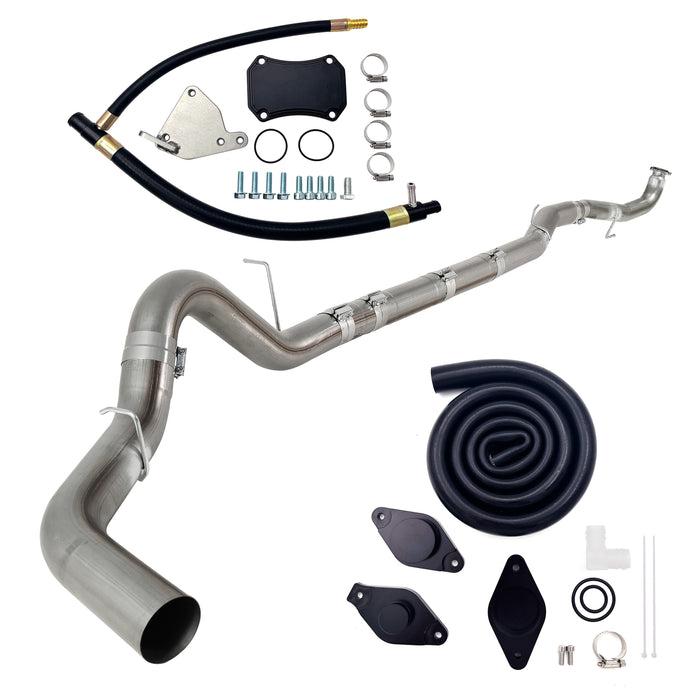


L5P vs LML Duramax Delete: Which Platform Costs More
The L5P costs more to delete — $6,000 to $9,000 all-in versus $2,000 to $3,500 for the LML. But the reason isn’t what most people assume. The two trucks carry nearly the same emissions hardware, and a full LML hardware kit actually costs more than a comparable L5P kit. The entire price gap comes from one thing: the L5P’s encrypted ECM, which forces you into an unlock fee, tune credits, and a CAN BUS plug kit that the LML never needed.
Here’s the honest, line-by-line breakdown.
The Short Answer: It’s the ECM, Not the Hardware
Put the two platforms side by side and the pattern is immediately clear.
| Cost Driver | LML (2011–2016) | L5P (2017+) |
|---|---|---|
| Delete hardware | ~$800 (5" DP-Back + EGR + CCV) | ~$700+ (4" race + EGR + downpipe + CAN BUS) |
| Tuning / ECM | OBD port, $600–$1,500 | Encrypted — unlock + credits + tune, $4,000–$5,000 |
| CAN BUS plugs | Not needed | Required on 2017–2023 |
| All-in, DIY | $2,000–$3,500 | $6,000–$9,000 |
The LML uses a Bosch EDC17 ECM that the aftermarket cracked over a decade ago — you plug a tuner into the OBD-II port and flash, same as the old Cummins and Powerstrokes. The L5P switched to an encrypted E41 (and later E42) ECM that GM locked down hard enough that tuning requires either a physical ECM swap or a bench-unlock service.
That single difference is worth thousands of dollars before a single bolt comes off.
Why the LML Is Cheap to Delete
The LML (2011–2016) is the last Duramax with an “open” ECM, and it shows in the delete math.
-
The EDC17 flashes through the OBD port. No ECM swap, no unlock fee, no sending hardware out. The same EZ Lynk or EFI Live device that works on a 6.7 Cummins works here.
-
A “software-only” delete exists. This is the LML’s secret weapon and the reason quotes range so wildly. You can leave the EGR cooler bolted in place, unplug the EGR valve, and let the tune shut off the emissions monitors — no hardware teardown at all. Forum owners report getting a driveable deleted LML for around $1,600 with just a tune and a pipe.
-
“Real” deletes run $2,000–$3,500. Pull the EGR cooler, swap the up-pipes, and go full exhaust, and you’re looking at the $2,365–$3,500 range owners actually quote — still a fraction of the L5P.
The catch is that the LML’s cheapness comes with a separate, more expensive problem. More on that below.
Why the L5P Is Expensive to Delete
The L5P’s bill is driven by three line items the LML simply doesn’t have. Here’s the itemized math a 2020 L5P owner documented in detail:
| Line item | Cost |
|---|---|
| Modified ECM (HP Tuners) | $1,800 |
| Core charge (keep your stock ECM) | $625 |
| Tune credits (10 × $50) | $500 |
| MPVI2 interface | ~$300 |
| Tune file + tax | $1,378 |
| Downpipe + delete kit | $800 |
| 5" exhaust | $750 |
| Subtotal (no labor) | ~$6,270 |
Add a shop install at roughly $2,000 and you’re at ~$9,000 turnkey. The owner’s 35–40 hour solo install is the only way to dodge that labor line.
Two more L5P-only costs stack on top:
-
CAN BUS plugs. On 2017–2023 trucks, the NOx and DEF sensors you disconnect need dedicated connector plugs to keep the J1939 network from throwing ghost codes. Roughly $125, and it doesn’t exist on the LML.
-
Transmission tuning. The 2020+ 10-speed (10L1000) needs its own TCM calibration — another ~$500 — and for a while the aftermarket hadn’t cracked it at all.
And on 2024–2025 trucks, the E42 ECM can’t even be done through the OBD port. The ECM has to be physically removed and shipped to HP Tuners for a bench unlock — a separate cost plus a week or more of downtime, with a single-calibration-only tune (no switch-on-the-fly levels).
The Hardware Is Nearly a Wash
This is the part that surprises people: strip away the electronics and the two platforms cost about the same to physically delete — the LML even runs a little higher because a full downpipe-back kit is a bigger piece of pipe.
2015.5-2016 6.6L Duramax LML 5" DP-Back DPF delete Pipe/EGR/CCV Delete Kit
The LML option — 2015.5–2016 6.6L LML 5" DP-Back DPF Delete + EGR + CCV Kit — $808.36. One box does all three jobs: a 5" straight pipe from the downpipe back, the EGR cooler delete, and a CCV reroute. It’s a complete hardware package for a single price, built for the 2015.5–2016 trucks with the 3-bolt turbo flange (the 2011–2015.5 trucks use a V-band clamp, so you match the flange before ordering).
2017-2023 6.6L Duramax L5P DPF/CCV/EGR Delete & Downpipe w/Can Bus kit
The L5P option — 2017–2023 6.6L L5P DPF/CCV/EGR Delete & Downpipe with CAN BUS Kit — from $726.99. This one is modular: you pick your EGR delete, CCV reroute, 4" or 5" pipe, and whether you need the CAN BUS plugs for a 2017–2019 or 2020–2023 truck. The exhaust hardware itself lands right in the same $700–$800 band as the LML kit.
The point stands:
The hardware is not where the L5P’s premium lives. If you’re shopping delete kits and see a big price jump between an LML kit and an L5P kit, look at what’s not in the box — the tune, the credits, and the plugs — because that’s where the real money went.
DIY vs. Shop Install: The Trade-Off
Once the parts are bought, the next cost fork is who turns the wrench. This is where a few thousand dollars can move in either direction.
Doing It Yourself
The upside is real money saved:
A shop delete runs roughly $2,000 in labor, and the owners who document their own installs report the work is doable — just slow. On an L5P, one owner clocked 35–40 hours doing it solo, and the honest review was that “it really sucked.”
The reasons it’s slow are platform-specific:
The L5P packs its aftertreatment tight against the firewall, every bolt is buried, and you have to pull the turbo off its pedestal to get the downpipe in. Rusted exhaust hardware is the one thing that turns a long day into a broken-bolt nightmare, and a brand-new truck (nothing seized) was the saving grace in that 35–40 hour figure.
The downside is you’re on your own for the electronics. No DIY build dodges the ECM step — the unlock or bench flash still goes out to HP Tuners. You’re only saving the mechanical labor, not the tuning.
Paying a Shop
The upside is time and a warranty on the work:
A good diesel shop knows the L5P’s traps — the coolant reroute to cylinders #5 and #6, the CAN BUS plug locations, the EGR bolt that snaps. You pay for that experience.
The downside is finding one that’ll touch it:
Deletes sit in a legal gray zone, and many shops won’t take the work at all. The shops that do often charge a premium precisely because the demand outstrips the willing supply. And “shop-installed” doesn’t automatically mean “done right” — a botched coolant reroute from a sloppy shop cooks a rear cylinder just the same as a sloppy DIY job.
The Realistic Middle Ground
A lot of owners split the difference: farm out the ECM work, do the mechanical teardown themselves. That captures most of the labor savings while leaving the riskiest, most specialized step (the tune) to the professionals who have the unlock tooling.
The Real Cost Scenarios, Line by Line
Here’s what each path actually lands at, from cheapest to most expensive, using the real numbers owners and shops report.
| Scenario | Platform | What you get | All-in cost |
|---|---|---|---|
| Software-only delete | LML | Unplug EGR + tune + basic pipe, hardware left in place | ~$1,600 |
| Real delete, DIY | LML | Full exhaust + EGR/CCV kit, self-installed | $2,000–$3,500 |
| Real delete, shop | LML | Same hardware, shop labor | $3,500–$5,000 |
| Full delete, DIY | L5P | ECM + tune + hardware + CAN BUS, self-installed | $6,000–$6,800 |
| Full delete, shop | L5P | Same, plus ~$2,000 labor | $8,500–$9,000+ |
The spread inside each row comes from pipe diameter (4" vs 5"), stainless vs aluminized steel, whether you add CCV reroute and transmission tuning, and — on the LML — whether you’re the V-band or 3-bolt generation.
What Moves the Price Up and Down
If you’ve seen two quotes for the “same” delete that are thousands apart, here’s what’s actually different between them.
-
The ECM generation is the biggest lever. An LML EDC17 flashes through the OBD port for a few hundred dollars; an L5P E41 needs an unlock and credits; an E42 (2024+) needs a bench flash and ships the ECM out. That alone spans a $4,000 range.
-
The year split within each platform. The LML changes flange style at 2015.5 (V-band → 3-bolt), and the L5P splits into 2017–2019, 2020–2023, and 2024+ — each with different plugs, credits, and unlock steps. The wrong-year kit is a re-order.
-
How deep the delete goes. Software-only, EGR-only, DPF-only, or full — every layer of hardware you keep adds back labor and parts you didn’t buy.
-
Pipe diameter and material. A 5" stainless downpipe-back system costs more than a 4" aluminized mid-pipe, and the difference is flow and longevity, not just cosmetics.
-
DIY vs. shop. The $2,000 labor line is the single biggest discretionary item in the whole quote.
-
Add-ons. CAN BUS plugs, CCV reroute, transmission tuning, and a lift pump each tack on a line item — and on the LML, a CP3 conversion to kill the CP4.2 risk is a four-figure add.
-
Where you live. Labor rates, rust, and how many local shops even take delete work all shift the number.
None of these are scams — they’re different jobs wearing the same label. That’s why “what does a delete cost?” has no single answer until you pin down the platform, the year, and how far you’re going.
The Hidden Costs Nobody Quotes
The sticker price on the kit and the tune is never the whole bill. These are the line items that show up after you’ve committed.
-
The core charge. The L5P’s $625 core fee comes back only if you mail your stock ECM in. Keep it for peace of mind, and that $625 stays gone.
-
The fittings you buy mid-job. One L5P owner found the 2020–2023 trucks don’t have the quick-connect coolant fittings the kit assumed, so he had to run to the store for merge fittings and hose — a small but unplanned cost on an already-expensive job.
-
Tools. Deep sockets, swivels, a ratchet strap for the DPF canister, and a magnetic pickup for dropped bolts. You either own them or you buy them before the truck goes up.
-
Downtime. A 2024+ E42 unlock means shipping the ECM out and waiting a week or more with the truck dead. A 35–40 hour DIY install is a week of weekends. If this is a work truck, that’s lost revenue, not just lost time.
-
The follow-up you didn’t plan for. On the LML, deleting the EGR and DPF doesn’t touch the CP4.2 pump — so a lift pump or CP3 conversion is a four-figure add most people buy after the delete, not before.
-
Resale. A deleted truck won’t trade in at most dealers without you reinstalling the exhaust first, and private buyers are buying your compliance risk. That’s a multi-thousand-dollar haircut on the back end.
-
The legal tail risk. A fine up to $5,911 per violation, a failed inspection, and a voided emissions warranty are costs that don’t show up on a parts invoice — but they’re real.
The honest way to read the L5P vs LML question is this: the LML hides its cost on the front end (cheap delete, expensive CP4 risk later), while the L5P hides its cost on the back end (expensive ECM, but no CP4 sword). Neither is free — the money just shows up in different places.
The LML’s Dirty Secret: Cheaper to Delete, Pricier to Own
Here’s where the comparison gets honest in the other direction. The LML is cheaper to delete — but it has a list of platform problems that a delete does nothing to fix, and they’re expensive:
-
The CP4.2 injection pump. This is the LML’s famous weakness. The pump’s cam-and-roller design can shed metal shavings through the entire fuel system, and a failure runs $8,000–$12,000 once injectors and rails are replaced. Deleting the EGR and DPF does nothing to protect it.
-
Head gasket failures. Shops report LML head gaskets failing at stock power levels, seemingly at random — and a head gasket replacement is a cab-off job.
-
Broken crankshafts. Another known LML issue, correlated with big low-end torque tunes, and also a cab-off repair with zero warning.
The L5P, by contrast, ditched the CP4.2 for a Denso HP4 pump — which is exactly why the CP4.2 headache doesn’t carry over. So the real trade-off is this: the LML costs less to delete but carries a $8,000–$12,000 CP4 sword hanging over it, while the L5P costs more to delete but shed the CP4 problem entirely.
Which Platform Should You Actually Choose?
The answer flips depending on what you’re optimizing for.
Choose the LML if you want the cheapest delete. The open EDC17 ECM means a sub-$2,000 software delete is genuinely possible, and a full hardware delete still lands under $3,500. Just budget for the CP4.2 — plan a lift pump or a CP3 conversion, because the delete won’t save you from it.
Choose the L5P if you want the more robust engine and can stomach the ECM bill. The Denso HP4 pump and the 10-speed transmission are genuine improvements, but the encrypted ECM means you’re paying $4,000–$5,000 in electronics before you turn a wrench. If the truck is still under warranty or you don’t have off-road-only use, that math gets even worse.
A third option most people skip: tune first, delete later — or never. Since the horsepower comes from the tune regardless of platform, start there. On the LML especially, a tune alone delivers the power and drivability gains for a few hundred dollars, and you can decide whether the reliability benefits of a full delete are worth the extra money after you’ve felt the difference.
The Legal Reality (Read This Before You Commit)
Deleting emissions equipment on a truck driven on public roads violates the federal Clean Air Act (42 U.S.C. § 7522). Fines run up to $5,911 per violation for individuals, and the EPA has made clear there is no exemption for vehicles used only off-road or for racing. Deleting also voids your factory emissions warranty, and most dealers won’t take a deleted truck on trade without you putting the exhaust back on first.
Everything described here — the costs, the parts, the install — applies to off-road, competition, or closed-course vehicles where that use is lawful. Know your local and state laws before you touch a wrench.
Get the Right Kit for Your Platform
Whether you’re going the cheap-LML route or committing to the L5P, the hardware is the easy part of the decision — it’s the electronics and the platform’s known weaknesses that make the real difference.
For the LML (2015.5–2016), the 5" DP-Back DPF Delete + EGR + CCV kit gives you all three systems in one $808 box — just confirm whether your truck is the V-band or 3-bolt flange before ordering. For the L5P (2017–2023), the DPF/CCV/EGR Delete & Downpipe kit with CAN BUS plugs lets you build the exact setup — pipe size, EGR, CCV, and the CAN BUS protection your year requires.
Both are engineered for their specific platform, ship free, and come with the fitment detail you need to avoid ordering the wrong flange or the wrong ECM generation in Trucktok. If you want to have a deeper understanding of the 6.6L Duramax, you can check out these blogs:
-
Is Deleting L5P Duramax DPF, EGR and CCV Worth It? The Ultimate Kit Guide
-
LML Duramax Delete Guide: Do It Now or Wait Until It Breaks
- Best DPF Delete Kit for Every Duramax Generation: LB7 to L5P
Frequently Asked Questions
Q1: Which Duramax costs more to delete, the LML or the L5P?
The L5P, by a wide margin. An LML delete runs $2,000–$3,500 all-in, while an L5P delete runs $6,000–$9,000. The gap is the encrypted ECM, not the hardware.
Q2: Why is the L5P so much more expensive to delete?
Because GM locked the ECM. The L5P requires a physical ECM swap or bench unlock, tune credits, an MPVI interface, and a CAN BUS plug kit — none of which the LML’s open EDC17 ECM needs.
Q3: Does the delete hardware itself cost more on the L5P?
No — it’s nearly identical, and a full LML kit can even cost slightly more because it’s a bigger downpipe-back pipe. The hardware is not where the L5P premium lives.
Q4: Can you delete an LML without removing the hardware?
Yes, and that’s the LML’s big advantage. You can unplug the EGR valve and use a tune to shut off the monitors, landing a driveable delete around $1,600. The L5P has no equivalent shortcut.
Q5: Does deleting add horsepower?
Not meaningfully. A tuned, emissions-intact LML can dyno 520 hp, the same as a deleted one. The power comes from the tune, not the delete — the delete’s payoff is reliability.
Q6: What’s the CP4.2 problem, and does a delete fix it?
The CP4.2 is the LML’s high-pressure fuel pump, and its cam-and-roller design can shed metal through the fuel system for an $8,000–$12,000 repair. Deleting the EGR and DPF does nothing to protect it — you need a lift pump or a CP3 conversion.
Q7: Does the L5P have the CP4.2 problem?
No. The L5P switched to a Denso HP4 pump, which is exactly why the CP4.2 headache doesn’t carry over. That’s one of the L5P’s genuine reliability improvements.
Q8: What’s a CAN BUS plug, and does the LML need one?
It’s a connector plug that seals off the NOx and DEF sensor harnesses you disconnect on an L5P, keeping the network from throwing ghost codes. It’s L5P-only (2017–2023) and not needed on the LML.
Q9: Is an LML delete legal on the road?
No. It violates the Clean Air Act (42 U.S.C. § 7522), carries fines up to $5,911 per violation, and voids your emissions warranty. It’s off-road or competition use only.
Q10: What’s the difference between the LML V-band and 3-bolt flange?
The 2011–2015.5 LML connects the turbo to the downpipe with a V-band clamp; the 2015.5–2016 trucks switched to a 3-bolt flange. Ordering the wrong style is the most common fitment mistake.
Q11: Which platform is the better buy overall?
The LML is cheaper to delete but carries the CP4.2 pump, head gasket, and crankshaft risks. The L5P is more robust but costs $4,000–$5,000 more to delete purely because of the ECM. It depends on whether you’re optimizing for upfront delete cost or long-term engine risk.
Q12: Should I tune first instead of deleting?
Usually yes. Since the power comes from the tune either way, start there — especially on the LML, where a tune alone is a few hundred dollars. You can decide on the full delete after you feel the difference and weigh the reliability benefits against the cost and legal risk.
For off-road / competition use only. Not legal for on-road use in emissions-regulated areas. Check your local, state, and federal laws before modifying any emissions-related component.