

Home > News > 6.7L Cummins EGR Throttle Valve Delete — The Bottleneck You Didn’t Know



6.7L Cummins EGR Throttle Valve Delete — The Bottleneck You Didn’t Know
The short answer: your 6.7L Cummins has a butterfly valve in the intake that has nothing to do with your throttle pedal — it exists solely to choke fresh air so the EGR can force hot exhaust back into the engine. If you delete the EGR but leave this valve in place, you’ve removed the source of the soot but left a restrictive butterfly sitting right in the airflow path. That valve is the bottleneck most owners don’t know they have, and deleting it is the part of the job people skip.
For off-road / competition use only. Not legal for on-road use in emissions-regulated areas. Check your local, state, and federal laws before modifying any emissions-related component.
Why Does a Diesel Even Have Throttle Valve?
What Is the Throttle Valve
On a gasoline engine, the throttle plate is what your accelerator pedal actually opens — step on the gas, the butterfly opens, more air rushes in. On a 6.7L Cummins, the accelerator pedal has nothing to do with this valve. The “throttle valve” is a diesel-only butterfly mounted on the far driver’s side of the intake horn, and it’s there for one reason: emissions.
Here’s the Physics Behind It
A gasoline engine creates vacuum in the intake on every stroke, so its EGR can just “suck” exhaust gas in. A turbocharged diesel intake is always under positive pressure — there’s no vacuum to draw exhaust through. So Cummins added a butterfly that partially closes, restricting fresh airflow and creating the pressure difference needed to pull exhaust gas through the EGR valve and into the intake.
In other words: the throttle valve is the EGR’s accomplice. The two work as a pair — when the EGR valve opens, the throttle valve pinches down to force the flow.It’s not doing anything for you except helping the truck meet NOx targets.
Why It’s the Bottleneck You Didn’t Know About
Here’s the part that bites people: even when the throttle valve is “open,” it’s still a restriction.
-
The butterfly shaft and plate sit dead-center in the intake stream. Even fully open, they take up cross-sectional area and disrupt airflow. It’s a small obstruction in a place where every square inch of flow matters for turbo spool and EGT control.
-
It can stick. The valve is spring-loaded to sit open, but it’s driven by a small motor and, like everything else in the EGR system, it gets coated in carbon. A valve that’s gummed up can hang partially closed — and a partially closed throttle valve is a real airflow restriction.
-
It’s a failure point with zero upside once the EGR is gone. Its only job was to help the EGR flow. Delete the EGR and this valve becomes a redundant obstruction — plus a mechanical thing that could theoretically fail shut and strangle the engine.
That’s the “bottleneck you didn’t know.” Most owners get the EGR and the cooler out, pat themselves on the back, and leave the throttle valve sitting there — still in the airflow path, still a restriction, still able to stick.
The Mistake: Deleting the EGR but Forgetting the Throttle Valve
The reasoning usually goes: “the valve stays open anyway once the EGR is unplugged, so what’s the point?” And that’s the trap. The tune can code out the command, but software cannot delete metal — the plate and shaft are still in the intake tract, and unplugging the actuator doesn’t lock the valve open. It just stops anything from holding it in position, so vibration, vacuum, and gravity all get a vote. That leaves:
-
A butterfly and shaft still occupying the intake stream, which a straight-through delete tube removes entirely.
-
A component that can still drift shut. With the actuator unplugged, nothing pins the valve open — it can move on its own and partially or fully close off your air supply. And because nothing is monitoring it anymore, it won’t throw a code when it does.
-
An intermittent fault that gets blamed on the wrong part. A valve that moves on its own doesn’t fail the same way twice — the truck pulls clean one day and goes soft the next, and owners end up chasing the tune, the turbo, and the fuel system while the real culprit sits unplugged in the intake.
The clean way to think about it: the EGR delete removes the soot source, and the throttle valve delete removes the restriction. They’re two halves of the same “clean air in” job. A complete kit does both in one pass instead of leaving the bottleneck behind.
What a Throttle Valve Delete Actually Changes (Honest Numbers)
Removing the throttle valve does not add horsepower on its own. It removes a restriction, which helps the engine breathe — but the power you actually feel comes from the tune you pair it with, plus the cumulative effect of the EGR delete and a freer intake. The real, honest benefits of the throttle valve delete are:
-
A cleaner, straighter intake path. The delete tube replaces the butterfly and its shaft with an open, smooth-bore passage.
-
One less thing that can fail shut. A fixed, open plate has no actuator, no motor, and no moving parts — nothing to stick, drift, or lose position. Compare that to the workarounds people try: wiring the actuator open (fine until the connector corrodes), zip-tying it, or wedging it. Every one of those is a temporary patch with a service life.
-
Faster, crisper throttle response, especially combined with the EGR delete and a tune — because the engine isn’t pulling through the restriction anymore.
-
Lower EGTs under load, mostly a byproduct of the EGR delete itself, but a freer intake helps here too.
The honest framing: a throttle valve delete is a reliability and airflow-cleanliness mod, not a horsepower mod. Anyone quoting a specific HP number for the valve alone is guessing. The value is that you’re finishing the job the EGR delete started — clean air in, no obstruction, no failure point.
Know Your Generation Before You Order
The 6.7L Cummins spans a lot of years, and the throttle valve hardware doesn’t all interchange. The two big buckets that matter:
-
2007.5–2009: The first-generation 6.7L, and the simpler one — no DEF/SCR system, just EGR plus DPF. The throttle valve and EGR hardware on these early trucks is its own configuration, so it needs its own kit.
-
2010–2018 (and 2019+): The DEF/SCR system arrives in 2010, and the EGR/throttle-valve layout changes. This is the highest-volume platform with the widest aftermarket support. Some later-year kits run through 2024.
The thing to watch: year ranges overlap on paper but the hardware doesn’t always line up. Two kits can both say “6.7L Cummins” while using different plates, coolant fittings, and throttle-valve brackets. Match the kit to your exact year and configuration — pickup vs. chassis cab matters too, since Cab & Chassis trucks route differently and most kits explicitly don’t fit them.
When to Choose a Throttle Valve Delete
Not every 6.7L owner needs this. The throttle valve delete earns its keep when it’s the finishing piece of a larger job, not a standalone upgrade. Here’s the decision, made plain.
Do It If…
- You’ve already deleted the EGR. Once the EGR is gone, the throttle valve has no job — deleting it removes the last obstruction and the last failure point.
- You’re keeping the truck long-term. The whole point is a permanently cleaner, more reliable engine. Half the job is still half the job.
- The intake is already carbon-fouled. If you’re tearing into the intake to clean soot anyway, pulling the throttle valve while you’re in there is zero extra labor.
- You’re running a tune and want maximum airflow. The delete tube plus a freer intake is where the throttle response actually shows up.
- You’re worried about the valve sticking. It’s spring-loaded open, but carbon can seize it. Removing it removes the risk.
Skip It (or Wait) If…
- The truck is still under warranty and you’re not ready to give that up.
- You’re driving on-road in an inspection state and staying legal matters more than the last bit of airflow.
- You just want a daily driver and aren’t chasing performance — on a stock truck the intake gain alone is marginal.
The short version: the throttle valve delete pays for itself when it finishes an EGR delete, not when it’s bolted onto a stock truck by itself.
TruckTok carries the throttle valve delete as part of two year-specific EGR kits, so you get the whole “clean air in” job in one box rather than a throttle valve piece bolted onto a half-finished delete.
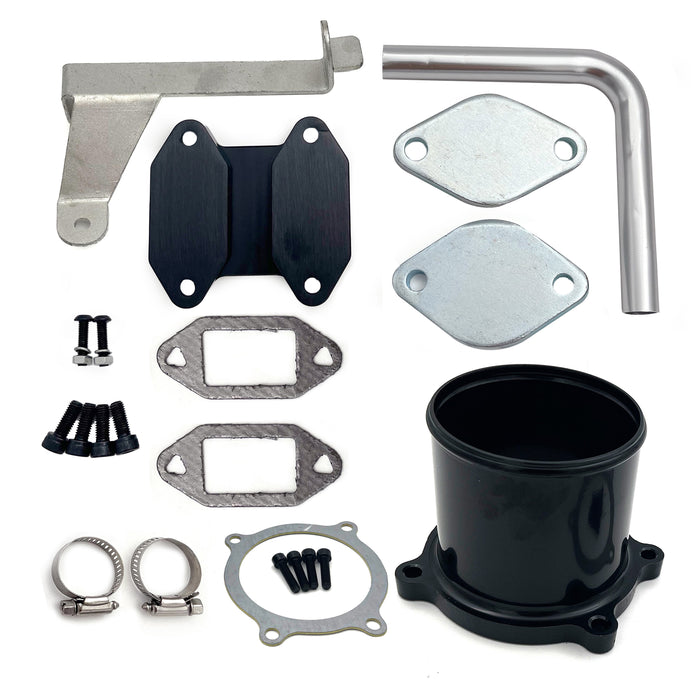
2010-2024 6.7L Cummins Dodge Ram EGR Throttle Valve Cooler Delete Kit
The EGR Throttle Valve Cooler Delete Kit replaces the full EGR and throttle valve system with high-flow CNC-machined components:
- Straight-through throttle valve delete tube that swaps the restrictive butterfly for an open passage.
- EGR cooler delete with a heavy-duty coolant bypass hose to keep coolant flowing through the block without hot spots.
- A pre-tapped 1/8" NPT EGT port on the exhaust plate for a direct aftermarket EGT probe.
- Fits 2010–2024 2500/3500 pickups (not Cab & Chassis).
2007-2009 6.7L Dodge Ram Cummins Diesel EGR Delete Kit
The EGR Delete Kit uses precision CNC billet-aluminum and stainless block-off plates to delete the EGR loop and throttle valve on the early, no-DEF trucks.
Both kits require a delete tune — the ECU monitors both valves, so without a proper calibration you’ll get a check-engine light and limp mode. That’s non-negotiable, and it’s the part every good install starts with.
How to Install the Throttle Valve Delete: Step by Step
This is a bolt-on job, but it’s fiddly — the throttle valve sits on the back of the intake horn with a few hard-to-reach bolts, and the gasket tends to seize. Here’s the walkthrough drawn from a real 6.7L install.
Tools You’ll Want
- 10mm socket and wrench (plus a longer bolt for the manifold hold-down)
- Flathead screwdriver or pry tool for the boot clamp
- Hammer (to tap a seized valve loose) and a gasket scraper
- Ratchet with extensions, and a magnetic tray for the small bolts
- Torque wrench, plus a cover/rag for the open intake port
Step 1: Prep and Tune
Flash the delete tune before you unbolt anything — the ECU needs the calibration in place or it’ll throw codes the moment the valves are unplugged. Then disconnect both batteries and let the engine cool completely.
Step 2: Clear Access
Remove the intake boot clamp (7/16" on some trucks, a flathead on others) and pull the boot off the throttle valve. Cover the open intake port immediately — you don’t want a stray bolt or a chunk of gasket dropping into the turbo. Unplug the MAP sensor and pull it out; this is also a good time to clean the soot off it.
Step 3: Remove the Throttle Valve
The valve is held by four 10mm bolts — one on top and three along the bottom. There’s also a longer 10mm bolt that holds the back side of the intake manifold to the block, so watch for that one. Once the bolts are out, the valve often needs a gentle tap with a hammer to break the gasket free — that factory gasket can act like it’s glued on.
Step 4: Install the Delete Tube
Lay the new gasket in place, set the delete tube on the manifold, and start every bolt by hand before tightening any of them down. Bring them down evenly so the gasket seats flat. (More on why bolt length matters in a second.)
Step 5: Reassemble and Verify
Put the intake back together, reconnect the MAP sensor, refill and bleed the cooling system if your kit touched the coolant circuit, then reconnect the batteries. Start it, get it up to temperature, and check for any intake or boost leaks before you put load on the engine.
Where DIY Installers Get It Wrong
The throttle valve delete is simple enough that it tempts people to rush it — and the cheap-kit failures are well documented.
-
Buying the cheap off-brand tube. There’s a real teardown out there where a $15 eBay throttle body delete blew its gasket on the first drive and leaked boost past 3–5 psi. The shipped bolts were too long (M6×30 instead of M6×25), so the tube never seated and the gasket couldn’t clamp. The fix was shorter bolts and a proper gasket — exactly what a quality kit includes from the start. Cheap here is a false economy.
-
Dropping debris into the intake. The throttle valve sits right at the intake mouth. Cover the port the moment the boot comes off, or a stray bolt heads straight for the turbo.
-
Tightening one corner first. The delete tube and gasket need to come down flat, not pinched on one side. Start every bolt by hand, then tighten evenly.
-
Skipping the tune. Unplug the valves without a delete calibration and you’re driving a truck in limp mode with a lit dashboard.
-
Forgetting to bleed the cooling system. If your kit touched the coolant circuit, trapped air will hot-spot the block. Refill and bleed it properly.
What a Delete Won’t Fix
Be clear-eyed here, because it’s the honest part of the job.
-
It won’t rebuild a tired engine. Blow-by, worn injectors, low compression, and turbo wear are all still there underneath the hardware you removed.
-
It won’t fix the CP4 fuel pump. On the later 6.7L Cummins (2019–2020), the CP4.2 pump is a known weak point that has nothing to do with the EGR or throttle valve. That’s a separate upgrade with its own fix.
-
It won’t add horsepower by itself. The power comes from the tune and the cumulative intake cleanup, not from unbolting a butterfly.
The case for the throttle valve delete is the same as the case for the EGR delete it finishes: reliability and a clean, unobstructed engine — not a magic power bump.
The Legal Alternative: Cleaning the EGR and Throttle Valve
If you’re on-road, under warranty, or in an inspection state, deleting isn’t an option — and the honest, legal alternative is to keep the intake system clean. Be clear about what cleaning is and isn’t: it’s a stopgap. It clears the deposits so the EGR valve and throttle valve keep working, but it doesn’t stop them from building up again, and it won’t fix a cracked cooler.
Why Cleaning Has to Cover Both Parts
The carbon you’re fighting doesn’t just live on the EGR valve. That layer of gunk is what slowly robs fuel economy, throttle response, compression, and clean emissions, and left long enough it’s what makes a throttle valve stick and an EGR valve seize.
Method 1: Spray-In Cleaning (In Place, No Disassembly)
This is the quick approach using a throttle-valve / intake cleaner, and it’s preventive maintenance rather than a deep fix. Here’s the proper sequence:
- Create direct access to the throttle valve — remove the intake hose or pipe so the spray can reach the butterfly.
- Start the engine. If it won’t run with the intake hose removed, disconnect the mass airflow (MAF) connector with the ignition off — the system will enter limp-home mode. Note that limp-home mode sets a fault code, which you’ll need to erase afterward and re-learn the MAF adaptation.
- Hold the engine at a steady 2,000 RPM and spray the cleaner into the throttle opening in controlled bursts, keeping the RPM constant.
- Watch the RPM. If engine speed fluctuates more than 1,000 RPM, stop spraying and wait for it to recover before continuing.
- Keep the cleaner away from the MAF sensor and any painted surfaces — the fluid is corrosive to both.
- Repeat with a second can if deposits remain after the first pass.
- After cleaning, hold the engine at 2,000+ RPM for 20 seconds or more to burn off any remaining residue in the intake.
This is worth doing at every service interval as upkeep. But it’s weak medicine for heavy, hardened carbon — the spray mostly burns off before it reaches deep deposits, and it won’t free a valve that’s already seized.
Method 2: Remove and Clean by Hand (Thorough)
For a valve that’s actually sticking or a manifold that’s badly coked, the only reliable fix is to pull the parts and clean them off the truck:
- Disconnect the batteries and let the engine cool.
- Remove the intake pipe and boot to access the throttle valve and EGR valve — cover the open intake port so nothing drops in.
- Unbolt the EGR valve (10mm fasteners) and lift it off its sealing surface.
- Clean it with carburetor/EGR cleaner, a soft brush, and mechanical scraping where the carbon is thick. Work the valve shaft by hand to confirm it moves freely again.
- Clean the throttle valve the same way, scrubbing the butterfly and the bore until the plate springs back open on its own.
- Reinstall with fresh gaskets, tightening the bolts evenly, then reconnect and verify there’s no intake leak.
This actually restores valve movement — but the truth is still the truth: it’s a recurring job, not a one-time fix. That’s the real difference between cleaning and deleting: cleaning is maintenance, deleting is a permanent removal of the problem.
The Legal Reality (Read This Before You Commit)
Removing or tampering with emissions equipment on a vehicle used on public roads violates the federal Clean Air Act (42 U.S.C. § 7522), with penalties up to $5,911 per individual and higher for shops and sellers. There is no off-road or race-use exemption — the EPA states plainly that a vehicle used only off-road is still not exempt from the tampering rules.
Everything in this article applies strictly to off-road, competition, and closed-course vehicles where permitted by law. A deleted truck will fail an OBD readiness check or visual inspection in any state that runs them, and it complicates resale, warranty, and registration. Know your local and state laws before you touch a wrench.
Get the Right Kit for Your Truck
The 6.7L Cummins is a strong engine hiding behind an EGR system that chokes it — and the throttle valve is the part of that system most people forget to remove. A complete delete takes out the soot source and the restriction, so the engine finally breathes clean, unobstructed air.
If you’re taking a 2010–2024 or 2007–2009 Ram off-road and want the throttle valve gone along with the EGR, the year-matched EGR Throttle Valve Cooler Delete Kit and EGR Delete Kit give you the full job in one box — no leftover butterfly, no leftover failure point.
Browse the full 6.7L Cummins lineup at TruckTok.com. If you have any other questions about the 6.7L Cummins engine, you can refer to these blogs.
- Why Does Your 6.7L Cummins Have Turbo Lag Issues?
- 2010-2024 6.7L Cummins EGR Delete: What Ram 2500 Owners Should Know
- 6.7L Cummins EGR Cooler Clogging — Why It Happens and How to Prevent It
Frequently Asked Questions
Q1: Is the throttle valve the same thing as my gas pedal?
No. On a diesel, the accelerator pedal has nothing to do with the throttle valve. It’s a butterfly in the intake that exists purely to restrict fresh air so the EGR can force exhaust gas into the engine. Once the EGR is deleted, the tune codes out the valve’s operation and the actuator is left unplugged — but unplugging doesn’t lock it open, so the butterfly can still drift shut on its own.
Q2: Why does a diesel have a throttle valve at all?
Because a turbocharged diesel intake is always under positive pressure, so there’s no vacuum to draw exhaust gas through the EGR. The throttle valve partially closes to create that pressure difference, forcing the EGR to flow. It’s an emissions component, not a driver control.
Q3: Do I need to delete the throttle valve if I already deleted the EGR?
You don’t strictly have to — the valve stays open once unplugged — but leaving it means you’ve kept a restrictive butterfly and a potential failure point in the airflow path. The clean fix removes it with a straight-through tube.
Q4: Does deleting the throttle valve add horsepower?
Not by itself. It removes a restriction, which helps the engine breathe, but the power you feel comes from the tune and the cumulative intake cleanup. Anyone quoting a specific HP number for the valve alone is guessing.
Q5:What happens if the throttle valve sticks closed?
It strangles the engine. The valve is spring-loaded open, but it can carbon-seize, the spring or motor can fail, and — once the actuator is unplugged after an EGR delete — it can even drift shut on its own with nothing pinning it open. A partially closed throttle valve is a real airflow restriction — which is exactly why a fixed, open plate eliminates the risk.
Q6: Do I need a tune to install a throttle valve delete?
Yes. The ECU monitors both the throttle valve and the EGR valve, so without a proper delete calibration you’ll get a check-engine light and limp mode. Flash the tune before you unbolt anything.
Q7: Which year 6.7L Cummins needs which kit?
The 2007.5–2009 trucks are the simpler, no-DEF generation and need their own kit. The 2010–2024 trucks have the DEF/SCR system and a different throttle-valve layout. Match the kit to your exact year, and confirm pickup vs. chassis cab.
Q8: Is a throttle valve delete hard to install?
It’s a bolt-on job, but fiddly — four 10mm bolts plus a longer manifold hold-down, a boot clamp, and a gasket that tends to seize. It’s a couple of hours with basic hand tools, not a shop-only job.
Q9: Why did my cheap throttle valve delete leak boost?
A common cause on budget kits is bolts that are too long, so the tube never seats and the gasket can’t clamp. It’s the classic cheap-kit failure — a quality kit ships with the right hardware and a proper gasket.
Q10: Does deleting the throttle valve affect fuel economy or EGTs?
The throttle valve delete itself has a minor effect; the bigger wins come from the EGR delete it’s paired with — no more soot in the intake, lower EGTs under load, and a freer intake. It’s a reliability mod, not a fuel-economy mod.
Q11: What else should I watch out for during the install?
Cover the open intake port the moment the boot comes off so nothing drops into the turbo, tighten the tube bolts evenly so the gasket seats flat, and bleed the cooling system if your kit touched the coolant circuit.
Q12: Is a throttle valve delete legal for street use?
No. It’s part of removing emissions equipment, which violates the federal Clean Air Act (42 U.S.C. § 7522). These parts are for off-road, competition, and closed-course use only — check your local laws.