

Home > News > 6.7L Powerstroke Downpipe — Why Your Turbo Still Lags After DPF Delete

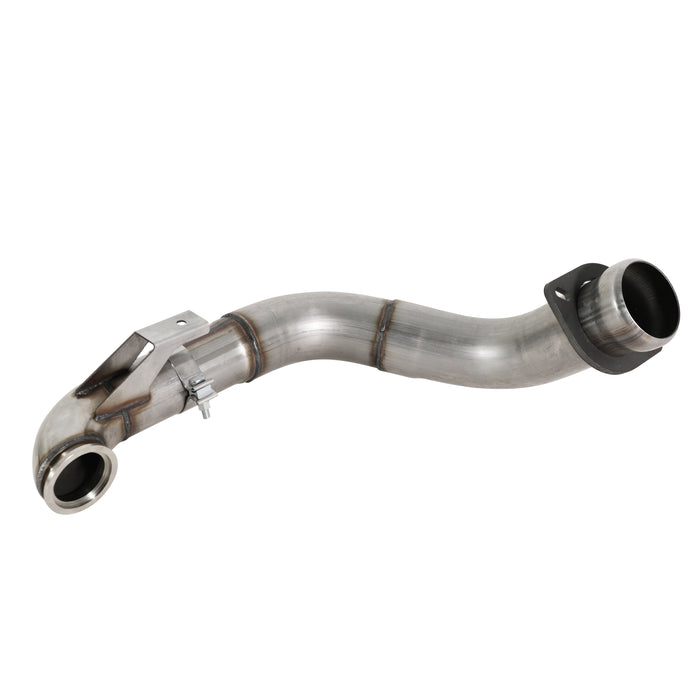

6.7L Powerstroke Downpipe — Why Your Turbo Still Lags After DPF Delete
You pulled the DPF, flashed the delete tune, and the truck is faster — but the turbo still feels soft off the line. The lag isn’t the tune, and it isn’t the turbo. On the 2020–2024 6.7L Powerstroke, it’s the downpipe: Ford crimped a flat section into the factory pipe to clear the frame crossmember, pinching exhaust flow down below 3 inches. The DPF is gone, but that pinch point is still choking the turbine wheel. Here’s what’s actually happening, and what a 4" downpipe does about it.
For off-road / competition use only. Not legal for on-road use in emissions-regulated areas. Check your local, state, and federal laws before modifying any emissions-related component.
Deleting the DPF Doesn’t Delete the Bottleneck
Most owners assume the DPF is the restriction, so removing it should free everything up. It does free up the downstream side — the filter, the catalyst, the regen strategy, the DEF dosing. But the exhaust path has more than one choke point, and a DPF delete only addresses the ones after the downpipe.
Deleting the DPF removes everything downstream of the downpipe. But the downpipe itself — the first section bolted straight to the turbo — is still the factory part. And on the 2015–2024 trucks, that factory part is a quiet, deliberate restriction.
The Crimped Bottleneck: Why Ford Flattened the Downpipe
This is the detail most delete guides skip, and it’s the whole reason this article exists. On two generations of the 6.7L Powerstroke, Ford deliberately crimped a flat section into the factory downpipe to make it fit around something — and that crimp is a flow restriction that survives a DPF delete.
Same Root Cause in Two Different Generations
-
2015–2019 trucks: the factory downpipe is pinched down to about 2.5 inches where it clears the transmission bellhousing. The pipe has to squeeze past the gearbox, so Ford flattened it to get the clearance.
-
2020–2024 trucks: when the Super Duty was redesigned, the frame crossmember moved into the path, and Ford crimped a flat section to tuck the pipe under it — pinching flow to 3 inches or less.
In both cases it’s a packaging compromise, not a flow feature: the exhaust gas — at its hottest and moving its fastest right at the turbine outlet — hits a flattened section, backs up, and the turbo can’t shed its spent air as quickly as it should
Stock 2016 6.7L Powerstroke downpipe dimensions — image credit: brokestroke, Ford-Trucks.com.
This Matters in Two Ways You’ll Actually Feel:
- Lag off the line. The turbo has to fight the residual backpressure before it can spool, so boost builds a beat later than it should.1
- Heat stacking under load. Towing heavy, the hot gas can’t evacuate fast enough, so EGTs climb higher and stay higher than they would with a clean path.
And here’s the key point that ties it to the title: this pinch survives a DPF delete. Remove the filter and everything downstream, and that flattened section is still sitting inches from the turbo, still choking flow. That’s why the truck still lags after the delete — you removed the wrong restriction.
The only 6.7L trucks that escaped this are the earliest ones. The 2011–2014 trucks ran a different factory turbocharger and downpipe layout that’s more uniform.
Know Your Generation: Not Every 6.7L Downpipe Is the Same
The 6.7L Powerstroke has been built since 2011, and the downpipe has changed across three distinct generations. “Fits 6.7L” doesn’t mean it fits your truck.
| Generation | Model Years | Factory Downpipe | The Bottleneck Story |
|---|---|---|---|
| Early-gen | 2011–2014 | Different factory turbocharger and downpipe layout | More uniform pipe; the exception that isn’t pinched |
| Second-gen | 2015–2019 | ~3" pipe with a flattened section pinched to 2.5" to clear the bellhousing | The pinch is a real restriction, especially once tuned or deleted |
| Third-gen | 2020–2024 | ~3.25" pipe with a crimped flat section to clear the crossmember | The crimp is the #1 remaining restriction after a delete |
The honest nuance here, and it matters:
A long-time 6.7 owner quoting a well-known diesel shop put the stock downpipe at “more than adequate for a stock truck not making 500 to 600 horsepower.” That’s true — for a bone-stock truck, the flattened section isn’t the thing holding you back, because the stock tune isn’t asking for enough flow to choke on it.
But that’s not who this article is for. That’s the whole point: the downpipe conversation flips from “marginal upgrade on a stock truck” to “the single most impactful exhaust change you can make after a delete.”
Drive Pressure vs. Back Pressure — the Distinction That Keeps Getting Missed
Before the “what it fixes” section, one definition that keeps the whole conversation honest, because it’s where most owners (and more than a few forum threads) go wrong.
When you log exhaust pressure on a 6.7L, there are two very different numbers:
-
Drive pressure is the pressure before the turbine — in the exhaust manifolds feeding the turbo. One owner logged 16 psi at idle and 60+ psi at full power and thought his downpipe was clogged — but that’s normal drive pressure doing its job. You change drive pressure with the turbo (turbine wheel, VGT geometry), not the exhaust pipe.
-
Back pressure is the pressure after the turbine — in the downpipe and everything downstream. This is what restricts flow, raises EGTs, and slows spool. This is the number the downpipe and the DPF delete actually move.
Why it matters, in plain terms: A downpipe upgrade only ever moves the back-pressure number, never the drive-pressure number. It helps the turbo breathe out, which in turn helps it spool — but it doesn’t change how hard the exhaust is driving the turbine.
What Actually Causes Lag After a Delete — the Honest, Ranked List
A downpipe is a cause of post-delete lag, not the cause. If you’re chasing lag after a delete, here’s the list in the order you should work through it, because throwing a downpipe at the wrong problem won’t fix a thing.
1. The downpipe pinch (2015+ trucks)
If the truck is a 2015–2024 and the DPF is already gone, the flattened section — 2.5" on the 2015–2019, under 3" on the 2020–2024 — is the most likely culprit, and the one a 4" downpipe directly fixes. This is the sweet spot where the article’s advice actually applies.
2. The tune
A delete tune that disables the DPF but doesn’t recalibrate the VGT and fueling for the freer exhaust leaves response on the table. The hardware is only half the job; a matched tune is the other half. Hardware without a matched calibration under-delivers — or throws codes and derates.
3. Sensors
This is the sleeper, and it’s easy to burn weeks on. One owner chasing “turbo, intercooler, and intake gremlins” for an extended period found the culprit was a couple of bad sensors all along. A wrong MAP, EBP, or MAF reading makes the ECM command lazy boost and mask the real behavior. Swap the sensors before you swap the pipe.
4. The turbo itself
A sticking VGT actuator, a boost leak on the charge side, or a mechanically tired turbine all read as lag — and no pipe on earth fixes a turbo that’s worn out. Diagnose the turbo before you bolt on a downpipe.
The takeaway: diagnose before you bolt on. If the lag is the downpipe pinch, the fix is clear and the money is well spent. If it’s a sensor or the tune, a downpipe is money thrown at the wrong symptom.
When a Downpipe Upgrade Is Actually Worth It
Here’s the honest math on downpipe value, because it’s the easiest mod in this space to oversell:
-
Stock, 2011–2014 truck: the early downpipe is relatively uniform and adequate. Upgrading to 4" buys little you’ll feel in the seat — the pipe isn’t your restriction.
-
Stock 2015–2019 or 2020–2024 truck: the flattened section exists, but a bone-stock tune isn’t asking for enough flow to choke on it. The downpipe isn’t your problem yet.
-
2015–2024 truck, DPF deleted and tuned: this is where the flattened section — 2.5" on the 15–19, under 3" on the 20+ — becomes a genuine bottleneck. A 4" mandrel-bent downpipe restores a uniform flow path straight off the turbo, and it’s here the upgrade earns its cost: sharper spool, snappier throttle, and meaningfully lower EGTs under load.
-
Any truck chasing 500–600+ hp: at that output the factory pipe becomes a real limit regardless of year, and a larger downpipe is a supporting mod, not an option.
The common thread: the downpipe is a supporting mod that clears a restriction — it doesn’t make power by itself. The power comes from the tune. What the downpipe does is let the tune (and the turbo) actually deliver what it’s already commanding.
What a 4" Downpipe Actually Does (and Doesn’t Do)
Let’s be precise about the gains, all of which assume a matched tune:
| What It Does | What It Does NOT Do |
|---|---|
| Kills the pinch point — uniform 4" diameter off the turbo | Does not add horsepower on its own (power comes from the tune) |
| Faster VGT spool — less backpressure at the turbine | Does not repair a tired turbo or fix a boost leak |
| Lower EGTs under load — hot gas evacuates faster | Does not compensate for a bad sensor |
| Cleaner, deeper exhaust note without straight-pipe drone | Does not change drive pressure or protect the CP4.2 pump |
In short: a 4" downpipe clears a restriction so the tune and the turbo can actually deliver — it doesn’t manufacture power, and it doesn’t fix anything on the fuel or boost-control side. If you’re going to spend on a downpipe, spend it on the right problem.
A True 4" Path Off the Turbo, For Both Generations
TruckTok carries a 4" downpipe for each of the two crimped generations, so the fix matches your truck.
2020-2024 6.7L Ford powerstroke 4" downpipe Exhaust
The 2015–2019 6.7L Powerstroke 4" Downpipe replaces the factory pipe that’s pinched to 2.5" where it clears the bellhousing.

- Uniform 4" mandrel-bent T409 stainless — no flattened section, a true full-diameter path off the turbo.
- Fits 2015–2019 F-250 / F-350 / F-450 Super Duty.
- Reinforced flex section — the factory flex pipe is the weakest link on these trucks and splits under high-boost tunes; this one is built to take the vibration.
- Kills the heat-shield rattle — the welded factory heat shields crack and rattle at idle; the 4" pipe removes that annoyance along with the flow restriction.
2015-2019 6.7L Ford powerstroke 4" downpipe Exhaust
The 2020–2024 6.7L Powerstroke 4" Downpipe targets the crimped section Ford added to clear the crossmember.
- Uniform 4" mandrel-bent T409 stainless from the turbo exhaust housing — no flattened section, no pinch point.
- Fits 2020–2024 F-250 / F-350 / F-450 Super Duty, connecting the turbo outlet to the mid-section exhaust.
- Works two ways: it’s a bolt-in heavy-duty replacement if your factory pipe is rusted or cracked (no tuner needed with a stock DPF), or the first piece of a full turbo-back delete when paired with a DP-Back pipe and a delete tuner.
Both pipes pair with a 4“ Cat & DPF or 5" Down-pipe back DPF delete kit for a complete high-flow system from the turbo all the way to the tip. For the full step-by-step install on this platform, see the 4" downpipe install guide on TruckTok Forum.
The 6.7L in Context: Why This Platform Responds Differently
A quick cross-platform note, because the downpipe conversation looks different depending on which engine you’re under the hood of.
The 6.7L Powerstroke Runs A Single Garrett VGT turbo
On a single-turbo engine, everything the turbo breathes out has to go through one downpipe, which makes backpressure at that point disproportionately important to spool and EGT. That’s why the 2015–2024 flattening — a restriction sitting right at the single turbo’s outlet — hits harder than it would on a twin-turbo engine where the load is split.
The 6.7L Bosch CP4.2 High-pressure Fuel Pump
It’s worth naming here because it’s a common point of confusion: a downpipe fixes exhaust flow, not fuel delivery. If your concern is the CP4.2, the fix is a disaster-prevention or conversion kit, not a bigger pipe. Different system, different fix.
The Install: A Two-Section Swap, Step by Step
The 6.7L downpipe is a two-piece assembly — an upper section at the turbo and a lower section running down to the mid-pipe. That split is the saving grace of the job, because you can work each piece into place separately instead of wrestling one long pipe around the crossmember. Plan for a solid afternoon the first time through.
Tools You’ll Need:
| Tool | What It’s For |
|---|---|
| 10mm socket | Upper downpipe-to-engine-cover bolts (Step 5) |
| 11mm wrench | The T-bolt clamp at the turbine (Step 4) |
| Pry bar | Separating the lower section from the upper (Step 3) |
| Hammer | Tapping the stubborn top nut loose (Step 4) |
| Penetrating oil | Soaking the heat-cycled bolts before you touch them |
| Socket set / ratchet | The two studs and two nuts at the cylinder head (Step 3) |
Work cold — heat-cycled exhaust bolts snap if you rush them, and a hot downpipe is miserable to work around. Every one of these bolts has been through thousands of heat cycles, so the penetrating oil soak is genuinely the difference between a clean job and a broken stud.
Step 1 — Cool It Down and Soak the Bolts
Shut the truck off and let the exhaust cool completely before you touch anything. Spray the clamp nuts and flange bolts with penetrating oil while you gather tools, and give it a few minutes to work in. This is the single best thing you can do to avoid snapping a bolt.
Step 2 — Open Up the Wheel Well
Remove the inner fender liner on the passenger-side front wheel. This is what gives you clear access to the lower downpipe section, and skipping it turns an otherwise reachable set of bolts into a blind, knuckle-busting fight. A handful of push-pins and screws is all that holds the liner on.
Step 3 — Drop the Lower Section
- With the liner out of the way, loosen the clamp that secures the lower downpipe to the upper section.
- Remove the two bolts holding the lower section, then remove the two nuts and two studs that attach the lower section to the passenger-side cylinder head.
- Once everything is free, pry and wiggle the pipe until it separates from the upper section — it usually hangs up on the mating joint, and a pry bar worked around the seam is the fastest way to break it loose.
- If you still can’t get room, pull one or two exhaust hangers to let the pipe move.
Step 4 — Loosen the Upper Section
Loosen the 11mm nut on the T-bolt clamp, then remove the clamp connecting the upper section to the rear of the turbine. The top nut is the classic bolt-snap spot — if it’s fighting you, give it a few sharp taps with a hammer from underneath to break the corrosion loose before you crank on it.
Step 5 — Free the Upper Section
Remove the 10mm bolts that secure the upper downpipe to the engine cover, then lift the old pipe out. Take a quick look at the old pipe while it’s out — if it’s a 2015–2024 truck, you’ll see the flattened section that’s been choking your flow this whole time.
Step 6 — Hang the New Upper Section
Bolt the new 4" upper section to the rear of the turbo using the downpipe clamp — but leave the clamp a little loose so you can still rotate the pipe into position. Reinstall the 10mm bolts onto the rear cover, then snug the clamp nut down.
The “leave it loose, rotate, then tighten” sequence is what lets you get the alignment right without fighting the whole assembly.
Step 7 — Install the Lower Section
Slide the new lower section into place and mate it to the upper section. Install the clamps from your kit with the nuts facing the firewall — this is a small detail that matters later, because it’s the difference between being able to reach the nut for a final snug and having to contort around a hot pipe. Reinstall the two studs and two nuts.
Step 8 — Tighten Everything Down
Once the studs and nuts are secure, tighten the clamps that seal the lower section to the upper. Go evenly so the joint seats square and seals cleanly.
Step 9 — Reconnect and Check
Rejoin the rest of the exhaust to the downpipe, then check for leaks at every joint — a quick feel for escaping air at each clamp with the engine running is the fastest test. If it’s clean, reinstall the fender liner and you’re done.
Three Things People Get Wrong
-
Rushing the top nut — that’s where bolts snap. Soak it, tap it, be patient. A broken exhaust stud turns a two-hour job into a full-day extraction.
-
Cheap pipes that need to be hammered to fit — one owner’s Amazon downpipe took several dents to clear the frame, and every dent is a new restriction that defeats the whole point of the upgrade. A quality mandrel-bent pipe drops in without modification.
-
Skipping the tune on a delete — a downpipe bolted to a stock DPF needs no tune, but in a full delete setup you must flash the delete tuner first or the truck throws codes and derates.
Frequently Asked Questions
Why is my turbo still lagging after I deleted the DPF?
Because the DPF delete only removes the restriction after the downpipe. On 2015–2024 trucks, the factory downpipe has a flattened section (2.5" on the 15–19, under 3" on the 20+), and that bottleneck is still there after the DPF is gone.
Do I need a tune with a downpipe?
Only if you’re running a delete. A downpipe bolted to a stock DPF needs no tune. But in a full delete setup, you must flash a delete tuner or the truck throws codes and derates.
Does a downpipe add horsepower?
Not by itself — the power comes from the tune. The downpipe clears a restriction so the tune and turbo can actually deliver. A 6.7L downpipe typically adds 15–25 hp when paired with tuning.
What’s the difference between drive pressure and back pressure?
Drive pressure is the pressure before the turbine (in the exhaust manifolds) — it spins the turbo and is changed by the turbo. Back pressure is the pressure after the turbine — it restricts flow and is changed by the exhaust pipe. A downpipe only affects back pressure.
Will a bigger downpipe fix a sticking turbo?
No. A sticking VGT actuator, a boost leak, or a worn turbine will still read as lag no matter how big the downpipe is. Diagnose the turbo before you bolt on a pipe.
Is a downpipe worth it on a stock truck?
On a stock 2011–2014 truck, the downpipe is adequate and the gains are small. On a 2015–2019 or 2020–2024 truck that’s been deleted and tuned, the flattened section becomes a real bottleneck and a 4" downpipe is worth it.
Why does the factory downpipe have a flat section?
Ford crimped it to clear something: on the 2015–2019 trucks it’s pinched to 2.5" to clear the transmission bellhousing, and on the 2020–2024 trucks it’s flattened to clear the frame crossmember. Both are packaging compromises, not flow features — and both are why these trucks still lag after a delete.
Is the downpipe the same across all 6.7L years?
No. The 2011–2014 trucks ran a more uniform pipe that’s adequate for stock use. The 2015–2019 trucks added a flattened section (2.5"), and the 2020–2024 trucks kept one too (under 3") — different locations, same flow-killing pinch.
Will a downpipe make my truck louder?
Yes, modestly. It deepens the exhaust note and gives a cleaner turbo whistle without the drone of a full straight-pipe. It’s a noticeable but not obnoxious change.
Do cheap downpipes fit properly?
Often not. Some require hammering dents into the pipe to clear the frame, and every dent is a new restriction that defeats the purpose. A quality mandrel-bent pipe should drop in without modification.
Is a downpipe legal for street use?
A downpipe by itself, bolted to a stock DPF, is a legal replacement part. A catless downpipe in a full delete setup removes emissions equipment and is for off-road, race, or competition use only.
What should I pair with a 4" downpipe for a full system?
A DP-Back exhaust (4" or 5") to complete the path from the turbo to the tip, plus a delete tuner. The downpipe is the first piece; the DP-Back pipe finishes the job.
Does a downpipe help with the CP4.2 pump problem?
No. The CP4.2 fuel-pump issue is a fuel-delivery failure, not an exhaust-flow problem. A downpipe won’t touch it — that’s what a disaster-prevention or conversion kit is for.
How do I know if my lag is the downpipe or something else?
If the truck is a 2015–2024 with the DPF already deleted, the downpipe pinch is the likely cause. Otherwise, check the tune, then the sensors, then the turbo before spending on a downpipe.
Get the Rest of the Flow Back
If your 2015–2024 6.7L is deleted and still soft off the line, the right 4" downpipe — the 2015–2019 downpipe or the 2020–2024 pipe — is the piece that clears the last restriction, the flattened section Ford built in to clear the bellhousing or crossmember. It drops EGTs, sharpens spool, and lets your tune actually deliver what it’s commanding. Pair it with a DPF delete pipe for a full turbo-back system. Browse the full 6.7L lineup at TruckTok.com.
Legal Disclaimer
For off-road / competition use only. Not legal for on-road use in emissions-regulated areas. Check your local, state, and federal laws before modifying any emissions-related component.