
Home > News > 6.7L Powerstroke Delete — Race Pipe, EGR and CCV, Why Do Them Together?



6.7L Powerstroke Delete — Race Pipe, EGR and CCV, Why Do Them Together?
The race pipe, the EGR delete, and the CCV reroute are one job split across three parts, not three separate mods you can cherry-pick. They share a single root cause — dry soot from the EGR plus wet oil vapor from the CCV, baked together into the sludge that chokes your intake and turbo. Do one without the others and you’ve solved a third of the problem and left the other two-thirds still feeding it.
This guide lays out what each system actually does, why they’re locked together, what a combined delete really changes (with real dyno numbers, not the inflated ones), and what it won’t fix.
For off-road / competition use only. Not legal for on-road use in emissions-regulated areas. Check your local, state, and federal laws before modifying any emissions-related component.
What Does Each of the Three Actually Do?
Before the “together” part makes sense, you have to see what each system is doing to your truck in the first place.
The DPF (What the Race Pipe Replaces)
The diesel particulate filter traps soot in a ceramic honeycomb. To clean itself, the ECM periodically triggers a regeneration — it injects raw fuel on the exhaust stroke, spiking exhaust temps to burn the soot off. That sounds fine until you realize two things:
- It wastes fuel every cycle
- The unburned fuel that doesn’t burn in the filter washes past the piston rings into the oil pan,thinning your oil and chewing on bearings.
On a work truck that idles and short-trips, the regen cycle never fully completes, the filter loads up, backpressure spikes, and you get a P2463 code and a derate.
The EGR (What the EGR Delete Removes)
The exhaust gas recirculation system routes metered exhaust back into the intake to lower combustion temperature and cut NOx. The side effect is that it deposits soot and carbon throughout the intake manifold, restricting airflow and causing incomplete combustion — which produces more soot, which loads the DPF faster. It’s a loop. The EGR valve also gums up and throws P0401/P0402.
The CCV (What the Reroute Redirects)
The crankcase ventilation system routes blow-by gas — which carries oil vapor — back into the intake path. That oil mist condenses on the turbo inlet, the intercooler piping, and the intake boots. By itself it’s just a mess. But it’s the second ingredient in the sludge problem, which is the whole point of doing all three together.
Why They Have to Go Together: The Soot + Oil = Sludge Problem
Here’s the mechanism that ties all three systems into one job.Dry soot and wet oil are each annoying on their own, but it’s only when you combine them that you get the thick, sticky, carbon sludge that actually ruins a 6.7L.
The EGR supplies the dry soot. The CCV supplies the wet oil vapor. Mix the two in the intake tract and you get a paste that coats the intake runners, the intercooler, and the turbo compressor side — and it doesn’t wash off with a spray can.
That’s why the three deletes are one job:
-
Delete the EGR and you stop the soot source, but the CCV is still pumping oil vapor into the intake, which still bakes onto the surfaces.
-
Reroute the CCV and you stop the oil source, but the EGR is still dumping soot, which still cakes the intake.
-
Replace the DPF with a race pipe and you fix the exhaust side, but the intake is still getting fed by the other two.
Only when you do all three do you break the cycle — no soot, no oil vapor, no regen fuel wash. Clean air in, free exhaust out, and a crankcase that vents away from the turbo instead of into it.
The Systems Also Feed Each Other — So a Partial Delete Backfires
There’s a second reason “together” matters, and it’s the part most owners learn the hard way: the three systems are mechanically linked, so deleting one shifts the load onto the others.
-
Delete the EGR but keep the DPF, and the engine now runs a richer burn (no cooled EGR charge) with higher combustion temps — which produces more soot, which clogs the still-installed DPF even faster.
-
Delete the DPF but keep the EGR, and the EGR keeps feeding soot into the intake with nowhere to go but your turbo and intercooler. You fixed the tailpipe and left the intake dirty.
-
Keep the CCV stock through any of it, and the oil vapor keeps gluing whatever soot remains to every intake surface.
A partial delete doesn’t save you money — it usually means a second tune, a second round of labor, and a second round of downtime when you finally go back and finish the job you should have done all at once.
What a Combined Delete Actually Changes (Honest Numbers)
Now let’s be straight about what you’re getting, because a lot of marketing inflates this.
The Tune Does Add Horepower
The delete itself does not add horsepower. That’s the single most important caveat, and it applies to all three systems. What the hardware actually buys you is reliability and airflow cleanliness— and the tune is where the power comes from..
A Real-world Dyno Sequence
It straight from a 2017 6.7L that was stock, then deleted with a 5-inch exhaust, EGR removal, and shift-on-the-fly tuning:
| State | Horsepower | Torque |
|---|---|---|
| Stock (crank rated 440 hp) | 340 whp (dyno, 4th gear) | 602 lb-ft |
| Deleted + tuned (level 5) | 451 whp (4th) / 461 whp (5th) | 996 lb-ft |
That’s about +120 hp at the wheels — but note two things:
- The truck was running 24×14 wheels and 36-inch mud tires that ate a chunk of the stock baseline.
- The gain came from the tune, not from unbolting parts.
On fuel economy:
The honest range is +2 to +3 MPG — not the “+4 to +6” some listings claim. And that gain comes mostly from stopping the regen fuel waste and the oil dilution, not from the exhaust flowing freer.
The CCV reroute is worth zero horsepower and zero MPG:
It’s a mechanical upgrade (the product itself confirms it requires no tuning), and its entire value is keeping oil vapor out of the turbo and intake. If anyone tries to sell you a CCV “delete” as a power mod, walk away.
Know Your Generation Before You Order
The 6.7L Powerstroke spans 2011 through 2023+, and the hardware doesn’t all interchange. The big splits that matter for a combined delete:
-
2011–2014: The early DPF assembly carries up to eight sensors that all need to be unplugged and capped. The EGR cooler bolts on this generation are the ones most notorious for snapping.
-
2015–2016: Revised EGR routing, but still the pre-2017 body.
-
2017–2019: New body style, and a meaningful change on the CCV side — the CCV filter was redesigned in 2017, so an older-style replacement filter won’t fit a 2017+. If you’re rerouting, this is where the year matters.
-
2020+: Newer ECM security; tuning access and ECM-unlock requirements change.
The kit covered here fits 2011–2022 F-250/F-350/F-450 Super Duty (not Cab & Chassis). Always confirm your exact year and cab/bed configuration before ordering — “fits 6.7L” is not the same as “fits your 6.7L.”
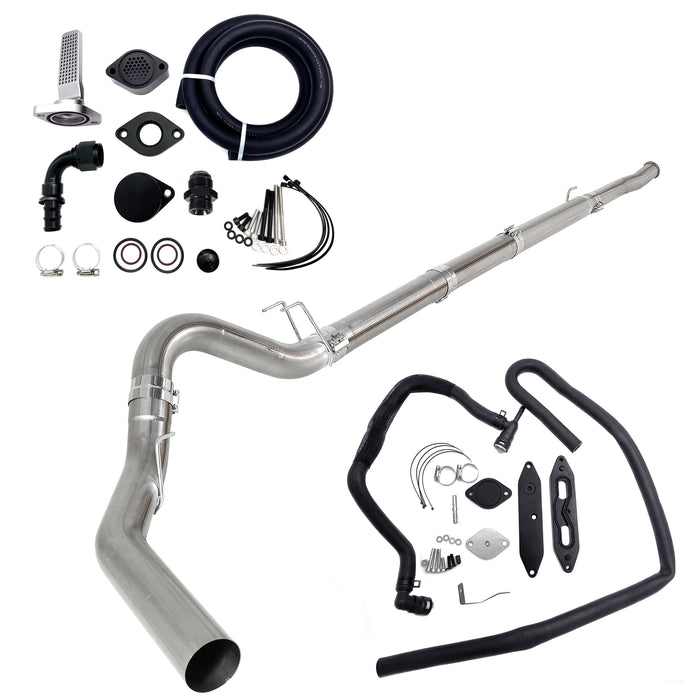
2011-2022 6.7L Powerstroke 5" Dp-Back pipe & CCV Reroute EGR cooler Delete Kit
Instead of sourcing a pipe, an EGR kit, and a CCV kit from three vendors — and hoping they all play nice — the 2011-2022 6.7L Powerstroke 5" Pipe & CCV Reroute EGR Delete Kit bundles the whole job in one box:
- Full 5-inch DP-back exhaust — replaces the entire restricted path behind the turbo, not just the DPF section, for maximum flow and the deepest diesel tone.
- EGR cooler delete — removes the soot source feeding the intake.
- CCV/PCV reroute — channels crankcase blow-by and oil mist away from the turbo inlet and down toward the undercarriage, instead of pooling it in your intercooler pipes.
The product’s own FAQ answers the title question directly: each upgrade addresses a different airflow issue — the 5-inch exhaust fixes exhaust flow, the EGR delete cuts intake soot, and the CCV reroute removes oil-vapor contamination. And it confirms the one thing you must not skip: custom ECM tuning is required for the removed DPF and EGR systems, while the CCV reroute is mechanical and needs no tuning.
How to Choose the Right Kit
When you’re putting a three-piece delete together, the choices that actually matter are fewer than the marketing would have you believe. Here’s what to weigh.
Buying Separately vs One Kit: The Real Difference
The biggest fork in the road isn’t the pipe diameter — it’s whether you source three pieces from three sellers, or buy them as one matched kit.
| Dimension | Buying Separately | One Matched Kit |
|---|---|---|
| Tuning | Staged deletes may need multiple flashes | Written once, covers everything |
| Compatibility | Three sellers, parts may not match | Designed to work together |
| Missing-parts risk | High (reroute / catch can often absent) | Low (complete) |
| Install labor | Repeated teardowns | One teardown, done |
| Total cost | Looks cheaper, then the add-ons add up | One box, no hidden cost |
The honest trade-off:
Buying separately can look cheaper on paper, but the savings evaporate the first time you realize the EGR kit didn’t come with a coolant reroute, or the CCV piece is just a bare hose with no catch can. A matched kit costs more up front, but it’s engineered so the pipe, the EGR hardware, and the CCV reroute all fit the same truck without fighting each other, and the tune is written once for the full job.
What Actually Matters When You’re Comparing Kits
-
Material. 304 stainless is the lifetime pick; 409 stainless is a solid step down (surface rust, won’t rust through); aluminized steel is the cheap option that rusts out in a few years of road salt. On a delete you only want to do once, stainless is the right call.
-
Completeness. Does the kit include the EGR block-off and the coolant reroute, or just the pipe? Does the CCV piece come with the internal catch can, or just a bare hose? A “kit” that’s missing the reroute or the catch can isn’t really a kit — it’s half the job.
-
Fitment. “Fits 6.7L” is not the same as “fits your 6.7L.” The 2011–2014 DPF carries eight sensors, the CCV filter changed in 2017, and Cab & Chassis trucks route differently. Confirm your exact year and cab/bed before you order.
-
Spec transparency. A kit that lists real material, real diameter, and real fitment has been engineered. One that just says “high-flow stainless” without numbers is hiding something.
Install Reality: Tune First, Then Unbolt
The golden rule on any 6.7L delete is unchanged: flash the delete tune before you remove a single part. Pull the hardware first and the ECM will immediately throw codes and derate. The two common tuner paths are a handheld like the BDX or a cloud-based setup like EZ LYNK with a switch for shift-on-the-fly power levels. Keep a battery charger on the truck during the flash .
Here’s the full walkthrough, split into the three systems in the order they come out.
Tools You’ll Want Before You Start
- Socket set with 8mm, 10mm, 13mm, 15mm, plus a deep 10mm and a swivel socket
- 10mm ratchet wrench (for the EGR’s infamous rear nut) and a flex-head ratchet
- Extensions, including a ~21.5-inch reach for the CCV rear bolts
- Penetrating oil (PB Blaster or WD-40), applied a day or two ahead
- Ratchet strap (pulls the heavy DPF and the fuel lines out of the way)
- Coolant catch pan, new coolant, torque wrench, dead-blow hammer, zip ties, O-ring lube (or petroleum jelly)
Step 1: The Exhaust (Race Pipe)
- Drop the spare tire to reach the rear sensor, which plugs in up behind the spare. Unplug it and every other sensor on the DPF assembly, then cap them — or leave them plugged and zip-tie them up out of the way. The key is to never leave them dangling where they can corrode.
- Unbolt the section. The rear nuts are welded, so work from the bolt side. Spray the studs and hangers with penetrating oil first.
- Lower the DPF. It’s heavy, so use a ratchet strap or a second pair of hands, and pry the hangers off the frame side.
- Test-fit the new pipe from front to back, leave the clamps loose, then tighten from the turbo back.
- Fifth-wheel trucks: mark where the 5-inch pipe touches the fifth-wheel plate, pull the section, and tap a small dent in with a hammer so it clears. Every brand needs this.
Step 2: The EGR Cooler
- Drain the driver-side cooling loop. There are two reservoirs; only the driver-side one feeds the EGR cooler. The drain plug turns about 90° and pulls out — remove the cap to let it flow faster. (A faster trick is a 1/4-inch hose on the EGR cooler line draining straight to a bucket.)
- Pull the intake to open up access.
- Remove the seven cooler bolts. The two rear ones are the break-prone pair — warm the engine first, soak them in penetrating oil, and work each one in-and-out a few turns rather than one hard pull. A swivel socket and a 6-inch extension reach the tight ones.
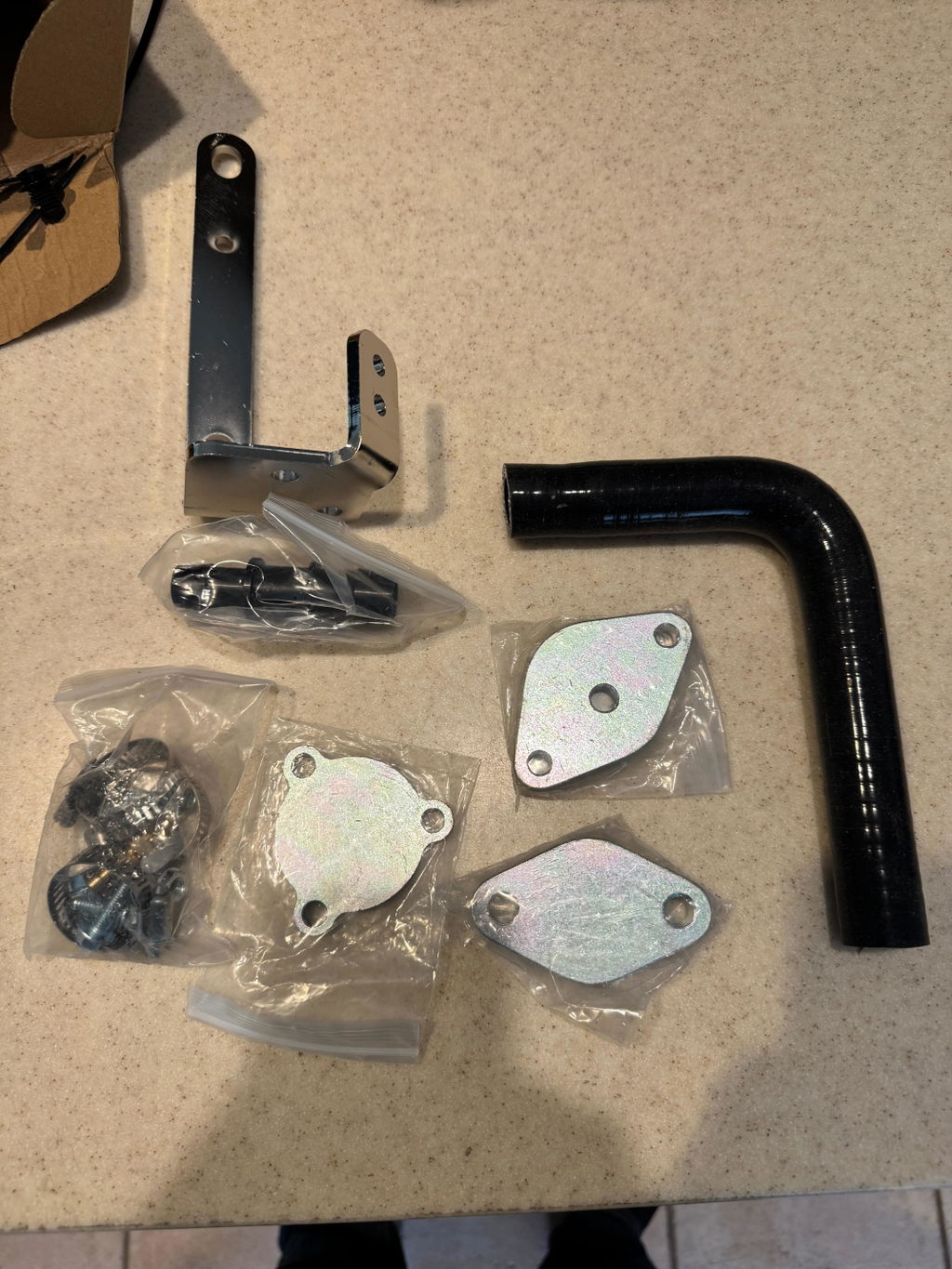
- Install the block-off plates. Keep the O-rings in good shape and clean the mating surface before the plate goes on.
- Reroute the coolant line. This is the step cheap kits skip, and it’s the one that matters: the 6.7L EGR cooler lives on the secondary cooling circuit, and if you block the cooler without rerouting, you trap air against cylinders #4 and #8. Remove the spacer and connect the line straight to the tee.
Step 3: The CCV Reroute
- Pull the in-bay fuel filter for access (expect a little diesel — keep a towel handy).
- Remove the four bolts holding the CCV box. The real time-saver here is a ratchet strap looped around the fuel lines to pull them down and out of the way of the rear bolts — it’s the trick most videos leave out.
- Install the block-off plate and internal catch can, lubricating the O-rings before they seat.
- Route the vent hose down and away from the turbo inlet, behind the brake booster and toward the undercarriage.
- Reconnect the fuel filter and prime the system (cycle the key a few times with your foot off the brake) before starting.
Step 4: Finish and Verify
Two cautions that catch people every time:
- Reconnect every sensor you unplugged (a missed MAF or EGR sensor plug is the classic cause of a “runs rough after delete” call),
- Expect the coolant level to drop after the first heat cycle as the system burps out air — top it up before you call the job done.
Then take a short shakedown drive, get it up to temperature, and recheck the coolant and the exhaust clamps for leaks.
After the Delete: How to Care for a Deleted 6.7L
Deleting the emissions hardware doesn’t make the truck maintenance-free — it just removes three of the things that were wearing it out. Here’s how to keep a deleted 6.7L healthy for the long haul.
Recheck Everything in the First 500–1,000 Miles
New gaskets settle and clamps seat after a few heat cycles. In the first thousand miles, take a look at the exhaust clamps for leaks, the EGR block-off plates for seepage, and the coolant level (it’ll drop once as the last air burps out). A quick inspection now beats a leak that’s been dripping the whole time.
Watch the Coolant Like a Hawk
The coolant reroute is the one part of a delete that can cause real damage if it’s wrong. If the truck runs hot, or the coolant level keeps dropping with no visible leak, don’t assume it’s normal — check the reroute for a kink or a trapped air pocket. Cylinders #4 and #8 are the ones that suffer first if the secondary circuit isn’t flowing right.
Stay on Top of the Oil
One of the delete’s real wins is that you stop the regen fuel dilution that was thinning your oil — which means your oil changes now actually go the distance they’re supposed to. Don’t stretch intervals to “save money”: the oil is still carrying soot and doing its job, and the bearings and turbo are still the parts it protects.
The CP4.2 Is Still the Thing to Watch
This is worth repeating: the delete did nothing for the Bosch CP4.2 fuel pump. Keep clean fuel flowing, change the fuel filters on schedule, and seriously consider a disaster-prevention bypass if you’re keeping the truck. A CP4 failure is a multi-thousand-dollar event that has nothing to do with whether your emissions are deleted.
Keep the Orphan Connectors Protected
Any sensor connectors you left unplugged should be capped and sealed against moisture, not left bare. A corroded orphan connector can short a 5-volt circuit and drag down other sensors — exactly the kind of mystery drivability problem that’s hard to chase later.
Drive It the Way It Was Meant to Be Driven
A deleted 6.7L still likes to work. Get it up to full temperature when you drive it, don’t idle it for hours, and don’t baby it — the turbo and the bottom end are happier running warm and under a little load than they are sitting cold.
What a Combined Delete Won’t Fix
Be clear-eyed here, because the honest answer is part of doing this right.
-
The CP4.2 fuel pump is still a liability. The 2011+ 6.7L runs a Bosch CP4.2 high-pressure pump whose known failure mode — cam-roller wear sending metal through the entire fuel system — is completely separate from emissions. If you’re protecting a 6.7L for the long haul, a CP4 disaster-prevention bypass kit is the complementary upgrade to plan for.
-
The transmission still has limits. The 6R140 is strong — it’ll hold a mild-to-mid tune without drama — but a max-effort hot tune on a stock trans is still playing with fire, especially without a TCM tune.
-
A delete doesn’t rebuild a tired engine. Blow-by, low compression, worn injectors, and turbo wear are all still there underneath the emissions hardware you just removed.
If you’re chasing pure power, there are cheaper ways than a delete. The case for a combined delete is reliability and a clean engine — stopping the regen, the soot, and the oil vapor that were slowly cooking your intake and turbo.
The Legal Reality (Read This Before You Commit)
Removing or tampering with emissions equipment on a vehicle used on public roads violates the federal Clean Air Act (42 U.S.C. § 7522). Recent EPA enforcement has pushed fines higher for shops and sellers of defeat devices. There is no off-road or race-use exemption — the EPA states plainly that a vehicle used only off-road is still not exempt from the tampering rules.
Everything in this article — the parts, the tuning, the install — applies strictly to off-road, competition, and closed-course vehicles where permitted by law. A deleted truck will fail an OBD readiness check or visual inspection in any state that runs them, and it will complicate resale, warranty, and registration. Know your local and state laws before you touch a wrench.
Get the Right Kit for Your Truck
The 6.7L Powerstroke is a genuinely strong engine hiding behind an emissions system that works against it — soot in the intake, regen fuel in the oil, and oil vapor in the turbo. A partial delete only moves the problem around. The fix that actually sticks is doing all three together, in one matched kit, with one tune written for the full job.
If you’re taking a 2011–2022 Super Duty off-road and want the race pipe, EGR delete, and CCV reroute as a single coordinated package, the 5" DP-Back Pipe & CCV Reroute EGR Delete Kit is the one-box answer — everything you need, built to work together.
Browse the full 6.7L Powerstroke lineup at TruckTok.com, where every kit is engineered for the platform’s specific EGR, DPF, and CCV layout and is backed by fitment guidance for your exact year and configuration. If you still have any doubts, you can check out the related blog to learn more about the 6.7L Powerstroke deletion:
- 6.7L Powerstroke CCV problems guide
- Guide to how a DPF and EGR delete stops the regen problem
- EGR delete vs cleaning
Frequently Asked Questions
Q1: Why do the race pipe, EGR delete, and CCV reroute have to go together?
Because they share one root cause. The EGR supplies dry soot, the CCV supplies wet oil vapor, and together they form the sludge that clogs the intake and turbo. Delete only one or two and the remaining system keeps feeding the problem. A full delete breaks the cycle on all three fronts at once.
Q2: Does deleting the DPF, EGR, and CCV add horsepower?
The hardware doesn’t — the tune does. The delete removes restriction and contamination, but the power gain comes from the calibration you flash. On a 2017 with a 5-inch exhaust and shift-on-the-fly tuning, a real dyno showed roughly +120 hp at the wheels, all of it driven by the tune.
Q3: Does the CCV reroute add power or MPG?
No, and no. The CCV reroute is a purely mechanical upgrade — it keeps oil vapor out of the turbo and intake. Its entire value is intake cleanliness and longevity, not power. It also requires no tuning, unlike the DPF and EGR deletes.
Q4: Can I just delete the EGR and leave the DPF?
Technically yes, but it backfires. With the EGR gone, the engine runs richer and hotter, producing more soot that clogs the still-installed DPF even faster. That’s exactly why the systems are done together — deleting one shifts the load onto the next.
Q5: What’s the single most important step before removing any hardware?
Flash the delete tune first. Remove hardware before tuning and the ECM throws codes and derates within miles. Tune first, then unbolt — this is the one rule that never changes.
Q6: What does the CCV filter look like, and does it need replacing instead?
On 2011–2016 trucks the CCV is a black box with a serviceable filter; the filter was redesigned in 2017. If you’re rerouting instead of replacing, the year matters because the old-style filter doesn’t fit a 2017+. A clogged CCV builds crankcase pressure and pushes oil past the seals.
Q7: Will a 5-inch exhaust clear a fifth-wheel hitch?
Often it needs a small dent massaged into the pipe where it passes the fifth-wheel plate — this happens with every exhaust brand. If you don’t have a fifth-wheel, it’s a non-issue.
Q8: Is a delete legal for street use?
No. Removing emissions equipment violates the federal Clean Air Act (42 U.S.C. § 7522), with penalties up to $5,911 per individual and no off-road exemption. These parts are for off-road, competition, and closed-course use only.
Q9: What won’t a combined delete fix?
The CP4.2 fuel pump, the transmission’s torque limits, and any pre-existing engine wear. The CP4.2 is a separate known failure point on 2011+ trucks that a delete does nothing for — it needs its own disaster-prevention upgrade.
Q10: Do I need a specific tuner for a delete?
Yes. You need a tuner that specifically supports DPF and EGR deletion for your exact truck — a generic “diesel tuner” won’t carry the delete files, and cheap ones under $600 typically don’t include them. Match the tuner to the platform and the year.
Q11: What’s the biggest install mistake people make after a delete?
Forgetting to reconnect a sensor they unplugged. A missed MAF or EGR sensor plug is the classic cause of a rough-running or no-throttle truck right after a delete, and it’s easy to overlook when you’re excited to fire it up.
Q12: Why do the rear EGR cooler bolts break, and how do I avoid it?
They’re heat-soaked and seize into the manifold, and the 90,000-mile mark is roughly where they start snapping. Warm the engine first, soak the bolts in penetrating oil, and work them in-and-out a few times rather than one hard pull. If one breaks, you’ll be drilling and tapping — so take your time up front.