

Home > News > 6.7L Powerstroke DPF and EGR Delete — How It Stops the Regen Problem

6.7L Powerstroke DPF and EGR Delete — How It Stops the Regen Problem
If you own a 6.7L Powerstroke, you’ve probably had the conversation: the dash chimes, “Cleaning Exhaust Filter” pops up, your fuel gauge drops, and the truck runs hot for the next twenty minutes while it burns off soot. For a lot of owners, that cycle stops being occasional and becomes a weekly — even daily — ritual. And that’s usually the moment the word “delete” enters the chat.
Here’s the thing most discussions skip: a regen problem is almost never the DPF’s fault. The DPF is the trash can. Something else is generating too much trash, or the truck can’t reach the heat it needs to empty the can. Delete the DPF and EGR without understanding that, and you’ve removed the symptom, not the disease — and left a couple of other killers in place.
This guide breaks down what a regen actually is, why it’s quietly hurting your engine, the real reasons it runs too often, and how a proper DPF and EGR delete stops the cycle at the source.
What a Regen Actually Is — and Why It’s a Double-Edged Sword
What Is The Regen
The Diesel Particulate Filter (DPF) is a ceramic honeycomb filter mounted in the exhaust, downstream of the DOC (diesel oxidation catalyst) and upstream of the SCR/DEF system.
The Working Principle:
Its job is simple: trap soot before it leaves the tailpipe. Keeping it clean is where things get expensive.As you drive, soot loads into the DPF. Once the ECM sees enough backpressure across the filter, it commands a regeneration.
- Passive regen happens at highway temperatures when the exhaust is already hot enough to oxidize soot on its own.
- Active regen is the one you feel — the truck injects extra fuel on the exhaust stroke to spike exhaust gas temperatures (EGTs) to roughly 1,000–1,200°F and torch the trapped soot into ash.
The Source of Both of Regen’s Hidden Costs:
- It burns fuel for heat, not motion. Every active regen dumps raw diesel into the cylinders after combustion has already happened. None of it moves the truck. All of it raises EGTs.
- It dilutes your oil. Some of that late-injected fuel washes past the piston rings and lands in the crankcase. Owners doing frequent short trips have pulled dipsticks reading a quart or two over full — with diesel, not oil.
A healthy 6.7L should regenerate roughly every 300–500 miles in mixed driving. If yours is doing it every 100 miles — or worse, every 50 — you have a problem that’s actively diluting your oil and cooking your exhaust components.
“Frequent Regen Is a Symptom, Not a Disease”
This is the single most important line in this article, and it comes from a diagnostic, not a sales, mindset. Before you blame the DPF, look upstream. The five most common reasons a 6.7L regens too often are all upstream of the filter:
1. The Lying Sensor (EGPS / Delta P)
The ECM decides when to regen based on the pressure difference before and after the DPF, read by the Exhaust Gas Pressure Sensor (EGPS), also called the Delta P sensor. On the 6.7L, the rubber tube or metal port feeding this sensor — mounted near the firewall — routinely clogs with soot.
When the tube clogs, the sensor sends a false “high pressure” signal. The computer thinks the DPF is full even when it’s clean, and triggers a regen. Cleaning the soot out of this ~$50 part fixes “rapid regen” instantly in a surprising number of cases.
2. The Soot Generator (EGR Valve)
If the sensor is fine and the DPF is genuinely filling fast, the question is why. The prime suspect is the EGR valve.
The EGR (exhaust gas recirculation) system routes exhaust back into the intake to cool combustion and cut NOx. But if the EGR valve sticks partially open — or the cooler is clogged — the engine chokes on its own exhaust, combustion goes incomplete, and the engine produces a flood of black soot. That soot travels downstream and packs the DPF in record time. Replacing the DPF won’t fix this; you have to fix the EGR.
3. The Intake Mod Trap (MAF/MAP Skew)
Worth flagging: a cold-air intake or aftermarket elbow can also cause frequent regens. The mass airflow (MAF) and manifold absolute pressure (MAP) sensors are calibrated to the factory intake’s airflow geometry. Change that geometry and you can skew how the MAF reads, which skews the air/fuel ratio rich. A rich engine runs dirty, produces more soot, and fills the DPF faster.
Worse, the MAF/MAP inputs feed the ECM’s inferred soot load — so the computer can trigger regens based on a soot level that isn’t actually there. One tuner documented his own 2020 truck regenning every 50–100 miles after an intake install, then fixing it purely by rescaling the air/fuel maps.
4. Idle Time (Wet Soot)
Idling is about the worst thing you can do to a modern diesel emissions system. At low cylinder temperatures, a diesel produces “wet soot” — heavy, sticky particulates that pack the DPF quickly and resist passive burn-off. Service vehicles, job-site trucks, and anything that sits running for hours regen far more often than highway rigs, even with healthy filters.
5. The Blocked CCV (The Sleeper Killer)
This is the one that turns a regen annoyance into a four-figure repair bill. The CCV (crankcase ventilation) filter separates oil mist from blow-by gases before they return to the intake. When it clogs, crankcase pressure rises — and pressure always finds the weakest seal first.
One owner’s full story on a 2015 F-250 is the cautionary tale: frequent regens, then a Blackstone oil analysis showing 3x normal fuel dilution, then a diagnosis of a blocked CCV that had blown the rear main seal and the upper oil pan seal. Final bill: $7,900.
The Two Ways a Regen Goes Wrong
Regen Problems In Two Buckets
| Regen Problem | What It Looks Like | Typical Root Cause |
|---|---|---|
| Too frequent | Regen every 50–150 miles, oil smells like diesel, fuel economy drops | EGPS tube clog, EGR valve stuck, intake MAF skew, idle wet soot, CCV blocked |
| Won’t complete | Regen starts but never finishes, “Cleaning Exhaust Filter” stays on, power loss | EGR valve stuck open (cools combustion below regen temp), ash overload, or a fault code blocking the cycle |
Need to Pay Attention:
1. A regen needs heat — well over 1,000°F at the DPF. If the EGR valve is stuck open, it can pull temperatures down far enough that the truck can’t reach regen heat at all, so the cycle drags on and never completes.
The Fix: A $20 infrared thermometer pointed at the exhaust is the zero-cost DIY check: if it isn’t getting hot enough, the EGR (or a fault code) is usually why.
2. And then there’s ash. Regen burns soot into ash, but ash doesn’t burn. Over tens of thousands of miles, ash accumulates until no amount of regen will restore flow. That’s the DPF’s natural end of life.
The Fix: A cleaning service or replacement is the only option short of deleting.
How a DPF and EGR Delete Stops the Regen Problem
A delete isn’t a band-aid. It removes the entire mechanism that produces the regen cycle in the first place, on three levels:
No Filter to Clog
The DPF/SCR canisters come out and a straight-through race pipe or downpipe-back system goes in. There’s no ceramic honeycomb to load with soot, no ash to accumulate, no differential pressure to trip a sensor. The “Cleaning Exhaust Filter” strategy simply has nothing left to clean.
No Soot Source
The EGR cooler and valve come out, with block-off plates and a coolant reroute in their place. No more hot, soot-laden exhaust fed back into the intake. The engine breathes clean air, combustion stays efficient, and it stops manufacturing the soot that was filling the DPF in the first place.
No Post-Injection
This is the part that actually saves your engine. With the delete tune flashed, the ECM stops injecting fuel on the exhaust stroke for heat. That single change ends the oil-dilution mechanism — no more raw diesel washing past the rings into the crankcase, no more diluted oil eating your high-pressure fuel pump, turbo, and bearings.
The result is what a deleted 6.7L owner actually notices: regen frequency drops to zero, oil stays cleaner between changes, and EGTs fall because the exhaust isn’t being cooked to 1,200°F every few hundred miles.
Why DPF and EGR Have to Go Together
You can’t do half this job and expect it to hold. The DPF and EGR are two halves of one interconnected system, and leaving one in place while removing the other creates a new failure:
-
Delete the DPF but keep the EGR, and the tune shuts the EGR valve 100% closed. Soot packs into the now-unused EGR cooler with nowhere to go, and within months the cooler can crack — dumping coolant into the intake and risking a hydrolock.
-
Delete the EGR but keep the DPF, and the engine still has a filter downstream that needs regen. The DPF no longer gets the passive soot reduction the EGR cycle was providing, and the regen problem you were trying to solve comes right back.
This is why the “DPF-only” or “EGR-only” kits you see at the cheap end of the market are a false economy. A proper delete treats the two as a single job.
The Fourth Killer: Why the CCV Belongs in the Conversation
The blocked-CCV story above isn’t a one-off. On the 6.7L, the factory CCV system routes oily blow-by vapor back through the turbo inlet. Over time that vapor combines with EGR soot to coat the intake manifold, intercooler, and turbo inlet in sludge — the same “oil vapor is the glue” mechanism that turns dry soot into hard carbon.
The factory CCV filter has a finite life (roughly 20,000–30,000 miles in real-world use, far shorter than most owners assume). When it clogs, two things happen:
-
Crankcase pressure rises, which blows seals — rear main, upper oil pan, valve covers, front crank seal — in order of weakness.
-
The restricted ventilation forces oily vapor past the turbo, accelerating the intake coking that robs airflow and throttle response.
A delete that stops at DPF and EGR leaves this third problem in place. That’s why the better kits pair the exhaust and EGR delete with a CCV reroute — moving the crankcase vapor out of the intake path entirely so it can’t keep feeding the sludge. It’s the difference between “deleted” and “actually clean.”
The Honest Numbers: What a Delete Actually Changes
Delete marketing loves big round numbers. Here’s the reality, stripped down:
-
Horsepower: The delete hardware itself adds almost nothing — single-digit to maybe 10–20 hp from reduced backpressure. The real gains come from the tune, which is a separate decision. A conservative tow tune adds +30 to +80 hp; an aggressive street tune more.
-
Fuel economy: Real-world gains are typically +1 to +4 mpg, mostly from ending the regen fuel waste and reducing backpressure. Anyone promising “5–7 mpg” is selling, not measuring.
-
EGT: Lower under load — often 100–200°F — because the exhaust isn’t being heat-soaked to 1,200°F by post-injection and the restriction is gone.
-
Oil: Cleaner, longer, because the dilution mechanism is gone.
The honest framing: a delete doesn’t transform the engine into something it wasn’t; it removes the thing that was slowly killing it.
What a Delete Won’t Fix
This is where an honest article earns its keep. Two problems survive a delete on the 6.7L, and neither is solved by pulling emissions hardware:
The CP4 Fuel Pump (2011+)
The Bosch CP4 high-pressure pump — used on 6.7L Powerstrokes from 2011 onward — is the platform’s most notorious weak point, and it fails on stock trucks just as readily as deleted ones. The CP4’s internal design means a failure sends metal shavings through the entire fuel system, often costing $8,000–$12,000 to repair. Deleting the DPF and EGR does nothing to prevent this.
The Fix: Owners who want protection add a disaster prevention bypass kit or swap to a more robust pump (like a DCR conversion) — a separate decision from the delete.
The CCV and Blow-By
As covered above, the CCV filter clogs and crankcase pressure rises whether or not the DPF is present. A delete that includes a CCV reroute addresses the intake-coking half, but the filter itself still needs to be serviced or rerouted. Don’t assume “deleted” means “bulletproof.”
Your Driving Habits
A deleted truck still makes wet soot at idle and still benefits from reaching operating temperature. Deleting removes the filter that punishes short-trip driving, but it doesn’t make short-trip driving good for the engine.
Two Ways to Delete, Both Built for the 6.7L
TruckTok builds two delete paths for the 6.7L Powerstroke, and they map directly to how deep you want to go.
2011-2022 6.7L Ford Powerstroke 4"/5" Dp-Back DPF Delete Pipe & EGR Delete
For the owner who wants the complete solution in one shot, the 6.7L Powerstroke 4"/5" Downpipe-Back DPF & EGR Delete replaces the restrictive factory aftertreatment with a full mandrel-bent exhaust and removes the EGR system entirely.
- 4" or 5" downpipe-back exhaust, with or without a muffler, so you pick the sound and clearance you want.
- Complete EGR delete — cooler, valve, and block-off — ending the soot recirculation and the cooler-leak risk in one step.
- Two EGR delete tiers: the Standard (M12 EGT port) and the Upgraded (M10 EGT port plus an additional coolant flow plate for cleaner routing).
- Fits 2011–2022 F-250/F-350/F-450 Super Duty (pickup; not Cab & Chassis).
2011-2023 6.7L Powerstroke 4" Exhaust Delete Pipe & CCV/EGR Delete Kit
For the owner who wants the regen problem solved and the intake sludge problem addressed, the 4" DPF & CCV/EGR Delete Kit is the value play — it treats all three airflow killers in a single package.
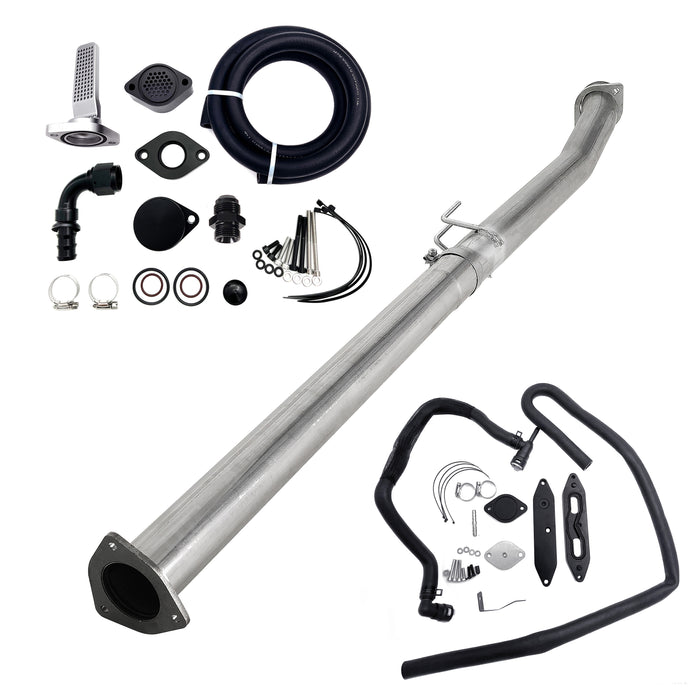
- 4" race pipe to end DPF regens and drop EGTs.
- EGR delete to stop soot from feeding the intake.
- CCV reroute to pull crankcase oil vapor out of the turbo inlet — the piece most budget kits leave out, and the one that keeps your intake clean long after the EGR is gone.
- Fits 2011–2023 F-250/F-350/F-450 Super Duty (pickup; not Cab & Chassis).
Both kits require a compatible delete tuner — that’s non-negotiable, and it’s covered next.
Know Your Generation: 2011–2023 Isn’t One Truck
The engine badge says “6.7L Powerstroke” the whole way through, but the truck under it changed repeatedly. “Fits 6.7 Powerstroke” is never enough to order parts:
| Model Years | What Changed | Buying Note |
|---|---|---|
| 2011–2014 | Early emissions layout, first-gen turbo and fuel system | Confirm pipe length and tuner support for the early platform |
| 2015–2016 | Updated sensors, turbo revisions, hardware changes | Use a kit explicitly listed for 2015+ trucks |
| 2017–2019 | Redesigned Super Duty body, tighter ECU strategy | Matched tuner and hardware are non-negotiable |
| 2020–2022 | 10-speed transmission, revised ECM, more monitoring | Later ECM security changes how tuning is accessed |
| 2023+ | High-output engine option, further electronic changes | Don’t assume a 2020–2022 kit or tune carries over |
The split that matters most for tuning is roughly 2011–2019 vs 2020+: the later trucks added electronic security that changes how (and whether) the ECM can be reflashed. Confirm your exact year and ECU strategy before ordering anything — a box of beautiful hardware is useless if the tune can’t be written.
4-Inch vs 5-Inch: Don’t Overthink It
| Factor | 4-Inch | 5-Inch |
|---|---|---|
| Best for | Daily, towing, work trucks | High-horsepower builds, max sound |
| Low-end torque | Preserved (higher exhaust velocity) | Slightly softer under 2,000 RPM |
| Cab noise | Controlled | More drone |
| Fitment | Broad, easier | Tighter around crossmembers |
How to Choose:
-
Most 6.7L owners should run a 4-inch pipe. It flows more than enough for a stock or mildly tuned truck, fits with better clearance, and keeps the cab quieter.
-
The 5-inch system is for high-output builds chasing maximum flow and a deeper tone — and it comes with noticeably more drone and a slightly softer bottom end.
A 5-inch pipe doesn’t add towing power by itself. The torque ceiling on these trucks is set by the transmission and the tune, not the pipe diameter. Pick 4-inch unless you have a specific reason not to.
Before Installation: You Must Tune First
This is the one step that turns a clean install into a bricked truck if you skip it: flash the delete tune before you remove any hardware.
What will happen if it is not Tune:
The 6.7L’s ECM is constantly watching the DPF, EGR, and their sensors. Pull the hardware and drive before the tune is written, and the truck will throw codes and drop into limp mode — sometimes within a single drive cycle. The tuner reprograms the ECM so it stops monitoring the removed systems, disables the regen strategy, and suppresses the related DTCs.
The Tips:
Tuning access varies by year (covered in the generation table above), so confirm your ECM strategy and tuner compatibility before ordering. A quality tuner is not an accessory — it’s the other half of the delete.
The Legal Reality: Read This Before You Commit
Removing or tampering with emissions equipment on a truck driven on public roads violates the federal Clean Air Act (42 U.S.C. § 7522) and EPA regulations.
The practical consequences are real and growing:
- Fines — civil penalties can reach into the thousands for individuals; commercial tampering penalties run higher.
- Registration and inspection — many states fail deleted trucks on visual inspection and OBD readiness, and enforcement is tightening.
- Warranty — Ford will deny powertrain claims tied to an emissions tamper, and modern dealer tools can detect a prior tune even after flashing back to stock.
- Resale — a growing number of dealers won’t take a deleted truck on trade, and private buyers discount for the legal risk.
These parts are intended for off-road, race, competition, and export applications where permitted. Know your local laws before you modify anything — that’s the owner’s responsibility, not the seller’s.
Conclusion
The 6.7L Powerstroke is one of the strongest diesel platforms Ford has ever built, but its emissions system is also the reason so many of them end up in the shop. The regen cycle — is the root of the oil dilution, the heat cycling, and the endless “Cleaning Exhaust Filter” messages that wear these trucks down.
The right response starts with diagnosis, not deletion. But when the emissions system genuinely is the failing part, a proper DPF and EGR delete stops the regen problem at its source: no filter to clog, no soot to feed it, and no post-injection to dilute your oil. Do it right — delete both systems together, add the CCV reroute, run a conservative tune, and keep an eye on the CP4 and the CCV filter that no pipe will ever fix — and a 6.7L you intend to keep can run clean, cool, and strong for years.
For the full lineup of 6.7L Powerstroke delete pipes, EGR kits, CCV reroutes, and tuners — built for the exact year and cab configuration of your Super Duty — head to TruckTok.com. Every kit is engineered for the platform’s specific emissions and airflow layout, ships free, and is backed by install guidance so you order the right part the first time.
Frequently Asked Questions
Q1: Will a delete improve my fuel economy?
A: Modestly — real-world gains are usually +1 to +4 mpg, mostly from ending the regen fuel waste and reducing backpressure. The 6.7L is a thirsty engine regardless, so don’t expect a dramatic jump. The real savings are on the repair side, not the pump.
Q2: Do I have to delete the EGR if I delete the DPF?
A: Yes. Deleting the DPF while leaving the EGR forces the tune to shut the EGR valve closed, packing soot into the cooler until it cracks and risks a coolant hydrolock. The two systems are one interconnected job and should be treated together.
Q3: Does a delete add horsepower?
A: Not by itself — the hardware only frees up single-digit to maybe 10–20 hp from reduced backpressure. The power comes from the tune you pair with it, and a conservative tow tune is the best reliability-to-power balance. The delete is the reliability mod; the tune is the power mod.
Q4: Does deleting fix the CP4 fuel pump problem?
A: No. The CP4 fails on stock and deleted trucks alike, and a failure can cost $8,000–$12,000 in fuel-system damage. If you’re worried about the CP4, a disaster-prevention kit or pump conversion is a separate decision from the delete.
Q5: My truck regens every 100 miles — is the DPF done?
A: Not necessarily. Check the cheaper causes first: a clogged pressure-sensor tube, a stuck EGR valve, an intake mod skewing the MAF, or a blocked CCV. A new or cleaned DPF will just plug again if the root cause is still producing soot.
Q6: Why does idling hurt the DPF?
A: At low cylinder temperatures, a diesel produces “wet soot” — heavy, sticky particulates that pack the filter fast and resist passive burn-off. Service vehicles and anything that idles for hours regen far more often than highway rigs, even with a healthy filter.
Q7: What is the CCV, and why does it matter for a delete?
A: The CCV (crankcase ventilation) filter separates oil mist from blow-by gases. When it clogs, crankcase pressure rises and blows seals — one owner’s blocked CCV caused a $7,900 rear-main and oil-pan seal repair. A delete that adds a CCV reroute keeps that oil vapor out of the intake for good.
Q8: Is a delete legal to drive on the street?
A: No. Removing emissions equipment on a public-road truck violates the federal Clean Air Act and can bring fines, inspection failures, warranty denial, and resale trouble. These parts are for off-road, race, competition, and export use only — check your local laws first.
Q9: What happens if I delete without a tune?
A: The ECM will detect the missing systems and throw codes, often dropping the truck into limp mode within a drive cycle. A delete-capable tune is mandatory — always flash it before removing any hardware.
Q10: Should I choose a 4-inch or 5-inch exhaust?
A: 4-inch for daily driving, towing, and work trucks — it flows plenty, fits easier, and keeps the cab quiet. 5-inch is for high-horsepower builds chasing maximum flow and a deeper tone, at the cost of more drone and slightly softer low-end torque.
Q11: Can I restore a deleted truck to stock?
A: Technically yes, if you kept the factory parts and can reflash a stock file — but it’s costly, and some dealer diagnostics can still detect a prior tune. Treat a delete as a committed decision, not a reversible experiment.
Q12: How often should I really change the CCV filter?
A: Real-world guidance points to roughly 20,000–30,000 miles, far shorter than many owners assume. If you’re keeping the stock CCV, service it on schedule; if you’re deleting, a CCV reroute removes the filter from the equation entirely.