

Home > News > LBZ Duramax EGR Delete vs Blocker Plate — The Holy Grail Engine Decision


LBZ Duramax EGR Delete vs Blocker Plate — The Holy Grail Engine Decision
Ask a Duramax guy to name the one engine he’d build a truck around, and the answer is almost always the same: the LBZ. The 2006–2007 Classic Silverado HD and Sierra HD — VIN code D — is the last Duramax built before the diesel particulate filter, the DEF tank, and the SCR catalyst arrived. It’s the platform everyone wants, and for good reason: a 6.6L V8 with a forged crank, a six-bolt main bearing web, and nothing but a single EGR system standing between it and mechanical simplicity.
That EGR system is the one crack in the grail. And when owners set out to fix it, they hit a decision that splits the community in half: spend twelve bucks on a blocker plate, or do it right with a full EGR delete.
Why the LBZ Is the Holy Grail — and Why That Makes the EGR Decision Matter
To understand the decision, you have to understand what makes the LBZ special in the first place.
The Duramax timeline
LB7 → LLY → LBZ → LMM → LML → L5P. Each generation added emissions hardware.
- The LMM (2007.5–2010) brought the DPF.
- The LML (2011–2016) added DEF and SCR.
- By the L5P (2017-2023), the emissions stack — EGR, DPF, DOC, SCR, DEF, and an encrypted ECM — was so integrated that deleting it became a five-figure.
The LBZ Structure Is Simple
It’s EGR-only, pre-DPF, pre-DEF. There’s no regen cycle to fight, no DEF fluid to freeze, no particulate filter to clog. Delete the EGR and you have a mechanically simple, durable engine — which is precisely why the LBZ has the cult following it does, and why “LBZ delete” means something completely different from “L5P delete.”
That simplicity also means the decision is simpler. On a modern truck you’re weighing a dozen interlocking systems. On an LBZ, you’re weighing one thing: how to deal with the EGR.
First, Confirm It’s Actually an LBZ (Not an LMM)
Before you order anything, nail down the engine generation. This is the single most common way owners buy the wrong parts — and the 2007 model year is the trap.
| Check | LBZ (2006–2007 Classic) | LMM (2007.5–2010) |
|---|---|---|
| Body style | 2007 Classic body | 2007.5 new body |
| VIN 8th digit | D | 6 |
| Factory DPF | No | Yes |
| Emissions | EGR only | EGR + DPF |
| Delete scope | EGR delete only | EGR + DPF delete |
A 2007 Classic-body truck is an LBZ; a 2007.5 new-body truck is an LMM. If someone is selling you an “LBZ DPF delete,” that’s a red flag — the LBZ has no factory DPF to delete. That phrase almost always means the truck is actually an LMM, or the seller is confused.
What the EGR System Is Doing to Your LBZ
On the LBZ, the EGR is the whole emissions story. It routes a portion of hot exhaust gas back into the intake to cool combustion and cut NOx. The problem is what that hot, soot-laden gas does to the engine over time — and what the EGR cooler does when it fails.
Two separate problems, both worth understanding:
1. Soot ingestion
The EGR valve feeds exhaust soot back into the intake manifold, where it mixes with crankcase oil vapor to form a thick, hardened sludge. Owners report a quarter-inch of carbon caking the intake bridge and Y-bridge by 150,000 miles — enough to choke airflow, raise intake temps, and slowly rob throttle response. The engine isn’t “running fine, just getting old”; it’s progressively strangling itself.
2. The cooler time bomb
The EGR cooler is a heat exchanger that cools the recirculated exhaust before it reaches the intake. On the LBZ it’s prone to internal cracking — a fatigue failure that leaks coolant directly into the intake tract.
Signs Your LBZ’s EGR Is Failing — Before You Decide
The decision between a plate and a delete only matters if you know what you’re actually dealing with. The two failure modes — cooler cracking and valve carbon — produce different symptoms, and telling them apart tells you which path is even on the table.
Signs the Cooler Is Cracking (The Serious One)
- Coolant drops with no puddle under the truck. The coolant is leaking internally into the intake and being burned off, so it never hits the ground. This is the single clearest sign of a cracked cooler.
- White smoke on cold start or hard throttle. Coolant entering the cylinders burns as white vapor — intermittent at first, then more persistent.
- A sweet smell from the exhaust or an oily film in the coolant reservoir. Both point to coolant and oil mixing where they shouldn’t.
- In the worst case: a hydrolocked cylinder or a blown head gasket, which is the $1,500 repair turning into a $5,000 engine job.
A cracked cooler is the one symptom a blocker plate cannot fix — blocking the exhaust flow doesn’t stop the coolant leak. If you’re seeing coolant loss and white smoke, your real choice is delete the cooler or replace the cooler. A plate just leaves the leak in place.
Signs the Valve Is Carboned Up (The Common One)
- Rough or uneven idle — the valve can’t seat cleanly anymore.
- Sluggish throttle and soft power — the intake charge is restricted by the carbon caked in the valve and intake bridge.
- Black smoke under load, from incomplete combustion.
- P0401 / P0404 codes — the ECM has detected the EGR flow is out of spec.
- Visible carbon when you pull the intake — a quarter-inch of hardened sludge on the bridge and Y-bridge is common by 150,000 miles.
A carboned valve is less catastrophic than a cracked cooler, but it’s still choking your engine and only gets worse. Unlike the cooler, a valve can sometimes be cleaned — but cleaning is a band-aid too, and it doesn’t stop the soot from coming back.
The short version: coolant loss + white smoke = cooler cracking (delete or replace it). Rough idle + black smoke + P0401 = valve carbon (delete, or clean it and keep fighting). Either way, the EGR system is doing damage, and the decision in front of you is how to make it stop.
Option 1: The Blocker Plate (The Band-Aid)
Understand The EGR Blocker Plate
A blocker plate is a thin machined shim — often $12 to $50 — that bolts between the up-pipe and the EGR cooler, physically stopping exhaust gas from flowing into the intake. All the factory hardware stays in place: the valve, the cooler, the plumbing, the sensors.
The appeal is obvious: it’s cheap, it installs in under an hour, and from the outside the truck looks completely stock. For a tight budget or a truck you plan to sell, it feels like a no-brainer.
The Problem Is What The Plate Does to Your Up-Pipe
The LBZ’s up-pipe features a flexible metal bellows designed to absorb thermal expansion. When you block off the EGR passage with a plate, the exhaust drive pressure that once flowed through the cooler now dead-ends against the plate. This trapped pressure, combined with engine vibration and thermal cycles, hammers the factory bellows, eventually leading to fatigue, cracking, and massive exhaust leaks under the hood.
Consequences In The Real World:
The result, documented again and again by owners and builders, is a blown-up bellows. The metal fatigues, cracks, and eventually lets go — creating an exhaust leak that coats the engine bay in soot, drops boost, and leaves you stranded.
WC Fabrication’s founder, Jason Worley, put it bluntly when asked why his company won’t sell blocker plates: “Nine times out of ten they lead to cracked pipe bellows and massive exhaust leaks.”
The One Nuance Worth Knowing:
A blocker plate that keeps the cooler installed can sometimes survive longer, because the cooler still provides physical support to the up-pipe and damps the vibration. One owner documented his dad’s truck running a plate for eight years of towing a 30-foot boat without a crack — because the cooler was left in place.
The failures happen most often:
When owners combine a plate with a cheap kit that also removes the cooler, leaving the up-pipe unsupported and the bellows to absorb both pressure and vibration. It’s a narrower distinction than the marketing suggests, but it explains why some plate setups live and others don’t.
Either way, you’re gambling on a part that was never designed to dead-head exhaust pressure. There’s a better answer.
Option 2: The Full EGR Delete (The Fix)
A full delete removes the EGR valve, the cooler, and the plumbing, then re-routes the coolant and closes off the ports with billet block-off plates. Done right, it eliminates the failure point entirely rather than working around it. But “full delete” isn’t a single thing. It’s a depth gauge, and how far you go determines both the cost and how bulletproof the result actually is.
Depth 1: The Basic Delete (Remove Valve + Cooler)
This is the minimum complete job. The valve and cooler come out, dual billet block-off plates (with O-ring seals, on an LBZ) close off the intake ports, a coolant line bypasses the now-removed cooler, and a support bracket holds the intake plumbing where the cooler used to anchor it. The engine breathes clean, cold air, and the cooler-leak risk is gone for good.
2006-2007 6.6L Chevrolet Silverado Classic GMC Duramax LBZ Diesel EGR Valve Cooler Delete Kit
The LBZ EGR Valve & Cooler Delete Kit removes the valve and cooler and closes off the intake with dual billet block-off plates, each with a built-in O-ring seal for a leak-free fit under boost. It includes the heavy-duty stainless steel support bracket that takes over the intake anchor point the cooler used to provide — the detail cheap kits skip, and the reason your intake plumbing doesn’t sag after the swap.
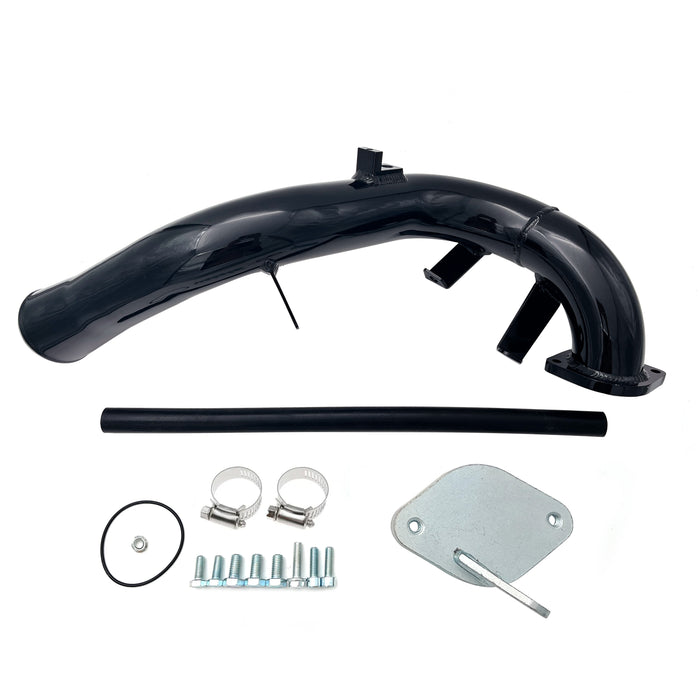
Depth 2: Add the High-Flow Intake Elbow
The factory intake elbow on the LBZ necks down — a deliberate restriction that slows the incoming air charge. A basic delete removes the EGR, but it leaves that necked-down elbow in place. Swapping in a smooth, mandrel-bent high-flow elbow opens up the air path, drops EGTs further, and sharpens turbo spool and throttle response — the difference between “deleted” and “deleted and breathing.”
2006-2007 6.6L Chevy Silverado Classic GMC Duramax LBZ Diesel EGR Delete Kit
The LBZ High-Flow Intake Elbow & EGR Delete Kit does everything the basic kit does and swaps the factory necked-down intake elbow for a smooth, mandrel-bent high-flow pipe. That’s the difference between simply removing the EGR and actually opening up the air path — lower EGTs, faster turbo spool, and a crisper throttle response under load. It’s the Depth 2 option for owners who want the delete to feel like an upgrade, not just a repair.
Both kits are built specifically for the 2006–2007.5 Classic LBZ (Silverado/Sierra 2500HD and 3500HD) and do not fit Cab & Chassis trucks or the later LMM. Both are designed to clear the factory MAP sensor bracket — on the LBZ the MAP sensor lives on the intake bridge, not the EGR hardware, so you don’t splice or extend any wiring.
Depth 3: The Bulletproof Stack (LB7 Up-Pipe + Y-Bridge)
This is the complete, do-it-once-and-be-done setup. It addresses the up-pipe bellows problem at the source, because a basic delete with the factory up-pipe still leaves that EGR leg and its bellows in place — the very part a blocker plate blows out. The full stack adds:
- LB7 up-pipe — the first-gen Duramax up-pipe has no EGR leg and runs straight to the turbo pedestal. It eliminates both the restriction and the bellows weak point entirely.
- Upgraded Y-bridge — the factory Y-bridge seals to the intake with two O-rings that are prone to blowing out under boost. A one-piece aftermarket bridge removes those O-rings and the boost leaks that come with them.
- 3-inch cold-side pipe — completes the unrestricted air path from intercooler to intake.
This is the setup builders call “bulletproof.” It’s also the most expensive — roughly $1,200 in parts if you do it yourself — which is why most owners don’t do it all at once.
The honest framing: a basic delete already fixes the EGR. The high-flow elbow and the bulletproof stack are performance-and-durability upgrades on top of that fix. You don’t have to go all the way to Depth 3 to beat a blocker plate — even Depth 1 does that — but if you’re going to tear into the back of the engine anyway, it’s the smart place to spend a little more.
What a Delete Won’t Do for You
An honest article ends with the caveats, so here they are:
-
It won’t add horsepower by itself. The delete removes a restriction and a heat source, which sharpens response — but the actual power comes from the tune. A conservative tune on a healthy LBZ is the reliability-to-power sweet spot; chasing big numbers is a separate project with separate risks.
-
It won’t fix a truck that already has a cracked cooler or a blown bellows. If your up-pipe is already damaged, deleting the EGR means swapping that up-pipe anyway — which is exactly why the bulletproof stack makes sense if you’re already in there.
-
It won’t make the truck emissions-legal. Removing the EGR on a street-driven truck is a Clean Air Act violation (42 U.S.C. § 7522), full stop. These parts are for off-road, race, competition, and export use — know your local laws before you buy.
The Cost Math: What Each Path Actually Costs
Here’s the real numbers, using the two TruckTok LBZ kits and the prices owners actually pay:
| Path | Hardware | Tuning | Real Risk Down the Road |
|---|---|---|---|
| Blocker plate | $12–50 | Required (~$400–600) | Up-pipe bellows blowout, cooler still cracks |
| Basic delete (ER-0024) | $63.49 | Required | Factory up-pipe leg still present |
| High-flow delete (ER-0026) | $128.99 | Required | Same, plus restricted elbow removed |
| Bulletproof stack | ~$1,200 (up-pipe + Y-bridge + cold side) | Required | Nothing left to fail |
Two Things Jump Out:
-
First, the difference between a blocker plate and a real delete is measured in tens of dollars, not hundreds. The “cheap” option isn’t saving you much — and it’s the only one that actively sets up a future failure.
-
Second, the tuning cost is the same on every path, because the ECM doesn’t care whether you blocked or removed the EGR; it detects the missing flow either way.
Tuning Is Not Optional
Here’s the part every budget plan forgets: the LBZ’s ECM is watching the EGR flow. Whether you install a $12 plate or a full delete, the computer will see that the expected exhaust flow is gone and throw P0401/P0402 codes — usually within the first mile, often followed by limp mode.
The Fix:
A tune disables the EGR logic in the ECM. On the LBZ, that’s done through EFI Live (the industry standard for Duramax) or a reputable custom tuner. Budget $400–600 for a quality delete tune, and don’t try to skip it — a truck that runs “fine” with the check-engine light on is still running incorrect fueling, and the light itself masks the next real problem.
When to Choose a Delete vs a Blocker Plate
Now that both options are on the table, here’s the decision made plain. The whole thing hinges on one question: are you willing to leave the EGR cooler in place?
That’s the real fork, because it determines whether a plate is a defensible choice or a trap:
-
Keep the cooler → a plate can work. The cooler still physically supports the up-pipe and damps vibration, which is why some plate setups survive for years. You block the flow, leave the hardware, and the main remaining risk is the cooler eventually cracking on its own.
-
Remove the cooler → go full delete. If the cooler is coming out — because it’s already leaking, or you want the clean engine bay and the elimination of the failure point — then a plate makes no sense. At that point, the delete is the cheaper and safer option.
Choose a Blocker Plate If…
- You’re on a very tight budget and need to stop soot ingestion now.
- You plan to sell the truck within a year or two and want it to still look stock.
- You’re keeping the cooler in place and accept the residual leak risk.
- You live somewhere that does basic visual inspections and want the delete to stay invisible.
- You just want to test whether eliminating the EGR improves how the truck runs before committing.
Choose a Full Delete If…
- You plan to keep the truck long-term and want the job done once.
- The EGR cooler is already leaking or showing signs of fatigue — a plate can’t fix a cracked cooler.
- You want the cooler gone entirely, along with its heat soak and its failure point.
- You’re running (or planning) any level of tune, and want clean airflow to match.
- You tow, haul, or work the truck hard and don’t want to gamble on a bellows blowing mid-pull.
- You want the cleaner engine bay that makes every future maintenance job easier.
The trap to avoid: the “staged” approach — start with a plate, then “upgrade to a full delete later.” Most owners who do this end up paying for the tune twice and re-doing the same labor, and the plate has often already stressed the bellows by the time they get around to it. If you think you’ll delete eventually, skip the plate and go straight to the delete now.
How to Install the LBZ EGR Delete: Step by Step
A full LBZ EGR delete is an intermediate-to-advanced DIY job — roughly 3–6 hours for a first-timer, with the tightest access at the back of the engine. Here’s the walkthrough, drawn from a real Evergreen-kit install on a 2007 Classic, so the steps and tool sizes are what you’ll actually hit. Here are more detailed installation instructions.
Tools You’ll Need
- Socket set with 8mm, 10mm, 11mm, 12mm, 13mm, 14mm and a 9/16" socket
- Swivel socket or ratchet wrench — the single most useful tool for the cooler’s rear nuts
- 2-inch extension, plus a cheater pipe for breaking the tight rear nuts loose
- T30 Torx bit, flathead screwdriver, pry bar or drywall knife
- Coolant catch pan, new coolant to refill, penetrating oil
- Magnetic tray — the small bolts are easy to drop into the valley
Step 0: Prep
- Disconnect both battery negatives before you touch anything electrical.
- Drain the coolant. The EGR cooler is full of it, and pulling it will dump coolant everywhere if you don’t drain first.
- Spray the rear cooler nuts with penetrating oil while you gather tools — they’re the hardest part and every minute of soak helps.
Step 1: Clear the Top of the Engine
- Loosen the intake resonator’s hose clamp and support bolt, then pull the resonator off.
- Remove the mass airflow (MAF) sensor (two small screws) and set it aside — now’s a good time to hit it with MAF cleaner.
- Pull the intake assembly off to open up working room.
Step 2: Remove the Intercooler Pipe and PCV Hose
- Slide the intercooler pipe off — it clears space in the back.
- Disconnect the PCV hose (10mm) — it runs right in front of the coolant tube and will fight you otherwise.
Step 3: Clear the Plastic Cover and Harness
- Remove the T30 Torx bolts holding the plastic cover over the valley.
- Unbolt the 10mm wiring-harness hold-downs and gently move the harness aside — there are several, so be patient and label nothing loose.
Step 4: Remove the EGR Valve
- Loosen the turbo mouthpiece hose clamp with a flathead and move it out of the way.
- Unbolt the EGR valve — typically four bolts, two top and two bottom — and set the valve aside with its gasket.
Step 5: Pull the EGR Cooler (The Hard Part)
This is where most of the time goes. The cooler is held by two rear nuts (top and bottom), two bolts by the alternator, and a top bolt:
- Pull the turbo heat shield off first — it opens up the space you need behind the turbo.
- The top rear nut usually yields to a ratchet with a cheater pipe.
- The bottom rear nut is the worst — you’ll want a swivel socket plus a 2-inch extension, working in the gap between the cooler and the downpipe.
- Remove the two 9/16" bolts holding the cooler by the alternator, and the 14mm top bolt.
- Disconnect the two coolant hoses — one at the back, one at the bottom.
- Work the cooler out by pulling it back toward the firewall, rotating it, and threading it past the harness. It’s tight; don’t force it.
Step 6: Install the Block-Off Plates and Coolant Reroute
- Match the block-off plate to the intake ports, reuse the metal gasket if it’s in good shape, and thread the bolts in by hand before tightening.
- Route the coolant bypass line from the bottom fitting up to the firewall, and install the included silicone hose in place of the cooler.
- If the kit has a support bracket, bolt it in where the cooler used to anchor the intake plumbing.
Step 7: Install the Intake Elbow and Reassemble
- Apply a thin bead of gasket maker to the intake elbow’s sealing surface, then bolt it down — leave the bolts loose until everything is lined up, then snug them.
- Reinstall the MAF sensor, the intake, and the resonator.
- Refill the coolant and bleed any air before first start.
Three Things That Bite First-Timers
- Crushing the plastic coolant fitting. The bypass line connects to a plastic fitting at the firewall. Tighten the clamp until it’s snug, and stop the moment it’s secure — over-tightening cracks the plastic, and that’s a dealer-only part.
- Dropping the rear nuts into the valley. The bottom rear cooler nut is right over the engine valley. Use a magnetic tray or a socket that grips the nut, because fishing a 12mm nut out of a Duramax valley is a special kind of misery.
- Skipping the tune. You can finish the install and drive the truck, but the check-engine light and limp mode will follow within the first mile if the ECM hasn’t been flashed. Do the tune before or immediately after — never weeks later.
Conclusion
The LBZ earned its “holy grail” title because it’s the last Duramax you can strip back to mechanical simplicity — no DPF, no DEF, no SCR, just a strong bottom end and a single EGR system to deal with. The decision that matters is how you deal with it.
The blocker plate is tempting, and for a truck you’re about to sell or a budget with no room to breathe, it’s something. But it’s the one option that actively engineers a future failure into your exhaust. A real delete — remove the valve and cooler, close the ports, reroute the coolant, and flash a proper tune — eliminates the failure point instead of bandaging it. Go one step further and swap the high-flow elbow, and it stops just fixing the problem and starts improving the truck.
For the full lineup of LBZ EGR delete kits, high-flow intake elbows, up-pipes, and tuners — built specifically for the 2006–2007 Classic Silverado HD and Sierra HD — head to TruckTok.com. Every kit is engineered for the LBZ’s exact dual-intake and up-pipe layout, ships free, and is backed by fitment guidance so you order the right part for your truck the first time.
Frequently Asked Questions
Q1: Does the LBZ Duramax have a DPF?
A: No. The LBZ (2006–2007 Classic) is EGR-only, pre-DPF and pre-DEF. If a listing mentions an “LBZ DPF delete,” that’s usually a sign the truck is actually an LMM or the seller is confused.
Q2: Is a blocker plate really going to blow out my up-pipe?
A: It’s the documented failure mode — the plate dead-ends exhaust pressure against the up-pipe bellows, which then fatigue and crack. Keeping the cooler in place can buy you time, but you’re gambling on a part never designed for that load.
Q3: What’s the difference between a basic delete and a high-flow delete?
A: A basic delete removes the EGR valve and cooler and blocks the ports. A high-flow delete also swaps the factory necked-down intake elbow for a mandrel-bent pipe, lowering EGTs further and improving turbo spool and throttle response.
Q4: Do I need a tune if I only install a blocker plate?
A: Yes. The ECM detects the missing EGR flow either way and throws P0401/P0402 codes, often followed by limp mode. A delete tune is required on every path, not just the full delete.
Q5: Does deleting the EGR add horsepower?
A: Not by itself. The delete removes a restriction and heat source, which sharpens response, but the power comes from the tune you pair with it. The main gains are reliability and a cleaner intake.
Q6: What is the “bulletproof” setup, and do I need it?
A: It’s the full stack — LB7 up-pipe, upgraded Y-bridge, and 3-inch cold-side pipe — that removes every O-ring and bellows weak point. You don’t need it to beat a blocker plate, but if you’re already tearing into the engine bay it’s the smart place to spend more.
Q7: Will the delete throw a check-engine light?
A: Without a tune, yes. With a proper EFI Live or custom delete tune, the EGR codes are disabled and the truck runs clean. A check-engine light left on is masking the next real problem.
Q8: Is an LBZ EGR delete legal on the street?
A: No. Removing emissions equipment on a public-road truck violates the federal Clean Air Act and can bring fines, inspection failures, and resale trouble. These parts are for off-road, race, competition, and export use only.
Q9: How do I confirm my truck is an LBZ and not an LMM?
A: Check the body style (2007 Classic vs 2007.5 new body) and the VIN’s 8th digit — “D” is LBZ. An LMM has a factory DPF, which the LBZ does not.
Q10: How hard is a full LBZ EGR delete to install?
A: It’s an intermediate-to-advanced DIY job, roughly 3–6 hours, with the tightest access at the back of the engine and the cooler’s two rear nuts being the hardest part. Plan for coolant handling and a swivel socket or ratchet wrench for the tough bolts.
Q11: Does a delete improve fuel economy?
A: Modestly — many owners report 1–3 mpg from the cleaner, denser intake charge and more efficient combustion. The bigger win is reliability and removing the cooler-leak risk, not the fuel gauge.
Q12: Why is the LBZ called the holy grail?
A: Because it’s the last Duramax before the DPF, DEF, and SCR systems arrived — a strong bottom end with a single, simple emissions system. That mechanical simplicity is what makes it the platform builders and enthusiasts still chase.