

Home > News > 6.7L Powerstroke EGR Delete vs Cleaning — Which One Do You Need?


6.7L Powerstroke EGR Delete vs Cleaning — Which One Do You Need?
Here’s the question every 6.7L Powerstroke owner hits sooner or later: the check engine light is on, the code points at the EGR system, and now you have to decide — clean it, replace it, or delete it entirely.
It’s a real decision, and it’s easy to get wrong. Clean a valve that’s actually mechanically seized and you’ll be back under the hood in a month. Replace a cooler that was never the real problem and you’ve spent $1,500 to watch the same failure come around again. And delete the whole thing without understanding what you’re committing to, and you’ve turned a repair into a legal liability.
This guide lays out all three paths with real numbers, so you can make the call for your truck — not the one a forum stranger made for theirs.
The Two Ways a 6.7L EGR Fails: Why It Matters
Before you can decide between cleaning and deleting, you have to understand that “the EGR is bad” actually means two completely different things. Getting this wrong is the single biggest reason people waste money on the wrong fix.
Carbon Build-Up: The Slow Choke
The EGR system’s whole job is to pipe a portion of hot, soot-laden exhaust gas back into the intake to cool combustion and cut NOx. The trade-off is that exhaust gas is filthy. Every mile, that loop carries carbon, soot, oil vapor, and unburnt fuel particles back into the intake manifold, the throttle body, and the EGR valve itself.
Over tens of thousands of miles, this sludge hardens into a black, tar-like coating. The EGR valve — gets sticky, then sluggish, then stuck. At that point you’re looking at:
- Rough, lumpy idle — the valve is letting exhaust in when the engine doesn’t want it
- Power loss under load — the intake is breathing through a carbon-clogged straw
- P0401 / P0404 codes — insufficient flow (clogged) or circuit range/performance (stuck valve)
Short trips and long idling accelerate this dramatically, because the engine never gets hot enough to burn deposits off naturally. This is why a plow truck or a stop-and-go delivery rig will coke an EGR valve in half the miles of a highway hauler.
Cooler Cracking: The Sudden Leak
To cool those recirculated exhaust gases before they re-enter the intake, Ford runs engine coolant through an EGR cooler — a compact brazed-aluminum heat exchanger that sits between the exhaust and intake streams. The problem is that this cooler runs brutally hot under load, and the constant thermal cycling — hot, cold, hot, cold — eventually cracks those brazed joints.
When the cooler cracks, coolant leaks directly into the intake tract. That’s a completely different failure than a carbon-clogged valve, with different symptoms:
- White smoke from the exhaust, especially at startup or light throttle
- Coolant level dropping with no visible leak — no puddle on the driveway, because the coolant is being burned in the combustion chamber
- Hydro-lock risk — enough coolant in a cylinder and the piston can’t compress it, which bends rods
This is the “not a matter of if, a matter of when” failure on the 6.7L. And here’s the thing that matters most for your decision: cleaning a cracked cooler does nothing. You can scrub the valve until it shines, but a cracked brazed joint is a physical hole that no solvent will fix.
Symptoms: Reading What Your Truck Is Telling You
So how do you know which failure you’re dealing with before you commit to a fix? The symptoms split fairly cleanly:
Pointing At A Clogged Valve:
- Rough idle, especially cold
- Power loss or hesitation on acceleration
- P0401 (insufficient EGR flow) or P0404 (circuit/performance)
- Black soot or a fuel smell, but no coolant loss
Pointing At A Cracked Cooler:
- White smoke at startup or under light throttle
- Coolant level dropping with no external leak
- A sweet smell from the exhaust
- Coolant in the oil (milky residue on the dipstick)
The Definitive Test
A Cooling-System Pressure Test:
Pressurize the system with a hand pump, watch for a pressure drop, and if it won’t hold with no external leak — the cooler is your culprit. A combustion-leak (block) test checking for exhaust gas in the coolant confirms it.
A Visual:
It is worth a thousand codes: pull the intake tube on the driver’s side and look at the throttle body and intake inlet. If it looks like the inside of a chimney, the EGR system has been pumping soot for a long time.
Option 1: Cleaning — When It Works, When It Doesn’t
Cleaning is the conservative, compliant path, and for the right truck it’s a legitimate fix. But “cleaning” is a word that covers two very different jobs, and only one of them actually works.
The Spray Myth
You’ve seen the videos: spray a can of EGR cleaner into the intake while the engine runs at 2,000 RPM, and the carbon “just dissolves.” Here’s what those videos don’t tell you.
The truth about spraying cleaning agents:
When you spray cleaner into the intake, most of it gets sucked straight into the combustion chambers and burns up before it ever reaches the EGR valve. More fundamentally, the EGR system flows exhaust gas from the exhaust manifold into the intake — the cleaner would have to travel backwards against that exhaust flow to touch the actual valve. It can’t.
What a spray does clean:
It can clean the intake manifold and intake passages — the oily sludge coating the inside of the intake pipes. That can improve airflow and throttle response a bit, and some drivers report smoother running. But that improvement comes from cleaning the intake, not the EGR valve.
There’s a downside: all that loosened carbon has to go somewhere, which usually means downstream into the DPF.
The spray cleaning is preventative maintenance for a valve that isn’t actually blocked yet. Think of it like flossing — it slows plaque buildup, but it doesn’t fix a cavity that already exists. If your EGR is blocked enough to throw a code, a can of spray won’t fix it.
Real Cleaning Means Removal
If the valve is actually clogged, there’s only one DIY method that has a chance: remove it and clean it manually.
That means unbolting the EGR valve, soaking it in carburetor/throttle-body cleaner, and physically scraping the carbon out with brushes and picks. The key is mechanical action — solvents loosen the deposits, but a brush is what actually removes them. A proper job takes a few hours and $20–50 in supplies.
Here’s The Hard Truth:
Cleaning is a treatment, not a cure. The carbon comes back, because the soot recirculation that caused it hasn’t stopped. A 2012 F-250 owner who had deleted his EGR, then returned it to stock for emissions testing, found his valve so coked up it threw a P0403. He cleaned it thoroughly — and the P0403 became a P043A (valve mechanically stuck open), because the valve’s internal mechanism had actually failed, not just gotten dirty. Cleaning couldn’t fix a seized actuator. He ended up buying a new valve anyway.
The bottom line on cleaning:
It works when the valve is only mildly dirty and mechanically sound. It fails when the valve is seized, when the passages behind it are blocked, or — critically — when the real problem is a cracked cooler.
How to Clean the EGR Valve: Step by Step
If you’ve decided the valve is worth cleaning (mild buildup, no coolant loss, no white smoke), here’s the full process for the 6.7L. Budget 3–4 hours for a first-timer.

Tools you’ll need: 8mm and 10mm sockets with extensions, a swivel, carburetor/throttle-body cleaner (or brake cleaner), a stiff brush and picks, compressed air, fresh gaskets and O-rings, a torque wrench, and a drain pan plus coolant for the top-up.
-
Disconnect the battery. Both negatives, so nothing shorts while you’re working around the valve’s electrical connector.
-
Drain the secondary cooling system. The EGR valve sits high on the engine, so you only need to drain about 3 gallons — once pressure equalizes, stop. This is the secondary circuit that feeds the EGR, transmission, and heater.
-
Pull the air cleaner assembly and outlet pipe to clear working room around the driver’s side of the engine.
-
Disconnect the EGR valve’s coolant vent hose and its hose retainer, then unplug the electrical connector.
-
Remove the inlet tube. There’s a 2-bolt bracket, then 4 bolts holding the EGR valve inlet tube. Set them aside in order — they’re not all the same length.
-
Remove the 13 EGR valve bolts. Note that one of them is noticeably longer than the rest and passes all the way through — remember where it goes. The bottom bolts are the hardest to reach and reinstall; a swivel and patience beat forcing them.
-
Pull the spacer/plate between the valve and the cooler. It’s another 8 bolts, and it cokes up just as badly as the valve itself — don’t skip cleaning it.
-
Clean everything. Soak the valve and spacer in carb cleaner, then work the carbon loose with a stiff brush and picks. Compressed air to blow the loosened gunk out of the passages. For heavy buildup, oven cleaner works well but is aggressive on aluminum — don’t let it sit too long.
-
Inspect before you reinstall. If the valve is mechanically seized, the seat is eroded, or the diaphragm is cracked, cleaning won’t save it — replace the valve. This is the step that separates a fix from a wasted afternoon.
-
Reassemble with fresh gaskets, following Ford’s torque pattern for the 13 bolts (and the 8 on the spacer), then refill the coolant, bleed the system, clear the codes, and test-drive.
One thing worth doing while you’re in there: if the cooler is accessible, flush it with a soap-and-water solution and let it dry before reassembly. It won’t fix a cracked cooler, but it clears the passages so a good cooler keeps working.
Option 2: Replacement — The Recurring Bill
When the cooler has cracked, or the valve is beyond cleaning, the “fix it” path means replacing parts. Here’s what that costs on a 6.7L:
- EGR valve replacement: $300–$1,050 all-in (valve part $150–600 OEM, plus 1.5–3 hours labor)
- EGR cooler replacement: $800–$2,000 at a Ford dealer, depending on region and whether they flush the cooling system (they should)
The problem with replacement is philosophical: you’re reinstalling the same design that failed in the first place. The factory EGR cooler is a brazed-aluminum unit that cracks under thermal cycling — and the replacement is a brazed-aluminum unit that will crack under thermal cycling.
Replacement makes sense for a truck that has to stay road-compliant and emissions-tested. It’s the legal path, and it keeps your OBD readiness and warranty intact. But if you’re planning to keep the truck for years, budget for this as a recurring expense, not a one-time fix.
Option 3: Delete — The Permanent Fix
An EGR delete physically removes the valve, cooler, and associated plumbing, replacing them with precision block-off plates and a coolant reroute. Once it’s done, exhaust gas never enters the intake again — no more carbon recirculation, no more cooler to crack.
The documented results, stated honestly:
- The intake stays clean. No soot recirculation means no more throttle-body and manifold carbon, period.
- Lower intake temps. Removing a major heat source (the hot cooler) drops intake air temps and reduces thermal stress on the surrounding wiring and sensors.
- Sharper throttle response under heavy load, because the intake is breathing clean, oxygen-rich air instead of diluted exhaust.
- No more recurring cooler/valve bills. The failure point is gone.
What a delete does not do, despite what some marketing claims, is add big horsepower. A delete alone is worth roughly 5–15 hp from reduced intake restriction — the real power comes from the tune you pair with it. And it is not legal on public roads: removing emissions equipment violates the federal Clean Air Act (42 U.S.C. § 7522). Delete kits are for off-road, race, and competition use only.
A delete requires a tune:
The 6.7L’s PCM constantly monitors the EGR loop through differential sensors. Remove the hardware without an emissions-off tune and you’ll get P0401 or P040F codes and a truck locked into limp mode. Tune first, then unbolt — never the other way around.
The Real Decision: Valve vs Cooler
Here’s the whole guide distilled into a decision you can actually use:
| Your situation | What it points to | The right move |
|---|---|---|
| Rough idle, P0401, no coolant loss, under ~80k miles | Clogged valve, mechanically sound | Clean it (manual removal) |
| Cleaning didn’t fix it, or valve seized (P043A) | Failed valve actuator | Replace the valve |
| White smoke, dropping coolant, no external leak | Cracked cooler | Replace or delete — cleaning won’t help |
| Recurring failures, off-road/competition use | The design itself is the problem | Delete it |
The single most important takeaway: if the cooler is cracked, cleaning is off the table. A cracked brazed joint is a hole, and no amount of carb cleaner fills a hole. That’s the fork in the road that decides whether you’re on the repair path or the delete path.
The Cost Math: The Three Ways
Let’s put real numbers side by side so the decision is concrete:
| Path | Recurring? | Notes |
|---|---|---|
| DIY valve cleaning | Yes, every 30–50k miles | Only works on mild buildup |
| Pro EGR system cleaning | Yes | Comprehensive, but carbon returns |
| Valve replacement | Maybe (cooler can fail next) | Legal, compliant |
| Cooler replacement (dealer) | Yes, every 60–80k miles | Same design, same failure |
| EGR delete + tune | No | Off-road only, permanent |
The math that surprises most people:
A delete, even with the tune, often costs less than a single dealer cooler replacement — and it never comes back. That’s why, for trucks that live off-road or are used hard for towing and farm work, the delete is the financially rational long-term play. The catch is entirely legal, not mechanical.
What a 6.7L Delete Actually Involves
If you’re going the delete route, there are three things specific to the 6.7L platform that you have to get right.
Tune First — This Is the Golden Rule
Before you touch a single bolt, flash an emissions-off delete tune into the PCM. The 6.7L’s computer is aggressive about protecting the engine, and a missing EGR with no tune means instant codes and limp mode. Do the tune while the truck is still complete, then remove hardware.
The Coolant Reroute — The 6.7L’s Hidden Complexity
This is where the 6.7L is different from a lot of other diesels, and where cheap kits fall short. The 6.7L runs a split (primary/secondary) cooling system, and the EGR cooler lives in the secondary circuit. When you remove the cooler, you can’t just cap the lines and walk away — coolant has to keep circulating through that rear section of the block, or you create hot spots around cylinders #4 and #8 (which are already the hottest cylinders on this platform).
This is the single biggest thing that separates a quality kit from a box of generic plates. It’s also why some model years need extra attention:
- 2011–2014: first-gen trucks, the most frequent cooler failures (original cooler design)
- 2015–2016: Ford revised the secondary cooling layout and quick-connect hardware — these trucks need an additional, model-specific reroute hose
- 2017–2019: updated hardware, generally improved but not immune
Block-Off Plates — Install Them When You Delete
This one comes straight from a real failure. The forum record is clear: owners who delete the EGR but don’t install block-off plates right away find their EGR valve coked solid within months — because the now-dead valve just sits there accumulating carbon. Install the block-off plates at the same time you delete, not weeks later.
How to Install an EGR Delete Kit: Step by Step
The physical install follows a clear order, and getting that order wrong is what trips up most first-timers. Budget a full day the first time through — access behind the 6.7L is tight.
Tools You’ll Need:
The 8mm and 10mm sockets with a wobble and long extensions, a pry bar, picks, PB Blaster or equivalent penetrating oil, a torque wrench, a drain pan, fresh coolant, and — a trick worth stealing — an old socket with a slot ground in it to turn the radiator petcock.
Tune First
Before you unbolt a single part, flash the emissions-off delete tune into the PCM while the truck is still complete. This is non-negotiable; skip it and you’re in limp mode with P0401/P040F before the job is done.
Install The EGR Delete Kit
-
Disconnect both negative battery terminals.
-
Drain 3–5 gallons of coolant from the secondary system. The petcock sits in a tight spot; a slotted socket lets you ratchet it out instead of fighting it with pliers.
-
Clear the top of the engine. Pull the air cleaner, the crossover tube from the manifold, and start disconnecting sensors — lay the harness up and over the engine so it’s out of your way when the cooler comes out.
-
Crack the two 8mm manifold bolts. These are the two bolts holding the manifold to the EGR cooler, and they’re the most-feared part of the whole job — they seize and snap. The proven play: take the truck for a hard 20-minute drive first to heat-soak everything, then crack them loose while it’s still hot, working them in-and-out with penetrating oil rather than forcing them. A wobble socket is your friend.
-
Remove the EGR cooler. Disconnect the coolant lines, the sensors, and the mounting bolts, then work the cooler out — it’ll still have some coolant in it, so keep the drain pan handy and don’t tip it into the engine.
-
Remove the EGR valve (the 13 bolts from the cleaning section above, plus the spacer).
-
Bolt on the block-off plates. Manifold plate, exhaust plate, and coolant plate — all three, in that order, with fresh gaskets. Torque them properly; these are aluminum mating surfaces and don’t need to be cranked down.
-
Install the coolant reroute. This is the step cheap kits skip and you can’t. Whether it’s a pass-through plate or a bypass hose, the coolant has to keep circulating through the rear block. If your kit uses a hose, cut the “T” connector out of the factory line and bridge it with the supplied hose barb and clamps — or, with a quick-connect kit, just click the molded hose into the factory ports.
-
Protect the orphaned connectors. Every sensor you unplug and leave behind will corrode. Pack them with dielectric grease, tape them up, and zip-tie them out of the way so they stay good if you ever re-install the emissions hardware.
-
Refill and bleed. Top up the coolant, burp the system thoroughly to get the air out, check for leaks, clear any codes, and take it for a test drive — watching the temp gauge until you’re confident it’s stable.
The single most important thing to internalize: the coolant reroute is not optional on the 6.7L. Skip it and you’re not “saving a step” — you’re creating hot spots on cylinders #4 and #8, which is exactly the kind of failure a delete is supposed to prevent.
The Three Kits: Matching Coolant Reroute to Your Build
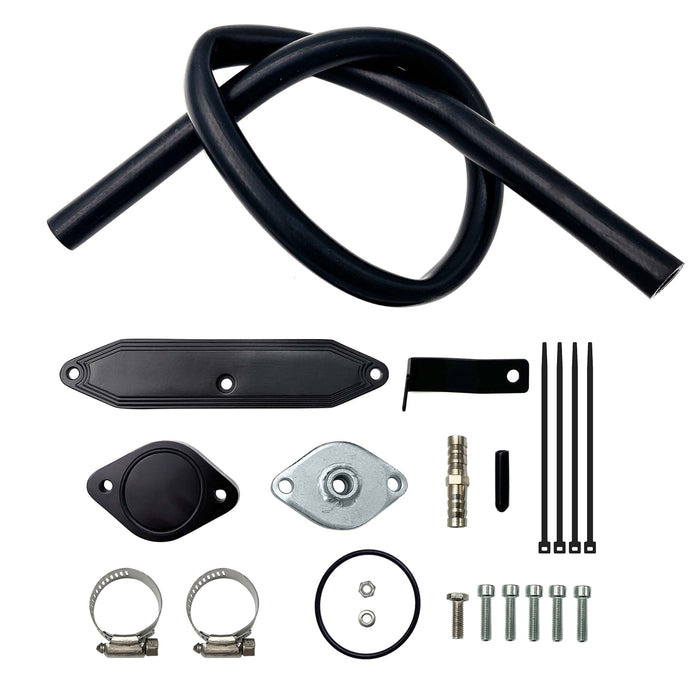
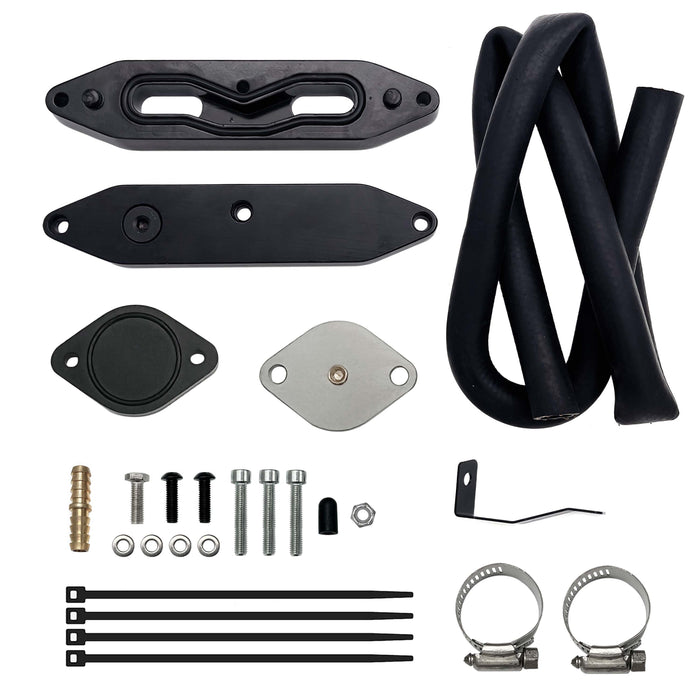
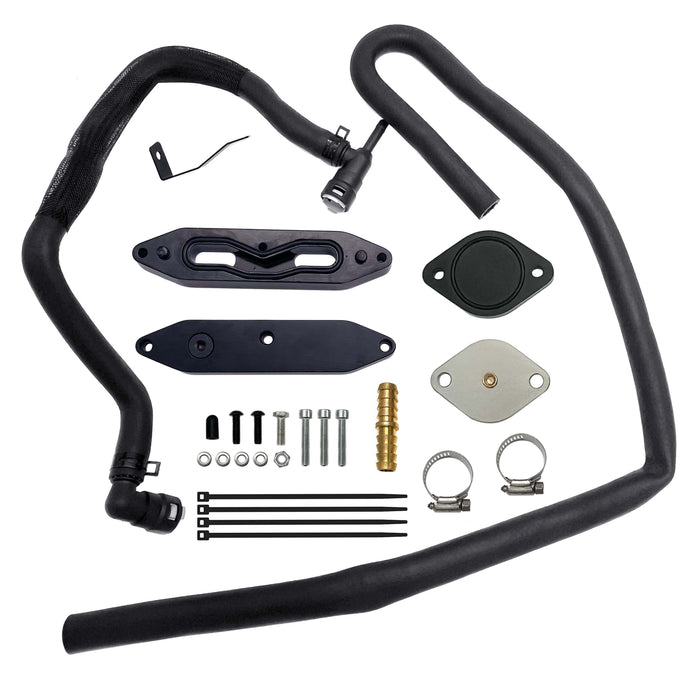
TruckTok builds three 6.7L EGR delete kits, and the difference between them is exactly the coolant-reroute complexity we just covered. Here’s how they stack up:
Option 1: The Value Kit — $55.99
2011-2023 6.7L Ford F250 F350 F450 F550 Powerstroke Diesel EGR Valve Delete Cooler Delete Kit
-
The entry point. CNC 6061 billet-aluminum flanges plus a 304 stainless steel exhaust block-off plate rated to 1,472°F, with an upgraded coolant pass-through plate that keeps the rear-block coolant loop flowing while sealing off exhaust gas.
-
The stainless plate comes pre-drilled and tapped (1/8" NPT) so you can re-thread your factory EGT sensor or run an aftermarket gauge.
-
Drops pre-delete area temps by up to 36°F.
-
Fits 2011–2023 F-250/F-350/F-450/F-550, pickup and cab & chassis — measure your EGT sensor thread (10mm or 12mm) before ordering.
Option 2: The Thermal-Management Kit — $85.99
2011-2023 6.7L Ford Powerstroke Diesel EGR Delete Kit
-
Steps up to a dedicated extra coolant bypass plate engineered specifically to prevent hot spots around cylinders #4 and #8 — the two cylinders notorious for running hot on the 6.7L.
-
It pairs with a reinforced silicone reroute hose that connects the heater-core return to the secondary water pump on the front-passenger side, completely bypassing the old cooler routing.
-
6061-T6 billet construction throughout.
-
This is the kit for trucks that tow heavy and live at high EGTs, where thermal stability is the whole point of the delete.
Option 3: The Plug-and-Play Kit — $108.99
2011-2023 6.7L Ford Powerstroke Diesel EGR Delete Kit
-
The premium option, built around a dual-layer plate with an internal bridge track that keeps coolant actively moving across the back of the block, and — the headline feature — a molded, model-specific bypass hose with factory quick-connect fittings on both ends.
-
Instead of cutting your OEM lines and wrestling brass barbs and worm-gear clamps, you click the hose straight into the factory secondary-cooling ports.
-
The stainless exhaust plate includes a threaded hex plug if you’d rather delete the EGT sensor entirely.
The Through-Line:
All three seal off exhaust and keep coolant circulating — the question is just how much thermal engineering and install convenience you want to pay for. For a weekend toy, the option 1 gets it done. For a truck that earns its keep towing, the option 2’s #4/#8 protection or the option 3’s plug-and-play hose are worth the step up.
A note on pairing: an EGR delete blocks the soot, but your factory CCV still dumps oil mist into the intake — and leftover soot + oil mist = the same engine-choking sludge you were trying to eliminate. For a truly clean intake tract, a CCV reroute kit is the natural companion to any of these three. And remember, every one of these kits requires a delete tuner — the hardware won’t run without it.
Where DIY Installers Get It Wrong
From the videos and forum threads, the recurring mistakes on a 6.7L EGR job:
-
Skipping the tune. The #1 mistake. Remove hardware without the tune and you’re in limp mode with P0401/P040F before the hood’s even down.
-
The two manifold bolts. The two 8mm bolts that hold the manifold to the EGR cooler are the most-feared part of this job — they seize and snap. The proven trick: take the truck for a hard 20-minute drive to get everything heat-soaked, then crack them loose while it’s still hot, working them in-and-out with penetrating oil rather than forcing them. A wobble socket and patience beat a snapped bolt every time.
-
Not draining the secondary system. You don’t need to drain the whole radiator — the EGR sits high on the secondary circuit, so draining 3–5 gallons from the right point (with the EGR valve’s coolant lines open) is enough. But skip it entirely and you’ll be wearing a faceful of coolant.
-
Forgetting the block-off plates. As covered above — delete without block-off, and the valve cokes solid in months.
-
Not re-bleeding the cooling system. After refilling, you have to burp the system to get air pockets out, or you’ll overheat. Idle it up to temperature, bleed, top off, and check for leaks.
-
Leaving orphan connectors exposed. Any sensor you unplug and leave dangling will corrode over time. Pack the connectors with dielectric grease and zip-tie them out of the way, so they’re still good if you ever re-install the emissions hardware.
Conclusion
The 6.7L Powerstroke is one of the most capable diesels Ford ever put in a Super Duty — and its EGR system is the one weak link that threatens that capability. The question isn’t really “clean or delete,” it’s “what’s actually wrong, and what’s the truck’s life going to look like.”
If you’ve got a mildly dirty valve on a lower-mileage, road-driven truck, clean it — but do it by removal, not spray, and know the carbon’s coming back. If the cooler is cracked, that’s a different problem with only two honest answers: replace it (legal, recurring) or delete it (permanent, off-road only). And if you’re tired of fighting the same failure on a truck that works hard and lives off-road, the delete is the fix that actually stays fixed — as long as you pair it with a tune, get the coolant reroute right, and install the block-off plates at the same time.
For the full lineup of 6.7L EGR delete kits — from the value ER-0046 to the plug-and-play ER-0088 — plus the CCV reroute kits and delete tuners they pair with, head to TruckTok.com. Every kit is engineered specifically for the 2011–2023 Super Duty’s split cooling system, ships free, and is backed by install guidance for your exact year and body style, from standard pickup to commercial cab & chassis.
Frequently Asked Questions
Q1: Can I clean my EGR valve without removing it?
A: Technically you can spray cleaner into the intake, but it mostly burns up before reaching the valve, and it can’t flow backwards against the exhaust stream. Spray only works as light preventative maintenance, not on a valve that’s already blocked enough to throw a code.
Q2: How do I know if my EGR cooler is cracked or just the valve is clogged?
A: White smoke and unexplained coolant loss point to a cracked cooler. A clogged valve shows up as rough idle and P0401/P0404 with no coolant loss. A cooling-system pressure test is the definitive diagnostic for the cooler.
Q3: Do I need a tune if I delete the EGR on a 6.7L?
A: Yes, always. Without an emissions-off tune, the PCM detects the missing EGR and triggers P0401 or P040F codes plus limp mode. Flash the tune before removing any hardware.
Q4: Which years of the 6.7L have the worst EGR problems?
A: Cooler failures are documented across all generations, but the 2011–2014 first-gen trucks see them most often due to the original cooler design. The 2015–2016 refresh improved things but didn’t eliminate the issue.
Q5: Why does a 6.7L EGR delete kit need a coolant reroute?
A: The 6.7L runs a split cooling system, and the EGR cooler sits in the secondary circuit. You can’t just cap the lines — coolant has to keep flowing through the rear block or you’ll get hot spots on cylinders #4 and #8.
Q6: Is a 6.7L EGR delete legal?
A: No, not on public roads. Removing emissions equipment violates the federal Clean Air Act (42 U.S.C. § 7522), and individual fines can reach $5,911. Delete kits are for off-road, race, and competition use only.
Q7: Does deleting the EGR add horsepower?
A: Only a little on its own — roughly 5–15 hp from reduced intake restriction. The real power gains come from the tune you pair with the delete, not the hardware removal itself.
Q8: Why do I need block-off plates if I’m deleting the EGR?
A: Without block-off plates, the now-dead EGR valve sits there accumulating carbon and cokes solid within months. Install the plates at the same time you delete, so you don’t end up with a seized valve if you ever need to re-install the system.
Q9: How long will a cleaned EGR valve stay clean?
A: Cleaning is a treatment, not a cure — the soot recirculation that caused the buildup hasn’t stopped, so the carbon comes back. Expect to re-clean roughly every 30,000–50,000 miles depending on driving habits. Short trips and heavy idling coke it up faster.
Q10: If I delete the EGR, do I also have to delete the DPF?
A: Yes, in practice. Once the EGR is gone, the factory DPF no longer self-cleans and will plug up with soot quickly. Pairing the EGR delete with a 4-inch DPF delete pipe and an emissions-off tune keeps the exhaust flowing, since the two systems are designed to work together.
Q11: Are cab & chassis and pickup EGR parts interchangeable?
A: No. Cab & chassis trucks use a cast-iron EGR valve, while pickups use an aluminum one, and they are not interchangeable. Match your kit and any replacement valve to your body style before ordering.