

Home > News > 6.7L Powerstroke P0401 / P0402: What the EGR Codes Tell You

6.7L Powerstroke P0401 / P0402: What the EGR Codes Tell You
P0401 and P0402 are the same EGR system telling you two opposite things — too little flow or too much. The mistake almost everyone makes is assuming the fix is a new EGR valve. On the 6.7L Powerstroke, it usually isn’t. P0401 is a clogged cooler, and P0402 is either a stuck valve or a sensor lying to the computer. Read the code the right way and you’ll spend $50 on the right fix instead of $1,500 on the wrong part.
For off-road / competition use only. Not legal for on-road use in emissions-regulated areas. Check your local, state, and federal laws before modifying any emissions-related component.
The Two Codes, and What the ECM Is Actually Saying
The EGR valve routes a controlled amount of exhaust back into the intake to lower combustion temperature and cut NOx. The ECM opens the valve, watches airflow and pressure drop, and verifies the exhaust actually arrived. When that verification fails, it throws one of two codes.
| Code | Meaning | What the ECM is really saying |
|---|---|---|
| P0401 | EGR flow insufficient | “I opened the valve and not enough exhaust made it to the intake.” |
| P0402 | EGR flow excessive | “I closed the valve and exhaust is still getting through.” |
Neither code means “the valve is broken.” It means “the flow I measured doesn’t match what I commanded.” The distance between those two statements is where all the misdiagnosis lives.
Source: the P0401/P0402 definitions are the standard OBD-II EGR flow descriptions; the ECM’s actual logic is MAF/position based on the 6.7L platform.
The Full Family: Four Codes, Four Different Faults
EGR codes aren’t interchangeable — each one points at a different part of the system:
- P0401 (insufficient flow) — the passages aren’t flowing. Clogged cooler first, stuck-closed valve second, plugged feedback tubes or a soot-packed intake behind those.
- P0402 (excessive flow) — the valve is admitting exhaust it shouldn’t, or a sensor is inventing flow. Stuck-open valve or a false reading.
- P0403 (control circuit) — the electrical signal to the valve motor is out of range. Wiring, connector, or a failed valve motor.
- P0404 (position sensor) — the valve’s internal position sensor is reporting impossible values. Mechanical binding or a dead sensor.
The pair that matters most on this platform: P0401 and P0404 traveling together. The cooler clogs (P0401), backpressure rises, the valve gets pushed partially open against its motor, and the position sensor reports erratic data (P0404). Fix the clogged cooler first and P0404 often clears itself.
Why P0401 Is Almost Never the Valve on a 6.7L
Here’s the platform-specific fact that flips the generic diagnosis on its head: the 6.7L Powerstroke puts the EGR valve upstream of the cooler. That means the valve sees exhaust before it’s been cooled, but it doesn’t sit in the worst of the soot — the cooler does.
The result is the single most useful rule for this engine:
- The EGR valve rarely fails on the 6.7L. It’s not the soot-catching part.
- The EGR cooler is the #1 cause of P0401, specifically its secondary side. Exhaust flows through a bundle of small tubes; after 80,000–120,000 miles those tubes pack with carbon until the valve opens but almost nothing gets through.
One shop’s frequency breakdown for P0401 across the diesel platforms puts the cooler at 60–70% of cases and the valve at only 15–20%, with feedback sensors/tubes, a soot-packed intake manifold, and a manifold leak upstream making up the rest. Pull the valve and scope the cooler passage before you order a single part.
Source: diesel diagnostic guides and shop experience; percentages are representative ranges, not OEM data.
Why P0402 Is a Different Animal: The Lying Sensor
P0402 (excessive flow) is where owners waste the most money, because its most common cause on a 6.7L isn’t mechanical at all — it’s a sensor reporting flow that isn’t there.
The P0402 test runs at idle. The ECM closes the EGR valve, then measures fresh airflow through the MAF to establish a baseline. If airflow reads lower than expected with the valve shut, the ECM concludes “exhaust is leaking past the valve” and sets the code.
But three things produce that exact same reading without any valve fault:
-
A dirty or drifting MAF sensor reading airflow low.
-
A failed or soot-clogged EBP (exhaust back pressure) sensor — the absolute king of false alarms on this platform, which tricks the ECM into seeing ghost backpressure.
-
An air leak after the sensor, or a dirty air filter.
Before you condemn the valve, compare MAP, EBP, and MAF readings against each other with a scan tool. An EBP that reads roughly double the MAP at the same RPM, or is completely carbon-plugged at its inlet tube, indicates a dead sensor—not a bad valve. Try cleaning the EBP tube or checking its live data before ordering parts.
Source: Ford-trucks forum diagnostics; the EBP-sensor-as-false-P0402 pattern is owner-and-tech reported.
The Diagnostic Order: Cheapest Check First
Follow this ladder and you’ll almost never buy the wrong part:
-
Visual (free). Inspect every rubber hose, vacuum line, and connector near the valve and cooler. The #1 free fix for P0401 is a reference or feedback tube that popped off or cracked.
-
Sensor sanity (free with a scan tool). Key on, engine off: MAF should read near zero, MAP near barometric pressure, IAT near ambient, EGR position 0%. If MAF shows 40 g/s with the engine off, fix the sensor first — bad sensor data can’t be cured with EGR work.
-
Valve command test (bidirectional scan tool). At hot idle, command the valve to 50% open. If MAF drops and the engine stumbles, the valve and passages are functional. If the position PID matches the command but MAF and RPM don’t change, the passage is blocked — that’s the cooler problem.
-
Scope the passage ($30 boroscope). Pull the valve, look into the cooler port. Solid black carbon = you found it. Don’t replace the valve.
-
Cooling-system check (water-cooled cooler). Pull the degas bottle cap. “Chocolate milk” (oil and coolant mixed) means a ruptured cooler — which is past P0401 and into a real problem.
Source: the diagnostic sequence is the standard EGR flow-test path; the KOEO baseline values are platform-typical.
The Reason You Don’t Just Tear Into the EGR
On the 6.7L specifically, the EGR is a job you approach carefully, because the disassembly itself carries two real risks:
-
The cooler O-rings get pinched. The two O-rings deep in the cooler housing are easy to cut on reassembly, and a cut O-ring leaks coolant straight into the intake — a hydrolock risk. Some techs replace the whole cooler assembly on the bench to avoid it.
-
The exhaust-manifold bolts break. The EGR crossover pipe bolts into the exhaust manifold, and they’re notorious for snapping. If one breaks, you’re drilling it out — or, worst case, lifting the cab, which is a 12-hour job.
This is why the diagnostic order exists: you don’t want to be the guy who pulled the cooler, snapped a bolt, and discovered the real cause was a $250 EBP sensor.
Source: owner install videos and tech reports; the bolt-break and O-ring risks are widely documented on the 6.7L.
Clean, Replace, or Delete: The Three Paths, Weighed
Once you’ve found the actual cause, the decision follows from what you found — and each path has a real trade-off.
Cleaning
-
Pros: The cheapest fix, usually $50–$100 in supplies and an afternoon of labor. It keeps the truck emissions-compliant and legal, and it works when the problem is carbon slowing an otherwise healthy valve.
-
Cons: It’s a stopgap, not a cure. Cleaning can’t fix a fully plugged secondary cooler, a failed actuator or position sensor, a cracked housing, or a worn seat. On a high-mileage truck, the carbon comes back — and the code with it.
-
Right for: A street truck with light-to-moderate buildup where the valve still moves and the cooler isn’t packed solid. Owners who want to stay legal and don’t mind doing it again down the road.
Replacing
-
Pros: Restores factory function and keeps the truck street-legal and emissions-compliant. A new valve or cooler brings the EGR system back to spec, and on a low-mileage truck it can hold for years.
-
Cons: The most expensive of the three legal options. An EGR valve runs $100–$700 for the part and $400–$1,600 installed; a cooler runs $280–$620 in parts and $1,200–$3,500 installed. And you’re replacing the failure mode with the same part — same design, same thermal stress, same eventual clog.
-
Right for: A street truck where the valve failed an active test, gives a bad position signal, has a damaged seat, or sticks again right after cleaning. Anyone under warranty or in an emissions-testing state.
Deleting
-
Pros: The only permanent fix. It removes the valve, cooler, and the passages, so the failure mode is gone — no more P0401, no more P0402, no more coolant-in-the-intake risk from a cracked cooler. The intake stays clean for the life of the engine.
-
Cons: It’s an emissions modification — off-road and competition use only, with federal penalties up to $5,911 per violation if you run it on the road. It voids the emissions warranty, needs a delete tune (a separate purchase, and non-negotiable), and can complicate resale in states with inspections.
-
Right for: A dedicated off-road, farm, or competition truck where the EGR has already failed once and you don’t want to pay for it twice.
The honest distinction: cleaning and replacing keep you legal and keep the failure mode alive. Deleting ends the cycle, but it’s an emissions modification — off-road and competition use only, and it requires a tune to keep the ECM from throwing a permanent rationality fault.
Three Ways to Delete the EGR on a 6.7L: Choose the Right One
If you’ve diagnosed a clogged cooler or a failing valve and you’re going off-road, here are three kits that match three different priorities — all built for the 2011–2023 6.7L Powerstroke, all deleting both the EGR valve and cooler.
The Budget Pass-Through
The 2011–2023 6.7L Ford EGR Valve & Cooler Delete Kit is the entry point, and it’s the most straightforward way to get the failure point off the engine.
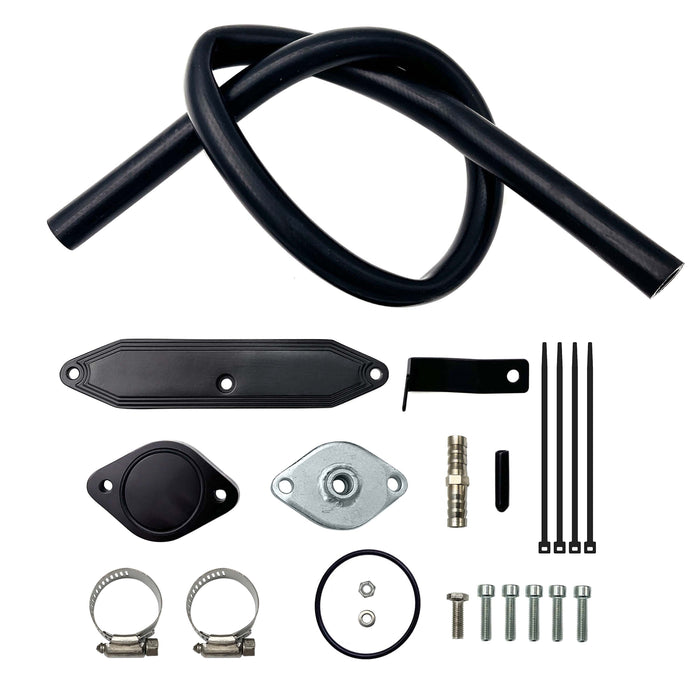
- Material: CNC 6061 billet aluminum block-off plates plus a 304 stainless steel exhaust plate rated to hold up under diesel exhaust heat.
- The coolant solution: a pass-through plate that keeps the secondary loop circulating through the old coolant track while sealing off the exhaust gas. It’s the simplest reroute — no custom plumbing to figure out.
-
Exhaust side: the 304 stainless plate comes pre-drilled and tapped with a 1/8" NPT port, so you can thread the factory EGT probe back in, run an aftermarket gauge sensor, or plug it clean.
- Who it’s for: the owner who just wants the failure point gone at the lowest price and doesn’t tow hard enough to worry about rear-cylinder heat.
The Mid-Tier With the #4/#8 Protection
The 2011–2023 6.7L Ford Powerstroke EGR Delete Kit adds the piece that actually matters on a deleted, working 6.7L.
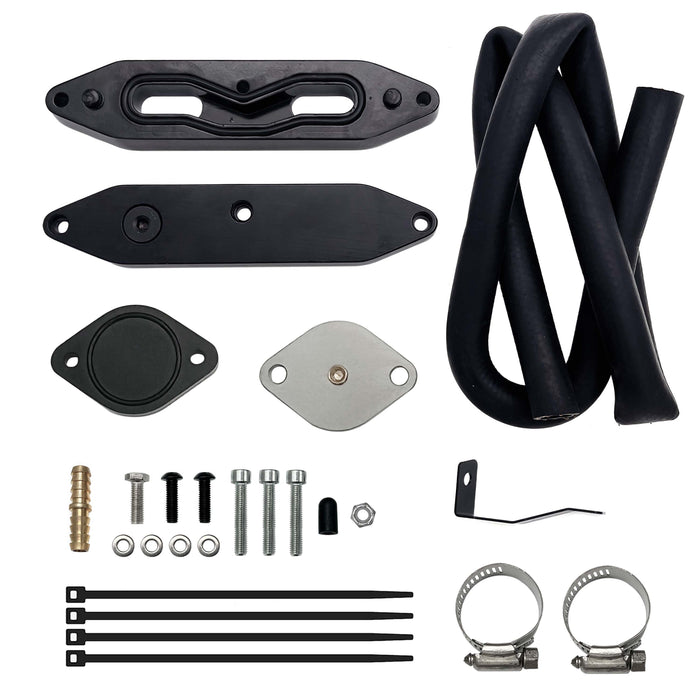
- Material: 6061-T6 billet aluminum flanges with high-temperature gaskets for a zero-leak seal.
- The coolant solution: a dedicated bypass plate with an internal hollow track that routes coolant back to the water pump. This is the fix for the 6.7L’s known hot spots .
-
The hose: a reinforced silicone reroute hose that connects the heater-core return to the secondary water pump on the front-passenger side, completely bypassing the old cooler routing.
- Who it’s for: owners who tow or work the truck and want the rear-cylinder safety margin without paying for the top-tier fitment.
The Top-Tier Plug-and-Play (ER-0088, $108.99)
The 2011–2023 6.7L Ford Powerstroke Diesel EGR Delete Kit is the complete version — the one you buy when you want the delete done right the first time, with no fitment fiddling.
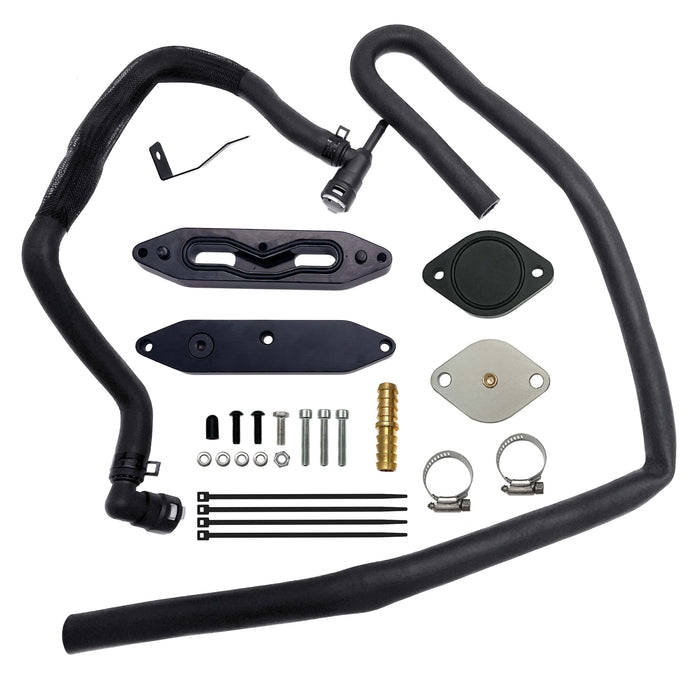
- Material: 6061-T6 billet aluminum with high-temperature gaskets.
- The coolant solution: a dual-layer plate with an internal bridge track built in. Instead of a flat plate, the two layers connect the open coolant channels so fluid keeps moving across the back of the block — the best thermal stability under sustained heavy load.
- The hose: a molded, factory-style quick-connect bypass hose. This is the plug-and-play part — the elbows click directly into the truck’s original secondary cooling ports, so there’s no cutting the OEM lines, no brass barbs, no worm-gear clamps.
- Exhaust side: the stainless plate includes a low-profile threaded hex plug, so if you delete the fragile EGT sensor instead of transferring it, you can seal the port cleanly.
- Who it’s for: the owner who wants the delete done once, correctly, and doesn’t want to fight the coolant routing — or who plans to run the truck hard.
All three kits are hardware only — the delete tune is a separate purchase and is non-negotiable. Without a tune, the ECM throws a permanent EGR rationality fault on every drive cycle, and the truck derates.
How to Install a 6.7L EGR Delete: Step by Step
A 6.7L EGR delete is an intermediate-to-advanced job — roughly 4–6 hours for a first-timer, and the tightest part is the cooler removal at the back of the engine. Here’s the walkthrough, drawn from real 6.7L cooler removals, so the tools and sequence are what you’ll actually hit.
Tools You’ll Need
- 8mm socket (most of the fasteners), plus 10mm, 13mm, and 16mm for the cooler and crossover pipe
- 3/8 impact driver with a long extension, plus a hand impact driver and hammer for the stuck exhaust bolts
- Torch with a small heating tip for the manifold-side crossover bolts
- Panel trim tool to pop the plastic clips without breaking them
- Long pick and needle-nose pliers if you’re doing O-rings in place
- Coolant catch pan, fresh coolant, and a vacuum filler (or a slow, patient hand-fill) to bleed the system
- Magnetic tray — the small bolts vanish into the valley
Step 0: Flash the Tune First
This is non-negotiable. Flash the delete calibration into the ECM before you remove any hardware. The 6.7L’s ECM actively monitors EGR flow, and a truck driven with the EGR gone and the stock calibration still live will derate and throw a wall of codes. Tune first, then unbolt.
Step 1: Drain Both Cooling Systems
The 6.7L has two cooling systems — the main radiator (petcock on the driver’s side) and a secondary radiator (passenger side) that feeds the EGR cooler and intercooler. You drain both, because the cooler is full of coolant. Release the cap pressure before you open the petcock, or you’ll get a face full of it.
Step 2: Clear the Top of the Engine
- Pull the airbox and intake snorkel (a few clips and an 8mm bolt).
- Disconnect the main PCM connector and the EGR sensor connectors, then move the wiring harness out of your way.
Step 3: Remove the EGR Valve
Unplug the valve, then remove the ~10 bolts around its perimeter. It sits on dowels and can be corroded in place — work it gently so you don’t break the ears off the cooler housing (you may reuse it).
Step 4: Pull the Crossover Pipe — the Risky Part
The crossover pipe runs from the exhaust manifold to the cooler, and its manifold-side bolts are notorious for snapping due to extreme thermal cycling. The method that actually works to save you from drilling: spray them down with a high-grade penetrating oil beforehand, and apply heat to the exhaust manifold boss itself with a small torch tip, then use a hand impact driver with steady, even pressure.
If one still breaks, you’re looking at drilling it out on the truck or—in the worst-case scenario—lifting the cab, which turns a 4-hour job into a 12-hour nightmare. Go slow and be patient here.
Step 5: Remove the Cooler
Three large mounting bolts hold the cooler through the primary coolant passage, plus the EBP tube (10mm nut) and the degas bottle in the way. The cooler is heavy and full of residual coolant — keep it level and have a pan under it, or it’ll dump on you. Some techs pull the whole housing and rebuild it on the bench to avoid fighting the back O-rings in place.
Step 6: Install the Block-Off Plates and Coolant Reroute
This is the step that separates a good delete from a cooked engine. The 6.7L’s EGR cooler sits in the secondary cooling loop, and simply capping the ports starves cylinders #4 and #8 of coolant. A proper kit includes a bypass or pass-through plate that keeps coolant flowing to the rear of the block. Clean the mating surfaces, seat the plates flat, and torque evenly to the kit’s spec — this is not a place to guess.
Step 7: Refill, Bleed, and Verify
Refill both cooling systems. A vacuum filler is the clean way to pull the air out; if you’re hand-filling, go slow and keep checking until the thermostats open. Road-test and watch for leaks and codes. Note: a freshly deleted 6.7L may idle rough or even stall on first startup while the ECM re-learns — that’s normal and settles within a few drive cycles.
Where It Goes Wrong
- Skipping the tune — the #1 mistake, and it puts you in limp mode within miles.
- Snapping the crossover bolt — heat the manifold, not the bolt, and use a hand impact driver with a fresh bit.
- Pinching the cooler O-rings — a cut O-ring leaks coolant into the intake and can hydrolock the engine. If in doubt, replace them on the bench.
- Capping the coolant ports instead of rerouting — this is what cooks cylinders #4 and #8. Use the bypass plate, not a plain cap.
Source: 6.7L Powerstroke cooler-removal install videos; torque values are per the kit’s instructions, not published here.
The Legal Reality (Read This Before You Commit)
Removing or disabling EGR equipment on a road-driven truck violates the federal Clean Air Act (42 U.S.C. § 7522), with individual penalties up to $5,911 per violation. Cleaning or replacing a failed EGR component is the compliant path for a street truck; deleting is an off-road and competition modification. The “off-road” label does not create a legal exemption for a truck that touches public roads.
Get the Right Fix for Your Code
P0401 and P0402 are not a license to buy a valve — they’re a request to look. On the 6.7L Powerstroke, P0401 points at the cooler, P0402 points at a stuck valve or a lying EBP/MAF sensor, and the diagnosis is what decides between a $50 cleaning, a $600 valve, and a permanent delete.
Whatever you find, TruckTok’s 6.7L EGR delete kits cover the off-road path at three price points — and if you’re staying stock, the diagnostic order above keeps you from paying for a part you don’t need.
For off-road / competition use only. Not legal for on-road use in emissions-regulated areas. Check your local, state, and federal laws before modifying any emissions-related component.
Related Blogs:
-
What Problems Does a 2011-2023 6.7L Powerstroke EGR Upgrade Solve?
- 6.7 Powerstroke EGR Delete Kit: The Ultimate Fix Explained
- 6.7L Powerstroke EGR & DPF Delete Kit Install: Tools, Time & Difficulty
- 6.7L Powerstroke Delete: The 5 Mistakes That Cost You Twice
-
After a 6.7L Powerstroke Delete: What Still Breaks
Frequently Asked Questions
Is P0401 the same as P0402?
No — they’re opposite ends of the same system. P0401 means the ECM opened the valve and didn’t see enough exhaust flow; P0402 means it closed the valve and still measured flow. The two codes point at different causes, so don’t treat them as interchangeable.
What’s the most common cause of P0401 on a 6.7L Powerstroke?
A carbon-packed EGR cooler, usually its secondary side. Because the 6.7L puts the valve upstream of the cooler, the valve stays relatively clean while the cooler catches the soot and plugs up after roughly 80,000–120,000 miles.
Does P0401 mean I need a new EGR valve?
Usually not. The valve rarely fails on this engine. Scope the cooler passage before buying a valve — solid black carbon in the cooler opening is the real cause, and a new valve won’t fix it.
Can a bad sensor cause P0402?
Yes, and it’s common. The P0402 test runs at idle using MAF airflow as the baseline, so a dirty MAF, a failed EBP sensor, or an air leak can all produce a false excessive-flow reading with no valve fault. Check the sensors before condemning the valve.
What’s the difference between P0402 and P0404?
P0402 is a flow problem (too much exhaust reaching the intake), while P0404 is a position problem (the valve’s internal sensor reports impossible values). A stuck valve can cause both, and on this platform P0404 often stacks on top of a P0401 cooler clog.
Can I just clean the EGR valve and clear the code?
It depends on the cause. Cleaning works when carbon is stopping an otherwise healthy valve from moving. It won’t fix a clogged cooler, a failed actuator or position sensor, or a cracked housing — those need replacement or deletion.
Why is the EGR such a risky job on a 6.7L?
Two reasons: the cooler O-rings are easy to pinch on reassembly (which leaks coolant into the intake), and the crossover-pipe bolts into the exhaust manifold are prone to breaking. That’s why you diagnose thoroughly before tearing into it.
How much does an EGR valve replacement cost?
The valve itself runs $100–$700, and a shop install runs $400–$1,600 total. A cooler runs $280–$620 in parts and $1,200–$3,500 installed, which is why people weigh replacement against a delete.
Does deleting the EGR fix P0401 or P0402 permanently?
Yes — a properly installed delete removes the valve, cooler, and the passages, so the failure mode is gone. The catch is that it needs a delete tune to stop the ECM from setting a permanent rationality fault, and it’s an off-road-only modification.
Do I still need a tune after an EGR delete?
Yes, always. The tune disables the EGR monitors and revises fueling for the cleaner intake charge. Without it, the truck throws a permanent code on every drive cycle and may derate.
Is an EGR delete legal on the road?
No. It violates the federal Clean Air Act, with penalties up to $5,911 per violation. Delete parts are for off-road and competition use only, and there’s no legal exemption for a truck that touches public roads.