

Home > News > 6.7L Cummins Delete Kit: Why EGR and DPF Must Go Together



6.7L Cummins Delete Kit: Why EGR and DPF Must Go Together
If you’ve got a Ram 2500 or 3500 stuck in regen cycles, losing power, or sitting in limp mode, the answer isn’t an EGR delete or a DPF delete. It’s both, together, in one job. Here’s why splitting them costs you more — and how the EGR and DPF are wired to fight each other from the factory.
For off-road / competition use only. Not legal for on-road use in emissions-regulated areas. Check your local, state, and federal laws before modifying any emissions-related component.
What the DPF and EGR Actually Are?
Before the “why together,” you need the “what.” These aren’t abstract acronyms — they’re two physical components bolted to your truck, and each one has a specific job and a specific way of failing.
The DPF: A Soot Trap That Has to Burn Itself Clean
The diesel particulate filter sits in the exhaust, downstream of the turbo and the catalytic converter. Inside is a ceramic honeycomb with a wall-flow design — exhaust is forced through the porous walls, which trap soot particles down to about one micron while the gas passes through.
That trap is the problem. Every mile of driving loads soot into those walls, and a filter can only hold so much. When it fills, the ECM runs a regeneration (regen) — it injects extra fuel on the exhaust stroke to spike exhaust temperatures past 1,000°F and literally burn the trapped soot into ash.
Two Things Go Wrong Here:
-
Soot burns off, but ash doesn’t. The ash left behind after each regen is permanent — it accumulates in the filter until it physically can’t hold enough soot to stay functional. This somewhere past 150,000 miles, and no regen fixes it.
-
Short trips never finish a regen. If the truck keeps getting shut off mid-cycle, the soot never burns, the filter loads faster, and you spiral into more frequent, incomplete regens — the exact cycle that strands trucks in limp mode.
The EGR: Exhaust Recirculated to Cool the Burn
The exhaust gas recirculation system is on the intake side. It routes a metered stream of exhaust out of the manifold, through a cooler (a small radiator that sheds the exhaust’s heat into the engine coolant), and back into the intake through an EGR valve.
Its failure mode is carbon. The same soot the DPF is supposed to trap is also flowing through the EGR cooler and valve, where it bakes onto the walls. The valve sticks, the cooler clogs — and because the cooler has coolant running through it, it’s also subject to thermal fatigue that eventually cracks it. A cracked EGR cooler leaks coolant into the intake, and coolant doesn’t compress. That’s hydrolock.
The Seesaw: EGR Lowers NOx, DPF Traps the Soot It Makes
You Have to See Them As One Machine
Every diesel makes two pollutants:
- Soot (diesel particulate matter) — the black smoke you can see.
- NOx (nitrogen oxides) — invisible, and the thing the whole emissions stack exists to kill.
These two are a seesaw. Hotter combustion burns fuel more completely, so you get less soot — but the high heat creates more NOx. Cooler combustion makes less NOx, but the fuel doesn’t burn as clean, so you get more soot.
What the Factory Bolted On to Fight Both at Once
- EGR routes exhaust back into the intake to cool combustion — which drops NOx, but pushes unburned fuel out the tailpipe as more soot.
- DPF traps that soot. But when it fills, the truck runs a regen — it dumps fuel and spikes exhaust temps past 1,000°F to burn the soot out, which spikes NOx right back up.
- SCR/DEF (2013+) sprays ammonia downstream to clean up that regen-generated NOx.
It’s a Rube Goldberg loop: EGR makes soot, DPF burns soot (making NOx), DEF cleans NOx. Every stage fixes the problem the last stage created. The video from Dark Iron Diesel puts it bluntly.
Why Deleting One Makes the Other Fail Faster
This is the part most half-delete builds get wrong, and it’s the whole reason “together” matters.
Delete EGR, Keep DPF → You Clog the DPF in Record Time
When you delete or disable the EGR, combustion runs hotter. Hotter combustion means more NOx — and more complete fuel burn, so more soot entering the DPF. With the EGR gone and the tune shutting regen off, the DPF has no way to clean itself. It face-plugs: exhaust flow chokes, backpressure climbs, and the truck starts losing power and derating.
You didn’t fix the problem — you moved it downstream and made it worse.
Delete DPF, Keep EGR → The Cooler Still Hydrolocks You, and the Intake Still Cakes
Now flip it. This is the direction most people think is safe, because deleting the DPF frees up the exhaust and stops the regen. And it’s true — the exhaust side is genuinely better: no backpressure, no regen cycle, no fuel dumped into the filter.
But the EGR side is completely untouched, and that leaves two live problems:
- The EGR keeps pumping soot into the intake. The intake manifold, the EGR valve, and the intercooler keep carbon-caking exactly as they did stock, because the exhaust recirculation loop is still running. You stopped the downstream soot, not the upstream source.
- The EGR cooler is still a live grenade. It’s still bolted to the engine, still full of coolant, still heat-cycling every time you drive. A delete on the exhaust side does nothing to stop that cooler from cracking and dumping coolant into the intake.
Keep the Hardware, “Tune It Out” → The EGR Cooler Still Hydrolocks You
The single most dangerous half-measure is tuning the EGR off but leaving the cooler bolted to the engine. A master tech’s warning is worth quoting directly: on a Cummins, that EGR cooler is still full of coolant and still prone to cracking. Leave it in place and it can puke coolant into the intake, hydrolock the engine, and you’re buying a whole engine because you “saved” an hour of labor.
You can’t leave the components in line and just tune them out. It works for a little while, then the drivability problems show up.
Already Deleted One? Here’s How to Fix the Half-Done Job
If you’ve already pulled the trigger on a half-delete — or you bought a truck that was “partially deleted” — here’s the recovery path, depending on which side you’re missing.
You Deleted the EGR But Left the DPF
This is the most common half-measure, and it’s the one that backfires fastest. With the EGR gone and the tune disabling regen, the DPF is now receiving a steady stream of soot it can never burn off. Within weeks to a few thousand miles it face-plugs, backpressure climbs, and the truck derates.
The fix: finish the job. Pull the DPF/CAT and install the race pipe that should have gone in at the same time. The good news is the EGR side is already done, so you’re only doing the exhaust half — but you’ll want to re-flash the tune to make sure the DPF monitoring is fully disabled, not just masked.
You Deleted the DPF But Left the EGR (Tuned Out)
If the DPF is gone but the EGR cooler is still bolted to the engine with its function switched off in software, you’re carrying a live grenade. The cooler is still full of coolant and still cycles through heat, and a tuned-out cooler that cracks will still dump coolant into the intake and hydrolock the engine.
The fix: remove the EGR cooler and valve physically, and install the block-off plates and coolant reroute. A tune that turns the EGR off does nothing to stop a cracked cooler from killing your engine — only taking the hardware off does.
The Rule for Both
A half-delete isn’t a cheaper delete, it’s a more expensive one — you pay for the tune twice, do the labor in two sessions, and spend the interval between them driving a truck that’s slowly choking itself. If you’re going to delete at all, do both systems in one pass and be done with it.
On a Budget? Here’s Which One to Delete First
It’s the question everyone asks when the full kit is a stretch: can I start with one system and do the other later? The short answer is uncomfortable, so here it is plainly.
The Direction of the Seesaw Decides It For You
There is exactly one “safe-ish” order, and it’s not the one most people pick. Because the EGR makes soot and the DPF traps it:
- You can delete the DPF first and temporarily leave the EGR in place, switching its function off in the tune. The EGR makes no soot now, and there’s no DPF left to clog. The truck runs.
- You cannot delete the EGR first and leave the DPF. The hotter combustion floods the still-installed DPF with soot it can never burn off, and it face-plugs in weeks. This is the single most common budget mistake on the 6.7L.
So if you must split it, the exhaust side goes first — every time.
But “DPF First” Is Still Not Safe
The catch: deleting the DPF and tuning the EGR off still leaves the EGR cooler bolted to the engine, full of coolant. That cooler is the exact component that cracks and hydrolocks engines, and switching it off in software does nothing to stop a physical crack. You’ve bought yourself time, not safety — and the clock on that cooler is still ticking.
The Honest Answer: Don’t Split It, Save Up Instead
Here’s the math nobody likes:
- A tune costs $400–$1,500, and a half-delete pays for it twice — once now, once again when you finish the job.
- You do the labor in two sessions instead of one, and the second session re-opens half of what the first one already took apart.
- Between sessions, you’re driving a truck that’s either still carrying a live EGR cooler or still lugging a dead DPF — neither is a finished, reliable engine.
A staged delete almost always costs more than a full one, not less. If the budget is the constraint, the smart move is to wait a month or two, save the difference, and buy the matched kit that does both systems in one pass. That’s the genuinely cheaper path in total.
Know Your Generation: The Kit Changes With the Year
Not all 6.7L Cummins trucks carry the same emissions hardware, and a kit that fits a 2010 won’t bolt onto a 2019. Match your year before you buy:
| Generation | Years | Emissions Stack | What the Kit Deletes |
|---|---|---|---|
| Third-gen | 2007.5–2012 | EGR + DPF (no DEF/SCR) | EGR cooler/valve + DPF/CAT + throttle valve |
| Fourth-gen | 2013–2018 | EGR + DPF + SCR/DEF | EGR + DPF + DEF disable (in tune) |
| Fifth-gen | 2019–2024 | EGR + DPF + SCR/DEF + locked ECM | Same, plus SGW bypass for tuning |
The 2007.5–2012 trucks are a hidden trap: because they run richer without DEF, they make more soot and the DPF clogs faster — which is exactly why deleting both systems together matters even more on those years.
What You Actually Gain After a Full Delete
Strip away the marketing and here’s the honest list of what changes on a properly deleted and tuned 6.7L Cummins — the real, mechanical wins, not the inflated horsepower claims.
1. The Regen Cycle Stops for Good
No DPF means no soot to burn, which means no regen. That’s three gains stacked on top of each other:
- No more wasted fuel. Every regen dumped diesel into the exhaust to make heat, not power. That fuel is now in your tank where it belongs.
- No more oil dilution. Incomplete regens are a major source of fuel washing into the oil on these trucks. Stop the regen and the oil stays clean longer.
- No more surprise limp-mode derates from a filter that hit its soot threshold at the worst possible moment.
2. The Intake Stays Clean
With the EGR gone, exhaust — and the soot it carries — stops re-entering the intake manifold. No more carbon caking the intake runners, the valves, or the grid heater. On a truck where the CCV is also rerouted, the intake stays dry enough that you stop fighting the oil-soot sludge entirely.
3. The EGR Cooler Failure Point Disappears
The cracked-cooler-hydrolock scenario is the single most expensive EGR failure on a Cummins — and it’s a question of when, not if, once the cooler has enough heat cycles on it. Removing the cooler removes the failure. No coolant in the intake, no bent rods, no engine replacement.
4. Lower, More Stable EGTs Under Load
Removing the DPF restriction drops exhaust backpressure, which means the turbo isn’t working as hard to push exhaust out. Under towing and heavy load, owners report EGTs running noticeably lower — which translates directly into longer turbo and piston life.
The Honest Caveat
The horsepower and fuel-economy numbers you’ll see quoted — up to 150 hp and 1–4 MPG — come from the tune, not from unbolting parts. A delete’s real value is reliability and consistency: it removes the failure points and the regen nuisance, not magically adds power.
Three 6.7L Cummins Delete Kits: Choose the Best One
TruckTok builds a generation-matched kit for each 6.7L era, and every one of them deletes the EGR and DPF together — because that’s the only way it works.
2010–2012: The 4-in-1 Master Kit
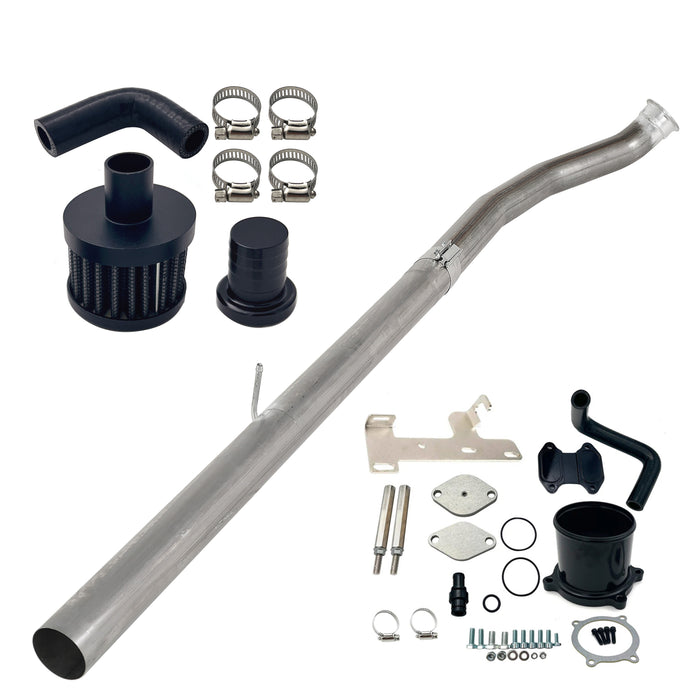
The 2010–2012 6.7L Cummins 4" DPF Delete Pipe & EGR cooler Delete Kit is the complete pre-DEF package, and it bundles four fixes in one:
- 4" DPF/CAT race pipe — kills the soot trap and the regen cycle.
- EGR valve & cooler delete — removes the exhaust-recirculation loop and its coolant-leak risk.
- High-flow throttle valve delete tube — clears the intake restriction the EGR used to need.
- CCV reroute — redirects crankcase oil vapor away from the turbo inlet, so the intake stays dry instead of caking with oil-soot sludge.
The CCV reroute is the piece most budget kits skip, and it’s the difference between a clean intake and one that still carbon-cakes from blow-by. Once it’s rerouted, you stop buying the expensive internal CCV filter too.
2013–2018: The DEF-Era Delete Kit
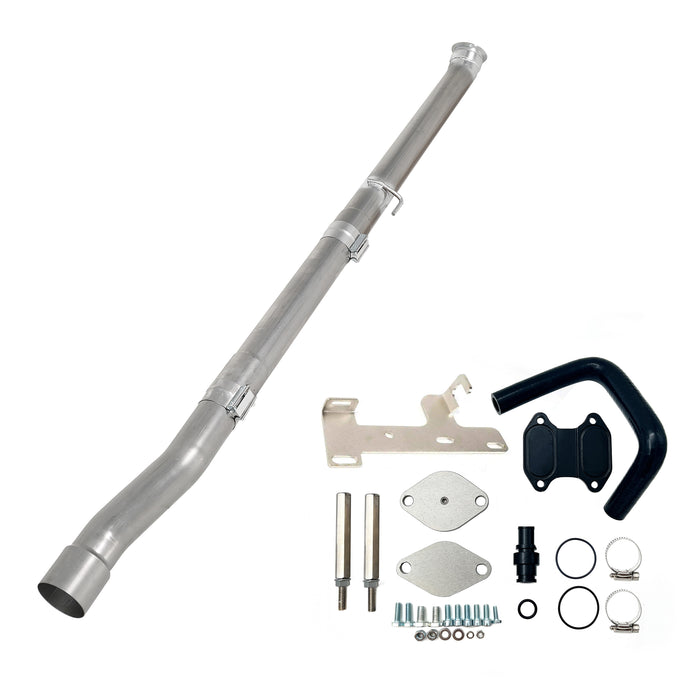
The 2013–2018 6.7L Cummins 4" Exhaust Pipe & EGR Delete kit handles the fourth-gen truck, which adds the SCR/DEF layer on top of the EGR + DPF.
- 4" exhaust pipe replaces the DPF and SCR canister section.
- EGR cooler + throttle valve delete removes the intake-side soot source.
- The DEF/SCR disable happens in the tune — no physical DEF bypass pipe needed.
This is the highest-volume 6.7L generation, and the kit is built for exactly the emissions stack it carries.
2019–2024: The DP-Back Kit (4" or 5")
The 2019–2024 6.7L Ram Cummins 4"/5" DP-Back DPF/EGR Delete kit covers the fifth-gen trucks, and it’s modular so you only pay for what you need:
- 4" or 5" downpipe-back pipe — 5" for maximum flow and lower towing EGTs, 4" for a factory-style fit.
- With or without a muffler — straight pipe for max sound, muffled to cut cab drone on long hauls.
- EGR delete included in every configuration.
The fifth-gen adds a tuning wrinkle: the 2019+ truck has a Security Gateway Module that locks the OBD-II port, so you need a bypass cable before the tune will flash. The kit assumes you’ll handle the tune separately — it’s the one thing every delete build has to budget for.
The Golden Rule: Tune First, Then Unbolt
No matter which kit or year, the sequence never changes:
- Flash the tune first — with the truck still fully assembled. This tells the ECM the emissions hardware is gone before you touch a bolt.
- Disconnect both batteries and let the exhaust cool completely.
- Remove the DPF/CAT/SCR section — label every sensor, support the heavy canister, and swap in the race pipe.
- Remove the EGR valve and cooler, install the block-off plates, and reroute or cap the coolant lines.
- Reconnect, refill coolant, burp the system, and check for leaks before the first drive.
The single most common mistake is unbolting everything first and then flashing — that’s how you land in limp mode with the truck half apart. Tune first, always.
What a Delete Won’t Fix
Be clear-eyed about the limits, because they matter on the 6.7L:
- The CP4 fuel pump (2019–2020 trucks, y78 recall) is a fuel-system problem a delete doesn’t touch. Budget for a disaster-prevention kit or CP3 conversion separately.
- The grid heater bolt on the 6.7L Cummins is a known mechanical weak point that can drop a stud into #6 cylinder — a delete doesn’t solve it, and it’s often worth addressing while you’re in there.
- Hydraulic lifters on the 2019+ trucks can fail regardless of emissions status.
A delete removes the emissions failure points. The rest of the engine’s maintenance is still yours.
After the Delete: How to Maintain It
Deleting doesn’t make the truck maintenance-free — it just changes what you’re maintaining. Here’s what a deleted 6.7L Cummins still needs, and what changes now that the emissions stack is gone.
Oil and Filter — Still the Most Important Job
A deleted engine burns cleaner, but that’s not a license to stretch oil changes. Stick to the interval — roughly every 5,000–7,500 miles with a quality full-synthetic diesel oil (5W-40 or 15W-40). The 6.7L has tight tolerances, and clean oil is cheap insurance against the hydraulic-lifter and bearing wear these engines are known for.
Fuel Filters — More Important After a Delete, Not Less
With the EGR and DPF out of the picture, the fuel system is now the most vulnerable thing on the truck — specifically the CP4 high-pressure pump on 2019–2020 trucks. Change fuel filters on schedule (or sooner if you tow hard) and drain the water separator regularly.
Coolant — Watch the Reroute
After the EGR cooler comes out, the coolant circuit was rerouted. Check the level for the first few hundred miles and after the first heat cycle — a small leak at the new fittings or caps is the most common post-delete issue. Keep the system full and burped.
The CCV — Reroute It, or Keep Replacing the Filter
If your kit didn’t include a CCV reroute, the crankcase vent is still feeding oil vapor into the intake — which means you’re only solving half the sludge problem. Either reroute it (the 2010–2012 kit bundles this), or keep replacing the internal CCV filter on schedule. A clogged CCV filter builds crankcase pressure and can push oil past the seals.
Protect the Orphan Connectors
When you unplug the emissions sensors, the now-open connectors on the harness are exposed to water and corrosion. Seal them with dielectric grease and cap them — a corroded open connector can short a 5V reference circuit and cause unrelated drivability gremlins.
Keep Your Factory Parts
Store everything you removed — DPF, EGR cooler, DEF components, sensors. If you ever sell the truck, move to an inspection state, or need to reverse the delete, that hardware is four figures to buy back new. A few labeled boxes in the garage save you a fortune later.
Scan It Occasionally
A deleted truck won’t throw emissions codes anymore, but it’ll still throw fuel, turbo, and transmission codes. A periodic scan catches a slipping sensor or a pending injector balance issue before it strands you. Deleting the emissions doesn’t delete the need to pay attention to the rest of the engine.
The Legal Reality
Deleting emissions equipment on a road-driven truck violates the federal Clean Air Act (42 U.S.C. § 7522), and individual penalties can reach roughly $5,911 per violation. There is no off-road or competition exemption in federal law — the parts are sold for off-road, race, and competition use, and it’s on you to know your local, state, and federal rules before modifying anything.
Keep every factory part you remove. If you ever sell the truck, move to an inspection state, or need to reverse the delete, buying that hardware back is a four-figure mistake you can avoid by storing it.
Conclusion:
The 6.7L Cummins is one of the most durable diesel engines ever put behind a Ram grille — and the emissions stack bolted to it is the thing that strands you in limp mode at the worst possible time. The fix isn’t an EGR delete or a DPF delete. It’s both, together, because they’re two ends of the same seesaw: leave one and the other chokes.
For the full lineup of generation-matched 6.7L Cummins delete kits — each built to remove the EGR and DPF in one job, with the throttle valve and CCV addressed too — head to TruckTok.com. Every kit is matched to your exact year and emissions configuration, so you’re never mixing parts that were never meant to work alone.
Related Blogs:
-
6.7L Cummins P0401: The EGR Code That Means It's Time
- 4-Inch vs 5-Inch Cummins Delete Pipe: Which Fits Your Build
- 6.7L Cummins CCV Delete: The Crankcase Vent You're Ignoring
- 2019-24 Cummins Delete: DIY vs Shop — What You'll Actually Pay
- 2007.5–2012 6.7L Ram Cummins EGR & DPF Upgrade Guide
- 2013–2018 6.7L Cummins: EGR, DPF & Wiring Upgrades
Frequently Asked Questions
Do I really have to delete the EGR and DPF together?
Yes. The EGR and DPF are a seesaw — EGR creates soot, the DPF traps it, regen burns it (making NOx), and DEF cleans that. Delete only the EGR and the hotter combustion floods the still-installed DPF with soot it can no longer burn off, clogging it faster. The only clean path is removing both.
Can I just tune the emissions off and leave the hardware in place?
No, and it’s dangerous. A tuned-out EGR cooler is still full of coolant and still prone to cracking — leave it on and it can hydrolock the engine. A tuned-out DPF can’t regen, so it face-plugs. The hardware has to come off, not just be switched off in software.
What’s the difference between the three kits?
They’re generation-matched. The 2010–2012 kit (pre-DEF) deletes EGR + DPF + throttle valve and adds a CCV reroute. The 2013–2018 kit adds DEF/SCR disable in the tune. The 2019–2024 kit is modular (4" or 5", muffled or not) and needs an SGW bypass cable to tune.
Does a delete add horsepower?
The delete itself doesn’t add horsepower — unbolting the EGR and DPF removes restriction, but the power comes from the tune you pair with it. The quoted gains of up to 150 hp and 1–4 MPG are the tune’s doing, not the pipe’s. What the delete actually buys you is reliability and cleaner running, not a bigger dyno number.
Will deleting stop my truck from regenerating?
Yes. With the DPF physically gone, there’s no soot trap to burn, so the regen cycle is eliminated entirely. That means no more fuel dumped into the exhaust to make heat, and no more fuel dilution washing into the oil from incomplete regens. The truck simply runs without ever asking to regenerate.
Do I need a tune if I install the hardware?
Absolutely, and it’s the step that matters most. Without a tune, the ECM detects the missing DPF, EGR, and DEF hardware and puts the truck into limp mode within miles. The tune disables the emissions monitoring and the DEF/SCR dosing so the engine runs cleanly without them. Skip it and the hardware is useless — the truck won’t drive.
Why does the 2010–2012 kit include a CCV reroute?
The CCV system vents oily crankcase vapor into the turbo inlet, where it mixes with EGR soot to form the sludge that cakes the intake. Once the EGR is gone, the soot half of that sludge is eliminated, but the oil-vapor half still flows unless you reroute the CCV. Rerouting it keeps the intake fully dry, and you stop paying to replace the internal CCV filter.
Is a delete legal on the road?
No. Removing or disabling emissions equipment on a public-road vehicle violates the federal Clean Air Act, with individual penalties up to about $5,911 per violation. There’s no off-road or competition exemption in federal law, and emissions-inspection states will fail a deleted truck. These kits are sold for off-road, race, and competition use only — check your local laws before installing.
What does a delete NOT fix on a 6.7L Cummins?
A delete removes the emissions failure points, not the engine’s mechanical ones. It doesn’t fix the CP4 fuel pump (a 2019–2020 recall issue), the grid heater bolt weak point that can drop a stud into #6 cylinder, or the 2019+ hydraulic lifter failures. Those are separate problems that exist whether or not the truck is deleted.
Which pipe size should I choose, 4" or 5"?
4" is the factory-fit, quieter default for the vast majority of builds. 5" gives more flow, lower towing EGTs, and a deeper tone, but adds more cab drone on the highway. For a stock-turbo truck, 4" is plenty — the 5" only earns its keep on high-output builds pushing big horsepower and heavy loads.