

Home > News > 4-Inch vs 5-Inch Cummins Delete Pipe: Which Fits Your Build

4-Inch vs 5-Inch Cummins Delete Pipe: Which Fits Your Build
The question comes after every DPF delete — “should I run 4-inch or 5-inch?” — and the honest answer is that most Cummins owners should buy the 4-inch. Not because 5-inch is bad, but because on a stock-turbo 6.7L the extra diameter mostly shows up as deeper sound and heavier in-cab drone, not as measurable horsepower.
That isn’t the answer the “bigger is better” crowd wants, but it’s what the flow numbers and a decade of owner reports actually support. Here’s the real math, the real tradeoffs, and how to match the pipe to your build instead of to the biggest number on the product page.
For off-road / competition use only. Not legal for on-road use in emissions-regulated areas. Check your local, state, and federal laws before modifying any emissions-related component.
What Pipe Diameter Actually Changes
Once the DPF, cat, and SCR are out of the way, the exhaust has a much shorter, more open path to atmosphere. Diameter is the last variable in that path — and it only matters as much as the exhaust volume you’re actually pushing through it.
The Flow Numbers
- A mandrel-bent 4-inch pipe flows ~1,400 CFM; a 5-inch flows ~2,200 CFM — a 56% jump in cross-sectional area (12.6 vs 19.6 square inches).
- A stock-turbo 6.7L Cummins at wide-open throttle only pushes ~900 CFM.
- The engine can’t fill the 5-inch pipe, so the extra flow capacity sits there unused.
Backpressure: The Gains Are Front-Loaded
- The factory DPF creates 3–5 psi of restriction.
- A 4-inch straight pipe drops it to ~0.5 psi.
- A 5-inch drops it to ~0.3 psi.
That 0.2 psi difference is inside the margin of measurement error — you won’t find it on a dyno.
When Diameter Starts to Matter
The diameter only earns its keep once you’re past ~650 rwhp with a bigger turbo — at that point the 4-inch becomes the actual bottleneck. Below that, 4-inch is not leaving meaningful performance on the table.
What the Two Sizes Actually Deliver: The Performance Gap
Here’s the honest answer to the question everyone is really asking — “how much faster is the 5-inch?” The answer is: on a stock or mild build, effectively nothing measurable.
Horsepower
A dyno won’t separate a 4-inch from a 5-inch on a stock-turbo truck. The whole performance benefit of a delete pipe comes from removing the DPF and its 3–5 psi of backpressure — and both diameters do that. The remaining difference between them is 0.2 psi, which is inside the margin of error on any dyno run.
Whatever horsepower a delete pipe “adds” lives in the tune, not in the extra inch of pipe.
Exhaust Gas Temperature
This is the one place a 5-inch can claim a real, if small, edge. Under sustained heavy load — towing near capacity up a long grade — the lower backpressure of the 5-inch helps the engine push hot exhaust out more efficiently, which can shave a few degrees off EGT. But the magnitude is small, and EGT is driven far more by tune quality, fueling, load, and gearing than by pipe diameter. Treat the 5-inch as a supporting upgrade for a hard-working truck, not as an EGT cure for a hot tune.
Turbo Spool and Throttle Response
The spool improvement you feel after a delete is real — but it comes from removing the DPF, and the 4-inch already delivers all of it. Because a stock 6.7L only moves ~900 CFM against the 4-inch’s 1,400 CFM capacity, there’s no extra exhaust velocity benefit waiting in the 5-inch. On a mild build, the 5-inch doesn’t spool the turbo any faster; it just sounds deeper doing it.
The Bottom Line
For a stock-turbo or mild-tune truck, 4-inch and 5-inch are a performance wash. The difference you’ll actually notice is sound and drone, not power. The 5-inch’s real performance advantage only shows up past ~650 rwhp with a larger turbo — the exact scenario where flow becomes the bottleneck.
Sound: The Real Reason Most People Go 5-Inch
Let’s be honest — most people choose 5-inch for the sound, not the flow. And it genuinely does sound different:
| Characteristic | 4-Inch | 5-Inch |
|---|---|---|
| Idle tone | Deep, medium volume | Deeper, throatier |
| Turbo whistle | Prominent — higher-pitched | Muted — larger pipe cuts gas velocity |
| WOT character | Loud, aggressive, raspy | Louder, deeper V8-style rumble |
| In-cab drone | Low (with muffler) | Noticeable — even with muffler |
The rule of thumb from owners who’ve run both:
- 4-inch gives more rasp and more turbo whistle.
- 5-inch gives a deeper, chest-thumping rumble.
One shop described it plainly — the 5-inch sounds like a jet, the 4-inch sounds like an 18-wheeler.
The counterintuitive part, and the reason this isn’t a clean “quiet vs loud” split:
A 5-inch with a good muffler can be more comfortable than a 4-inch straight pipe. The 5-inch has a lower resonant frequency that lands in the 1,800–2,200 rpm cruising range, so straight-piped 5-inch drones harder at highway speed — but add a flow-through muffler and it settles into a deep, clean tone that many owners prefer over the 4-inch’s rasp.
When 4-Inch Is the Right Call
The 4-inch is the default for a reason — it matches how most of these trucks actually get used:
- Daily driver or work truck. You get the full flow benefit of removing the DPF without turning every highway commute into a drone chamber.
- Stock or mild tune. The engine isn’t making enough exhaust volume to need the 5-inch’s extra area, so the smaller pipe isn’t holding anything back.
- Tow rig. Towing at 2,000–2,300 rpm sits right in the drone range. The 4-inch keeps the cab livable on a 12-hour pull.
- Tight clearance. The smaller OD leaves more room around the frame, spare tire, and heat shields.
- You’re coming from stock. This is the biggest jump — one owner who’s run both described going from stock to 4-inch as “night and day, like a new motor.” The 4-inch already delivers that transformation; the step to 5-inch is a much smaller, mostly-audible increment.
If you’re on the fence and the truck still has to work, start with 4-inch.
When 5-Inch Earns Its Place
5-inch isn’t a gimmick — it’s the right tool in three specific situations:
- Big build, big turbo. Past 650+ rwhp with compounds or a large single, the 4-inch becomes the restriction and 5-inch becomes necessary, not optional.
- Long exhaust runs. A crew cab with an 8-foot bed runs 12+ feet of pipe; friction loss over that length adds up, and the 5-inch reduces it.
- Sound and presence are the point. A lifted weekend truck, a show build, or an owner who just wants the deepest possible note — that’s a legitimate reason, as long as you accept the drone and the tighter packaging that come with it.
If you’re building for the sound or the horsepower ceiling, buy the 5-inch once and don’t pay for the 4-inch first.
The Low-End Torque Myth
One worry that keeps coming up deserves a clear answer: a 5-inch pipe will not cost you low-end torque.
The “backpressure is needed for torque” idea applies to naturally aspirated engines, not turbo diesels. A turbocharger generates its own backpressure upstream of the turbine — that’s the drive pressure spinning the wheel. Downstream of the turbo, you want the least restriction possible so the turbine can dump spent exhaust and keep spooling. A bigger pipe there helps, never hurts, low-end response.
So don’t let the old small-block folklore steer you away from 5-inch if the build actually calls for it. Just don’t buy 5-inch expecting a torque gain either — on a mild truck it’s a sound change, not a power change.
Clearance and Fitment: Where 5-Inch Gets Tight
The 5-inch pipe has a 5.0" OD, plus wall thickness, so it’s over 5.1" at every clamp and hanger. On the Ram 2500/3500 it fits, but it gets tight around the transmission crossmember and the spare tire, and some owners report rubbing on the spare-tire heat shield under articulation.
Two fitment traps specific to the 6.7L Ram worth flagging before you order either diameter:
- Rear air suspension trucks are excluded. The airbag brackets and track bar interfere with the exhaust routing, so most 4-inch and 5-inch kits are built for standard leaf-spring trucks only.
- Cab & Chassis is a different animal. The 4500/5500 runs a flat commercial frame with different crossmembers, axle clearance, and DEF tank placement — a pickup pipe does not bolt on.
Match the pipe to the exact cab, bed, and suspension before you match the diameter. A well-aligned 4-inch beats a 5-inch that rubs, rattles, or leaks.
What a Delete Pipe Does NOT Change
Keep the honest accounting straight, because the product pages won’t do it for you:
-
A delete pipe does not add horsepower by itself. The power lives in the tune. The pipe removes restriction and changes sound; it isn’t a dyno number on its own.
-
5-inch does not automatically lower EGT more than 4-inch. EGT depends on tune quality, fuel delivery, load, gearing, and cooling-system health. A bigger pipe is not an EGT cure — and it can’t diagnose a weak turbo, a hot tune, or a slipping transmission for you.
-
It doesn’t fix the rest of the truck. A deleted exhaust won’t paper over tired injectors, a boost leak, or a worn CP4-style fuel-system concern. The pipe only removes the emissions restriction — nothing more.
The Products: Two Diameters, Two Jobs
For the 2013–2018 6.7L Ram, the two diameters map to two different jobs — and it’s worth noticing the price gap is about more than just the pipe width.
The 4-Inch Tube Pipe Kit — $192.31
The 4" Exhaust Tube Pipe Kit is the quiet, budget-friendly delete. It’s a mid-section replacement — two mandrel-bent T-409 stainless sections that physically remove the DPF canister, catalytic converter, and SCR assembly, while leaving your factory downpipe and tailpipe (and muffler) untouched.

That’s the point of this pipe: you eliminate the most failure-prone, expensive parts of the exhaust train — the DEF heater, quality sensor, and NOx sensors that trigger 5-mph limp modes — and you keep the truck quiet and drone-free because the stock tailpipe and muffler stay in place. If the truck still has to commute or tow, this is the delete that doesn’t announce itself to the neighborhood.
The 5-Inch Turbo-Back Pipe — $658.00
The 5" Turbo Back DPF Delete Pipe is the full send. It replaces the entire exhaust from the turbocharger flange to the rear bumper, deletes the muffler entirely, and opens flow area by over 60% compared to stock. T-409 stainless, pre-welded contour-bent hangers that slide into the stock rubber isolators.
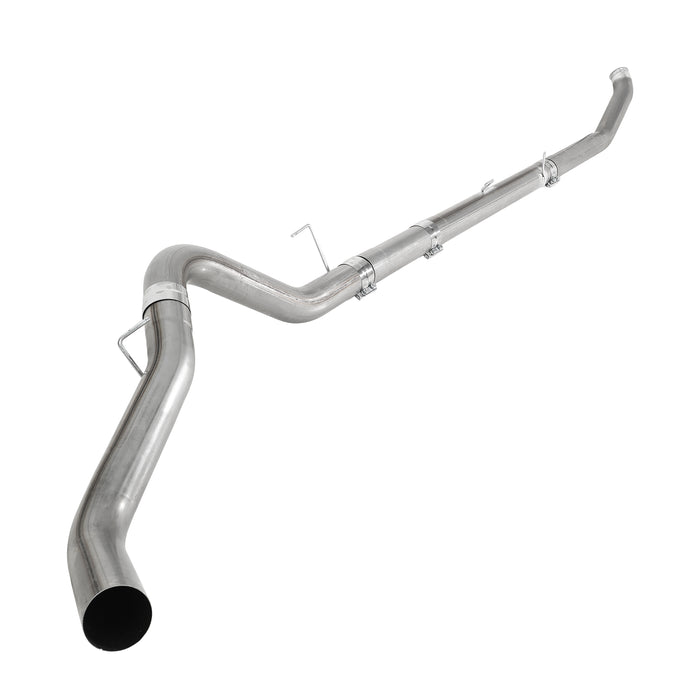
The tradeoff is stated right in the product’s own FAQ: yes, it drones. Because the muffler is gone and the diameter is massive, you’ll get low-frequency cab drone at certain RPM under load. The product page itself recommends adding a 5-inch flow-through muffler if you’re noise-sensitive or tow long distances. This is the pipe for the build where deep, hard-hitting straight-pipe roar is the goal — not the one for a quiet daily.
Which One Matches Your Truck
- Quiet, still-works truck → the 4-inch tube pipe. You kill the emissions failures and keep the cab livable.
- Sound-focused or big-horsepower build → the 5-inch turbo-back. You accept the drone for the rumble and the headroom.
Both are T-409 stainless, both are for standard leaf-spring pickups (no rear air, no Cab & Chassis), and both need a delete tune paired with them.
The Legal Reality
Removing or disabling emissions equipment on a public-road vehicle violates the federal Clean Air Act (42 U.S.C. § 7522), and a deleted truck fails visual and OBD emissions inspection. These pipes are for off-road, competition, or private-land use only — and if the truck is a daily driver, the clean-or-replace path is the one that keeps it legal.
Get the Right Pipe for Your Build
The 4-inch vs 5-inch decision is not a horsepower decision — it’s a “what do I actually use this truck for” decision. If it commutes, tows, and works, the 4-inch delivers the whole delete benefit with none of the drone, and it’s the cheaper, smarter default. If it’s a sound-focused or high-horsepower build, the 5-inch earns its place with deeper tone and real flow headroom.
TruckTok.com carries both diameters for the 6.7L Cummins, matched to the exact cab, bed, and suspension — so you buy the pipe that fits your build the first time, not the one that just sounds biggest.
Related Blogs:
-
6.7L Cummins EGR Cooler Leak: Why Is Coolant Disappearing
- 6.7L Cummins DPF Clogging: How to Spot It Before Limp Mode
- 2019-2024 Cummins P2463: Why the Regen Code Won’t Clear
- 2013-2018 6.7L Cummins EGR & DPF Delete: 4" Exhaust & Cooler Kit Buyer's Guide
Frequently Asked Questions
Is 4-inch enough for a deleted 6.7L Cummins?
Yes. A 4-inch pipe flows about 1,400 CFM against a stock-turbo engine pushing roughly 900 CFM at wide-open throttle, so it’s more than enough until you’re well past 650 rwhp. Bigger pipe doesn’t fix poor tuning or weak boost.
Does a 5-inch pipe lower EGT more than 4-inch?
Not automatically. EGT depends on tune, fuel delivery, load, gearing, and cooling-system health far more than pipe diameter. A 5-inch pipe alone is not an EGT cure.
Will a 5-inch pipe hurt my low-end torque?
No. The “backpressure is needed for torque” idea only applies to naturally aspirated engines. A turbo diesel wants minimum restriction downstream of the turbine, so a bigger pipe doesn’t cost low-end response.
Is a 5-inch pipe louder than 4-inch?
Yes — measurably. At idle a 5-inch straight pipe is a few decibels louder, and at wide-open throttle the gap widens to several decibels more. A flow-through muffler can bring either size down to a comfortable level.
Does a 5-inch pipe drone more on the highway?
Yes. The larger pipe has a lower resonant frequency that lands in the 1,800–2,200 rpm cruising range. A resonator or muffler tames it, but a straight-piped 5-inch will drone harder than a 4-inch.
Do I need a 5-inch downpipe too?
No. The factory downpipe outlet is 3 to 3.5 inches, and a 5-inch downpipe wouldn’t even fit the turbo flange. The delete pipe transitions from the factory downpipe size and opens up behind it.
What’s the difference between a mid-section pipe and a turbo-back system?
A mid-section pipe (like the 4-inch tube kit) removes the DPF/CAT/SCR and keeps your stock downpipe and tailpipe. A turbo-back system replaces everything from the turbo flange to the bumper, including the muffler. That’s why turbo-back costs more and drones more.
Will a 4-inch pipe fit trucks with rear air suspension?
Usually not. Rear air suspension trucks have airbag brackets and a track bar that interfere with the exhaust routing, so most kits are built for standard leaf-spring trucks only. Check fitment before ordering.
Is a DPF delete pipe legal for street use?
No. Removing emissions equipment on a public-road vehicle violates the Clean Air Act and fails inspection. These parts are for off-road, competition, or private-land use only.
Which should I choose if I’m coming from a stock exhaust?
Start with the 4-inch. The jump from stock to 4-inch is the big, night-and-day change — deeper sound, faster spool, no more regen. The step from 4-inch to 5-inch is a much smaller, mostly-audible increment you can always make later.
For off-road / competition use only. Not legal for on-road use in emissions-regulated areas. Check your local, state, and federal laws before modifying any emissions-related component.