

Home > News > 2019-2024 Cummins P2463: Why the Regen Code Won’t Clear

2019-2024 Cummins P2463: Why the Regen Code Won’t Clear
Here’s the frustrating part owners keep hitting: you drive a solid 45-minute highway run to trigger a regen, the dash says the filter cleaned itself, and P2463 is still there the next morning. The instinct is to blame the DPF — but most of the time the filter was never the problem. The code is being kept alive by a $85 sensor, a melted hose, a software bug, or an ECM that was never told the work was done.
For off-road / competition use only. Not legal for on-road use in emissions-regulated areas. Check your local, state, and federal laws before modifying any emissions-related component.
First, Get the Code Straight: Soot vs Ash
Before anything else, pin down what P2463 actually is, because a lot of the advice online gets it wrong.
- P2463 = soot accumulation. The ECM has decided the DPF is holding too much soot — the black carbon that regeneration burns off.
- P242F = ash accumulation. This is the different code. Ash is the non-combustible mineral residue left behind when soot burns. Regeneration can’t touch it.
That distinction is the whole game. Soot can be burned; ash can only be physically cleaned or the filter replaced. If you misread a P2463 as an ash problem, you’ll be told the only fix is a $2,500+ DPF — when in reality a good regen or a sensor swap clears it.
A note on terminology: you’ll see P2463 described as “DPF restriction — soot accumulation” in the Ram service info, and that’s the correct framing. It is not the ash code, and it is not automatically a death sentence for the filter.
The Related Codes: Don’t Mix Them Up
P2463 rarely travels alone, and mixing up the codes that ride alongside it is how owners get talked into the wrong repair. Here’s the family, and where each one sits in the chain.
| Code | What It Actually Means | Relationship to P2463 |
|---|---|---|
| P2463 | DPF soot accumulation | The core code — the filter is holding too much soot |
| P242F | DPF ash accumulation | The end stage — soot has burned, leaving ash that regen can’t touch |
| P2459 | DPF regeneration too frequent | The precursor — the system keeps trying to regen and can’t keep up |
| P0299 | Turbocharger underboost | The downstream effect — backpressure is choking the turbo |
| P1451 | DPF system performance | Often sets alongside P2463; covered by the same TSBs |
| P0401 / P0402 | EGR flow insufficient / excessive | The upstream cause — a sticking EGR makes more soot |
These aren’t interchangeable — they’re different links on one chain:
- P0401/P0402 (EGR) → P2459 (regen can’t keep up) → P2463 (soot piles up) → P242F (ash is left) → P0299 (backpressure hurts the turbo).
Read it left to right and you see the whole story. A sticking EGR valve makes the engine produce more soot; the DPF loads faster than regeneration can clear it; the soot accumulates (P2463); over time that soot burns down to permanent ash (P242F); and the rising backpressure strangles the turbo (P0299).
The Practical Takeaway:
If P2463 shows up with P0401 or P0402, the EGR is likely the real culprit — fix it first, or the soot will just come back. If it shows up with P242F, regen is a dead end and it’s a cleaning-or-replacement decision. The code next to P2463 tells you more than P2463 does on its own.
The Real Question: Why Won’t the Code Clear After a Regen?
A regen burns the soot. So if the filter really was the issue, the code should clear — and sometimes it does. When it doesn’t, one of these is almost always the reason, in rough order of probability.
1. The Pressure Sensor Is Lying (The #1 Cause)
The ECM doesn’t actually see soot. It infers it from a differential pressure sensor that measures backpressure across the DPF — one tube on the inlet side, one on the outlet.
That sensor lives in a brutal spot:
Heat, moisture, and soot contamination. When it drifts out of calibration or fails internally, it reports a “clogged” reading even when the filter is clean. You run a regen, the soot burns off, but the sensor is still feeding the ECM a high-pressure number — so the code stays.
The telltale sign:
A sensor that reads high (or stuck, or erratic) at idle, where a healthy reading should be 0.5–1.0 volts, or near-zero backpressure. The replacement part is Mopar 68312096AB (the AB supersedes the earlier AA), roughly $85–$150, mounted on a bracket near the transmission on the passenger side.
2. The Pressure Hoses Are Plugged or Melted
The two small hoses running from the exhaust to the pressure sensor see the same heat as everything else down there. They crack, melt, kink, or pack full of soot — and any one of those gives the sensor a false reading.
3. It’s a Software Bug (Check for a TSB)
This is the least obvious cause and the one owners never find on their own: Ram has released PCM software updates specifically because the factory regeneration logic misbehaves.
Two TSBs matter here:
- 18-102-22 REV. A (2020 models) — a PCM flash that addresses P2463, P0299, and P242F, but it’s only applicable after the Y78 (CP4→CP3 fuel pump) recall has been done.
- 18-066-23 (2019 models) — a PCM flash covering P2463, P1451, and P242F.
4. The Regen Never Actually Finished
A regen needs sustained exhaust heat — roughly 1,100°F — for a full burn. Short trips, stop-and-go traffic, and long idling never get there, so the regen either doesn’t start or gets interrupted mid-cycle. The soot never fully clears, the pressure stays high, and the code holds.
5. The ECM Was Never Reset (The Forgotten Step)
This is the one that gets people after they’ve already cleaned or replaced the DPF. When new or freshly cleaned hardware goes in, the ECM still holds the old soot-load and pressure values — so it keeps throwing P2463 against a filter that’s now clean.
The “Clear It and It Comes Right Back” Trap
Here’s a pattern worth internalizing, because it trips up everyone who’s tried the quick fix: manually clearing the code without fixing the underlying condition does nothing. Clear P2463, start the truck, and within seconds the ECM re-detects the same bad reading and lights the CEL right back up.
That’s the ECM doing its job. It’s not a glitch to be erased — it’s a signal to be traced. The only way the code stays gone is to fix whichever of the five causes above is actually responsible, then let the system confirm the repair on its own terms (a completed regen or a proper reset), rather than forcing the light off.
How to Diagnose It in Order (Don’t Skip to the DPF)
The expensive mistake is replacing the DPF first. The cheap fixes come first, and they’re the ones that actually work most of the time.
-
Pull the codes. Confirm P2463, and note anything riding along with it — P242F (ash), P2459 (regen too frequent), or P0299 (underboost from backpressure) change the diagnosis.
-
Watch the pressure sensor live. At idle it should sit near zero and rise smoothly with RPM. Stuck-high, stuck-low, or erratic readings point at the sensor or its hoses.
-
Inspect the hoses. Look for cracks, melting, kinks, or soot, and blow them clear.
-
Check for a TSB. Give the dealer your VIN and ask about 18-102-22 or 18-066-23.
-
Force a regen. With a bidirectional tool, command a stationary regen and watch the soot-load value drop. If it completes and the code clears, you’re done.
-
Only now consider the DPF. If a forced regen fails, the code returns immediately, or the soot load won’t come down, then it’s cleaning ($300–$650) or replacement ($2,500–$5,000) territory.
The pattern is the same every time: rule out the sensor, the hoses, and the software before you spend real money on the filter.
How to Actually Fix P2463 (By Root Cause)
Diagnosing it is half the job. Here’s the fix, matched to each cause, worked in the order that costs you the least and finds the answer the fastest.
-
Replace the pressure sensor. If the live data shows a stuck, high, or erratic reading, swap the differential pressure sensor for Mopar 68312096AB ($85–$150). It’s a bracket-mounted part on the passenger side near the transmission — unplug, unbolt, bolt the new one in, done.
-
Replace the pressure hoses. If the sensor reads fine but the hoses are cracked, melted, or packed with soot, replace them — 68363173AC upstream and 68363177AC downstream, $30–$80 for the pair. Blow the old ones clear first to confirm they’re the problem.
-
Get the software update. If the truck is on old PCM software, have a dealer flash the applicable TSB — 18-102-22 REV. A for 2020 models (only after the Y78 CP4→CP3 recall), or 18-066-23 for 2019 models. Free under warranty, or $150–$250 in labor. This fixes the regeneration logic that keeps tripping the code on an otherwise healthy truck.
-
Complete a real regen. For soot that simply hasn’t burned: drive at sustained highway speed (50+ mph) for 30–45 minutes, or command a forced stationary regen through a bidirectional scan tool. Watch the soot-load value actually drop — if it does, the code clears on its own.
-
Reset the DPF parameters. After a clean or a new filter, the ECM still holds the old soot-load and pressure values. Reset them through the scan tool so the system knows the filter is fresh — otherwise it keeps reporting a clog that’s no longer there.
Work those five in order, and most P2463 cases resolve at step 1 or 2 — long before you’d ever touch the filter itself. Only when a forced regen fails, the soot load won’t drop, and the code returns immediately does it become a cleaning ($300–$650) or replacement ($2,500–$5,000) job.
The Honest Cost Picture
| Fix | What It Is | Typical Cost |
|---|---|---|
| Differential pressure sensor | Mopar 68312096AB | $85–$150 |
| Pressure hoses | Upstream/downstream lines | $30–$80 |
| PCM software update | TSB 18-102-22 / 18-066-23 | $0–$250 |
| Forced regen | Scan-tool commanded | $0–$150 |
| DPF cleaning | Off-vehicle, ash removal | $300–$650 |
| DPF replacement | New filter | $2,500–$5,000 |
The sensor and the hoses are the highest-probability fixes and the cheapest. The DPF is the lowest-probability cause and the most expensive repair. Work that order.
When Diagnosis Points to a Delete
If you’ve genuinely ruled out the sensor, the hoses, the software, and the regen — and the code keeps returning because the filter itself is ash-loaded or structurally done — then the decision shifts to the permanent fix.
A DPF delete removes the filter and the entire soot-accumulation loop, so P2463 physically can’t return: there’s no filter to clog, no pressure differential to monitor, and no regen to fail. The trade-off is the one you already know — it’s a compliance decision, not just a mechanical one, and it requires a proper delete tune.
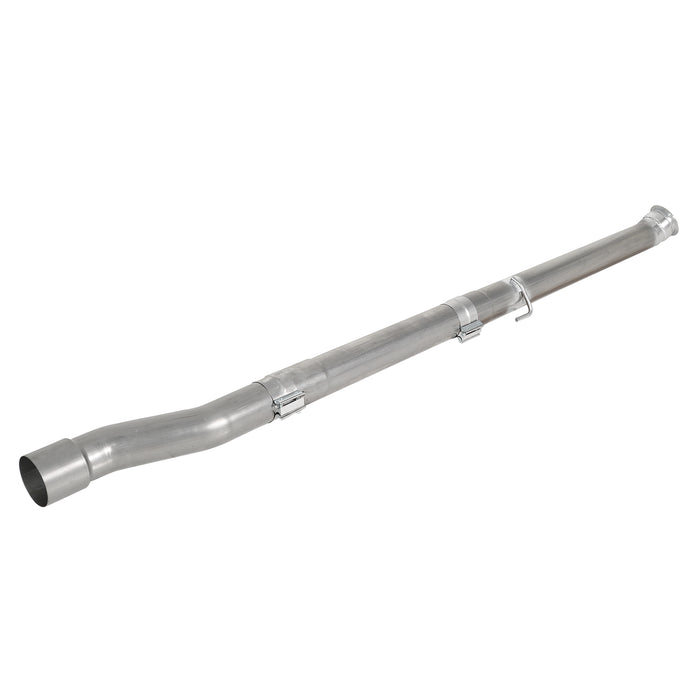
Option 1: The Mid-Section Delete (4" Cat & DPF Delete Pipe)
The 4" Cat & DPF Delete Pipe replaces only the DPF and SCR canister — the restrictive mid-section that actually causes the soot-accumulation and regen problem.
- What it is. A 4-inch mandrel-bent T-409 stainless pipe that bolts in where the DPF and catalytic/SCR assembly sat.
- What it deletes. The DPF and SCR catalyst — the parts that trap soot and demand regeneration.
- What it keeps. The factory downpipe, the factory muffler, and the factory tailpipe. The truck stays quiet and stock-looking from the outside.
- Why you’d pick it. It’s the cleaner, quieter, more affordable route. If your only goal is to end the regen cycle and make P2463 physically impossible, this does it without the noise or the full-system cost.
- Fitment. 2019–2024 6.7L Ram 2500/3500 pickups. Not for rear-air-suspension trucks or Cab & Chassis (4500/5500).
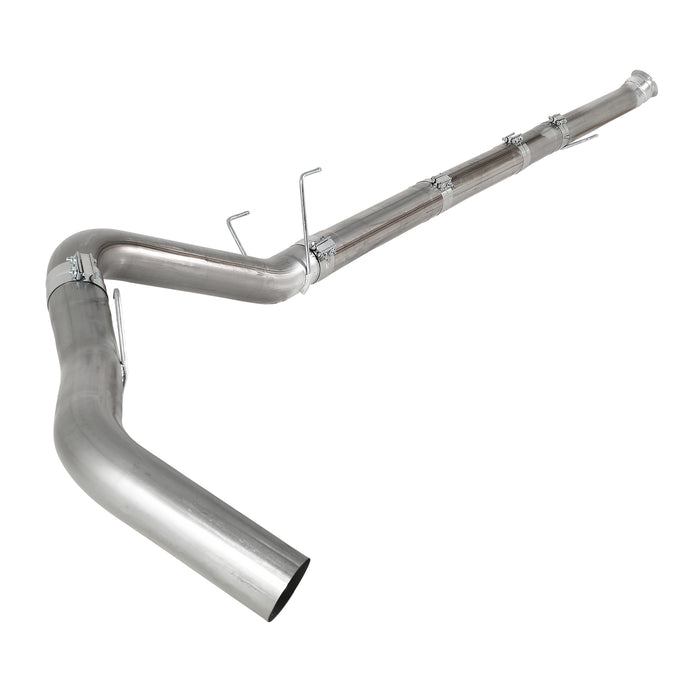
Option 2: The Full Downpipe-Back Delete (4" DPF Delete Exhaust)
The 4" DPF Delete Downpipe-Back Exhaust swaps the entire exhaust from the downpipe back, not just the DPF section.
- What it is. A 4-inch T-409 stainless system, two pieces, that replaces the DPF, the catalyst, and the factory muffler in one pass.
- What it deletes. The full restriction chain — DPF, CAT, and the stock muffler — for the biggest drop in backpressure.
- What it keeps. Only the downpipe up front; everything downstream is new.
- Why you’d pick it. Lower EGTs under sustained load and freer flow for a truck that tows hard or runs a bigger tune. It’s the choice when you want the performance side of the delete, not just the code gone.
- Fitment. 2019–2022 6.7L Ram 2500/3500 pickups.
Both are T-409 stainless and direct-fit for the 2019+ pickups, and both require a proper delete tune — the hardware removes the filter, but the tune is what stops the ECM from looking for it and throwing a fresh code.
The Legal Reality: Read This Before You Commit
Removing or disabling the DPF on a road-driven truck violates the Clean Air Act. EPA civil penalties for tampering run into the thousands per violation, and emissions-inspection states (California, New York, Colorado, and others) will fail a deleted truck on visual or OBD checks.
The January 2026 DOJ memo about pausing criminal prosecution changes nothing for civil EPA enforcement, which continues, and state agencies answer to their own rules. A DPF delete is off-road and closed-course only. If the truck is your daily driver or you live in an inspection state, the sensor-and-software route above is the legal fix — and it’s usually the cheap one, too.
Get the Right Fix for Your Truck
P2463 feels like a DPF problem, but it’s usually a signal problem — a sensor drifting, a hose melting, or software that needs an update. That’s why a regen clears the soot and the code still won’t budge.
Diagnose in order: sensor first, then hoses, then the TSB, then a real regen — and only then touch the filter. If it comes to that, the 4" Cat & DPF Delete Pipe or the 4" Downpipe-Back Exhaust from TruckTok.com ends the cycle for good. Match the kit to your year, get the tune right, and check the fitment notes before you order.
Related Blogs:
-
6.7L Cummins EGR Cooler Leak: Why Is Coolant Disappearing
- 6.7L Cummins DPF Clogging: How to Spot It Before Limp Mode
- 2019-24 Cummins Delete: The ECM Unlock That Changes Everything
- Best Diesel Performance Kits for a Cummins Truck (2026 Buyer’s Guide)
Frequently Asked Questions
Is P2463 the same as a clogged DPF?
Not always. P2463 means the ECM thinks the DPF is packed with soot, but a drifted pressure sensor, a melted hose, or a software bug can trigger the same code against a clean filter. Roughly 60% of the time it’s a sensor-side problem, not the filter.
Does a regen always clear P2463?
No. A regen burns soot, but if the code was caused by a lying sensor or a software bug, the soot burns off and the code stays because the ECM is still reading bad data. That’s the whole reason “the code won’t clear” is its own diagnosis.
What’s the difference between P2463 and P242F?
P2463 is soot, which regeneration burns off. P242F is ash, the non-combustible residue soot leaves behind, which can only be cleaned physically or replaced. Don’t confuse them — it changes the entire repair path.
Why does the code come right back after I clear it?
Because the underlying condition is still there. The ECM re-detects the same bad reading within seconds and re-lights the light. You have to fix the sensor, hose, software, or reset the DPF parameters — not just erase the code.
What’s the most common cause on the 2019–2024 Cummins?
A drifted or contaminated differential pressure sensor (Mopar 68312096AB). It’s the highest-probability failure and one of the cheapest fixes, so it’s always the first thing to check.
Is there a software fix for P2463?
Yes. Ram released TSB 18-102-22 REV. A (2020 models, after the Y78 recall) and 18-066-23 (2019 models) to fix regeneration logic that trips P2463. A dealer can flash the update, and it’s free under warranty.
Do I need to reset anything after cleaning the DPF?
Yes. After a new or cleaned DPF goes in, the ECM’s soot-load and pressure values need to be reset with a scan tool. Skip it and the truck keeps reporting a clog that no longer exists.
Can I force a regen myself?
Yes, with a bidirectional scan tool (AlfaOBD or similar, plus an SGW bypass on 2018+ trucks). It commands a stationary regen — coolant needs to be above about 140°F — and lets you clear the filter on your own schedule.
Will a DPF delete permanently fix P2463?
Yes. Remove the filter and there’s no soot to accumulate and no pressure differential to monitor, so P2463 can’t return — but it’s off-road/competition only, requires a delete tune, and carries the legal and warranty trade-offs.
Should I replace the DPF or delete it?
If the truck is a street-driven daily or lives in an inspection state, diagnose and repair legally — the sensor and software fixes are cheap and effective. If it’s a genuine off-road rig and the filter is truly ash-loaded, a delete is the permanent answer.
For off-road / competition use only. Not legal for on-road use in emissions-regulated areas. Check your local, state, and federal laws before modifying any emissions-related component.