

Home > News > 2019-24 Cummins Delete: DIY vs Shop — What You'll Actually Pay


2019-24 Cummins Delete: DIY vs Shop — What You'll Actually Pay
For off-road / competition use only. Not legal for on-road use in emissions-regulated areas. Check your local, state, and federal laws before modifying any emissions-related component.
A 2019–2024 6.7L Cummins delete will cost you $2,200 to $7,000 all-in — but that number hides two separate questions. The first is whether you wrench it yourself or hand it to a shop, which swings the total by $500–$1,800. The second, and bigger one, is which ECM your truck has: the 2019–2021 trucks need only a cheap SGW bypass cable, while the 2022–2024 trucks require a locked-ECM solution involving a bench flash or computer swap that adds $1,000–$3,000 and can brick the computer if you get it wrong.
This guide breaks down the real DIY-vs-shop math for this generation, so you know what you’re actually paying before you touch a wrench.
What the 2019–2024 Generation Actually Costs, By Year
The single biggest cost driver is not the hardware — it’s the ECM. Here’s the honest spread across the 6.7L Cummins run, with 2019–2024 broken out because it’s really two trucks wearing one model range.
| Year Range | ECM Status | DIY Total (Parts + Tune) | Shop-Installed Total | Key Cost Driver |
|---|---|---|---|---|
| 2007.5–2012 | Open | $1,200–$2,000 | $1,800–$3,000 | No DEF/SCR |
| 2013–2018 | Locked (easy bypass) | $1,800–$2,500 | $2,300–$4,000 | DEF/SCR adds tune complexity |
| 2019–2021 | SGW locked | $2,200–$3,500 | $3,000–$5,000 | SGW bypass + updated aftertreatment |
| 2022–2024 | Deep-locked | $3,500–$4,500 | $5,500–$7,000 | Bench flash / ECM swap + high risk |
The gap inside the 2019–2024 window is wider than the gap between 2013–2018 and 2019–2021. A 2019 Ram and a 2023 Ram may look identical on the lot, but they are different jobs at different prices.
The Fork That Splits the Generation: SGW vs Locked ECM
This is the part most buyers get wrong, so it gets its own section.
2019–2021: A $35–$100 Cable Is the Whole Unlock
Ram added a Security Gateway Module (SGW) to the OBD-II port starting in 2018. It sits between the port and the truck’s CAN network, and without bypassing it, no tuner can write a word to the ECM.
The fix is cheap — a bypass cable that re-routes the two CAN lines (pins 6 and 14) around the gateway. Budget $35–$100 for the cable, and you’re tuning through the OBD-II port the same day. There is no second wall of encryption on these trucks.
2022–2024: The Locked ECM
In 2022, Cummins locked the ECM down hard enough that a bypass cable can’t reach it. Getting a delete tune onto these trucks requires a physical bench flash (unlocking the stock ECM on a bench) or an ECM swap — and that single line item is $1,000–$3,000.
⚠️ Critical Warning for 2022–2024 Owners: This is the step that separates a clean DIY from an expensive mistake. Mishandle a locked-ECM bench flash and you can brick the unit, adding $2,000–$3,000 for a replacement. If you are not completely comfortable with bench flashing, this step alone makes paying a professional shop worth every penny.
What DIY Actually Costs (Beyond the Kit Price)
The kit price is the number you see, but it’s not the number you pay. Here’s the full DIY line-item list for this generation.
- Hardware (the kit). A 4" or 5" downpipe-back DPF delete pipe plus an EGR delete kit runs $300–$1,000, depending on diameter, material, and whether you want a muffler. This is the part most people budget for.
- The tune. Non-negotiable. A delete-capable tuner plus the delete tune file is the largest single line item on this platform — $400–$3,000 depending on whether you’re on the SGW-bypass years or the locked-ECM years.
- The SGW bypass cable (2019–2021). $35–$100. Easy to forget, impossible to skip.
- The ECM swap (2022–2024). $1,000–$3,000, and the highest-risk step.
- Hidden supplies. Coolant top-off after the EGR cooler comes out, gaskets, and small hardware — $50–$150.
- A way to protect the open connectors. When you pull the DEF, O2, and NOx sensors, you leave open plugs that water and corrosion can reach. A harness plug kit seals them — $50–$100 and worth every cent.
Add it up and the DIY total lands at $2,200–$3,500 on a 2019–2021, and $3,500–$4,500 on a 2022–2024. The kit is maybe a third of it.
What the Shop Charges (And Why It’s Getting Harder to Find One)
Paying a shop buys you three things: a lift, platform experience, and a tested tune-and-hardware combination. The cost is labor — typically $500–$1,000 on older trucks and $800–$1,800 on 2019–2024 models.
But there’s a second force driving shop quotes up on this generation specifically: fewer shops are doing the work. EPA enforcement has pushed many diesel performance shops out of delete work for on-road vehicles entirely. Less competition means higher rates and longer waits — especially on the locked-ECM 2022–2024 trucks, where the bench-flash step scares off the shops that remain.
A competent mechanic can knock out the hardware in 5 hours; the ECM work adds time on top. If you’re not comfortable pulling and flashing an ECM, the shop’s premium is buying you the safety of not bricking a $2,000–$3,000 computer.
DIY vs Shop: How to Actually Decide
There’s no universal answer, but there’s a clean decision rule.
Go DIY if:
- You’re on a 2019–2021 truck, where the tune is just a bypass cable and an OBD-II flash.
- You’re comfortable draining coolant, pulling the EGR cooler, and dropping the exhaust.
- You’re on a 2022–2024 truck and you understand the ECM swap well enough to follow the instructions exactly — or you accept the brick risk.
Pay a shop if:
- You’re on a 2022–2024 truck and the ECM swap makes you nervous. The labor premium is cheap insurance against a bricked unit.
- You don’t have a lift and the exhaust work looks like more than a weekend.
- You want a warranty on the work itself, which no DIY gets.
The honest summary: DIY saves $500–$1,800, but the 2022–2024 ECM swap is the one step where the savings can reverse — one bricked computer and you’ve spent more than the shop would have charged.
Choosing DIY: What You Need to Watch For
Going DIY on this generation is very doable on a 2019–2021, and riskier on a 2022–2024. Here’s what separates a clean weekend from a stalled truck.
Get the Order Right From the Start
The single most common DIY failure is removing hardware before flashing the tune. Flash first, unbolt second — otherwise the ECM is still hunting for a DPF that’s already in the scrap pile, and you’re in limp mode before you’ve torqued a single clamp.
Treat the ECM Swap as the Highest-Risk Step
On 2022–2024, the ECM swap is where DIYers get hurt. Back up the factory file before you touch anything, follow the kit instructions to the letter, and don’t rush. A bricked unit is a $2,000–$3,000 replacement — more than the labor you were trying to save.
Drain and Refill the Coolant Properly
The EGR cooler is full of coolant, and pulling it dumps coolant everywhere if you don’t drain first. After the block-off plates go in, refill and burp the system so you don’t cook the rear cylinders on the first heat cycle.
Support the Exhaust Canister
The DPF/SCR assembly is heavy. Support it before the last bolt comes out — it drops the moment the final fastener is free, and you don’t want it landing on your chest or yanking a wiring harness.
Label Every Sensor Before You Unplug
There are a pile of sensors on this generation’s exhaust. Photograph or label each one before you disconnect it, so the harness goes back together the same way. A missed connector is a mystery code that takes hours to hunt down.
Seal the Open Connectors
Once the DEF, O2, and NOx sensors are out, their connectors hang in the weather. Cap them with a harness plug kit — open plugs collect water and road salt, and a corroded 5V circuit can drag down unrelated sensors months later.
Budget the Time Honestly
A skilled mechanic can finish the hardware in about 5 hours. A first-timer should plan a full 8–10 hour day, more if the bolts are rusted. And remember: on the 68RFE, the tune clears the transmission’s shift memory, so drive it gently for the first while to let it relearn. The Aisin has no aftermarket trans tune, so that step doesn’t apply.
Choosing a Shop: What You Need to Watch For
Paying a shop is not a “hand it over and walk away” move on this platform — it’s a decision you still have to manage. Here’s how to avoid getting burned.
Confirm They Actually Do This Work
EPA enforcement has pushed a lot of diesel shops out of delete work entirely. Before you book, ask straight out: do you delete 2019–2024 Rams? Don’t assume a “diesel performance shop” still touches emissions hardware — many don’t anymore.
Verify Their Experience With Your Exact Year
A shop that’s comfortable on 2013–2018 trucks is not automatically qualified for the locked 2022–2024 ECM. Ask specifically whether they’ve done the bench flash or ECM swap on your year range. This is the step that separates a clean job from a bricked truck, and experience matters more than the shop’s hourly rate.
Get the Quote Itemized
Ask what the number covers. Is the tune included, or is labor the only line? Does the ECM swap cost extra? Are coolant, gaskets, and the harness plug kit in the price, or will they show up as surprise add-ons? A $1,500 “delete” that turns into $4,000 once the tune and the ECM work hit the invoice is the classic shop surprise.
Ask Who Wrote the Tune
A cheap kit with a generic tune file will chase codes for months. Ask whose calibration they’re loading and whether there’s follow-up support if the truck throws a code later. A good shop can tell you exactly who wrote the file and stand behind it.
Get the Workmanship Warranty in Writing
A reputable shop warrants its labor. Get that in writing before you pay — if a block-off plate leaks boost a week later, you want the rework covered, not a second invoice.
Keep Your Factory Parts
Whether you go DIY or shop, keep the DPF, EGR, and DEF hardware in a box. If you ever sell the truck, move to an emissions state, or need to reverse the delete, reinstalling the factory parts and stock tune runs $1,500–$3,000+ if you threw them away.
The Hardware You’ll Actually Pay For
Here’s how the pieces map to the numbers above, anchored to what’s actually on the shelf.
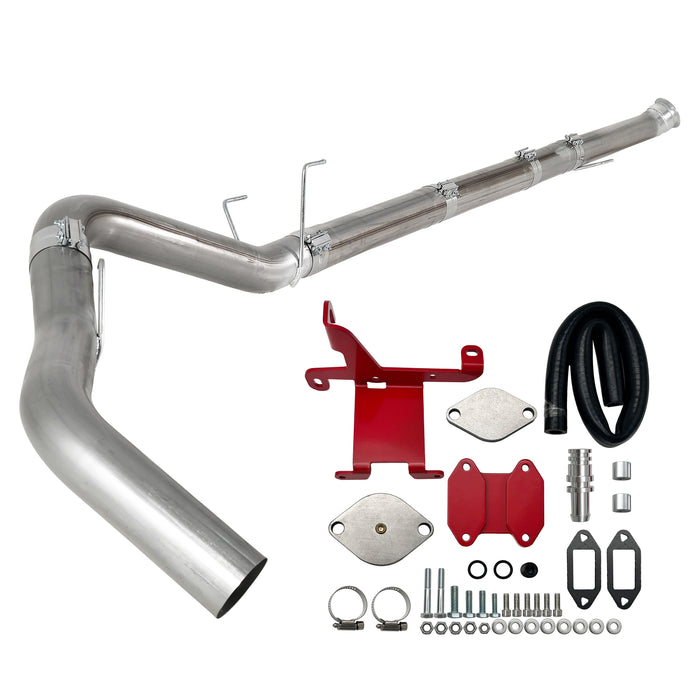
The Main Kit: 4"/5" Downpipe-Back DPF + EGR Delete
The 2019–2024 6.7L Ram Cummins 4"/5" DPF/EGR Delete kit is the hardware half of a full delete — EGR cooler and valve removal, plus your choice of 4" or 5" downpipe-back race pipe, in straight-pipe or muffled form. It fits standard 2500/3500 pickups (Crew Cab short/long bed and Mega Cab), and it does not fit Cab & Chassis 4500/5500. It’s hardware only — the tune is a separate, mandatory line item.
The Two Choices That Actually Matter
The kit is configurable along two axes, and they’re easy to confuse. Here’s the difference.
Pipe diameter — 4" vs 5".
- A 4" pipe gives clean factory-style fitment with great towing response and lower noise for a daily driver.
- A 5" pipe moves more CFM and drops towing EGTs a bit more, at the cost of a deeper — and louder — diesel tone.
For stock-turbo trucks, 4" is the honest sweet spot; 5" earns its keep on a big-build truck that actually uses the extra flow.
Coverage — mid-section vs full downpipe-back. This is the one most buyers gloss over. The 4" pipe comes in two versions: a mid-section DPF delete that replaces only the DPF/SCR canister and keeps your factory tailpipe, or a full downpipe-back that runs the whole way. The mid-section is quieter and cheaper; the full downpipe-back removes the last bit of restriction and changes the sound profile completely.
Muffler — straight vs muffled. Every configuration is available with a straight pipe (maximum volume and turbo whistle) or a high-flow performance muffler (tames the cabin drone while keeping flow up for towing). If the truck pulls long highway miles, the muffled option is the difference between a pleasant tow rig and a drone you hear for eight hours straight.
The Bypass Cable (2019–2021)
On the 2019–2021 trucks, the SGW bypass cable is the small, essential piece that lets the tuner talk to the ECM. Skip it and the port stays locked — no amount of hardware install gets you past that.
The Tune File (Two Year Ranges, Two Prices)
The tune is where the money goes, and it splits cleanly with the ECM fork:
- EZ Lynk tuning file for 2006–2021 covers the SGW-bypass years.
- EZ Lynk tuning file for 2022–2024 covers the locked-ECM years, and it’s the expensive end of the platform.
The Harness Plug Kit (The Hidden Line Item)
When you pull the DEF, O2, and NOx sensors, you leave connectors hanging in the weather. A tuner harness plug kit caps and seals those open plugs so water and road salt can’t corrode a 5V or 12V circuit and drag down unrelated sensors later. It’s a $50–$100 item that’s easy to skip and expensive to regret.
The Install: Tune First, Then Unbolt
The one rule that saves DIYers from a dead truck: flash the tune before you remove any hardware. Remove the DPF first and the ECM is still looking for it — you get a wall of codes and limp mode.
- Step 0 — Tune first. On 2019–2021, install the SGW bypass cable, then flash the delete tune. On 2022–2024, handle the ECM swap/bench flash first. This is the step that bricks trucks if rushed.
- Step 1 — Disconnect and drain. Both battery negatives off, then drain coolant for the EGR cooler removal.
- Step 2 — EGR out. Remove the EGR valve and crosspipe, then the cooler. Install block-off plates on the exhaust and intake sides, and reroute the coolant circuit.
- Step 3 — Exhaust out. Disconnect and label every exhaust sensor, then drop the DPF/SCR canister (it’s heavy — support it).
- Step 4 — Pipe in. Install the downpipe-back race pipe, torquing clamps front to rear.
- Step 5 — Seal the orphans. Cap every open connector with the harness plug kit.
- Step 6 — Refill, burp, road-test. Refill coolant, bleed the system, and check for boost or coolant leaks on the first drive.
The most common DIY failure on this generation isn’t a bolt — it’s the ECM swap done wrong on a 2022–2024. Follow the kit instructions exactly, and back up before you flash.
The Legal Reality (Read Before You Spend)
Removing emissions equipment from a vehicle certified for road use is a federal Clean Air Act violation under 42 U.S.C. § 7522(a)(3)(A) — and it carries no off-road or competition exemption. Individual penalties can reach $5,911 per violation. It voids your powertrain warranty, it fails visual and OBD inspections in emissions states, and it narrows your resale pool. These parts are for off-road, competition, and race use only.
For off-road / competition use only. Not legal for on-road use in emissions-regulated areas. Check your local, state, and federal laws before modifying any emissions-related component.
Get the Right Delete Kit for Your 2019–2024 Cummins
Before you spend a dollar, pin down which ECM your truck has — that single answer decides whether you’re paying for a $35–$100 bypass cable or a $1,000–$3,000 ECM swap, and whether DIY is a weekend project or a gamble. Once you know that, the rest is just matching hardware, tune, and the hidden pieces to the job.
Whether you wrench it yourself or pay a shop, TruckTok.com carries the complete 2019–2024 Cummins delete lineup — from the pipe and the EGR kit to the bypass cable, the tune, and the plug protection — so you’re never piecing the job together from three vendors and hoping the parts agree with each other.
If you still have any other doubts, you can check out other related blogs:
-
2019-24 Cummins Delete: The ECM Unlock That Changes Everything
- 6.7L Cummins P0401: The EGR Code That Means It's Time
- 2019-24 Cummins Delete: DIY vs Shop — What You'll Actually Pay
- How to Finally Eliminate Carbon Buildup in Your 6.7L Cummins?
Frequently Asked Questions
How much does a 2019–2024 6.7L Cummins delete cost, DIY vs shop?
DIY runs $2,200–$3,500 on 2019–2021 and $3,500–$4,500 on 2022–2024. Shop installs run $3,000–$5,000 and $5,500–$7,000 respectively. The gap is labor plus the locked-ECM work.
What’s the difference between the 2019–2021 and 2022–2024 trucks?
The 2019–2021 trucks use an SGW security gateway that a $35–$100 bypass cable defeats, then you tune through the OBD-II port. The 2022–2024 trucks have a locked ECM that needs a $1,000–$3,000 swap or bench flash.
Can I do a 2019–2024 Cummins delete myself?
Yes on 2019–2021, which is a manageable weekend job with basic tools. The 2022–2024 ECM swap is the risky step — mishandling it can brick the ECM and add $2,000–$3,000.
Do I need a tuner, or can I just remove the hardware?
You need the tuner, every time. Remove the DPF without a tune and the ECM throws codes and drops into limp mode. Hardware and tune are one job.
Does deleting add horsepower?
The horsepower comes from the tune, not the pipe. A delete alone just removes the restriction; the 75–180 hp gains are what a proper tune delivers on top of it.
What’s the most expensive line item?
The tune — $400–$3,000 depending on platform — is usually the biggest single cost, and on 2022–2024 trucks the ECM swap rivals it.
What hidden costs do most people miss?
Coolant and gaskets ($50–$150), an SGW bypass cable on 2019–2021, a harness plug kit to seal open connectors ($50–$100), and the brick risk on the 2022–2024 ECM swap.
Why are shops getting harder to find for this work?
EPA enforcement has pushed many diesel shops out of delete work for on-road vehicles, which cuts supply and drives quotes up — especially on the locked-ECM 2022–2024 trucks.
Does deleting void my warranty?
Yes. Once the ECM is flashed or the hardware is removed, expect powertrain and emissions warranty claims to be denied if the modification is discovered.
Is a delete legal to drive on the street?
No. It violates the federal Clean Air Act, fails inspections in emissions states, and carries fines up to $5,911 per violation. It’s for off-road, race, and competition use only.