
Home > News > 6.7L Powerstroke Delete: The 5 Mistakes That Cost You Twice

6.7L Powerstroke Delete: The 5 Mistakes That Cost You Twice
A 6.7L Powerstroke delete should be a one-and-done job. In practice, it becomes a two-and-done job — or three — for the owners who hit one of five predictable mistakes. The worst part is that none of these mistakes feel wrong while you’re making them. They feel like saving money, or saving time, or just “doing the easy version first.” Then the check engine light comes on, or the coolant disappears, or the truck derates on the highway, and you’re back under the hood paying for the same labor a second time.
Here are the five mistakes, why each one costs you twice, and what to do instead.
For off-road / competition use only. Not legal for on-road use in emissions-regulated areas. Check your local, state, and federal laws before modifying any emissions-related component.
Mistake 1: Flashing the Tune in the Wrong Order
Why It Happens
This is the most common mistake on the entire platform — and it’s easy to get wrong because even the vendors contradict themselves. One popular buyer’s guide says “install the delete tuner first,” then, three paragraphs later in its own installation section, tells you to “flash your delete tune LAST, only after all hardware is installed.” Two opposite instructions in the same article.
The Correct Order
The order is fixed: flash the delete tune first, then remove hardware.
What Happens When You Get It Backwards
- The 6.7L ECM runs closed-loop monitors on the EGR, DPF, and DEF systems — it watches EGR differential pressure, exhaust temperature, DPF soot load, and regen completion.
- Unbolt the EGR cooler or DPF without a recalibrated tune in place, and those sensors stop seeing expected values. The ECM throws a wall of DTCs and, on newer trucks, derates the engine — sometimes to a 5 mph limp.
Why It Costs You Twice
A truck that derates mid-delete has to be reassembled enough to run, reflashed, then torn back down — the same access work paid twice.
How to avoid it: Flash the tune while the truck is still complete, with a battery charger connected (a voltage dip mid-flash can corrupt the calibration). Only after the tune is confirmed do you start unbolting the DPF pipe, then the EGR hardware last.
Mistake 2: Blocking Only Half the EGR System
Two Circuits, Not One
The 6.7L Powerstroke doesn’t run one EGR circuit — it runs two: a high-pressure EGR circuit and a low-pressure EGR circuit, and a complete delete has to address both. Block only the high-pressure side and you still throw low-pressure EGR fault codes — and still leave a soot path into the intake.
The Coolant Bypass You Can’t Skip
The EGR cooler isn’t only an emissions part — it’s part of the cooling circuit. Coolant flows through it on its way to the rear of the block. Take the cooler out and dead-end the ports without a proper coolant bypass, and the rear cylinders — #4 and #8 on the 6.7 — run hot.
Why It Costs You Twice
The shops that see deleted 6.7s come back on a wrecker are almost always looking at a skipped coolant reroute. A hot rear cylinder means a head gasket, and a head gasket means the entire front of the engine comes back apart. That’s the definition of paying twice.
How to avoid it: Buy a kit that addresses both EGR circuits and includes the coolant bypass hardware — not just block-off plates. If a kit’s parts list doesn’t mention a coolant reroute, keep looking.
Mistake 3: Buying a “Universal” Pipe or the Wrong Year
Five Generations, Five Different Fitments
The 6.7L Powerstroke has been built in five distinct generations since 2011, and Ford changed the EGR routing, sensor locations, and exhaust geometry at every major break: 2011–2014, 2015–2016, 2017–2019, 2020–2022, and 2023+.
The Cost of the Wrong Pipe
- A 2017 pipe will not seat correctly on a 2015 truck — the hangers are in different spots, the flanges don’t line up, and the sensor bungs are in the wrong place.
- The owner who saves $40 on a “fits all years” pipe pays for it with a weekend of fighting fitment, then another round of shipping back the wrong part and waiting for the right one.
How to avoid it: Match the kit to your exact model year and cab configuration. Cab & Chassis trucks need different exhaust routing than pickups — a standard pickup pipe won’t bolt onto a C&C without modification. Confirm fitment before ordering, not after the box is open.
Mistake 4: Deleting in Stages Instead of All at Once
Why It Sounds Smart and Costs the Most
This is the mistake that sounds the most responsible and is actually the most expensive. An owner deletes the EGR now to solve an immediate problem, plans to “do the DPF later,” and leaves the CCV alone entirely. Six to eighteen months later, the DPF acts up — because the EGR was feeding it soot the whole time — and the owner pays for a second tune, a second round of labor, and a second session of downtime.
The Three Systems Are Linked
The EGR and DPF share the same soot source: delete the EGR and leave the DPF, and the now-richer, hotter combustion sends more soot into a filter that’s already loading faster. The CCV is the third leg nobody accounts for — crankcase oil vapor is the “glue” that binds dry EGR soot into the sticky carbon sludge that fouls the intake, turbo, and intercooler. Delete the EGR and DPF but leave the CCV, and you’ve cleaned the intake only halfway.
The Lazy Version: Unplugging Instead of Deleting
It’s common enough that owners brag about it — “I didn’t even delete the EGR, I just unplugged it.” Unplugging stops the valve from actuating but leaves the cooler in place, still cycling, still capable of cracking and dumping coolant into the intake. It’s a half-measure that reads like a shortcut and behaves like a deferred repair.
How to avoid it: If the truck is headed off-road anyway, do the whole job once. A matched kit that bundles the exhaust pipe, the EGR delete, and the CCV reroute in a single order means one tune, one teardown, and one calibration — instead of three.
Mistake 5: Cheaping Out on the Tune
The hardware is plumbing; the tune is the brain. The single most expensive “savings” in a 6.7 delete is buying a cheap, incomplete, or generic tune to shave a few hundred dollars off the total.
The Symptoms of an Incomplete Tune
An incomplete tune is the root cause behind the post-delete complaints owners post about all the time:
- The check engine light won’t go out.
- The switch-on-the-fly is stuck in one power level.
- Remote start stopped working.
- Fuel economy got worse instead of better.
None of those are the fault of the pipe or the plates — they’re all symptoms of a calibration that didn’t fully disable every DPF, EGR, and DEF diagnostic monitor.
The Transmission Cost
A tune that doesn’t calibrate the transmission is the second, quieter cost. The 6.7L mates to a 6R140 (through 2019) or a 10R140 (2020+) automatic, and both take shift commands from the PCM. A tune that adds fueling without matching transmission calibration accelerates clutch pack wear — you save a few hundred on the tune now and spend a few thousand on a transmission later.
How to avoid it: Budget for a proper tune and treat it as non-negotiable. Pair it with a tuner harness plug kit so the unused factory connectors stay weatherproof and corrosion-free — a clean flash starts with clean, protected wiring, and an exposed live connector is how you chase ghost codes for weeks.
The One Mistake That Isn’t on This List
There’s a sixth item that gets folded into delete discussions but has nothing to do with the delete itself: the CP4 high-pressure fuel pump. The 6.7L’s Bosch CP4.2 is a well-known weak point — when it fails, it sheds metal through the entire fuel system, taking injectors and lines with it at a cost that can exceed $10,000. But deleting the EGR, DPF, or DEF does nothing to protect the CP4. It’s a separate problem with a separate fix.
Owners who understand this run a disaster prevention kit, upgrade to a DCR or CPX pump, or at minimum change fuel filters on a strict schedule and run a lubricity additive on every tank — the CP4 was designed for fuel with more lubricity than today’s ultra-low-sulfur diesel. The trucks that make it to 350,000 miles on an original CP4 aren’t lucky; they’re maintained.
One Complete Kit: Built to Solve the Mistakes Above
The delete kit. The 2011–2022 6.7L Powerstroke 5" DP-Back Pipe & CCV Reroute + EGR Delete Kit bundles all three legs of a complete delete into one order — the 5" exhaust pipe, the EGR delete, and the CCV reroute — so you aren’t staging the job and paying for three teardowns. It covers 2011–2022 F-250/350/450 Super Duty trucks and addresses the exact failure chain this article is about: exhaust flow, intake soot, and crankcase oil vapor, in one pass.
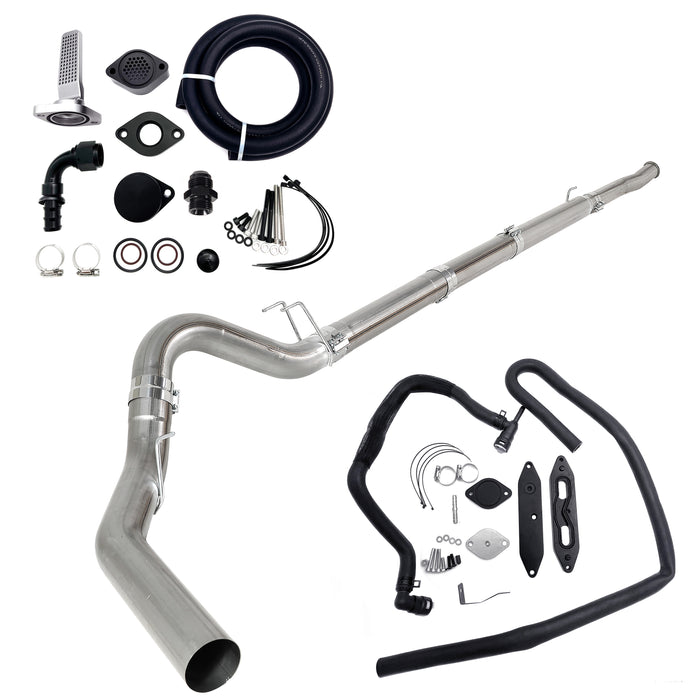
- It kills Mistake 2 (half a delete). The kit addresses the full EGR system with the coolant bypass — not just a block-off plate — so the rear cylinders don’t run hot and you don’t end up back under the hood chasing a head gasket.
- It kills Mistake 3 (the wrong year). It’s matched to 2011–2022 F-250/350/450 Super Duty trucks, not a “universal” pipe that fights fitment in the driveway.
- It kills Mistake 4 (deleting in stages). The 5" exhaust, the EGR delete, and the CCV reroute are all in one box — one tune, one teardown, and one calibration instead of three.
The Wiring Protection
The Shibby Engineering Tuner Harness Plug Kit for 2017–2019 6.7L Powestroke is the hardware half of that equation: it weatherproofs the factory EGR and DPF/exhaust temperature sensor connectors left open after the delete, so road salt and water can’t corrode live pins and trigger the short circuits that get misdiagnosed as a bad tune.
It’s protection only — no tuning — but it’s the difference between a clean flash and a weeks-long wiring diagnostic.
What a Delete Won’t Fix
Be clear-eyed about the limits, because the honest version is what keeps you from paying twice here too. A delete removes three emissions failure points — it does not make the engine bulletproof.
- The CP4 is still there. Covered above — a delete is not CP4 protection.
- The CCV filter is still a maintenance item on the stock setup. On 2017–2019 trucks, the serviceable CCV filter clogs and builds crankcase pressure that blows out seals, including the upper oil pan — a known leaker. The updated Ford CCV assembly (part FC3Z-6A785F) replaces the filter with a baffle design that doesn’t clog. A CCV reroute solves it by moving the vapor out of the intake entirely.
- Driving habits still matter. A deleted 6.7 is still a diesel: cold-start abuse, long idling, lugging under load, and hot shutdowns after towing all still wear the turbo and bearings regardless of what’s been removed from the exhaust.
After the Delete: How to Maintain It
A delete isn’t the finish line — it’s a new maintenance baseline. Once the emissions hardware is gone, the systems left behind need more attention, not less, because there’s no longer a regen cycle or an EGR loop quietly absorbing some of the abuse.
Fuel and Oil Filtration: The CP4’s Only Line of Defense
After a delete, the CP4 pump becomes the single most expensive and fragile part on the engine, and it survives on exactly two things: clean fuel and clean oil. Removing the EGR and DPF doesn’t change that.
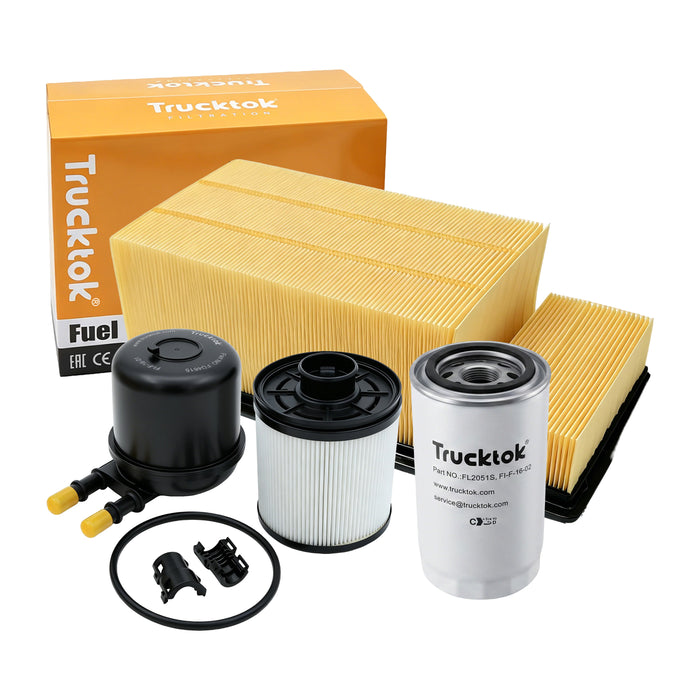
The 2011–2016 6.7L Fuel, Oil, Air & Transmission Filters Kit is that first line of defense: the dual-stage fuel filter set, the silicone anti-drainback oil filter, and the high-flow air filter are what keep the CP4 and the turbo alive once the factory hardware is gone.
Coolant: Watch the Level for the First Few Weeks
After the coolant reroute is done, keep an eye on the level for the first several weeks. An air pocket that wasn’t fully burped shows up as a slowly dropping level plus an occasional overheat, especially on long towing grades. Refill through the degas bottle and run it until the thermostat opens to confirm the loop is circulating cleanly.
Fuel Lubricity: Additive on Every Tank
The CP4 was designed for fuel with more lubricity than today’s ultra-low-sulfur diesel, which has had that lubrication stripped out. If you want the CP4 to last, run a lubricity additive on every fill-up — it’s cheap insurance against a $10,000 full-system replacement.
Driving Habits Still Apply
Deleting the emissions hardware doesn’t immunize the engine against bad habits. Warm it up before driving hard, don’t idle more than a minute or two, don’t lug it under load, and let the turbo cool for a few minutes after a heavy pull. Those are still the top variables in turbo and bearing life, delete or no delete.
After the Delete: Problems You Might Hit, and How to Fix Them
Even a delete done right can surface a few symptoms afterward. The good news: almost all of them trace to a specific, fixable cause — not mystery.
Check Engine Light That Won’t Clear
Root cause: an incomplete tune. A calibration that didn’t fully disable every DPF, EGR, and DEF monitor leaves one or two codes that won’t stay cleared.
Fix: go back to the tuner and confirm you’re running a complete delete calibration, not one that only turned off part of the monitoring. Don’t blame the hardware — pipes and block-off plates don’t throw codes on their own.
Hissing Under Boost, or Low Boost
Root cause: a boost leak. Usually a block-off plate that isn’t seated, a gasket that didn’t compress flat, or a vacuum/intake line that never got reconnected.
Fix: run a boost leak test — spray soapy water on the joints or pressurize the system — find the leak, and reseat the sealing surface.
Coolant Slowly Disappearing, No Visible Leak
Root cause: one of two things. Either the coolant bypass wasn’t done correctly, or the EGR cooler wasn’t actually removed (if it was a half-delete or just unplugged).
Fix: first confirm the cooler is physically gone; then check the bypass plumbing joints. Coolant getting into the intake is the one post-delete symptom you can’t afford to ignore.
Running Hot, Especially When Towing
Root cause: coolant isn’t reaching the rear cylinders — the coolant reroute was skipped or plumbed to the wrong port.
Fix: this is the #1 cause of post-delete overheating. Inspect the reroute line and confirm coolant is flowing to the back of the block. Don’t keep towing heavy until it’s sorted.
Remote Start or Switch-On-The-Fly Stopped Working
Root cause: the tune didn’t correctly preserve those features, or the calibration doesn’t match.
Fix: another classic symptom of an incomplete tune. Return to the tuner for a corrected file — it’s a calibration issue, not a hardware one.
Transmission Shifting Odd After the Flash
Root cause: reflashing cleared the transmission’s learned shift behavior, and it needs to re-adapt.
Fix: drive it normally for a few hundred miles and let it relearn. If the rough shifting persists, check whether your tune actually includes a transmission calibration.
The Legal Reality
Removing or bypassing the DPF, EGR, or DEF/SCR systems on a vehicle driven on public roads is prohibited under the federal Clean Air Act (42 U.S.C. § 7522). Violations carry civil penalties up to $5,911 per vehicle for individuals, and the EPA has actively pursued aftermarket defeat-device sellers. “Off-road use” is not a legal exemption — these parts are for off-road, competition, or closed-course vehicles only. Check your local and state laws before touching a wrench.
Get the Right Kit for Your Truck
The five mistakes all trace back to the same root: doing the job halfway and paying for the other half later. Wrong tune order, a half-blocked EGR, a universal pipe, a staged delete, and a cheap tune — every one of them turns a one-weekend job into a two- or three-weekend job with a bigger bill. The fix is the same across the board: flash first, delete both EGR circuits with a real coolant bypass, match the year, do all three systems at once, and don’t cheap out on the calibration.
For the full 6.7L Powerstroke delete lineup — pipes, EGR kits, CCV reroutes, tuner harness plugs, and the filters that keep a deleted truck alive — head to TruckTok.com. You can also visit the related blog:
-
6.7L Powerstroke EGR & DPF Delete Kit Install: Tools, Time & Difficulty
- 6.7L Powerstroke Delete — Race Pipe, EGR and CCV, Why Do Them Together?
- 6.7L Powerstroke CP4 Protection Guide: The Filters That Can Save You Thousands
Frequently Asked Questions
Q1: Do I really have to flash the tune before removing hardware?
Yes. The ECM monitors EGR flow, DPF soot load, and DEF dosing in closed loop. Unbolt the hardware without a recalibrated tune and the truck immediately sets fault codes and can derate — on newer trucks, to a 5 mph limp mode. Flash first, unbolt second.
Q2: Why do I need to block both EGR circuits on a 6.7L?
The 6.7L runs a high-pressure and a low-pressure EGR circuit, and a complete delete has to address both. Block only the high-pressure side and the low-pressure circuit still throws fault codes and still feeds soot into the intake.
Q3: What happens if I skip the coolant bypass?
The EGR cooler is part of the cooling circuit, carrying coolant to the rear of the block. Dead-end the ports without a bypass and the rear cylinders (#4 and #8) run hot, which is how deleted 6.7s end up with blown head gaskets.
Q4: Can I just unplug the EGR instead of deleting it?
You can, and owners do it, but it’s a half-measure. The cooler stays in place, still cycling, still capable of cracking and dumping coolant into the intake. Unplugging stops the valve, not the failure point.
Q5: Is a “universal 6.7 Powerstroke” delete kit a bad sign?
Generally yes. The 6.7L spans five generations with different EGR routing, sensor locations, and exhaust geometry. A pipe that “fits all years” usually fits none of them well — match the kit to your exact model year and cab configuration.
Q6: Does a delete add horsepower?
The delete itself doesn’t. The power comes from the tune you pair with it. A 120-horsepower tune is a tune, not a pipe — and the delete’s real value is reliability and intake cleanliness, not peak power.
Q7: Does deleting protect my CP4 fuel pump?
No. The CP4.2 is a separate weakness, and deleting the EGR or DPF does nothing to protect it. That takes a disaster prevention kit, a DCR/CPX conversion, or strict fuel filtration and a lubricity additive.
Q8: Will a cheap tune cause problems?
Yes. An incomplete or generic tune is behind most post-delete complaints — a check engine light that won’t clear, a stuck switch-on-the-fly, remote start that stopped working, and worse fuel economy. A tune that skips transmission calibration also shortens clutch pack life.
Q9: Should I delete the CCV along with the EGR and DPF?
Ideally yes. The CCV feeds oil vapor into the intake, which binds with soot into carbon sludge. Delete the EGR and DPF but leave the CCV, and the intake is only half-clean. A reroute kit handles it in the same teardown.
Q10: How do I avoid paying for a delete twice?
Do the whole job once, correctly. Flash the tune first, block both EGR circuits with a coolant bypass, match the year, delete all three systems together, and don’t cheap out on the calibration. Every “cost me twice” story skips one of those five.
For off-road / competition use only. Not legal for on-road use in emissions-regulated areas. Check your local, state, and federal laws before modifying any emissions-related component.