
Home > News > 6.7 Powerstroke vs 6.7 Cummins Delete: Which Is Cheaper and Easier


6.7 Powerstroke vs 6.7 Cummins Delete: Which Is Cheaper and Easier
For off-road / competition use only. Not legal for on-road use in emissions-regulated areas. Check your local, state, and federal laws before modifying any emissions-related component.
Here’s the short answer before the details: the delete hardware itself is a near-wash — a complete pipe-plus-EGR kit for either platform lands around $295. What actually decides whether one is “cheaper” or “easier” is the software side: the tuner, the ECM unlock, and the platform-specific traps that turn a simple bolt-on into a full weekend. Older trucks are close in price. The 2019+ Cummins — especially the 2022+ locked-ECM trucks — is where the Ram pulls ahead in cost, while the Powerstroke stays easier to tune.
Why the Hardware Is Basically a Wash
The first thing to understand is that the physical delete parts — the DPF/DOC race pipe, the EGR block-off plates, the coolant reroute hardware — cost almost the same on both platforms. This is the part most people get wrong, because they read a $300 “kit” and a $6,000 “bundle” and assume the difference is in the metal. It isn’t.
Look at two real TruckTok kits side by side:
| Kit | Platform | Contents | Price |
|---|---|---|---|
| 4" Exhaust Pipe & EGR Cooler/Throttle Delete | 6.7 Cummins 2013–2018 | 4" DPF/CAT race pipe + EGR cooler & valve delete + throttle valve delete | $299.45 |
| 4" DPF & CAT Pipe w/ EGR Delete Kit | 6.7 Powerstroke 2011–2023 | 4" DPF/CAT pipe + EGR cooler bypass | $294.59 |
Five dollars apart. The pipe is mandrel-bent 409 stainless on both. The block-off plates are machined the same way. The “expensive” part of a delete is never the hardware — it’s the tuner and the ECM access, and that’s where the two platforms finally separate.
Where the Cost Actually Splits: The Tuner and the ECM
On both trucks, the ECM runs closed-loop diagnostics on every emissions sensor, and the moment it sees zero EGR flow and a missing DPF pressure differential, it derates the truck — sometimes to a limp-home power level. The tune disables those monitors and recalibrates fueling. That tune is 30–50% of your total budget, and its price is where the platforms differ.
6.7L Powerstroke: The ECM has stayed tunable via the OBD-II port across all generations. EZ LYNK Auto Agent, BullyDog BDX, and H&S Mini Maxx all flash delete tunes directly — no ECM removal, no unlock service. Budget $700–$1,600 for the tuner and file, and that’s the whole software bill.
6.7L Cummins:
-
The early trucks (2007.5–2012) were just as open.
-
The 2013–2018 trucks add DEF/SCR to the tune but stay OBD-flashable (the 2018 adds a security gateway that needs a bypass cable — a $32 nuisance, not a wall).
-
The 2019–2021 trucks tighten things, and the 2022+ trucks lock the ECM hard: you’re looking at a bench-flash or a full ECM swap that runs $1,000–$3,000 on its own, pushing a complete professional delete to $5,500–$7,000.
That’s the real answer to “which is cheaper”: on hardware, neither. On software, the Powerstroke — because Ford never locked the ECM the way Ram did after 2022.
Which Is Cheaper, Generation by Generation
Here’s the honest cost picture across both platforms. “DIY” means parts and tune, no labor; “Shop” means a professional install.
| Generation | 6.7 Powerstroke | 6.7 Cummins | Verdict |
|---|---|---|---|
| 2011–2014 / 2007.5–2012 | $1,000–$2,000 | $1,200–$2,000 (no DEF) | Near tie; Cummins slightly simpler |
| 2015–2019 / 2013–2018 | $1,500–$3,000 | $1,800–$2,500 DIY / $2,300–$4,000 shop | Near tie |
| 2020+ | $2,000–$4,200 | $3,500–$7,000 (locked ECM) | Powerstroke clearly cheaper |
The Pattern:
For a decade, the two platforms tracked each other almost dollar-for-dollar. The split only appeared when Ram locked the 2019+ ECM and forced an ECM swap on 2022+ trucks. If you’re shopping a used truck today, a 2013–2018 Cummins and a 2015–2019 Powerstroke will cost about the same to delete; a 2022+ Cummins will cost two to three times what a same-year Powerstroke costs.
Which Is Easier to Delete?
“Easier” splits into two separate questions — the hardware and the software — and the two platforms are mirror images of each other.
The Powerstroke: Harder Hardware, Easier Software
The Ford’s physical install has more traps, because the 6.7 Powerstroke runs a dual-circuit EGR system — both a high-pressure and a low-pressure loop. A kit that blocks only one side leaves soot still feeding the intake, and a kit that skips the coolant reroute starves the rear cylinders (#4 and #8) and causes localized overheating. The CCV filter is another hidden item — it clogs, builds crankcase pressure, and blows seals if you don’t address it.
But the software is simple. Plug in the tuner, flash the file, done. No ECM shipping, no unlock fees, no swap.
The Cummins: Easier Hardware, Harder Software
The Ram’s EGR cooler is a single, relatively accessible unit (the toughest fastener is a front cooler nut that some owners bend a wrench to reach). The delete is more straightforward to wrench. The catch is the software: after 2018 you’re dealing with a security gateway bypass, and after 2022 the ECM is locked hard. And on Cab & Chassis trucks (4500/5500), the Aisin transmission runs torque-limiting that actively de-fuels — there’s no TCM unlock software, so a C&C Ram is capped at a ~50 hp tow tune, never a high-horsepower file.
The honest summary: if you’re comfortable wrenching but not flashing ECUs, the Powerstroke is easier. If you’re comfortable flashing but not fighting tight hardware, the Cummins is easier. They hand you the difficulty on opposite ends of the job.
The Hidden Cost of Getting It Wrong
Both platforms punish a half-done delete in their own specific way, and these mistakes are what actually drive the “real” cost past the sticker price.
-
Powerstroke — skipping the coolant reroute. The EGR cooler is part of the cooling circuit. Cap the ports without rerouting, and the rear cylinders run hot and eventually score. That’s a cylinder head, not a do-over.
-
Powerstroke — deleting only one EGR circuit. The dual-circuit layout means a partial block-off still lets soot into the intake. You’ve paid for the job without actually fixing it.
-
Cummins — deleting EGR and leaving the DPF. The EGR and DPF are linked: pull the EGR and the DPF loads faster, triggering more aggressive regens. A both-or-neither decision.
-
Cummins — buying a “no-ECM-swap” delete for a 2022+. These flash a factory emissions-exempt file rather than actually unlocking the ECM. They’re known to be a coin flip on whether they run cleanly — the ECM swap is the reliable route, and it’s the one that costs real money.
How to Save Money on a Delete (Without Cutting Corners)
The price range on a delete is wide for a reason — most of it is controllable. Here’s where the real savings live, and where “cheap” actually costs you more.
Do the Mechanical Work Yourself, Outsource Only the Software
Labor is the single largest controllable line item: a shop charges $400–$1,500 for the mechanical install on either platform. The wrenching — pulling the DPF canister, removing the EGR cooler, bolting on the race pipe and block-off plates — is a driveway job with basic hand tools and a weekend. The software, by contrast, is where a DIYer usually shouldn’t improvise.
So the smart split is: do the hardware yourself, and pay a tuner only for the file and the ECM work.
Source the ECM the Smart Way on a Locked Cummins
The single most expensive line item on a 2022+ Cummins is the ECM swap. The bundle price — $5,500–$7,000 installed — bakes in a new ECM and shop markup.
Owners who piece it together instead report buying a used 2019–2021 ECM from a part-out for $900–$1,500, then paying $1,000–$1,500 for the tuner device and file. That path lands a 2022+ delete around $2,150–$3,500 out of pocket instead of $6,000 — roughly half. The trade-off is that you own the compatibility risk instead of a shop, so verify the donor ECM’s year and strategy before you buy.
Use a Preloaded Tuner, Skip the Full Custom File
A preloaded tuner with off-the-shelf delete calibrations runs $500–$1,200. A fully custom tune written for your exact truck runs $800–$1,500+. For a daily or tow truck running a mild, conservative tune, the preloaded file is almost always sufficient. The custom tune earns its premium only when you’re chasing a specific build: big injectors, a compound turbo, or a transmission that needs bespoke shift logic.
Buy Stainless Once, Not Aluminized Twice
Aluminized steel pipe is $150–$250 cheaper up front, but it rusts through in 2–4 years in salt-belt or coastal duty and you buy the pipe again. 409 stainless costs more on day one but is the same grade OEMs use and lasts the life of the truck. The “cheaper” pipe is only cheaper if you plan to sell the truck before it rusts — otherwise it’s a false economy that shows up as a second exhaust purchase.
Don’t Cheap Out on the Tune Itself
This is the one place where spending less reliably costs more. A cheap, incomplete, or mismatched tune leaves the check-engine light on, fails to disable every monitor, or loads a file built for the wrong year — and the truck derates anyway. The result is a second tune purchase and a second trip through the install.
The Two Kits
These two kits are the cleanest illustration of the whole “hardware is a wash” point — same job, two platforms, five dollars apart.
6.7 Cummins 2013–2018: 4" Exhaust Pipe & EGR Cooler/Throttle Delete
The TruckTok 4" Exhaust Pipe & EGR Cooler/Throttle Delete kit covers the fourth-gen Ram’s three restriction points in one box: a mandrel-bent 4" DPF/CAT race pipe that bolts to the factory tailpipe, an EGR cooler and valve delete, and a high-flow throttle-valve delete tube.
- The throttle-valve delete matters on this platform because the factory butterfly is a genuine airflow restriction even after the EGR is gone.
- Mandrel bending (not crush bending) keeps the pipe diameter uniform through the bends, which is what actually drops towing EGTs.
- It fits the 2500/3500 pickup and does not fit Cab & Chassis — since the C&C trucks have a different exhaust and an Aisin transmission that caps tuning anyway.
6.7 Powerstroke 2011–2023: 4" DPF & CAT Pipe w/ EGR Delete
The 4" DPF & CAT Pipe w/ EGR Delete Kit pairs a 4" mandrel-bent pipe with an EGR cooler bypass assembly, addressing both the exhaust restriction and the intake soot source in one install.
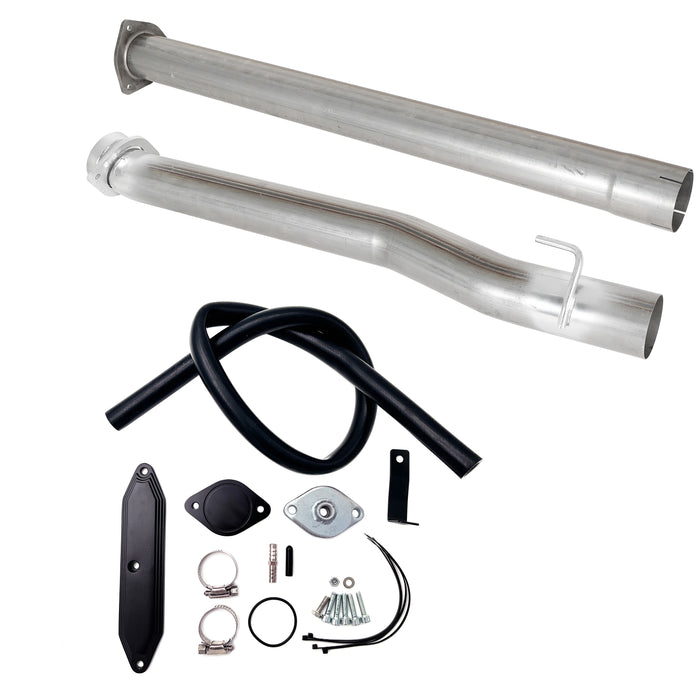
- The EGR cooler bypass is the piece that matters — it removes the cooler entirely so it can’t crack and dump coolant into the intake,
- The 4" pipe ends the regen cycle and drops EGTs under load.
- It fits the F-250/F-350/F-450 and does not fit Cab & Chassis.
Both kits are hardware-only — you still need a delete tuner matched to your exact year. That’s not optional on either platform.
The Install, Step by Step
The mechanical sequence is the same on both platforms, with a few platform-specific differences you have to respect. Here’s the full walkthrough — and where the two trucks diverge.
Tools You’ll Need
- Socket set with 7mm, 8mm, 10mm, 13mm, 15mm and a deep socket for the pipe clamps
- Ratchet, extensions, and a swivel for the tight cooler fasteners
- Penetrating oil (spray the exhaust and cooler bolts 24 hours ahead — they seize)
- Drain pan and fresh coolant (both platforms open the cooling circuit)
- A ratchet strap to lower the heavy DPF canister off its hangers
- Gloves, eye protection, and shop towels
- Your delete tuner, flashed and ready before you touch a bolt
Step 0: Flash the Tune First
This is the one rule that applies to both trucks and can’t be skipped: tune first, then unbolt. The ECM runs closed-loop monitoring on the DPF differential pressure, the EGT sensors, and the EGR valve position. Remove the hardware first and the truck throws a wall of fault codes and derates — sometimes to a limp-home level before you even finish the job. Connect the tuner, back up the factory calibration, and load the delete file while the truck is still intact. On a 2018+ Cummins, install the security-gateway bypass cable first; on a 2022+ Cummins, the ECM unlock or swap happens before anything else. Connect a battery charger during the flash so a voltage dip doesn’t brick the ECM.
Step 1: Disconnect Batteries and Drain Coolant
Disconnect the negative terminals on both batteries. Drain enough coolant to open the EGR cooler circuit without uncontrolled spillage — on the Powerstroke there are two radiators, each with its own drain plug (they’re plastic, turn gently); on the Cummins a single drain gets you there.
Step 2: Remove the Exhaust (DPF/DOC)
Unplug every sensor on the aftertreatment section — the EGT probes, the differential-pressure sensor, and the NOx/DEF sensors — and label each connector as you go. Undo the flange bolts at the downpipe and the rear clamp, then lower the canister with a ratchet strap. The DPF assembly is heavy, and it’s the one part you genuinely want a second set of hands for.
Step 3: Remove the EGR Cooler
Disconnect the coolant lines and cap the open ports. Unbolt the cooler and valve. This is where the platforms split:
- Powerstroke: the 6.7 runs a dual-circuit EGR — a high-pressure and a low-pressure loop — so both have to be blocked, not just the easy one. The cooler is also part of the cooling circuit, so the coolant reroute is mandatory: cap the ports without rerouting and the rear cylinders (#4 and #8) run hot and eventually score.
- Cummins: the cooler is a single, relatively accessible unit. The toughest fastener is the front cooler nut — many owners bend a sacrificial wrench to reach it. You’ll also remove the throttle valve here, since it’s a genuine airflow restriction once the EGR is gone.
Step 4: Install the Block-Off Plates and Race Pipe
Clean the mating surfaces, set the gaskets, and bring each block-off plate down evenly — don’t tighten one corner first. Bolt the race pipe in using the factory hanger locations, then tighten from the front flange back. Reuse new gaskets, not the crushed originals.
Step 5: Refill, Burp, and Test
Refill the coolant and run the air-bleed procedure for your platform — trapped air in the cooling system is a common cause of post-delete overheating on both trucks. Reconnect the batteries, start the engine, and check immediately for exhaust leaks (a tick under load) and coolant leaks at every reroute fitting. Take a short drive and confirm no warning lights.
The Three Mistakes That Come Back to Bite You
- Doing the hardware before the tune. This is the fastest way to derate the truck mid-install. Tune first, always.
- Skipping the coolant reroute on the Powerstroke. Blocking the EGR cooler without rerouting the coolant path cooks the rear cylinders. This is the single most expensive mistake on the Ford side.
- Deleting the EGR and leaving the DPF (Cummins). The two are linked — pull the EGR and the DPF loads faster. It’s a both-or-neither decision on the Ram.
The Three Things That Decide It (and the One That Doesn’t)
Before you pick a side, here’s what actually moves the needle — and what the marketing wants you to believe moves it.
What Decides It
- The model year, not the brand. A 2013 Cummins and a 2015 Powerstroke cost about the same to delete. The brand only matters at the extremes: a 2007.5–2012 Cummins has no DEF (cheapest), and a 2022+ Cummins has a locked ECM (most expensive).
- The ECM. Ford never locked it; Ram did after 2022. That’s the single biggest cost driver in the entire comparison.
- Pickup vs. Cab & Chassis. On the Ram side, C&C means the Aisin transmission and its torque-limiting — no high-horsepower tune, ever. On both platforms, C&C exhaust routing differs from the pickup.
What Doesn’t Decide It
The horsepower claim. Delete marketing runs on big numbers — “80–200 HP,” “100–150 HP,” “2–5 MPG.” Here’s the honest version that applies to both platforms: the delete hardware does not make horsepower. The power comes from the tune you pair with it, and even then a mild, reliable tune is worth far more than a race file that pushes the transmission past its limit. If you’re choosing between the Powerstroke and the Cummins based on “which deletes to more horsepower,” you’re answering the wrong question.
Get the Right Kit for Your Truck
The “cheaper and easier” question comes down to one thing: match the kit to your exact year and configuration, and don’t buy hardware without a plan for the tune. On the hardware side, both platforms cost the same — a complete pipe-plus-EGR kit is around $295 whether it’s a Cummins or a Powerstroke. The difference is the software you bolt on top of it — and that’s where knowing your model year, your ECM, and your pickup-vs-C&C configuration saves you real money before you ever turn a wrench.
For the full lineup of 6.7L delete pipes, EGR kits, and tuners — built for the Cummins and Powerstroke platforms across every generation — head to TruckTok.com. Every kit is engineered for the specific fitment of your year and body configuration, so you’re not guessing at a universal part that doesn’t quite fit.
The Related Blogs:
- Is EGR Delete, DPF Delete & CCV Reroute Worth It on a 6.7L Powerstroke?
- 2013-2018 6.7L Cummins EGR & DPF Delete: 4" Exhaust & Cooler Kit Buyer's Guide
- How to Finally Eliminate Carbon Buildup in Your 6.7L Cummins?
- 6.7L Powerstroke DPF and EGR Delete — How It Stops the Regen Problem
Legal Disclaimer
For off-road / competition use only. Not legal for on-road use in emissions-regulated areas. Removing or tampering with emissions equipment may violate the federal Clean Air Act (42 U.S.C. § 7522) and state emissions regulations. Penalties can include fines up to $5,911 for individuals. Check your local, state, and federal laws before modifying any emissions-related component.
Frequently Asked Questions
Q: Is a 6.7 Cummins or a 6.7 Powerstroke cheaper to delete?
A: On hardware, they’re a wash — a complete pipe-plus-EGR kit for either is around $295. The difference is in tuning: the 2019+ (especially 2022+) Cummins locks the ECM and requires a $1,000–$3,000 bench-flash or swap, while the Powerstroke stays OBD-flashable across all years. For same-year trucks, the Powerstroke is cheaper once you hit 2022+.
Q: Which is easier to delete?
A: It depends on your skills. The Powerstroke has harder hardware (dual-circuit EGR, a required coolant reroute, a CCV filter) but simple software. The Cummins has easier hardware but a locked ECM after 2022 and an Aisin de-fuel on Cab & Chassis trucks. They hand you the difficulty on opposite ends of the job.
Q: Do both trucks need a tuner after deleting?
A: Yes. On both platforms, removing hardware without a tune throws immediate fault codes and puts the truck into derate or limp mode. The tuner disables the DPF, EGR, and DEF/SCR monitors and recalibrates fueling — it’s 30–50% of the total budget on either truck.
Q: Why are 2022+ Cummins deletes so expensive?
A: Ram locked the ECM on late-model trucks, so standard OBD flashing no longer works. Getting a tune on requires a bench-flash or a full ECM swap that runs $1,000–$3,000 before you touch a single bolt, pushing a complete professional delete to $5,500–$7,000.
Q: Does deleting add horsepower?
A: The delete hardware itself doesn’t — the power comes from the tune. Mild tunes add roughly 40–80 HP on either platform; aggressive files claim more but push the transmission and head gaskets. The delete’s real value is reliability, not peak power.
Q: Does deleting improve fuel economy?
A: Modestly, and it varies by truck, load, and tune quality. Most owners see +1–3 MPG from eliminating regen cycles and reducing backpressure, but fuel economy is a possible benefit, not a fixed promise.
Q: What’s the CP4.2 fuel pump concern, and does it apply to both?
A: The CP4.2 is a Bosch high-pressure pump with a documented failure mode that sends metal through the fuel system — an $8,000–$12,000 repair. The 6.7 Powerstroke has used the CP4.2 across its run, so it’s a real concern there. The 6.7 Cummins used the reliable CP3 from 2007.5–2018, briefly switched to the CP4.2 in 2019–2020, then went back to the CP3. A delete doesn’t fix a CP4.2 — that’s a separate fuel-system decision.
Q: Can I delete a Cab & Chassis truck the same way as a pickup?
A: No. On the Ram side, C&C trucks (4500/5500) run the Aisin transmission with torque-limiting that de-fuels, and there’s no TCM unlock software — so you’re capped at a ~50 hp tow tune. On both platforms, the C&C exhaust routing and pipe geometry differ from the pickup, so the kits aren’t interchangeable.
Q: Is deleting cheaper than repairing the emissions system?
A: Usually, yes, for a high-mileage truck facing repeated failures. A single DPF replacement is $2,000–$5,000 and an EGR cooler is $1,000–$2,000, and two simultaneous failures hit $6,000–$10,000. A full delete on a 2013–2018 truck runs $1,800–$4,000 and removes those failure points permanently — but it’s illegal on-road and voids the warranty.
Q: Which truck should I buy if I plan to delete it?
A: If delete cost is your deciding factor, the sweet spot is a 2007.5–2012 Cummins (no DEF, open ECM, reliable CP3 pump) or a 2011–2016 Powerstroke (open ECM, before the tightest tuning). Avoid the 2022+ Cummins unless you’ve budgeted for the ECM swap.
Q: What’s the biggest mistake people make on either platform?
A: On the Powerstroke, skipping the coolant reroute or blocking only one EGR circuit — both leave the rear cylinders or the intake damaged. On the Cummins, deleting the EGR and leaving the DPF, or buying a “no-ECM-swap” delete for a 2022+ truck that turns out to be a coin flip. Both mistakes double the cost of the job.
Q: Does a delete hurt resale value?
A: Yes, on both platforms. Mainstream dealers detect deleted trucks and discount or refuse the trade, and emissions-test states won’t register them. Reverting to stock — reinstalling the DPF, EGR, and DEF hardware plus reloading the factory tune — can cost $1,500–$3,000 depending on what was removed.