

Home > News > How to Choose a Best Performance Delete Kit: What Actually Matters
How to Choose a Best Performance Delete Kit: What Actually Matters
The best delete kit is not the one with the biggest horsepower claim on the listing. It’s the one that matches your exact truck, works with the tuning you actually have, and doesn’t leave out a component you’ll need. A $150 pipe with no tuner and no EGR hardware costs more than a $600 complete kit once you finish buying the rest — and a kit that doesn’t fit your model year doesn’t work at any price.
For off-road / competition use only. Not legal for on-road use in emissions-regulated areas. Check your local, state, and federal laws before modifying any emissions-related component.
The First Rule: Diagnose Before You Buy
Before you order anything, answer one question: what problem are you actually solving?
Coolant loss, white smoke, a check-engine light, and frequent regens are symptoms, not proof that your DPF is the culprit. The same warning can come from a lazy thermostat, a cracked differential-pressure hose, a bad EGT sensor, a boost leak, an over-fueling injector, or a DEF/SCR fault. Bolting a delete kit onto a truck with one of those problems doesn’t fix the problem — it hides it under a pile of removed parts.
A trustworthy shop or seller should scan the truck first, check soot load and ash load and EGT data, and ask how you actually use the truck before quoting parts. If someone is happy to sell you a kit without ever asking what’s wrong with the truck, that’s your first red flag.
Know Your Delete: EGR, DPF, and Full Are Different Jobs
“Delete kit” is a catch-all term, and treating it as one thing is how people buy the wrong part. Three different jobs hide under that label:
-
EGR delete removes the exhaust gas recirculation valve and cooler. It cleans the intake, eliminates the cooler-cracking failure point, and needs its own block-off plates and coolant reroute.
-
DPF delete removes the particulate filter (and usually the SCR/DEF stack with it). It’s an exhaust-side change — a race pipe or a downpipe-back system.
-
Full delete bundles both, plus often a CCV reroute and the tuner to shut off every emissions monitor at once.
The important nuance is that you don’t have to physically remove the EGR to do a delete. A “bare minimum” delete is a tuner plus a race pipe — the tune shuts the EGR valve off in software, and you can leave the cooler bolted in place (unplugged) to save the teardown. However, there will be hidden dangers.
A “full” delete adds the physical EGR removal, which cleans up the engine bay and eliminates the cooler-cracking risk for good, but it’s optional, not mandatory.
The Seven Things That Actually Matter
Strip away the marketing and a delete kit comes down to seven things. Here they are, in the order that determines whether you’ll be happy with the result.
| Factor | What to check | Why it matters |
|---|---|---|
| 1. Fitment accuracy | Exact year, engine code, pickup vs. Cab & Chassis | A wrong-year pipe means grinding or welding on install day |
| 2. Hardware quality | Stainless grade, weld finish, flange thickness, gasket material | Thin flanges warp; cheap gaskets leak within 10,000 miles |
| 3. Kit completeness | EGR plates, DPF pipe, CCV kit, all block-off plates and gaskets | One missing plate = a coolant or boost leak |
| 4. Tuning ecosystem | Supported tuners, multi-power-level files, update policy | Hardware without tuner support is a boat anchor |
| 5. Install difficulty | Bolt-on vs. cutting, instruction clarity, tool list | Decides whether it’s a 4-hour job or a 2-day shop visit |
| 6. Post-sale support | Phone/chat, warranty, troubleshooting response | Deletes are install-sensitive; you will have questions |
| 7. Total price | Entry price vs. complete system with tuner | A cheap kit plus a separate tuner often beats a bundle’s price |
The single most-overlooked factor is #4 — the tune. A 5" stainless pipe is worthless if the ECM still expects a DPF pressure sensor to report back. Remove the hardware without the matching calibration and the truck throws a wall of DTCs and drops into limp mode within minutes.
Material: 304 vs 409 vs Aluminized Steel
Pipe material is the first thing cheap kits skimp on, and it’s the difference between a delete that lasts and one you replace in three winters. Three grades show up in delete pipes, and they are not interchangeable in quality.
The Aluminized Steel (“Aluminum” in Listings)
This is plain steel with an aluminum-silicon coating — it is not real aluminum, which would soften at 400°F and could never survive exhaust heat. The coating buys you 2–4 years before road salt and heat cycles wear it through and the pipe rusts out. It’s the cheapest option, and on a salted northern truck it’s a false economy.
The 409 Stainless
Chromium without nickel. It develops a light surface rust haze over time, but that haze is a protective layer — it doesn’t rust through. 409 is the durability sweet spot: it costs barely more than aluminized steel (often only $30–$80 more per pipe) but lasts many times longer.
The 304 Stainless
Chromium plus nickel, so it doesn’t rust at all. It’s the right call for coastal trucks, heavy winter-salt duty, or anyone who plans to keep the truck for a decade — but it’s the one with a real price premium, sometimes close to double 409 on a full downpipe-back system.
The honest takeaway: the jump from aluminized to 409 is the best value on the page, and the jump from 409 to 304 is the one you only pay for if you genuinely need it. Check the material on the listing — a kit that doesn’t name its steel grade is usually hiding a cheap pipe.
4-Inch vs 5-Inch: Bigger Is Not Automatically Better
Pipe diameter is the most over-weighted spec on a delete listing, so let’s settle it plainly.
-
4-inch is the practical fit for the vast majority of builds. It keeps exhaust velocity up for good low-end response, routes cleanly around crossmembers and spare tires, and produces far less cab drone. For a daily driver, a tow rig, or any moderate tune, 4" is the default answer.
-
5-inch is mostly about a deeper, louder exhaust note and a little more top-end flow. It makes sense on a high-output build with a big turbo and an aggressive tune — and it’s harder to route, drones badly at highway speed, and can actually soften low-RPM response by dropping exhaust velocity.
Here’s the part the listings won’t tell you:
A 5-inch pipe does not automatically mean more towing torque. On a stock or lightly tuned truck, the limiting factor is the transmission and the tune, not the pipe diameter. Going from 4" to 5" buys you sound and appearance, not a meaningful power increase — so choose the diameter for how the truck is actually used, not for a bigger number on the page.
Does It Include EGR and CCV? (This Is the Completeness Question)
The biggest hidden cost in a delete kit is what isn’t in the box. Two components get left out of cheap listings, and both matter for different reasons.
The EGR Delete
A bare-minimum delete (tuner + race pipe) shuts the EGR valve off in software, so you can skip the physical EGR removal. But the EGR cooler is still there, still heat-cycling, and still capable of cracking and dumping coolant into the intake. The EGR hardware is usually the cheapest part of a kit — if it’s missing, the listing is banking on you not knowing the cooler is still a live failure point.
The CCV Reroute
This is the one most buyers overlook. Intake carbon buildup has two ingredients — dry soot from the EGR, and oily vapor from the crankcase (CCV). Delete the EGR and you’ve removed the soot, but the CCV is still spraying oil mist into the turbo inlet, where it bakes into sticky sludge on its own. A complete kit addresses both sides of the intake, not just the exhaust side.
When you compare two kits, look past the pipe and check whether the EGR plates and the CCV reroute are included. A “complete” kit that’s missing the CCV is only solving half of the intake-cleanliness problem — and that’s the half you’ll be back for later.
Fitment Beats the Brand Name
“6.7 Powerstroke” is not enough to confirm fitment. The same engine badge hides multiple generations with different flanges, sensor locations, and exhaust routing — and the split can be as fine as half a model year.
-
Duramax: the LML changes flange style at 2015.5 (V-band → 3-bolt). An LML pipe does not fit an L5P, and an L5P kit needs the CAN BUS plugs the LML never had.
-
Cummins: a 2013–2018 pipe doesn’t fit a 2019+ truck — the VGT turbo outlet diameter changed. And a standard pickup pipe doesn’t fit a Cab & Chassis chassis.
-
Powerstroke: the 2011–2016 C&C trucks need a different hanger layout than a crew-cab pickup, and 2020+ trucks use different hardware than the 2011–2019 generation.
Before you click buy, confirm five things: model year, engine code, pickup or C&C, wheelbase, and whether you already have a tuner or exhaust. Those five answers eliminate most of the return-and-reorder headaches.
The Three Tiers of Kits
Delete kits fall into three rough tiers, and each has a distinct risk profile.
-
Budget ($100–$250, hardware only). Lowest entry price, but thin-wall pipe, generic fitment that may need trimming, and no tuner included. Once you add a compatible tuner separately, you’ve usually spent more than a complete bundle — $650–$900 all-in for a worse result.
-
Mid-tier ($250–$500, hardware + separate tuner). Noticeably better hardware and more accurate fitment, but tuner support varies wildly — some brands only ship a single locked power level, and support is inconsistent.
-
Premium bundle ($500–$1,200, complete). Matched hardware and tuner in one order, year-specific fitment, multi-power-level tunes, and real phone/chat support. Highest upfront cost, but the lowest total cost and fewest install headaches.
The honest rule of thumb: budget kits make sense only if you already own a compatible tuner and just need the pipe. For everyone else, a complete bundle is cheaper in total and less likely to strand you mid-install.
The Products: One Kit Per Platform, Built to Match
The right kit depends entirely on which platform you’re working on — and the differences between these three show exactly why fitment and structure matter more than a brand name.
6.7L Powerstroke — One Box, Three Jobs
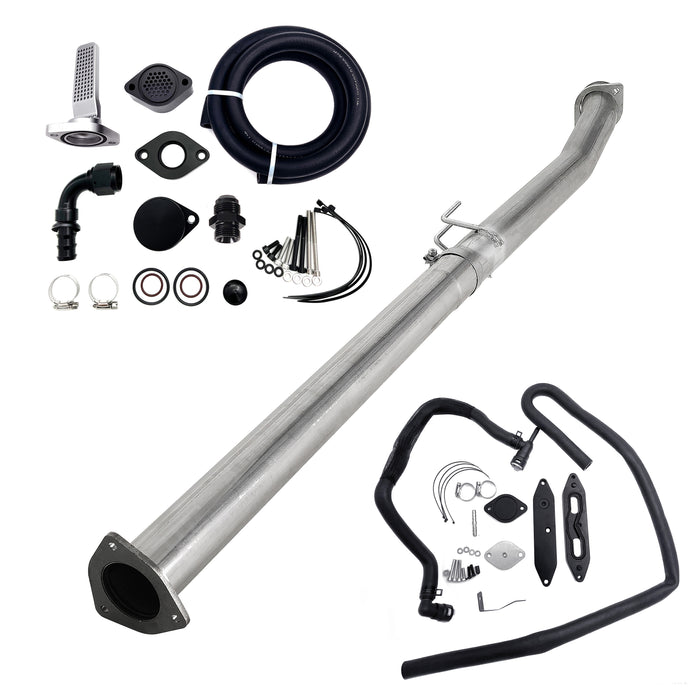
The 2011–2023 6.7L Powerstroke 4" Exhaust Delete Pipe & CCV/EGR Delete Kit is a fixed three-in-one: a 4" mandrel-bent race pipe, the EGR delete, and a CCV reroute in a single box at $502.82. It’s the “I want it all done at once” option for a stock F-250/F-350/F-450 — no picking and choosing, just a complete hardware package.
6.7L Cummins — The Big-Pipe Full Delete
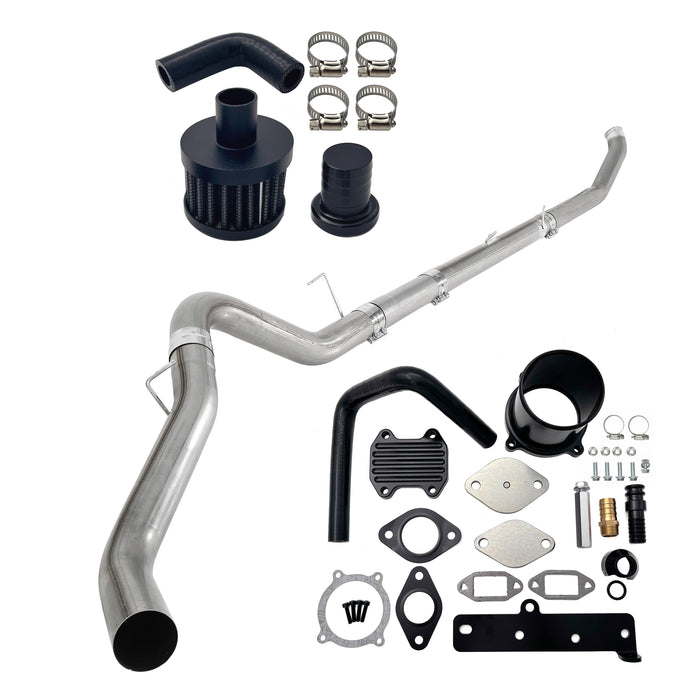
The 2013–2018 6.7L Cummins 5" Turbo Back DPF/CCV/EGR Delete Kit goes the other direction: a 5" turbo-back system that deletes the DPF, EGR cooler, throttle valve, and CCV in one shot at $793.00. It’s the deep-flow, low-EGT play for the highest-volume Ram generation — built for the standard pickup, not the Cab & Chassis.
6.6L Duramax L5P — Build It to Fit What You Already Have
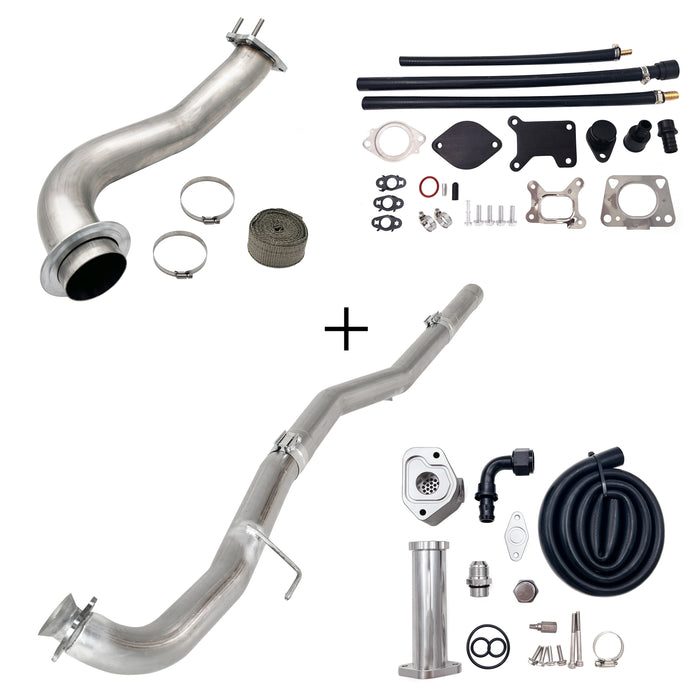
The 2017–2023 6.6L Duramax L5P DPF/CCV/EGR All-in-One Kit is the modular one — 30 variants spanning $131.99 to $1,311.17. You can order just the EGR delete, or the EGR plus a 4" race pipe, or add the 3.5" downpipe, or go all the way to a 5" downpipe-back with CCV — whatever matches the parts you already have. That’s the whole point of “choose what actually matters”: you only buy the pieces you need.
Every one of these kits still needs a tuner to disable the emissions monitors — the hardware and the calibration work together, and the tune is non-negotiable regardless of platform.
The Legal Reality (Read This Before You Commit)
Deleting emissions equipment on a vehicle driven on public roads violates the federal Clean Air Act (42 U.S.C. § 7522), and fines run up to $5,911 per violation for individuals. The EPA states plainly that there is no exemption for a vehicle used only off-road or only for racing. A delete also voids your emissions warranty and makes the truck harder to trade in later.
Everything here — the factors, the tiers, the costs, the parts — applies to off-road, competition, and closed-course vehicles where that use is lawful. Know your local and state laws before you touch a wrench, and be honest with yourself about whether your truck is a daily driver or a dedicated non-road build.
Get the Right Kit for Your Truck
Choosing a delete kit comes down to three honest questions, in order: what problem are you solving, what does your exact truck need to fit, and what tuning do you already have? Answer those before you look at a single price tag, and the rest falls into place.
For a stock 6.7 Powerstroke, the 4" pipe + EGR + CCV kit gets it done in one box. For a 2013–2018 Cummins, the 5" turbo-back delete clears the whole airflow path. For an L5P Duramax, the modular all-in-one kit lets you build exactly what your build needs. And whatever you pick, pair it with the right tuner — because the hardware is only half the job. Of course, Trucktok also have other products for you to choose from, allowing you to make your purchase freely and combine them as you wish.
If you still have doubts about the delete kit:
- EGR Cooler Delete: Fix Coolant Leaks for Good (Cost + Install)
- How to Get More Power From a Diesel Truck Without Wasting Money (2026)
-
DPF Delete Before and After — Real Performance, MPG, and Sound Data
Frequently Asked Questions
Q1: What’s the most important thing to look for in a delete kit?
Fitment. A kit that matches your exact year, engine code, and cab configuration is worth more than any horsepower claim — a wrong-year pipe means grinding or welding on install day, and a wrong-flange pipe doesn’t fit at all.
Q2: Does a delete kit add horsepower?
Not on its own. The power comes from the tune, not the removed hardware. A delete’s real payoff is reliability — no regens, no EGR cooler to crack, no DEF system to strand you.
Q3: What’s the difference between an EGR delete and a full delete?
An EGR delete removes the valve and cooler; a full delete adds the DPF/SCR exhaust work and the tuner. “Full delete” is a loose term — always check exactly which components are in the box.
Q4: Can I delete without removing the EGR?
Yes. A “bare minimum” delete is a tuner plus a race pipe, which shuts the EGR valve off in software. You can leave the cooler bolted in place, unplugged, and remove it later if you want the cleaner bay.
Q5: Why does the tuner matter more than the pipe?
Because the ECM still monitors the sensors you removed. Without a matched tune, the truck throws codes and enters limp mode in minutes. The tuner ecosystem — not the pipe diameter — is the real performance differentiator.
Q6: Is a bigger pipe always better?
No. A 4" pipe is the practical fit for most builds. A 5" pipe is mostly about sound and appearance, and it’s harder to route around crossmembers and hangers. More diameter doesn’t automatically mean a better truck.
Q7: Should I buy a cheap kit and add a tuner separately?
Usually not. A $150 hardware-only kit plus a separate $400–$600 tuner often costs more than a complete $600 bundle, and the cheap kit’s fitment is usually worse. Budget kits only make sense if you already own a compatible tuner.
Q8: How do I know if a kit fits my truck?
Confirm model year, engine code, pickup vs. Cab & Chassis, wheelbase, and whether you already have a tuner or exhaust. Those five answers eliminate most fitment mistakes.
Q9: Is a delete legal for street use?
No. It violates the Clean Air Act (42 U.S.C. § 7522), carries fines up to $5,911 per violation, and voids your emissions warranty. It’s for off-road and competition use only.
Q10: What’s the biggest mistake people make when choosing a kit?
Buying by price or pipe diameter alone. Confirm exact fitment, tuning support, kit completeness, and intended use before ordering — those matter more than the brand name or the number on the listing.
Q11: Will a delete void my warranty?
Yes, the emissions warranty is gone once you tamper with the equipment, and most dealers won’t take a deleted truck on trade without you reinstalling the exhaust first.
Q12: Should I diagnose the truck before buying a delete kit?
Always. Coolant loss, white smoke, and frequent regens can come from injectors, turbos, sensors, or electrical faults — not just the DPF. Diagnose the actual problem before spending money on a delete that won’t fix it.
For off-road / competition use only. Not legal for on-road use in emissions-regulated areas. Check your local, state, and federal laws before modifying any emissions-related component.