
Home > News > After a 6.7L Powerstroke Delete: What Still Breaks

After a 6.7L Powerstroke Delete: What Still Breaks
For off-road / competition use only. Not legal for on-road use in emissions-regulated areas. Check your local, state, and federal laws before modifying any emissions-related component.
The short answer is the part most delete threads skip: a delete fixes the emissions system — it does not fix the engine. Remove the DPF, EGR, and DEF, and you eliminate the regen cycles, the soot ingestion, and the EGR cooler failure. But the CP4 fuel pump is still sitting there waiting to fail. The water pump, glow plugs, turbo, and front end are still wearing out. And a tune or sensor you got wrong is still going to bite you, only now with no warranty to catch it.
This is not a “don’t delete” argument. It’s a “delete with your eyes open” one. Here’s exactly what still breaks after the delete, in order of what costs you the most.
The Delete Solves Three Things — and Only Three
Before the list of what still breaks, pin down exactly what a 6.7 delete removes — because “removes” is the right word, not “fixes.” A delete doesn’t repair the emissions system; it takes the parts that fail out of the engine entirely.
1. The DPF — and the Regen Cycle That Wastes Fuel and Cooks the Engine
The diesel particulate filter traps soot in a ceramic honeycomb. When it fills — every few hundred miles, more often on short-trip trucks — the ECM triggers an active regeneration: it injects fuel to spike exhaust temperatures past 1,000°F and burn the soot back out.
That cycle is the engine’s quiet self-destruction, and it costs three ways at once:
- Fuel that does zero work. Every regen burns diesel for one purpose only — to torch the filter clean.
- A heat spike the engine has to survive. A regen pushes exhaust temperatures through the roof, and each one is a thermal cycle stressing the turbo, the pistons, and the head gasket.
- The incomplete-regen spiral. A truck that gets shut off mid-regen — the short-trip and jobsite trucks that never stay hot long enough — never finishes the burn. The filter loads faster, the next regen comes sooner, and the truck spends more of its life trying to clean itself than hauling.
Delete the DPF and there’s no filter to fill and no regen to trigger. The fuel waste, the heat spikes, and the spiral all stop at the source.
2. The EGR — and the Soot It Pumps Back Into the Intake
The exhaust-gas-recirculation system routes a stream of hot, soot-laden exhaust back into the intake to lower NOx. The trade-off is that soot — mixed with the oil vapor the crankcase vents in — bakes into a carbon crust on the intake valves, runners, and ports. Over 100,000–150,000 miles that crust chokes airflow, makes the engine work harder for the same output, and feeds the turbo dirty air. The insidious part is that it’s invisible and gradual.
Delete the EGR and the exhaust stops coming back through the intake. Clean air in, and an intake that stays clean for the life of the truck.
3. The EGR Cooler — and the Coolant It Can Dump Into a Cylinder
The EGR cooler uses engine coolant to cool the recirculated exhaust before it re-enters the intake. It’s a brazed metal heat exchanger living through a brutal cycle. That cycle is why EGR coolers crack. When one does, coolant leaks into the intake stream and gets pulled into a cylinder. The result is hydrolock: a piston trying to compress a liquid, a connecting rod bending, and an engine finished in an instant.
Delete the EGR cooler and that failure point is gone. No cooler, no crack, no coolant in the cylinder.
The Thread That Ties All Three Together
All three share one root: the emissions system forces the engine to handle exhaust it was never meant to handle — soot routed back through the intake, fuel burned to clean a filter, heat dumped into a coolant loop. The delete doesn’t make the engine stronger; it stops asking the engine to do those three self-destructive jobs.
That’s the honest frame for everything that follows. The delete removes three specific ways the engine gets hurt — and the rest of the truck keeps aging exactly as it always did.
Why the 6.7 Is Different from the 6.4 and 6.0
Before the “what still breaks” list, one honest note that reframes the whole thing — and it matters because the delete conversation gets muddy across platforms.
The Older Engines Needed a Delete to Survive
The 6.7 Powerstroke’s factory emissions system is far more reliable than the 6.0 and 6.4 that came before it. The difference is the kind of problem each generation carried:
- 6.0: the oil-cooler-to-EGR-cooler cascade. A plugged oil cooler starved the EGR cooler of coolant, it cracked, and coolant flooded the intake. On that engine, leaving the emissions in place was gambling with the bottom end.
- 6.4: regen fuel-dilution spun bearings. The regen cycle washed fuel past the rings, thinned the oil, and spun the mains. Another “delete to save the engine” situation.
The 6.7 doesn’t have that. Plenty of stock 6.7s run past 200,000 miles with the emissions intact, and a deleted 6.7 isn’t dodging a death sentence the way a deleted 6.4 was.
On the 6.7, a Delete Is an Upgrade — Not a Rescue
So the honest framing for a 6.7 is different from what applied to the older trucks:
It’s a reliability upgrade and a driveability improvement. You’re removing three failure points, not saving the engine from an otherwise-certain early death. The engine was going to last either way. The block, crank, and rotating assembly are genuinely stout. The delete just removes the most expensive ways that life gets interrupted.
The Teardown That Killed the “Bulletproof” Fantasy
And here’s the part that kills the “deleted = bulletproof” idea for good. A real shop teardown of a tuned-and-deleted 6.7 found the engine knocking and dying anyway — not from emissions, but from a botched earlier rebuild:
- A crankshaft that had been ground but never polished. The microscopic grinding burrs chewed the new bearings apart.
- The cheapest bearings money can buy. The babbit (the soft bearing surface) melted off the shell and plugged the oil holes.
- One piston and one rod swapped as a “Band-Aid.” The whole thing came back apart in under 1,000 miles.
- Missing bolts, wrong bolts, a pan resealed with a heavy bead of silicone, a failed oil squirter, a cracked piston. None of it had anything to do with the DPF or the EGR.
It was a cheap, careless rebuild, and the delete didn’t save it. That’s the point in one truck: deleting the emissions removes the emissions, not the consequences of bad parts and bad work.
At a Glance: What a Delete Does and Doesn’t Touch
Here’s the whole article in one table:
| System | After a delete | Who’s still responsible |
|---|---|---|
| DPF / DEF / EGR | Gone — stops failing | (deleted) |
| CP4 fuel pump | Still fails | Fuel system |
| 6R140 transmission | Still fails (heavy towing, hot tune) | Drivetrain |
| VGT turbo | Still fails (hot tune, boost leaks) | Intake / exhaust |
| CCV filter | Still clogs | Crankcase ventilation |
| Injectors | Still wear (fuel quality) | Fuel system |
| Water pump, glow plugs, front end | Still wear out | Chassis / cooling |
The delete removes the top row — and only the top row. Everything below it is still there, still aging, and still fully capable of stranding you on the side of the road.
What Still Breaks #1: The CP4 Fuel Pump
This is the big one, and it’s the reason “deleted” and “bulletproof” are two different words.
Why the CP4 Fails — and Why the Delete Doesn’t Help
The CP4 high-pressure fuel pump is the 6.7 Powerstroke’s most notorious weak point, and it doesn’t care whether your truck is deleted or stock.
- On low-lubricity US diesel, the pump’s internal lifters can rotate. They grind metal shavings straight downstream through the injectors, rails, and lines.
- There’s no warning, no code, and no graceful failure. One day the pump eats itself, and the repair is an $8,000–$15,000 fuel-system replacement.
- A delete removes three emissions systems. It does not remove the CP4. If anything, a high-horsepower delete tune puts more demand on the fuel system, not less.
The Fix Is Separate From the Delete
Protecting the CP4 is its own job — a CP4 Disaster Prevention Bypass Kit catches the metal shavings before they reach the injectors, turning a $15,000 catastrophe into a pump replacement. It’s a supporting part — the main delete kit is covered later in this article.
What Still Breaks #2: The Engine’s Own Wear Parts
A deleted 6.7 Powerstroke has a genuinely stout bottom end — the block, crank, and rotating assembly were built to work. But “stout” is not “indestructible,” and the wear items keep wearing on the same schedule they always did.
| Mileage | What Still Wears Out |
|---|---|
| 200,000–300,000 | Water pump, glow plugs, batteries, front end (ball joints, tie rods), possibly the turbo |
| 300,000–400,000 | Injectors (especially with inconsistent fuel), the high-pressure pump, transmission on a heavily-towed truck, sensors |
| 400,000+ | Head gasket, an in-frame refresh, accumulated front-end and chassis wear |
Notice what’s not on that list: the DPF, the EGR cooler, the DEF heater. Those are the failures the delete removed. Everything else is a normal wear item on a hard-working diesel, and none of them disappeared when the emissions equipment did.
Year Range Still Matters
Even after a delete, the generation of your 6.7 still shapes what wears out next:
- 2011–2014: early-production turbo bearings and glow-plug control modules were the known weak spots. Most have been resolved by now, but a well-maintained early truck can still make 400,000+ miles.
- 2015–2019: the sweet spot. Ford sorted the early issues, and these are the trucks most likely to hit 500,000+ with care.
- 2020+: new pistons, a stronger crankshaft, and improved injection. Early indicators point to these being the longest-lived 6.7s yet — but the CP4 pump is still in the mix on every year.
What Still Breaks #3: The Transmission and Turbo
The 6R140 transmission behind the 6.7 is genuinely strong — it’ll hold around 700 hp on the stock unit, which is exactly why the 6.7 is such a mod-friendly platform. But “strong” has a limit, and a delete tune is how people find it.
-
Heavy towing plus a hot tune will find the clutch packs. The 6R140 doesn’t fail from being deleted; it fails from being asked to move more torque than its stock clutches were built for, especially under sustained towing. A responsible tune includes transmission calibration that holds the added torque.
-
The VGT turbo has a real service life, and a hot tune shortens it. The variable-geometry turbo is generally reliable, but an aggressive tune over-revs it, and an over-revved turbo is a known early death — as short as 150,000 miles on a hard-tuned truck. Clean oil and a 30–60 second cooldown after hard pulls are the two cheapest ways to keep it alive.
Then there’s the boost leak — the failure that feels like a delete problem but isn’t. A hiss or whistle under load is a boost leak, and on the 6.7 the usual culprits are an up-pipe bellows that cracked (a pre-turbo exhaust leak) or a plastic intake manifold that split. Boost leaks show up as slow spool, low power, and a whistle that grows with throttle.
What Still Breaks #4: A Tune or Sensor You Got Wrong
This is the one nobody puts in the delete brochure, and it’s the most common “post-delete surprise.”
The Bad-Tune Trap
A delete lives and dies on the tune, and a bad or mismatched tune creates exactly the problems you deleted the truck to avoid:
- An aggressive max-power tune over-revs the turbo and shortens its life to as little as 150,000 miles.
- A tune that doesn’t match your chassis (an F-450 cab-and-chassis tune flashed onto a pickup, say) throws check-engine lights and pumps enough excess fuel and soot into the cylinders to stick the piston rings.
The Unplugged-Sensor Trap
And the sensor trap is even simpler. One real install left the truck with zero throttle after the delete — not a limp mode, just no response.
- The culprit wasn’t the kit or the tune — it was a MAP sensor left unplugged during reassembly.
- The truck was perfectly fine once the sensor went back in.
The Lesson
The lesson is the same one a motor builder puts on every failed-delete truck: pay attention to everything you unplug, and everything you plug back in. A delete doesn’t remove the need to do the job right — it removes the emissions hardware, then hands you a truck that’s more dependent on your own work being correct.
The Codes That Still Show Up After a Delete
One of the clearest ways to see what a delete does and doesn’t fix is the fault-code list. After a proper delete, the emissions codes disappear — but a whole family of mechanical and fuel codes is still fully in play:
| Code | What it points to | Still appears after a delete? |
|---|---|---|
| P0401 / P0402 | EGR flow (low / excessive) | No — tuned out |
| P2002 / P2463 | DPF efficiency / soot load | No — DPF gone |
| P0087 | Low fuel rail pressure | Yes — CP4, filters, injectors |
| P0234 | Turbo overboost | Yes — VGT stuck, boost leak |
| P0299 | Turbo underboost | Yes — boost leak, up-pipe crack |
| P0263 / P0266 | Injector balance (cyl 1 / 6) | Yes — injector wear |
The pattern is the whole point: the top two rows vanish with the delete; the bottom four are still yours to deal with. A deleted truck that throws a P0087 isn’t having a “delete problem” — it’s having a fuel-system problem, and the delete just means there’s no DPF code piggybacking on top to muddy the diagnosis.
The Product: One Kit That Handles the Emissions Side
Everything this article has been about — the regen cycle, the EGR soot, and the CCV oil vapor — comes out of the engine in a single job with one package.
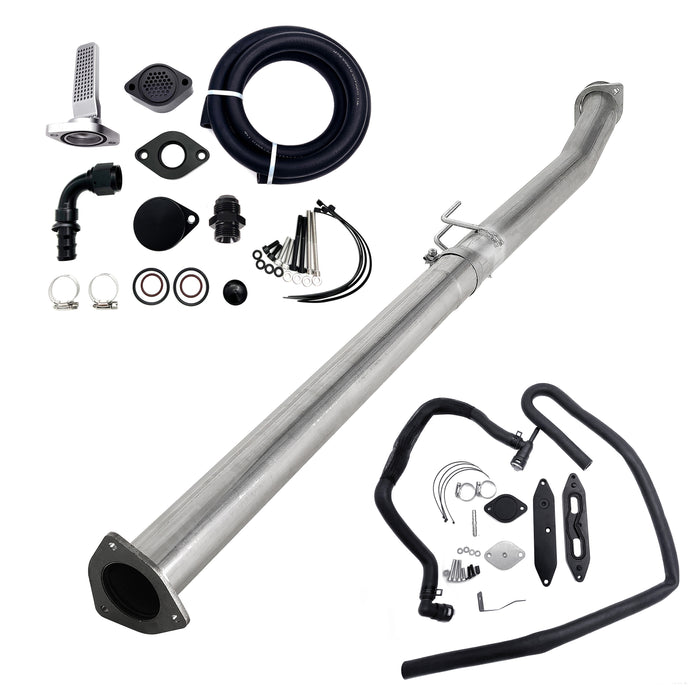
The 2011–2023 6.7L Powerstroke 4" Exhaust Delete Pipe & CCV/EGR Delete Kit is a 3-in-1, and each piece maps directly to one of the failure points above:
- The 4" race pipe replaces the factory DPF/catalyst canisters with smooth, mandrel-bent tubing. Less backpressure means the turbo spools faster, throttle response sharpens, and EGTs drop — and the fuel-draining active regens are gone for good.
- The EGR delete stops exhaust soot from being pumped back into the intake, so carbon stops caking the manifold, the valves, and the ports.
- The CCV reroute redirects crankcase oil vapor out of the turbo inlet, so it can’t mix with that soot and bake into the sludge that chokes the intake.
The reason these three belong together is the one the kit itself makes: Reroute the CCV alone (taking the oil mist out) and the EGR soot still pumps in, though it's dry soot instead of wet sludge.
Two things to know before you buy:
- Fitment is 2011–2023 F-250 / F-350 / F-450 Super Duty — not Cab & Chassis.
- It needs a matched tune. Like every delete, this hardware without a calibration throws codes and derates.
That’s the emissions-side fix. The things that still break after it — the CP4 pump, the filters, the transmission — are covered by the supporting parts below, not by this kit.
How to Keep a Deleted 6.7 Alive (The Part That Actually Works)
If the delete stops the emissions failures but the engine and fuel system keep aging, then the way to a long-lived truck is the same as any diesel — just with the emissions headaches gone:
-
Oil changes every 5,000–7,500 miles with a quality synthetic. Nothing else moves the longevity needle as much as clean oil. The delete stops the regen’s fuel waste and heat cycles; it does not stop the normal soot loading that any diesel puts in its oil.
-
Fuel and air filters on schedule. A 6.7’s CP4 pump is merciless to a truck fed dirty fuel, and a plugged air filter works the turbo harder than it likes.
-
Protect the deleted connectors. Once the DPF and EGR sensors are unplugged, those open plugs sit under the hood exposed to road salt and moisture. Left bare, they corrode and short — a Tuner Harness Plug Kit caps them off and keeps the wiring harness from becoming the next thing that fails.
-
Watch the gauges, not the badge. An EGT gauge and a boost gauge are cheap insurance on a tuned truck. If you’re pushing 1,300°F regularly, you’re working the turbo and pistons harder than they want to be worked.
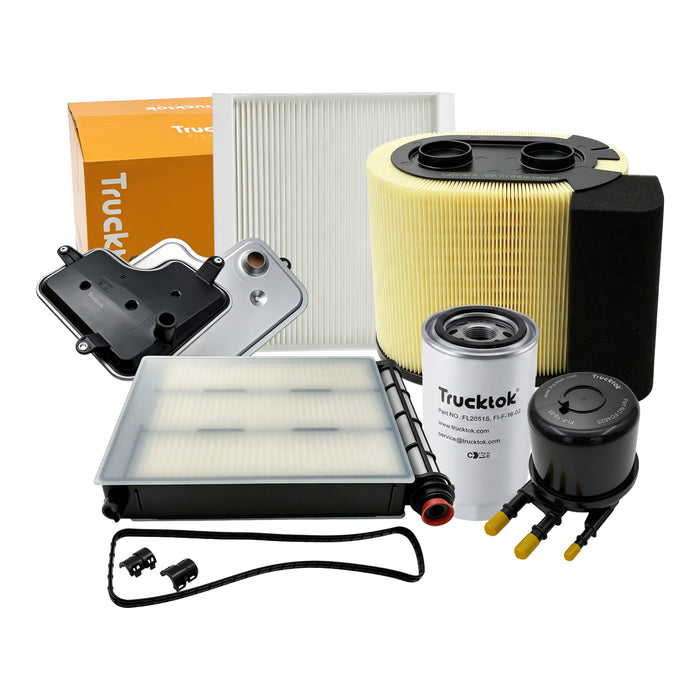
The maintenance items themselves — the fuel, oil, air, cabin, and transmission filters — are where most of the actual “keeping it alive” happens. A 2017–2025 6.7L Powerstroke Filter Maintenance Kit bundles the fuel and oil filters (and the air, cabin, and transmission filters) in one shot, so the maintenance that keeps the CP4 and the turbo alive doesn’t slip.
The Honest Bottom Line
A deleted 6.7 Powerstroke is not a compromised engine — it’s an engine running closer to how it was mechanically designed to run, minus the three emissions systems that were causing the most owner grief. What it is not is a truck with nothing left to break.
The play that actually works is the same on a deleted truck as on any diesel: delete the emissions, protect the CP4, keep the maintenance on schedule, and don’t chase a horsepower number the turbo and transmission have to pay for. Do that, and a deleted 6.7 will outlast most of what’s parked next to it. If you’re going to delete a 2011–2023 6.7L Super Duty, the 4" Exhaust Delete Pipe & CCV/EGR Delete Kit takes care of the emissions side in one package. Pair it with the CP4 protection and the filter kit, and you’ve covered the two things that will still try to kill the truck after the delete.
Related Blogs:
-
2011-2024 6.7L Ford Powerstroke Full Delete Package, Part by Part: EGR, DPF & CCV
- 6.7 Powerstroke vs 6.7 Cummins Delete: Which Is Cheaper and Easier
- 6.7L Powerstroke Delete: The 5 Mistakes That Cost You Twice
- 6.7L Powerstroke CP4.2 Pump: The $8,000 Failure You Can't Detect
Frequently Asked Questions
Does deleting a 6.7 Powerstroke make it bulletproof?
No. A delete removes three emissions failure points — the DPF regen, the EGR soot, and the EGR cooler — but the CP4 fuel pump, the turbo, and every normal wear part are still there. “Deleted” is not the same as “bulletproof,” and a high-horsepower tune can actually shorten turbo life.
What’s the most expensive thing that still breaks after a delete?
The CP4 fuel pump. It fails without warning, sends metal through the entire fuel system, and costs $8,000–$15,000 to repair. It’s completely independent of the delete, and it’s the single biggest reason to add a CP4 disaster prevention kit regardless of whether the truck is deleted.
Will a delete hurt my engine?
The delete itself doesn’t hurt the engine — but a bad or mismatched tune will. An aggressive tune over-revs the turbo and shortens its life to around 150,000 miles, and a tune that doesn’t match your chassis can run rich and soot up the rings. The tune, not the delete, is where the damage risk lives.
Does a delete add horsepower?
No. The delete removes restriction; the power comes from the tune you flash afterward. A stock 6.7 Powerstroke dynos around 340 hp to the wheels, and a delete plus a max tune can reach the mid-400s — but that gain is the calibration’s doing, not the pipe’s.
Do I still need to maintain a deleted truck?
Yes, arguably more carefully. The delete stops the regen cycle, but normal soot still loads the oil, and the CP4 pump is merciless to dirty fuel. Oil every 5,000–7,500 miles, filters on schedule, and monitoring EGT and boost are what keep a deleted truck alive.
What’s the most common post-delete surprise?
A sensor left unplugged during reassembly, or a tune that doesn’t match the truck. One common case leaves the truck with zero throttle — not a limp mode, just no response — traced to a MAP sensor that wasn’t plugged back in. Pay attention to everything you unplug.
Will a deleted 6.7 last longer than a stock one?
Generally yes, but for a specific reason: the emissions-related failures (cracked EGR cooler, DPF face plugging) are the things that kill stock trucks early. The engine’s mechanical wear schedule doesn’t change, so the gain is in avoiding those premature failures — not in the block itself lasting longer.
Should I delete a high-mileage 6.7?
A 200,000-mile 6.7 is actually a fine delete candidate — the reliability and fuel-economy benefits apply at any mileage. Just make sure the engine is mechanically healthy (a compression test is cheap insurance) before you invest in delete hardware, because a delete won’t fix an engine that’s already tired.
Is a deleted 6.7 legal to drive?
No, not on public roads. Removing emissions equipment from a street-registered vehicle violates the federal Clean Air Act, and civil penalties remain active regardless of any shift in criminal enforcement posture. These parts are for off-road, competition, and closed-course use only.
What should I pair with a 6.7 delete for the best odds?
Three things: a CP4 disaster prevention kit (to stop the one catastrophic failure the delete can’t), a filter maintenance kit (to keep the pump and turbo fed clean), and a tuner harness plug kit (to protect the deleted connectors from corrosion). Together they cover the parts that still break after the delete.
For off-road / competition use only. Not legal for on-road use in emissions-regulated areas. Check your local, state, and federal laws before modifying any emissions-related component.