

Home > News > Which 2006 Duramax EGR Delete Kit Is Right for Your Truck?
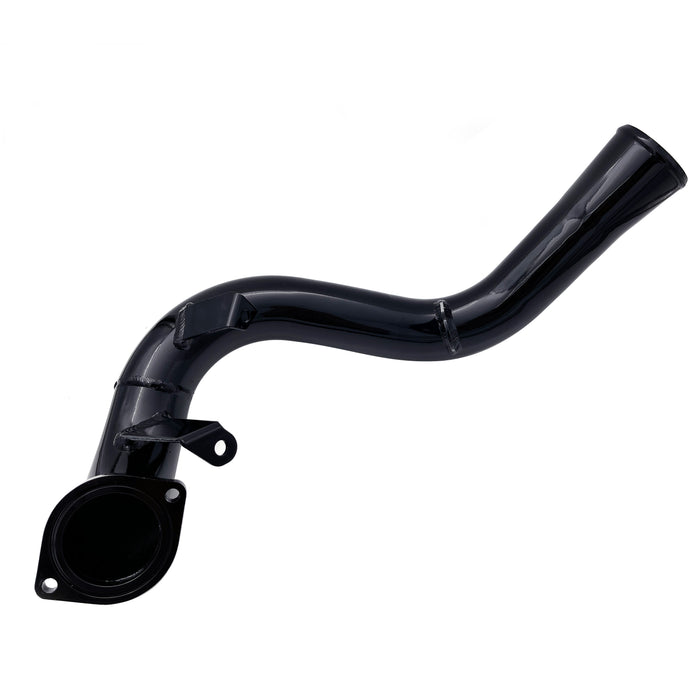
Which 2006 Duramax EGR Delete Kit Is Right for Your Truck?
The 2006-2007 LBZ Duramax earned its reputation honestly. No DPF, no DEF, a forged rotating assembly, and 360 hp and 650 lb-ft from the factory. Fifteen years later, clean examples still trade hands for real money.
But tucked between the cylinder banks, buried under intake plumbing and wiring harnesses, sits the one component every LBZ owner eventually confronts: the EGR system. When it works, it recirculates exhaust gas. When it fails — and it will fail — it leaks coolant into the intake manifold, packs the intake ports with carbon sludge, and puts a $1,500-3,000 repair bill on the table before labor.
What the EGR System Does — and Why the LBZ Version Fails
EGR stands for exhaust gas recirculation. On the LBZ, the system takes a portion of exhaust gas — which can exceed 1,200°F at the valve — runs it through a coolant-fed heat exchanger called the EGR cooler, then dumps the cooled gas back into the intake manifold through the EGR valve. The goal: lower combustion temperatures to reduce NOx emissions.
The Problem Is The Cooler Itself
The LBZ EGR cooler is a bundle of thin internal tubes that carry exhaust gas while engine coolant circulates around them. Heat cycling causes the internal tubes to crack. When that happens, coolant enters the intake charge. The engine burns it, the oil gets contaminated, and the failure mode ranges from white smoke and disappearing coolant to a hydrolocked cylinder.
The Soot Side
.Exhaust gas carries fine carbon particulates. The EGR valve and intake ports accumulate a sticky black sludge that builds up over tens of thousands of miles. Dark Iron Diesel pulled an EGR valve on a customer truck mid-video and held it to the camera:
“Look at all this gunk right at the EGR valve. This stuff’s so bad for your engine.”
Truckmaster, working on his own 2007 LBZ at 150,000 miles, found the same thing — and it was worse:
“You see why we do these EGR deletes? That is absolutely disgusting. That is nasty.”
The sludge doesn’t just look bad. It narrows the intake pathway, restricts airflow, and raises exhaust gas temperatures under load. The EGR system on an LBZ isn’t a neutral component you can ignore. It is an active liability that gets worse every mile.
Blocker Plate vs. Full Delete: The Critical Distinction
The cheapest EGR delete option is a blocker plate. A simple steel or aluminum plate that bolts between the EGR cooler and the up-pipe flange. Cost: $12 to $50. It stops exhaust gas from reaching the cooler and intake. On paper, it solves the problem.
It Trades One Failure For Another
The stock LBZ up-pipe has a branch leg that feeds exhaust to the EGR cooler. When you install a blocker plate, that branch becomes a dead-end chamber. Exhaust pressure pounds against the block-off plate with nowhere to go. The weak point isn’t the plate — it’s the accordion-style metal bellows on the up-pipe itself.
A cracked up-pipe bellow Is An Exhaust Leak
That means lost drive pressure, slower spool, higher EGTs, and an exhaust smell in the cab. It’s not an immediate failure — but it is a predictable one. Josh’s truck, featured in the same video, was sitting in the shop with exactly that problem. He blocked the EGR. The bellow cracked. Now he needed a new up-pipe anyway.
This is the core decision every LBZ owner faces. A blocker plate is a $12-50 fix that kicks the problem down the road. A full delete removes the EGR branch entirely and replaces or modifies the up-pipe so there’s nothing left to fail.
What a Complete EGR Delete Kit Actually Includes
A proper LBZ EGR delete isn’t just block-off plates. It’s a system of components that work together to remove every EGR-related failure point. Here’s what goes into a complete kit — and why each piece exists.
LB7-Style Up-Pipe
This is the foundation of a real delete. The LB7 (2001-2004) was the first Duramax and predated EGR entirely — so its passenger-side up-pipe has no EGR branch. It’s a clean, straight pipe from the exhaust manifold to the turbo pedestal. An LB7-style up-pipe swaps directly onto an LBZ, eliminating the EGR branch and the bellows that crack under pressure.

High-Flow Intake Elbow or Cold-Side Charge Pipe
The factory intake elbow necks down to accommodate the EGR valve mounting. When the EGR valve is gone, that restriction remains. A high-flow intake elbow replaces the factory casting with a smooth, mandrel-bent pipe — no internal restrictions, no EGR mounting flange.
On kits that include a cold-side charge pipe, the upgrade goes further: the entire path from intercooler outlet to intake bridge is replaced with a larger-diameter pipe. The result is reduced intake restriction, lower intake air temperatures, and faster turbo spool.
Y-Bridge Upgrade
This is the optional-but-recommended step. The stock Y-bridge — the cast aluminum piece in the engine valley that splits intake air to each cylinder bank — uses two rubber O-rings to seal against the intake ports. Over time, heat cycles and vibration wear those O-rings. Boost leaks develop, often without the owner knowing. The engine still runs, but it’s down on power and up on EGTs under load.
An upgraded Y-bridge eliminates the O-ring interface entirely with a one-piece design and larger internal volume. It’s the difference between a delete that works and a delete that’s bulletproofed. Cost: $300-600 for the part alone. It’s the single most expensive component in a full delete build — and the one that separates a kit from a complete solution.
Coolant Reroute
The EGR cooler is fed by two coolant lines — one from the engine block, one returning to the firewall. When you remove the cooler, those lines need to go somewhere. Most kits include a length of heater hose and clamps to connect the two open ports directly, bypassing the cooler entirely.
The Four Real Paths to an LBZ EGR Delete
Here’s the truth of the LBZ EGR delete market as it actually exists — from five different owners who filmed their installs and the kits available right now.
Path 1: The Blocker Plate ($12–$50)
You buy a thin steel or aluminum plate, bolt it between the EGR cooler and up-pipe flange, and call it done. The EGR cooler and valve stay on the truck. Exhaust gas stops recirculating. The check engine light comes on immediately — P0401, insufficient EGR flow.
What actually happens: The up-pipe bellows take the pressure and crack. Once they crack, you’re doing the full delete anyway — but now you’re doing it with an exhaust leak in the engine bay.
Who this is for: Someone who needs the EGR functionally disabled right now and is planning a full delete within a year. It buys time. It doesn’t solve the problem.
Path 2: The TruckTok Kits (Best Value, Real Support)
2006-2007 6.6L Chevy Silverado Classic GMC Duramax LBZ Diesel EGR Delete Kit
This is where most LBZ owners land — and for good reason.A complete EGR delete (ER-0026) that replaces the leak-prone factory cooler with a smooth, mandrel-bent high-flow intake elbow. CNC-machined anodized black aluminum billet blocks off the intake ports with pre-fitted O-ring seals that don’t need RTV. The intake path opens up for instant throttle response, lower EGTs, and cooler operating temperatures.
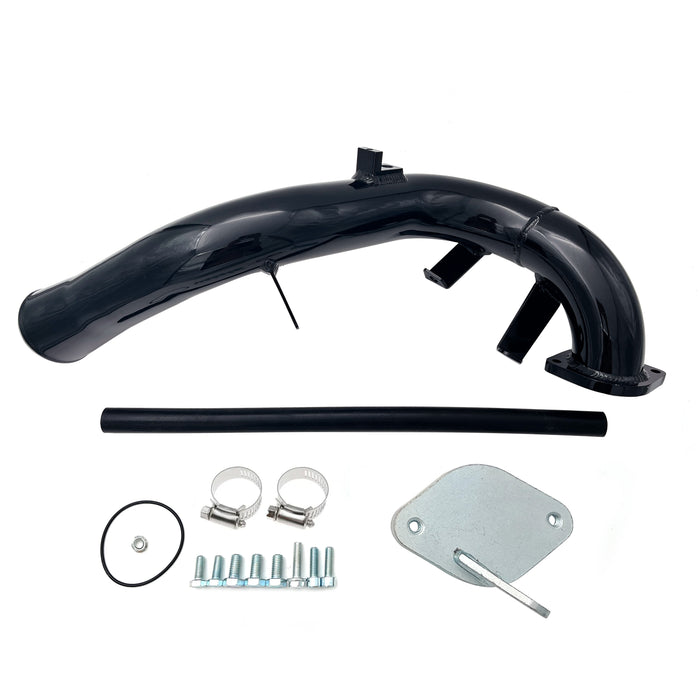
The Full High-Flow EGR Delete Kit is the “do it once” kit.
It replaces the entire EGR cooler and factory intake elbow with a high-flow pipe. The billet plates seal with O-rings. The intake support bracket keeps everything locked down. This is the kit for an owner who wants the mechanical delete done correctly, with quality parts, and doesn’t want to fight bolt alignment at hour three of the job.
What it does not include is the up-pipe.
And that’s intentional — not everyone is ready to pull the turbo downpipe and fight the manifold bolts to swap the passenger-side up-pipe. For owners who are, TruckTok sells the EGR-delete Up-Pipe separately, so you only buy what you’re actually going to install.
2006-2007 6.6L Chevrolet Silverado Classic GMC Duramax LBZ Diesel EGR Valve Cooler Delete Kit
The budget-conscious delete kit (ER-0024) that covers the essentials: dual billet aluminum block-off plates with integrated O-ring seals, a heavy-duty stainless steel intake support bracket that replaces the factory cooler mounting points, and all necessary hardware. This kit removes the EGR valve and cooler entirely — no blocking plates that leave the failure-prone cooler in place.

It is the clean-slate delete.
It removes the EGR valve and cooler entirely — no dead-end chambers, no blocked-off cooler waiting to leak coolant internally. The stainless support bracket is the detail that matters: when you pull the bulky factory EGR cooler, you also remove the physical support it provided for the intake plumbing. Without a bracket, the intake tube vibrates against engine fittings. With it, everything stays where it belongs.
Which TruckTok kit is right for you:
- If you want the delete done and the intake path opened up with a high-flow elbow, ER-0026 at $128.99 is the complete package.
- If you just need the EGR gone — the valve, the cooler, the leak risk — and you’re fine with the factory intake elbow for now, ER-0024 at $63.49 does exactly that.
Both bolt to the factory mounting points. Both include O-ring seals. Both ship free.
The Install: What Nobody Tells You Before You Start
Five different owners filmed their LBZ EGR deletes. Across those five videos, the same pain points came up every single time.
You Must Tune First — Not After
This is universal across every video and every article. Flash the ECU with an EGR-delete tune before you touch the hardware. The factory ECM monitors EGR valve position and flow. Disconnect the valve without tuning, and the truck throws codes and may enter limp mode.
The Rear Bolts Are the Worst Part
The EGR cooler mounts to the up-pipe flange with two nuts at the back — accessible only from behind the engine, between the firewall and the turbo downpipe.
- A stubby 12mm wrench with a pry bar for leverage.
- The bottom bolt with a swivel ratchet and a 2-inch extension through a gap next to the downpipe.
Multiple owners mentioned stripping these bolts. Penetrating oil the night before is not a suggestion. It’s what separates a two-hour job from a five-hour job. If the bolts snap, the turbo has to come out.
The Turbo Heat Shield Will Fight You
To remove the factory downpipe (required if you’re swapping the up-pipe), the turbo heat shield has to come off. It doesn’t want to.
The Solution: cut it in half with a zip disc, remove it in two pieces, and reinstall it the same way. Several owners noted that many trucks run without the heat shield entirely after a delete — but if you’re in a state where visual inspection matters, keep it.
The Coolant Drain Has No Drain Valve
GM didn’t put a radiator drain valve on the Duramax. The only way to drain coolant is to pull the fender liner, find the coolant line going to the radiator, pop the metal retaining clip, and pull the hose. Dark Iron Diesel walked through this step on camera.
The Intake Elbow Needs Support Brackets
When you remove the EGR valve and cooler, you remove the physical support that held the intake plumbing. Without brackets, the intake elbow vibrates against engine fittings, the O-rings wear out, and boost leaks develop. Back Road Diesel had this happen twice before upgrading to a Y-bridge:
“Those O-rings blow out. Mine did that two or three times. The reason is you don’t have these mounting brackets holding this in correctly.”
TruckTok’s kits both include support brackets. The ER-0024 kit includes a stainless steel bracket that replaces the factory cooler mounting points. The ER-0026 high-flow elbow has its own integrated bracket. If your kit doesn’t include a bracket, plan to fabricate one — or expect to re-seal the intake elbow sooner than you’d like.
Tuning: You Need It, Here’s Why
Without A Tune
An EGR-deleted LBZ will throw P0401 (insufficient EGR flow) and illuminate the check engine light. In some conditions, the ECM will enter a reduced-power mode based on its assumption that the EGR system has failed. A deleted truck on a stock tune runs worse than a stock truck.
The Tune Does Three Things
disables EGR diagnostic codes, optimizes fueling and timing for an engine that no longer recirculates exhaust, and — if you’ve also installed an exhaust — disables DPF regeneration cycles. Power gains are real: 40-60 hp and 80-100 lb-ft with a proper delete tune on EFI Live.
Tuning cost: $400-800 for a handheld tuner with custom tunes, or $600-1,200 for a professional dyno tune. Factor this into the total cost of the delete. The hardware price is only half the equation.
Was This Actually Legal?
Under 42 U.S.C. § 7522 of the federal Clean Air Act, removing emissions control equipment from a vehicle operated on public roads is a federal violation. EGR delete kits are sold for off-road and competition use only. This designation is not a legal loophole — the prohibition follows the vehicle regardless of how it is later driven. Individual penalties can reach $5,911 per violation.
State rules add complexity. California’s CARB standards exceed federal minimums. Several northeastern states have adopted CARB-equivalent programs. If your truck must pass emissions inspections or is registered in a state with active enforcement, an EGR delete is not legal for street use.
Every kit discussed in this guide — including TruckTok’s — is sold explicitly for off-road use.
Conclusion
The LBZ Duramax deserves better than a failing EGR cooler and a restricted intake. The question isn’t whether to delete — it’s which path you take.
If your cooler is already leaking or the truck has crossed 150,000 miles, a full delete is the only repair that doesn’t come with an expiration date. TruckTok’s High-Flow Intake Elbow & EGR Delete Kit ($128.99) gives you the complete package: billet block-off plates, a high-flow intake elbow, O-ring seals, and a support bracket — everything short of the up-pipe, which you can add when you’re ready. If you just need the EGR gone and want to keep the factory intake elbow for now, the EGR Valve & Cooler Delete Kit ($63.49) removes the failure points at a price that’s less than the diagnostic fee for a coolant-in-oil event.
If you’re still weighing replacement vs. delete, this TruckTok Forum breakdown of EGR valve replacement costs across engine platforms makes the math easy — parts and labor numbers that explain why most owners go delete instead.
FAQ About 2006 Duramax EGR Delete Kit
Q1: What’s the difference between a blocker plate and a full EGR delete?
A1: A blocker plate stops exhaust flow while leaving the EGR cooler, valve, and stock up-pipe in place. A full delete removes the cooler and valve entirely and replaces the up-pipe with an LB7-style pipe that has no EGR branch. The blocker plate is cheaper but traps exhaust pressure against the up-pipe bellows, which crack over time.
Q2: Do I need a tune after removing the EGR on my LBZ?
A2: Yes. The factory ECM monitors EGR position and flow. Removing the hardware without a tune triggers P0401 and illuminates the check engine light. A delete tune disables those diagnostics, optimizes fueling and timing for an engine without EGR, and prevents limp mode.
Q3: What’s the hardest part of installing an LBZ EGR delete?
A3: The two nuts on the back of the EGR cooler — accessible only from behind the engine between the firewall and turbo downpipe. Soak them in penetrating oil the night before. Use a stubby 12mm wrench with a pry bar for the top bolt and a swivel ratchet with an extension for the bottom. If they strip or snap, the turbo has to come out.
Q4: Will the TruckTok ER-0026 high-flow elbow fit my aftermarket intercooler pipe?
A4: Yes. The ER-0026 high-flow elbow matches factory connection specs. It fits the stock cold-side pipe and any aftermarket intercooler pipe designed to connect to the factory intake elbow.
Q5: Do I need to replace the passenger-side up-pipe when deleting the EGR?
A5: Yes, if you want a permanent fix. The stock up-pipe has an EGR branch. A full delete replaces it with an LB7-style pipe that has no branch. If you keep the stock pipe and just block the EGR, pressure builds against the block-off and eventually cracks the bellows.
Q6: How long does the install take?
A6: A professional shop on a truck with no seized bolts: about 1.5 hours. An experienced DIY owner with the right tools: 2-4 hours. A first-timer working alone with a budget kit and no instructions: plan a full Saturday and have a magnet handy for dropped hardware.
Q7: What happens to the MAP sensor after the delete?
A7: Nothing. On the LBZ, the MAP sensor lives on the intake bridge, not on the EGR components themselves. Both TruckTok kits clear the factory MAP sensor bracket — no splicing, extending, or relocating required.
Q8: Will this delete affect my fuel economy?
A8: Most LBZ owners report a 1-3 MPG improvement after a proper delete and tune. The gain comes from cleaner intake air and combustion that doesn’t have to work against re-burned exhaust soot. It’s not a dramatic change, but over tens of thousands of miles, it adds up.
Q9: Can I return my LBZ to stock after an EGR delete?
A9: Yes, but the difficulty depends on which path you took. Block-off plates and bolt-on intake elbows reverse in a few hours — save every OEM part in a labeled box. If you cut the EGR branch off the stock up-pipe and welded it shut, you’ll need a new stock up-pipe. If you went the full Y-bridge route, you’ll need the original Y-bridge and intake plumbing. Save everything.