

Home > News > LMM Duramax DPF Delete: The First-Gen Filter That Clogs Fastest
LMM Duramax DPF Delete: The First-Gen Filter That Clogs Fastest
The 2007.5–2010 LMM Duramax is the generation that introduced GM’s first diesel particulate filter — and it’s the filter that clogs fastest in the entire Duramax lineup. The fix isn’t a single pipe or a single plate. It’s removing the DPF and the EGR together, so the engine can finally run the way the LBZ it’s built on always did.
For off-road / competition use only. Not legal for on-road use in emissions-regulated areas. Check your local, state, and federal laws before modifying any emissions-related component.
Why the LMM Is a First-Generation Guinea Pig
To understand why this engine’s DPF fails so predictably, you need the timeline. The Duramax didn’t always have a particulate filter:
| Generation | Years | Factory DPF? | DEF/SCR? |
|---|---|---|---|
| LB7 | 2001–2004 | No | No |
| LLY | 2004.5–2005 | No | No |
| LBZ | 2006–2007 (Classic) | No | No |
| LMM | 2007.5–2010 | Yes (first) | No |
| LML | 2011+ | Yes | Yes |
The LMM sits at the exact moment GM bolted its first DPF onto the Duramax — but before the SCR/DEF system that later generations got. That gap is the whole story. GM was working out first-generation regen logic on a filter with no downstream NOx help, and the result is an emissions system that clogs faster than anything that came after it.
The engine underneath, though, is a known quantity. The LMM is essentially an LBZ with better heads, better injectors, and a bigger EGR cooler — and a pile of emissions hardware bolted on top.
Why This DPF Clogs Faster Than Any Other Duramax
Three things stack up, and none of them are the owner’s fault.
1. It’s a First-Generation Design
GM’s first attempt at DPF and active regeneration came with teething problems. The regen strategy wasn’t refined yet — the truck could cycle into regeneration too often, fail to complete it, and load the filter unevenly. Later generations smoothed this out. The LMM is the one that carried the learning curve.
2. No DEF Means a Richer Burn and More Soot
Here’s the technical part that actually explains “clogs fastest.” The LMM has no SCR/DEF system to split the NOx-reduction load. To keep NOx down without DEF, the engine runs richer — and a richer burn produces more soot. More soot means the DPF loads faster, regenerates more often, and accumulates ash sooner.
3. Interrupted Regeneration Is Brutal on It
The LMM is especially sensitive to interrupted regen cycles. A truck that gets shut off mid-regen — which is almost unavoidable in daily driving — leaves a half-burned filter. The leftover soot builds up, forces the next regen sooner, and each incomplete cycle leaves behind more ash that can never be removed.
Short trips, jobsite idling, and winter warm-ups all compound this.
The DPF Is Usually the Symptom, Not the Disease
Before you blame the filter, understand that a clogged DPF is very often the victim of something upstream. The filter just sits there catching soot — if it’s loading too fast, something else is making too much soot, or the regen isn’t completing.
Soot vs. ash is the key distinction:
- Soot burns off during regeneration. It’s the normal, expected load.
- Ash is what’s left behind after soot burns. It’s permanent — no regen touches it — and it slowly chokes the filter until it can’t hold enough soot to stay functional.
The common codes tell you where to look:
| Code | Meaning | First Check |
|---|---|---|
| P2002 | DPF efficiency below threshold | DPF pressure sensor, exhaust leaks, failed regen history |
| P242F | DPF restriction / ash accumulation | Ash load, differential pressure, regen history |
| P2453 | DPF pressure sensor circuit/range | Pressure sensor, pressure lines, soot blockage |
| P0401 | EGR flow insufficient | EGR valve, cooler, intake soot |
Frequent regeneration is almost never the filter’s fault on its own. A failed pressure sensor, a cracked pressure line, a boost leak, a weak thermostat that won’t let the engine reach regen temperature, or worn injectors dumping extra fuel — any of these will load the filter faster and masquerade as “the DPF is bad.”
How to Keep the LMM DPF From Clogging
You can’t stop a DPF from loading soot — that’s its job — but you can give it the operating conditions it needs to clean itself. On an LMM, where the filter is already fighting an uphill battle, these habits are the difference between a filter that lasts 150,000+ miles and one that dies in 60,000.
Give It a Weekly Highway Run
The single most effective habit is a sustained hot run. A diesel that only sees short trips never reaches the exhaust temperature passive regeneration needs. Once a week, run the truck at a steady 40+ mph for at least 20–30 minutes — a full hour is better — with the engine at operating temperature. Keep the RPMs between 2,000 and 3,000 and let it work.
Don’t Interrupt a Regeneration
Learn to recognize when the truck is mid-regen: a slightly higher idle, the cooling fan running hard, a hotter smell from the exhaust. If you shut the engine off halfway through, the filter is left half-burned, and that leftover soot forces the next regen sooner and leaves more ash behind. An incomplete regen is worse than no regen at all.
Use Low-SAPS Oil and Change It Often
Your oil directly feeds the DPF’s worst enemy: ash. Standard oils contain metallic additives that, when burned, turn into ash that collects in the filter and can never be removed. Use a low-SAPS oil (low sulfated ash, phosphorus, and sulfur) that meets the spec for the truck, and change it every 6,000–8,000 miles rather than stretching to the manufacturer’s 10,000+ interval.
Feed It Good Fuel
Poor-quality or water-contaminated diesel burns dirtier and produces more soot. Buy from high-turnover stations where the fuel is fresher, and keep the fuel filters changed on schedule. A clean fuel system burns cleaner, and cleaner combustion means fewer regens.
Fix Engine Problems Early
This is the one most owners skip, and it’s the one that matters most. Anything that makes the engine run inefficiently — a weak injector, a boost leak, a dirty EGR valve, a failing pressure or temperature sensor — either produces more soot or interrupts regeneration. The DPF is almost always the victim, not the culprit. Jump on leaks, smoke, and warning lights the moment they appear, and the filter lives far longer.
Avoid Cheap Tuning Boxes and Aggressive Remaps
A cheap tuning box or an aggressive remap dumps extra fuel to make power, and that excess fuel becomes soot — which lands straight in the DPF. If you want more power, get a proper tune from someone who understands DPF-equipped engines and keeps the air-fuel ratio balanced.
What to Do When It’s Already Clogged
When the warning shows up, the instinct is to panic and order the most expensive part. Don’t. Work through these steps in order — from free to expensive — and you’ll only spend what the problem actually needs.
Step 1: Diagnose, Don’t Condemn the Filter
Pull the codes and watch live data before buying anything. Check soot load, differential pressure, EGT readings, and regen history. A failed pressure sensor or a cracked pressure line will make a healthy filter look packed solid. The most expensive mistake on an LMM is replacing a $3,000 DPF that was never the real problem.
Step 2: Try a Highway Drive First
For light-to-moderate soot, a sustained highway run at 2,000–3,000 RPM for 20–30 minutes is often enough to complete a passive regen and clear the warning. A DPF cleaning additive ($15–25) can help by lowering the temperature the soot needs to burn. This only works before the filter is heavily loaded or already in limp mode — by then it’s too little, too late.
Step 3: Forced Regeneration
If the filter is loaded but the soot is still recoverable, a scan tool can command a forced regeneration. This raises the exhaust temperature under controlled conditions to burn the soot off. Only do this when the data confirms the filter is still serviceable and there are no blocking sensor faults — forcing heat into a damaged or overloaded filter makes things worse.
Step 4: Professional Cleaning
When ash has built up — the stuff regeneration can’t touch — removing the DPF for a professional clean is the fix. A shop flushes the filter with high-pressure detergent or water and dries it, restoring 90–98% of its original flow. Expect $250–400. This buys you a clean filter, but if the upstream root cause isn’t fixed, it’ll just load up again.
Step 5: Replacement
If the filter is ash-loaded beyond cleaning, cracked, melted, or oil-soaked, replacement is the only compliant option — and it runs $1,500–3,000. But understand what you’re buying: a new filter resets the clock, not the cause. A truck that loaded up its last DPF through short trips or a boost leak will do it to the new one too.
The Permanent Answer
Every step above treats the symptom within the law. If the truck is headed off-road for good — and you’re willing to accept the legal and resale trade-offs — the delete removes the filter, the regen cycle, and the whole clogging problem at once. That’s the path the rest of this guide covers.
Why the EGR Has to Go With the DPF
This is where the LMM delete conversation splits from “just swap the pipe.” The DPF and EGR are two ends of the same emissions loop:
- The EGR routes soot-laden exhaust back into the intake, where it cakes the intake runners and the EGR cooler.
- The DPF catches the soot that makes it past the cylinders.
Leave one in place and it sabotages the other. Delete the DPF but keep the EGR, and the intake keeps carbon-caking while the EGR cooler keeps heat-cycling toward a crack. The LMM’s EGR cooler is a known high-mileage failure — it cracks and dumps coolant into the intake, and coolant doesn’t compress.
The Intake Side: Passenger Up-Pipe & EGR Delete
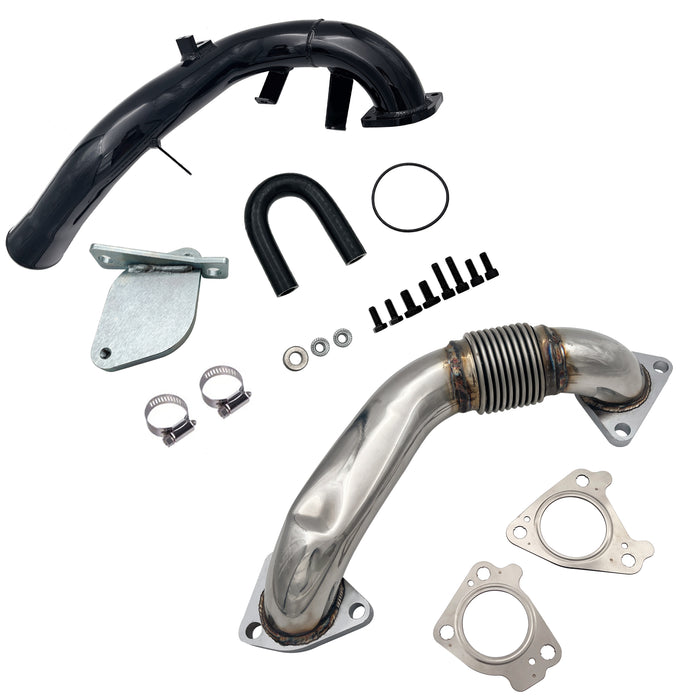
The exhaust pipe only does half the job. The Passenger Up-Pipe & EGR Delete Kit removes the EGR valve and cooler and seals the ports with billet aluminum and stainless block-off plates. That stops the soot at the intake source, eliminates the cracked-cooler coolant-leak risk, and — paired with the up-pipe — lets the engine breathe clean air on both sides.
What a Delete Actually Changes (And What It Doesn’t)
Let’s keep the claims honest.
What You Actually Get:
- No more regen cycles. No DPF, no soot to burn, no fuel dumped into the exhaust to make heat.
- No more fuel dilution. Incomplete regens are a major source of diesel washing into the oil on these trucks; kill the regen and the oil stays clean.
- Lower exhaust backpressure. The turbo isn’t pushing against a loaded filter, which drops EGTs under load — a real win for a truck that tows.
- No more EGR cooler failure point. The cracked-cooler-hydrolock scenario disappears when the cooler is removed.
What You Don’t Get:
- Horsepower from the pipe. The +100 hp figure you’ll see quoted comes from the tune, not from unbolting parts. A delete removes restriction and failure points; the power is calibration work.
- A fix for weak pistons. The LMM carried over the LBZ’s pistons, and they’re known to crack in the 600–650 wheel-horsepower range. A delete doesn’t change that — it’s a reliability mod, not a bulletproofing mod.
The Three Pieces of a Complete LMM Delete
An LMM delete isn’t one part — it’s three, and each one earns its place.
The Exhaust Side: 4" DPF Delete Downpipe-Back
The core of the job is replacing the factory DPF and catalytic converter with a free-flowing pipe. The TruckTok 4" DPF Delete downpipe-back exhaust for the 2007.5–2010 LMM (DP-0320, $599) is the exhaust-half of the delete.

- What it is: a true 4" CNC mandrel-bent pipe from the downpipe back, with zero internal neck-downs or restrictive bungs — a straight-through, high-velocity path for the exhaust.
- What it removes: both the DPF and the DOC. On the LMM these sit as two separate canisters in the exhaust path, and this pipe deletes both. That kills the regen cycle, the fuel it wastes, and the limp-mode shutdowns a loaded filter triggers.
- The heat payoff: the factory DPF and DOC act like a heat-retaining ceramic wall right in the exhaust path. Removing them drops backpressure to near-zero and lets hot exhaust escape instead of cooking the turbo .
- The material: heavy-welded T-409 stainless, built to take the thermal expansion while resisting road salt and moisture.
One honest note on power: the 40–70 wheel-horsepower gain this pipe is quoted at comes from the tune you pair it with, not from unbolting the filter. The pipe removes restriction; the tune unlocks the fuel mapping.
The Install: Tune First, Then Unbolt
The order matters more than the wrench work. On an LMM, the ECM actively monitors DPF differential pressure, EGT sensors, and EGR flow. Pull the hardware before the tune and the truck throws a wall of codes and enters limp mode.
The correct sequence:
- Flash the delete tune first — while the truck is still complete. This disables the DPF regen logic, the EGR monitoring, and the related fault codes.
- Remove the DPF/CAT section and hang the delete pipe.
- Remove the EGR valve and cooler, install the block-off plates, and route the coolant.
- Refill and bleed the coolant, then verify no codes before the first drive.
A careful first-timer should plan a full day; an experienced hand can do it in six to eight hours. The DPF canister is heavy, and the EGR cooler’s rear bolts are the tightest part of the job — a stubby wrench and patience beat brute force there.
Conclusion:
The LMM Duramax is a good engine wearing a bad first-generation emissions system. GM’s first DPF, with no DEF to ease the soot load and a regen strategy still being worked out, clogs faster than any filter in the Duramax line — and it takes the truck’s drivability down with it.
The fix that actually sticks is removing the DPF and the EGR together, paired with a proper tune. That stops the regen cycle, drops the backpressure, eliminates the cracked-cooler risk, and returns the LMM to the reliability of the LBZ it was built on. For the full lineup of LMM delete kits — the 4" downpipe-back exhaust, the EGR delete, and the SOTF switch to control it — head to TruckTok.com. Every piece is matched to the 2007.5–2010 platform, so you’re not mixing parts that were never meant to work together.
Related Blogs:
-
LMM Duramax EGR, DPF & CCV Delete Guide (2007.5–2010)
- Duramax Turbo Lag? 3 Exhaust & CCV Upgrades for LLY, LBZ & LMM
- Duramax Turbo Lag? 3 Airflow Upgrades for LLY, LBZ & LMM Trucks
- How to Install a 5-Position SOTF Switch on a 2006-2010 LBZ/LMM Duramax (30-Minute DIY)
- Why Do We Need 2006-2010 Duramax Filter Maintenance Kit —Instead of buying one
- Best DPF Delete Kits for Duramax (LB7 to L5P): 2026 Buyer's Guide
Frequently Asked Questions
What years use the LMM Duramax?
The LMM was used in the 2007.5–2010 Chevrolet Silverado HD and GMC Sierra HD. A 2007 Classic is an LBZ with no DPF, while the 2007.5 new-body truck is the LMM with factory DPF. Confirm body style and VIN before ordering anything.
Why does the LMM DPF clog faster than other Duramax filters?
It was GM’s first-generation DPF with no SCR/DEF system to ease the soot load, so the engine ran richer and made more soot. The immature regen strategy and sensitivity to interrupted regeneration made it worse. That combination is unique to the LMM.
Does the LMM have DEF?
No. DEF and SCR didn’t arrive until the LML in 2011. The LMM uses EGR, DOC, and DPF only, so any “DEF delete” listed for an LMM is either wrong or generic.
Do I have to delete the EGR with the DPF?
Yes, for a complete fix. The EGR routes soot into the intake and the cooler is a known high-mileage crack-and-leak failure. Leave the EGR in place and the intake keeps carbon-caking while the cooler keeps heat-cycling toward a hydrolock.
Does a DPF delete add horsepower?
The delete itself doesn’t. The power gains — often quoted around 100 hp — come from the tune you pair with it. The pipe removes restriction and failure points, not a dyno number.
What codes point to an LMM DPF problem?
P2002 (DPF efficiency), P242F (ash/restriction), and P2453 (pressure sensor circuit) are the common ones. Check the pressure sensor, pressure lines, and regen history first — a failed sensor often masquerades as a bad filter.
Is a delete legal on the road?
No. Removing emissions equipment on a public-road vehicle violates the federal Clean Air Act, with individual penalties up to about $5,911 per violation. These kits are for off-road, race, and competition use only.
What does a delete NOT fix on an LMM?
It doesn’t fix the weak pistons carried over from the LBZ, which crack in the 600–650 wheel-horsepower range. It also doesn’t fix worn injectors, boost leaks, or a slipping transmission — those are separate mechanical issues.
Do I need a tune with the hardware?
Absolutely. Without a tune, the ECM detects the missing DPF and EGR and puts the truck in limp mode. The tune disables the monitoring and the regen logic, and it’s non-negotiable.
How long does the install take?
Plan a full day for a first-timer, or six to eight hours if you’ve done one before. The DPF canister is heavy and the EGR cooler’s rear bolts are the tightest part of the job.
For off-road / competition use only. Not legal for on-road use in emissions-regulated areas. Check your local, state, and federal laws before modifying any emissions-related component.