

Home > News > Best DPF Delete Kits for Duramax (LB7 to L5P): 2026 Buyer's Guide



Best DPF Delete Kits for Duramax (LB7 to L5P): 2026 Buyer's Guide
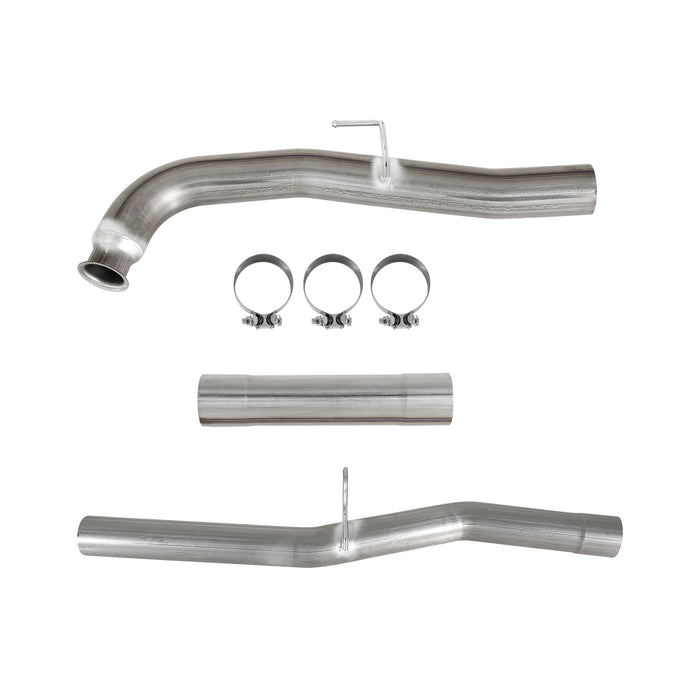
A Duramax DPF delete is about one thing: removing the biggest restriction in the exhaust so the turbo runs cooler and lives longer. The right kit depends entirely on your generation — the DPF only exists from the 2007.5 LMM onward, and pipe size, material, and tuning all change by year. Start with your engine code.
For off-road / competition use only. Not legal for on-road use in emissions-regulated areas. Check your local, state, and federal laws before modifying any emissions-related component.
Why Do Duramax Owners Delete the DPF?
There are three real motivations — exhaust flow, exhaust temperature, and fuel dilution — and none of them is “more horsepower.” The power comes from the tune you pair with the pipe, not the pipe itself.
Exhaust Flow and EGT
The DPF is a ceramic honeycomb that traps soot and forces exhaust through a filter media. That restriction builds backpressure. Backpressure holds heat in the turbine, drives up exhaust gas temperature (EGT), and over time shortens turbo life. Remove the filter and the exhaust flows freely, EGT drops, and the turbo runs measurably cooler.
Regen Cycles and Fuel Dilution
To clean itself, the DPF periodically dumps raw diesel into the exhaust stroke to torch the trapped soot. That extra fuel washes past the piston rings and into the oil pan, thinning the oil and degrading its ability to protect bearings. A delete removes the regeneration cycle entirely — which is why owners report cleaner oil and longer oil-change intervals after the fact.
What a Delete Doesn’t Fix
Be honest about the limits: a DPF delete does not fix a tired CP4.2 pump, a slipping transmission, or worn injectors. It removes one failure point — the filter and its regen cycle — and the heat and fuel-dilution damage that comes with it. The rest of the truck’s maintenance is still on you.
Which DPF Delete Fits Each Generation?
This is the table that matters, and it’s the one most buyers get wrong. Two facts trip people up: the DPF didn’t exist until the 2007.5 LMM, and the high-pressure fuel pump changed twice across these generations.
| Generation | Years | Fuel pump | DPF? | EGR? | DEF? |
|---|---|---|---|---|---|
| LB7 | 2001–2004 | CP3 | No | No | No |
| LLY | 2004.5–2005 | CP3 | No | Yes (first) | No |
| LBZ | 2006–2007 | CP3 | No | Yes | No |
| LMM | 2007.5–2010 | CP3 | Yes (first) | Yes | No |
| LML | 2011–2016 | CP4.2 | Yes | Yes | Yes |
| L5P | 2017–2026 | Denso HP4 | Yes | Yes | Yes |
Fuel-pump and emissions data are GM factory specifications.
The Thing to Internalize:
LB7, LLY, and LBZ never had a DPF. If a listing says “LBZ DPF delete,” it’s either wrong or selling you something you don’t need. Those early trucks have an EGR (LLY onward) but no particulate filter.
What Each Generation’s Delete Actually Involves
The delete is not the same job across the three DPF-equipped generations:
-
LMM (2007.5–2010): The simplest of the three. It’s EGR + DPF with no DEF system, so a delete is a DPF pipe, an EGR delete, and a tune. The CP3 pump is a non-issue, and tuning is straightforward OBD work.
-
LML (2011–2016): The most involved. You’re removing EGR, DPF, and DEF/SCR, so the tune has to disable DEF dosing and NOx monitoring on top of the regen strategy. The CP4.2 pump is the platform’s real weak point, and it has nothing to do with the exhaust.
-
L5P (2017–2026): The hardware is straightforward, but the encrypted ECM is the hurdle. 2017–2023 (E41) tunes over OBD; 2024+ (E42) needs the ECM sent out for an unlock first. The L5P also needs CAN-BUS plugs to terminate the sensor network after the delete. The Denso HP4 pump is the good news — it doesn’t carry the CP4.2 problem.
4-Inch or 5-Inch: Which Pipe Diameter?
The factory exhaust is 3" or 3.5". For almost every Duramax, 4-inch is the right answer — it removes the DPF restriction without hurting low-end torque. Five-inch is only worth it on a big-turbo, high-horsepower build where you’re actually moving enough air to need it.
-
4-inch: The default. Frees exhaust flow, drops EGT, preserves low-rpm torque and spool. This is the pipe for towing, daily driving, and mild-to-moderate tunes.
-
5-inch: For 500+ hp builds with an upgraded turbo. It’s louder, heavier, harder to fit around crossmembers, and can cost you a little low-end response on a stock turbo.
The mistake to avoid is buying a 5-inch pipe behind a stock turbo and calling it a power upgrade — that’s just a noise upgrade.
What to Look For in a Delete Kit
A cheap pipe and a good pipe look the same in a photo. Here’s what actually separates them.
| Feature | Why it matters |
|---|---|
| 409 stainless | 409 stainless is the budget alternative — it forms harmless surface rust but holds up; plain aluminized steel will rot in 2–4 years in salt. |
| OEM-position flanges | The pipe has to bolt to the factory turbo and exhaust hangers without cutting or welding. Wrong angles mean leaks. |
| Complete hardware | Clamps, gaskets, and bolts included — a kit missing hardware turns a bolt-on job into a fabrication job. |
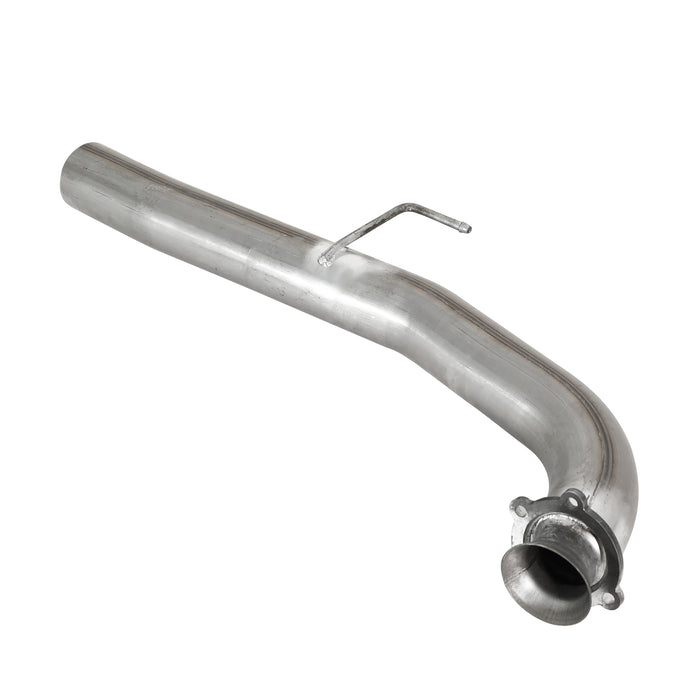
| Sensor bungs | Provisions for EGT or gauge sensors, capped when unused, so you can monitor without drilling. |
| Clean welds | Mandrel bends and consistent welds mean smooth flow and no future cracks. |
The material call is the one most people get wrong. 304 stainless is the pick for any truck that sees winter road salt or coastal humidity. 409 stainless is fine for dry climates and saves a little money — it’ll show surface rust but won’t rot through. Skip aluminized steel unless the truck is a short-term beater.
How Much Does a Duramax DPF Delete Cost in 2026?
Pricing breaks into three scopes, and the jump from one to the next is mostly about how much of the exhaust you’re replacing.
| Scope | What it replaces | 2026 price |
|---|---|---|
| DPF/CAT delete pipe (mid-section) | Just the DPF + CAT section, keeps factory downpipe and tailpipe | $235–$290 |
| Downpipe-back / turbo-back | The full exhaust from the turbo outlet back | $650–$715 |
| Full kit (pipe + EGR + tune) | Everything plus EGR delete and calibration | $300–$1,500+ |
Prices are current TruckTok retail listings verified 2026; they’re ranges because pipe diameter, muffler, and EGR scope change the price.
Two good reference points:
The LML 4" DPF & CAT delete pipe sits at $234.90 as a mid-section delete, while the L5P 4" DPF/CAT race pipe runs $290. A full downpipe-back system jumps to the $650–$715 range, and a complete pipe-plus-EGR-plus-tune bundle is where the $300–$1,500 spread lives.
One cost the table doesn’t capture:
The L5P’s ECM unlock. On 2024+ trucks, sending the ECM out for a bench flash is a separate line item that lands before any tune or pipe goes on — and it’s the single biggest reason an L5P delete runs higher than an LMM or LML.
What Are the Five Most Expensive DPF Delete Mistakes?
Most wasted DPF-delete money is spent before the first bolt comes out.
-
Buying the wrong pipe diameter. A 5-inch pipe on a stock turbo is a noise and low-end-torque downgrade, not an upgrade. Match the pipe to the power target, and remember the factory exhaust is only 3"–3.5".
-
Forgetting that pre-2007.5 trucks have no DPF. Buying a “DPF delete” for an LB7, LLY, or LBZ is buying a part for a filter that isn’t there. Those trucks only have an EGR to delete.
-
Going cheap on aluminized steel. It saves $100 up front and rusts through in a few years of salt — paying for the job twice. 304 stainless is the long-term answer; 409 is the acceptable budget pick.
-
Ignoring the sensor bungs. No provision for an EGT gauge means you’re flying blind on the exact temperature that kills turbos. A capped bung you can use later beats a smooth pipe you have to drill.
-
Installing hardware without a tune. A delete pipe without the matching calibration throws a check-engine light and derates the truck. The tune and the pipe are one job — never split them across separate installs.
On the fuel-system side, if you’re on an LML the CP4.2 pump is the weak link — and no exhaust pipe addresses it. Fresh fuel filters on schedule are the cheapest protection that pump has.
Frequently Asked Questions
Which Duramax years have a DPF?
The 2007.5 LMM was the first, followed by the LML (2011–2016) and L5P (2017+). LB7, LLY, and LBZ — 2001 through 2007 — never had a particulate filter, so a “DPF delete” doesn’t apply to them.
What’s the best DPF delete kit for an L5P?
A 4-inch DPF/CAT race pipe matched to your cab and bed, plus the tune. The L5P’s encrypted ECM is the real cost driver — the pipe itself is straightforward, but you’ll need the calibration to match, and 2024+ trucks need an ECM unlock first.
4" or 5" for a Duramax?
4-inch for almost everyone — it removes the restriction without hurting low-end torque. 5-inch only makes sense on a 500+ hp build with an upgraded turbo. On a stock turbo, 5-inch just adds noise and cost.
Does a DPF delete require a tuner?
Yes. Remove the hardware without the matching calibration and the truck throws codes and derates. The tune disables the regen strategy and the DPF-related monitors; it’s not optional.
Will a delete void my warranty?
Yes. Removing emissions equipment voids the factory emissions warranty and can complicate other powertrain claims. It also violates federal law (42 U.S.C. § 7522) for on-road use.
What’s the difference between downpipe-back and turbo-back?
A DPF/CAT delete pipe replaces only the filter section and keeps your factory downpipe and tailpipe. A downpipe-back (or turbo-back) system replaces everything from the turbo outlet to the tail — more flow, more cost, more install work.
Is 304 stainless worth it?
Yes, if the truck sees salt or coastal air. 304 won’t rust through; 409 holds up but shows surface rust; aluminized steel will rot in 2–4 years. The $100 or so between 409 and 304 is cheap insurance for a long-term truck.
How much does a Duramax DPF delete cost?
A mid-section delete pipe runs $235–$290, a downpipe-back system $650–$715, and a full kit with EGR delete and tune starts around $300 and tops $1,500 depending on diameter and scope.
Will I get a check engine light?
Only if you skip the tune. A properly calibrated delete suppresses the DPF-related codes. Hardware without the matching file lights up the dash immediately.
Can I keep the DPF for off-road and swap back?
Yes, if you save the factory pipe, sensors, and brackets, you can reinstall for inspection or resale. That’s why a bolt-on kit with OEM-position flanges matters — it’s reversible without cutting.
Does a delete lower EGT?
Yes. Removing the backpressure of the filter drops EGT measurably under load — typically 100–200°F depending on the tune and load. That’s the single biggest reliability benefit of the whole job.
What supporting mods do I need?
A matching tune is mandatory, and a transmission tune if you’re adding real power. On an LML, protect the CP4.2 with fresh fuel filters and consider a lift pump. An EGT gauge is worth adding since the delete changes your exhaust temperatures.
Get the Right DPF Delete Kit for Your Duramax
A DPF delete is only as good as the generation match and the material it’s made from. Confirm your engine code first — LMM, LML, or L5P — then pick the diameter your power target actually needs, in 304 stainless, with the tune to go with it. Do that and you get the cooler EGTs and cleaner oil that make the job worth it; skip it and you’re buying a noise upgrade.
Browse the full Duramax exhaust lineup at TruckTok.com, and see how other owners experiences:
- L5P 4"/5" DPF/EGR/CCV Delete Kit
- 6.6L Duramax Maintenance Guide: Are Dirty Filters Hurting Your Engine?
- Why Does Your 2011-2016 LML Duramax End Up in Limp Mode?
Legal Disclaimer
For off-road / competition use only. Not legal for on-road use in emissions-regulated areas. Check your local, state, and federal laws before modifying any emissions-related component.