

Home > News > 2013-2024 6.7L Cummins Filter Kit: Five Filters vs $15,000 Rebuild

2013-2024 6.7L Cummins Filter Kit: Five Filters vs $15,000 Rebuild
A 6.7L Cummins doesn’t have one filter — it has five, and each one guards a different system that can take the whole engine down if you let it go. The reason the “five filters vs $15,000 rebuild” math works is simple: every one of those filters is cheaper than the repair it prevents, and the failure they prevent is never a small one. Here’s what each filter actually protects, where owners get it wrong, and how one box covers all of it.
What Are the Five Filters on a 6.7 Cummins?
The 6.7L Cummins runs five filtration systems — but six physical filter elements, because fuel gets filtered twice. Understanding which one guards what is the difference between routine maintenance and a tow bill.
| Filter | What it guards | What happens if it fails |
|---|---|---|
| Frame-rail fuel/water separator | CP3/CP4 pump + injectors | Water reaches the high-pressure pump, flash-boils into steam, and erodes the injectors |
| Engine-bay fuel filter | Pump + injectors | Fine particles score the pump and plug injector tips |
| Oil filter | Bearings, turbo, valvetrain | Soot and metal shavings circulate until a bearing spins |
| Engine air filter | Turbo compressor wheel | “Dusting” erodes the blades and destroys the turbo |
| Cabin air filter | The cab (your lungs) | The least catastrophic, but part of a complete service |
| Transmission filter | 68RFE valve body | Debris plugs the valve body; shifts degrade into a rebuild |
The key word here is “systems,” not “parts.” A filter doesn’t protect itself — it protects an expensive component downstream, and the filter is always the cheap end of that equation.
What Each Filter Actually Saves You
Put in dollars, here’s what each filter is really buying you — the repair it prevents, not just the part it protects:
-
Frame-rail water separator — strips water out of the fuel before it reaches the pump. What it saves: the CP3/CP4 pump, eight injectors, and a tank flush, which together run $8,000+ when water gets past it and cavitates the injection system.
-
Engine-bay fine filter — catches the last 3-micron particulate before the high-pressure rail. What it saves: the same pump and injectors, from abrasive wear that scores the pump and plugs the nozzles.
-
Oil filter — holds soot and metal shavings out of the lubricant. What it saves: the main and rod bearings, the turbo bearings, and the valvetrain — the difference between an oil change and a spun-bearing teardown.
-
Engine air filter — keeps dust off the compressor wheel. What it saves: the turbo itself, because “dusting” erodes the blades and kills boost; a replacement turbo runs $2,000–$4,000.
-
Transmission filter — holds debris out of the 68RFE valve body. What it saves: the transmission — a $6,000–$15,000 rebuild, which is the single biggest number in this entire article.
The cabin filter is the exception that proves the rule: it doesn’t protect an expensive component, it just protects your lungs. That’s why a complete kit includes it.
Why Does the 6.7 Cummins Have Two Fuel Filters?
This is the one most owners don’t know, and it’s the single biggest reason cheap “filter kits” fall short.
The 6.7L Cummins filters fuel twice, in two different locations:
- The frame-rail separator (rear, near the axle) is a water/fuel separator. Its job is to strip water out of the fuel before it reaches the pump. It’s a 5-micron spin-on (2013–2018) or drop-in cartridge (2019+).
- The engine-bay filter (front, driver’s side) is a fine filter, rated at 3 microns. It catches the remaining particulate before the fuel enters the high-pressure common rail.
The reason for the split is the injection pressure. The Bosch CP3 pump (and the CP4.2 that briefly appeared on 2019–2020 trucks) runs at 29,000+ psi. At that pressure, a single droplet of water flash-boils into steam and cavitates — eroding injector nozzles and pump internals from the inside out. The separator catches the water; the fine filter catches the particles.
Which Filters Do Most Owners Miss?
Two of them, almost every time:
The frame-rail water separator. Owners change the engine-bay filter (it’s visible when you pop the hood) and never know the rear separator exists until the “Water in Fuel” light comes on — by which point water has already been through the pump. This is the most common single-point failure in the whole maintenance schedule.
The transmission filter. A “five-filter kit” that doesn’t include a transmission filter isn’t saving you money — it’s just missing a filter. The 68RFE transmission has both an internal pan filter and (on some years) a spin-on filter, and it’s the most expensive component in the truck to rebuild. A transmission filter is cheap insurance against a $6,000–$15,000 rebuild.
What’s the 68RFE vs Aisin Difference?
The transmission filter is the other year-sensitive piece, and it’s tied to which transmission you have, not just the year:
- 68RFE (most 2500/3500 pickups) uses filter 5013470AE.
- Aisin AS69RC (High-Output and Cab & Chassis trucks) uses filter 68224232AA.
These are completely different transmissions with completely different filters. If your truck has the Aisin, a 68RFE filter kit is dead weight — and the reverse is worse, because a mislabeled transmission filter means you’ve done the job but left the wrong component unserviced.
Why Is a $40 Filter Not a Bargain?
Here’s the story that the “five filters vs $15,000” title is really about.
An owner running a 2017 Ram 2500 sorted filter kits by price and bought the cheapest one on the page — $40 for a full set. Six months later, the frame-rail separator had collapsed internally. Water got past it, reached the CP4.2 pump, and the pump ate itself. The bill: a new pump, eight injectors, two fuel rails, a tank flush, and the labor to do it all — just over $8,000.
The tell is what the cheap filter doesn’t say. A legitimate filter lists its micron rating and its water-separation efficiency. A white-label filter lists a price and nothing else — no micron spec, no water-separation claim, no material data. When a filter won’t tell you what it’s rated to catch, that’s not an oversight. It’s the answer.
Source: owner-reported fuel-system failure, 2017 Ram 2500; figures are the owner’s documented repair total, not a manufacturer warranty claim.
What Does a Filter Kit Actually Cost?
The price spread tells the story better than any warning:
| Option | What’s in the box | Rough cost |
|---|---|---|
| Complete maintenance kit (6 filters) | Both fuel filters + oil + air + cabin + transmission | ~$197 |
| Five-filter kit (no transmission) | Both fuel + oil + air + cabin | ~$191–195 |
| White-label “bargain” set | Unknown-spec filters, often missing the separator | ~$57 |
| Dealer service (fuel filters only) | Just the two fuel filters, installed | ~$700 |
Two things jump out. First, the difference between a complete six-filter kit and a five-filter kit is a few dollars — and the missing filter is the one that protects a $15,000 transmission. Second, a dealer charges roughly $700 just to change the two fuel filters — more than three times the cost of the entire six-filter kit, for a fifth of the work.
Prices are 2026 retail ranges from aftermarket listings and dealer quotes; the complete kit price is the TruckTok maintenance kit reference. Verify current pricing before ordering.
How Do You Change Each Filter?
None of these is hard, but each has a location, a tool, and a couple of gotchas. Here’s the full walkthrough, filter by filter.

The Two Fuel Filters
Tools: 28mm socket (a 1⅛" works but is looser on the nut), ratchet with a long extension and a swivel, a #2 Phillips for the bleed screw, a catch pan, a length of 5/8" hose, and a little clean diesel to lube the O-rings.
Rear — the frame-rail water separator (passenger side, forward of the axle, above the driveshaft):
- Slide a section of hose over the drain nipple and run it into the catch pan so you can see what comes out.
- Open the petcock and drain the housing. Look at the bottom of the catch pan — if you see water beads, your fuel has been wet, and that’s the exact thing the separator is there to catch.
- On spin-on units (2013–2018), disconnect the water-in-fuel sensor and thread it out of the bottom of the old filter. On cartridge units (2019+), the sensor stays in the housing — leave it alone.
- Spin the housing off with the 28mm socket + swivel + extension, coming in from the driver’s side of the driveshaft for leverage (it’s on tight).
- Swap the O-ring (the smaller of the two in the kit), lube it with diesel, and snap the new filter onto the housing — it’s directional, so rotate it until the tabs line up. Spin the housing back on hand-tight, then snug it.
- Close the petcock.
Front — the engine-bay fine filter (driver’s side, below the brake reservoir):
- Slide a 5/8" hose over the factory drain hose — it’s short and sits above the crossmembers, so the extension keeps the mess off you.
- Crack the yellow bleed screw a quarter turn (Phillips #2) and drain into a pan. Don’t pull it all the way out or it’ll squirt.
- Remove the cap with the 28mm socket, then lift the filter straight out. It’s oval on the bottom, so note the orientation before you remove it.
- Swap the cap O-ring, lube it, seat the new filter, and thread the cap back on to 30.5 Nm — it’s a plastic canister and cap, so don’t over-tighten.
- Close the bleed screw.
Priming (the step that matters most): key to RUN (not start), let the electric lift pump run, then off — repeat four to six times — before you crank. Starting with air in the injection pump risks a no-start and, worse, can damage the injectors. Then reset the fuel-filter life in the cluster (Vehicle Info → Fuel Filter Life → hold reset).
The Oil Change
- Warm the engine briefly, then drain all 12 quarts (3 gallons) through the 3/8" square-drive plug; torque it to 35 ft-lb on the way back in.
- The oil filter is in the passenger-side wheel well, mounted upward. Turn the wheel inward for room, and use a filter wrench or strap to break it loose — it will dump oil on the way out, so have the pan under it.
- Fill the new filter with oil and lube its O-ring before installing; the upward mount makes it easy to spill if you skip this.
- Refill with 12 quarts — 15W-40 (API CJ-4) for 2013–2018, 10W-30 (API CK-4) or 5W-40 for 2019+ — start it, check for leaks, and reset the oil-life monitor.
The Air and Cabin Filters
- Engine air filter: in the airbox — a two-minute swap. Check it at every oil change and replace it when it’s visibly dirty or the restriction indicator trips.
- Cabin air filter: behind the glovebox, on trucks equipped with one. Some early 6.7s didn’t get a cabin filter from the factory, so verify yours has one before buying.
The Transmission Filter
- 68RFE: drop the pan (about fifteen 8mm bolts), remove the internal pan filter, and replace the spin-on on equipped years. The 68RFE has no drain plug, so draining is gravity-only — have a wide pan ready. Torque the pan bolts evenly and don’t use RTV. Refill with the correct ATF.
- Aisin AS69RC: a different filter and service procedure — match the filter to the transmission, not the year.
What Are the Five Expensive Mistakes?
Every one of these is a real way owners turn a $200 kit into a $8,000+ bill:
-
Buying the wrong-year separator. The 2013–2018 spin-on and 2019–2024 cartridge are not interchangeable. Order by part number, not by “2013–2024.”
-
Trusting a “five-filter” kit that skips the transmission. The transmission filter is the one guarding the most expensive component. A kit without it isn’t complete.
-
Saving $40 on a white-label filter. No micron rating, no water-separation spec, no protection. The pump and injectors downstream don’t care what you saved.
-
Forgetting the frame-rail separator entirely. The engine-bay filter is visible; the separator isn’t. Both need changing, or water reaches the pump.
-
Mixing up 68RFE and Aisin. Two different transmissions, two different filters. Confirm which one you have before you buy.
How Often Should You Change Each Filter?
Intervals vary by filter and by duty cycle, but here’s the baseline:
| Filter | Normal interval | Severe-service (towing/hot/ dusty) |
|---|---|---|
| Oil filter | 7,500 miles | 5,000 miles |
| Both fuel filters | 15,000 miles | 7,500–10,000 miles |
| Engine air filter | 30,000 miles / 24 months | Inspect at every oil change |
| Cabin air filter | 15,000–30,000 miles | More often in dust |
| Transmission filter | 60,000 miles | 30,000 miles |
One oil-side note worth knowing: on 2013–2018 trucks the factory oil spec is 15W-40 (API CJ-4), while 2019+ trucks move to 10W-30 full synthetic (API CK-4) in warm weather, with 5W-40 for cold climates. The 2019+ trucks also shorten the oil interval — the factory says never exceed 8,000 miles. Match the oil to the year, not the habit.
The Product: One Box, Six Filters
The cleanest way to handle all of this is a single maintenance kit that ships every filter the 6.7L needs in one box, matched to your year and transmission:
2013–2024 6.7L Dodge Ram five Filters Maintenance Kit — the six-filter set covering both fuel filters (frame-rail separator + engine-bay fine filter), the oil filter, the engine air filter, the cabin filter, and the transmission filter, with the year-specific separator and the transmission-specific filter included.
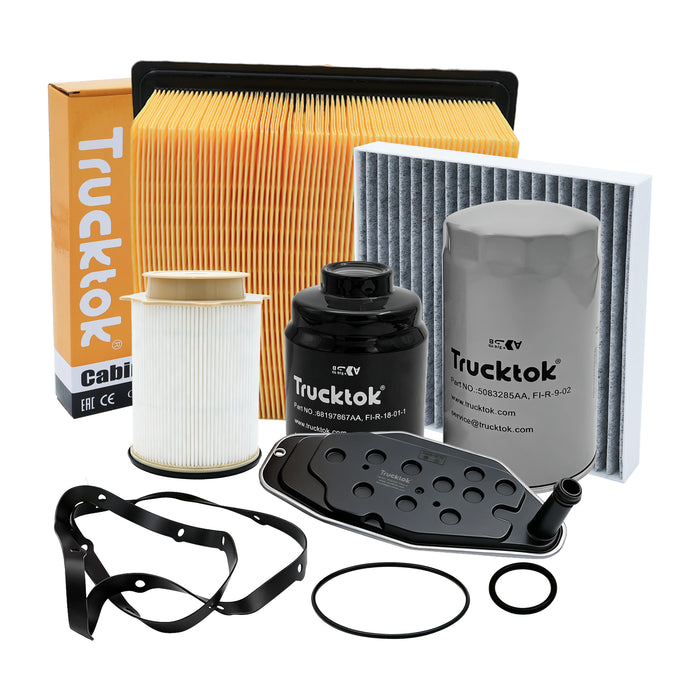
What makes it worth the ~$197 over the piecemeal route:
- It includes the two filters everyone forgets — the frame-rail water separator and the transmission filter — which are exactly the two that a “bargain” set drops to hit a lower price.
- The separator is year-matched (2013–2018 vs 2019–2024), so you’re not guessing which one threads on.
- The transmission filter is matched to your transmission (68RFE vs Aisin), so the box is actually complete for your truck.
- Every filter carries a real micron and water-separation spec, not a bare price tag — which is the difference between a filter that protects the pump and one that just looks like it does.
The point isn’t that a kit is cheaper than five individual filters — it’s that it removes the two ways people leave a gap: a missing separator, and a missing transmission filter. A gap is a $8,000 fuel system or a $15,000 transmission waiting for a bad tank of fuel or a hard summer.
Conclusion: Get the Right Filter Kit for Your 6.7 Cummins
Five filters, one engine, and a failure on any one of them ends in a repair that costs more than every filter combined. The two most expensive mistakes — a missed water separator and a skipped transmission filter — are both fixed by one thing: a kit that’s actually complete, matched to your year and your transmission.
Order the TruckTok 2013–2024 6.7L Dodge Ram maintenance kit to get all six filters in one box, with the year-specific separator and the transmission-specific filter already sorted. Change them on schedule, prime after every fuel-filter swap, and the only thing you’ll be rebuilding is your maintenance log — not the engine.
Related Blogs:
-
2013-2018 Ram 6.7L Cummins Filter Kit Buyer’s Guide (Fuel, Oil, Air)
- 2019-2026 Ram Cabin Air Filter Buyer’s Guide (68548579AA)
- 2025-2026 Ram HD Known Issues: Recalls, TSBs and Fixes
- Ram 6.7L Air and Cabin Filter Guide (53034051AB, 68406048AA)
- 2010-2012 Ram 6.7L Cummins 3-Filter Kit Buyer's Guide
Frequently Asked Questions
Does a 6.7 Cummins really have two fuel filters?
Yes — a frame-rail water/fuel separator and an engine-bay fine filter. The separator strips water (5 micron) and the engine-bay filter catches fine particulate (3 micron), protecting the 29,000+ psi CP3 pump and injectors. Both need changing at the fuel-filter interval.
What happens if I skip the water separator?
Water reaches the high-pressure pump and, at 29,000 psi, flash-boils into steam that cavitates and erodes the injector nozzles and pump internals. The result is a fuel-system rebuild that owners report at $8,000 or more.
Is the 2013–2018 fuel filter the same as 2019–2024?
The engine-bay fine filter is the same, but the frame-rail separator changed from a spin-on canister (68197867AA) to a drop-in cartridge (68436631AA). The two are not interchangeable, so match the separator to your exact year.
Why do I need to know if my truck has a 68RFE or an Aisin?
They use different transmission filters (5013470AE vs 68224232AA), and a filter for the wrong transmission leaves the real one unserviced. The Aisin comes on High-Output and Cab & Chassis trucks, the 68RFE on most pickups.
Is a cheap $40 filter kit a good deal?
Usually not. A legitimate filter states its micron rating and water-separation efficiency; a white-label filter lists only a price. A filter that won’t tell you what it catches isn’t protecting the pump and injectors downstream.
How many quarts of oil does a 6.7 Cummins take?
Twelve quarts, or three gallons. The drain plug is a 3/8" square drive torqued to 35 ft-lb, and the oil filter mounts in the passenger-side wheel well.
Do I need to prime after changing the fuel filters?
Yes. Cycle the key to RUN and let the lift pump run, then off, four to six times before cranking. Starting with air in the injection pump risks a no-start and can damage the injectors.
What oil should I use in a 2013–2024 Cummins?
2013–2018 trucks spec 15W-40 (API CJ-4); 2019+ trucks move to 10W-30 full synthetic (API CK-4) in warm weather, with 5W-40 for cold climates. The 2019+ trucks also cap the oil interval at 8,000 miles.
How often should I change the transmission filter?
Every 60,000 miles normally, or 30,000 miles in severe service (heavy towing, hot, dusty). The 68RFE has a pan filter plus, on some years, a spin-on, and it’s the cheapest insurance against a $15,000 rebuild.
Is a filter kit the same as a delete kit?
No. A filter kit is routine, street-legal maintenance that keeps the engine running; a delete kit removes emissions hardware and is a separate, off-road-only modification with its own legal constraints. Don’t confuse the two.
What’s the single most overlooked filter?
The frame-rail water separator, because it’s out of sight under the truck while the engine-bay filter is right there when you pop the hood. Both fuel filters need changing on the same schedule.
Can I change all six filters myself?
Yes, with basic tools — a 28mm socket, a 3/8" drive, filter wrenches, and a drain pan. It’s messy but straightforward, and doing it yourself saves the $700 a dealer charges for just the two fuel filters.