

Home > News > 6.7L Powerstroke EGR Cooler: The Clog vs The Crack
6.7L Powerstroke EGR Cooler: The Clog vs The Crack
The 6.7L Powerstroke EGR cooler dies two completely different ways, and mixing them up is how owners throw money at the wrong fix. The clog is soot packed so hard it blocks exhaust flow — it throws a P0401 code, raises EGTs, and costs you power, but your coolant level never moves. The crack is metal fatigue from thermal cycling — it dumps coolant into the intake without a single code, produces white smoke, and can hydrolock the engine if you ignore it.
For off-road / competition use only. Not legal for on-road use in emissions-regulated areas. Check your local, state, and federal laws before modifying any emissions-related component.
What the EGR Cooler Actually Does
The EGR cooler is a shell-and-tube heat exchanger sitting between the exhaust manifold and the EGR valve. Exhaust coming off the manifold is far too hot to feed back into the intake, so it’s routed through a bundle of tubes while engine coolant circulates around them, pulling the heat out before the gas re-enters the cylinders.
That puts the cooler in a brutal spot. On the 6.7L, exhaust hits roughly 1,000–1,200°F while coolant stays around 200°F — a 1,000-degree differential the cooler absorbs every time it cycles, roughly 50–80 times an hour in normal driving
Source: industry EGR cooler service data
The Two Ways It Dies
Here’s the whole article in one table, because the two failures present almost nothing alike:

| The Clog | The Crack | |
|---|---|---|
| What happens | Soot hardens into a rock-like deposit that blocks exhaust flow | Thermal fatigue cracks the tube wall or a welded joint |
| Fault code | P0401 (EGR flow insufficient) | Usually none — or a generic flow/AFR code that doesn’t point at the cooler |
| Coolant level | Unchanged — nothing leaks | Drops — coolant exits as vapor through the tailpipe |
| Symptoms | High EGTs, loss of power, a stumble on acceleration | White smoke, sweet smell, degas bottle pressurizing, rough cold starts |
| Worst case | Choked intake, harder-working engine | Hydrolock — coolant fills a cylinder and bends a rod |
| Fix | Clean it (if you can) or replace it | Replace it or delete it — cleaning does nothing |
The single most useful discriminator is the coolant. If your degas bottle is holding steady, you have a clog. If it’s dropping and there’s no puddle, you have a crack. Everything else follows from that.
The Clog: Soot You Can’t Wash Out
The clog is the slow one. Over tens of thousands of miles, diesel soot recirculated through the cooler deposits on the tube walls and hardens. On the 6.7L, that soot bakes into a rock-hard crust that chemical solvents struggle to dissolve — it’s not the loose carbon you wipe off an EGR valve.
The Signature is P0401 (EGR Flow Insufficient)
The ECM commands the EGR valve open, but the packed cooler won’t let enough exhaust through, so measured flow falls short of target. The truck still runs, but EGTs climb because the recirculated gas isn’t being cooled effectively, and you feel a lazy throttle and a stumble on acceleration.
A Clog is a Performance Problem(Not an Emergency)
You can keep driving it while you sort out a plan — but understand that the hardened soot makes a genuine cleaning rare to pull off, and a half-cleaned cooler is usually weeks away from the next fault.
The Crack: Coolant Where It Doesn’t Belong
The crack is the dangerous one, and it’s the more common failure on the 6.7L. The constant expansion and contraction of those heat cycles fatigue the metal until a tube wall or a welded joint lets go — then pressurized coolant finds its way into the exhaust or intake stream.
The tell-tale symptoms, in order of how reliably they point at the cooler:
-
Coolant loss with no puddle. The degas bottle drops week after week, but the driveway stays dry. The coolant is leaving as steam through the tailpipe, not dripping anywhere.
-
White smoke that doesn’t clear. Dense white vapor, thicker than cold-morning condensation, that persists after warm-up and smells sweet — that’s coolant boiling off in the exhaust.
-
A degas bottle that pressurizes fast. Combustion pressure pushing back through the crack can pressurize the cooling system within minutes of a cold start, faster than a typical head gasket.
-
A wet, gooey EGR valve. Pull the valve and look. A healthy valve is full of dry black carbon; a cracked cooler turns that carbon into a black, gooey mess — or steam-cleans it entirely.
The critical warning is the one most owners miss:
A cracked cooler usually throws no code that points at the cooler. You might get a generic airflow or fuel-trim code, but nothing that says “EGR cooler.” That’s exactly why the coolant level and the white smoke are the real diagnostic — not the scan tool.
The danger is hydrolock:
Coolant that pools in the intake while the truck sits gets drawn into a cylinder at the next startup, and an engine can’t compress a liquid. A rod bends, and a $1,200 cooler job becomes a $15,000+ engine rebuild.
How to Tell Which One You Have
Work through these in order, because they’re cheap and they separate the two failures fast:
- Watch the coolant. Steady level = clog. Dropping level with no puddle = crack. This is the whole ballgame.
- Scan the codes. A clean P0401 with steady coolant points at the clog. No EGR-specific code but dropping coolant points at the crack.
- Pressure-test cold, and leave it. Pump the system to 16 PSI and let it sit for an extended period, not two minutes. An internal crack often bleeds down slowly enough to pass a quick test.
- Test for combustion gas in the coolant. A chemical block tester separates a cooling-system breach from a head gasket — it won’t tell you which breach, but it narrows the field.
- Pull the EGR valve and look. Dry black carbon is normal. Wet, caked, gray sludge on the exhaust side is close to conclusive for a crack.
Don’t skip the combustion-gas test. A cracked EGR cooler and a blown head gasket produce the same white smoke and coolant loss, and treating one as the other is an expensive mistake.
How to Fix Each Failure: The Clog vs The Crack
Once you’ve identified which way your cooler died, the repair paths diverge in one important way: the clog still has a cheap, conservative option, and the crack doesn’t.
The Clog: Three Options, One of Them Cheap
A clog is a performance problem, not an emergency, so you have room to move:
- Clean it — if it’s still worth cleaning. A chemical soak, oven cleaner, or walnut-shell blasting can open a soot-blocked passage. The catch is that the 6.7L’s soot hardens into a rock-like crust that solvents struggle to dissolve, so a genuine clean is the exception, not the rule. A half-cleaned cooler is usually weeks away from the next P0401.
- Replace it. A new cooler restores stock flow, but it’s the same part dropped back into the same brutal thermal environment — you’ve reset the clock, not stopped it. Expect to be back in 80,000–100,000 miles.
- Delete it. Removes the clog and the future crack in a single job.
The Crack: No Cheap Option
The crack is the serious one, and the options narrow fast:
- Cleaning does nothing. The metal is fatigued and cracked, and no solvent welds a tube wall back together.
- Replace it — but as a system. A cracked cooler on the 6.7L means the dual cooling loop has to be addressed as one unit. Swap only the main cooler and the secondary radiator keeps leaking into the same intake path, and you’re back within 50,000 miles. Budget $1,100–$1,600 for a proper OEM job.
- Delete it. The same permanent answer as the clog, and the only path that guarantees you never touch the EGR system again.
The through-line is the same for both failures: cleaning and replacement buy time; deletion removes the problem. The difference is that the clog lets you hedge with a cheap fix, while the crack forces a decision — once the metal lets go, you’re choosing between an expensive system replacement and a delete.
Why Cleaning Only Fixes the Clog
This is the point where owners lose money. Cleaning — oven cleaner, walnut-shell blasting, a chemical soak — can open up a clogged passage. It cannot weld a crack back together. If the failure is thermal fatigue in the tube wall, no amount of scrubbing restores the metal, and the crack just reopens under the next heat cycle.
So the decision tree is simple: if you have a clog and the cooler is still structurally sound, cleaning or replacement are your street-legal options. If you have a crack, the cooler is done — replace it or delete it. There’s no middle ground, and no stop-leak product belongs anywhere near a diesel cooling system.
What a Delete Actually Fixes
An EGR delete removes the cooler, the valve, and the entire recirculation path — which means both failure modes go away permanently. No soot to clog, no metal to crack, no coolant path through a component that’s going to fail.
TruckTok’s 6.7L EGR delete kits are built around a block-off plate and a coolant reroute, and they come in two tiers. The difference between them is almost entirely how they handle the cooling circuit — the part that separates a clean delete from a cooked rear cylinder.
ER-0069: The Bypass-Plate Kit
The 6.7L Powerstroke EGR delete kit is the value play, and it’s built to do the job right without extra cost:
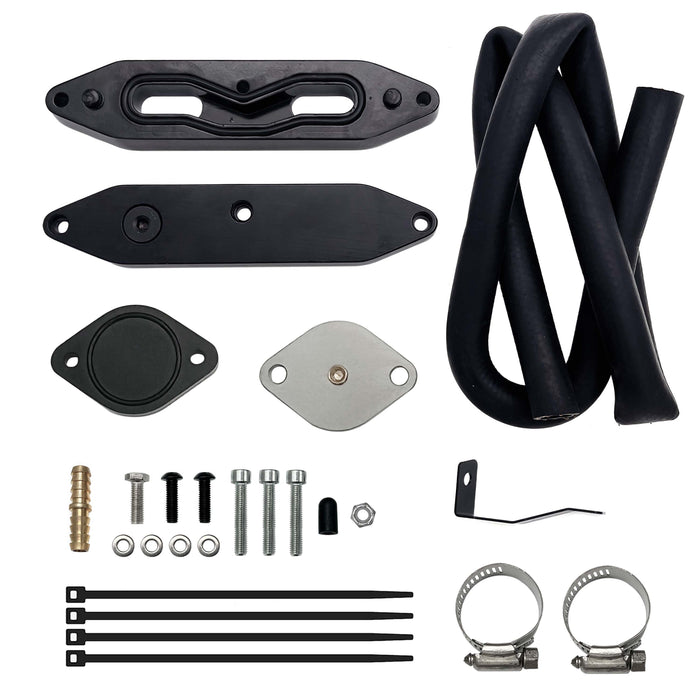
- Material and construction: A CNC-machined 6061-T6 billet aluminum block-off plate with a high-temp gasket, sealing the exhaust path cleanly.
- Coolant reroute: The plate carries an internal hollow track that routes coolant back to the water pump, so flow keeps reaching the known-hot #4 and #8 cylinders — the classic 6.7L hot spot when a delete skips the reroute.
- Hose setup: A reinforced silicone hose ties the heater-core return to the front passenger-side secondary pump, avoiding the air pockets that cause overheating after a half-done delete.
- Fitment: 2011–2023 F-250/F-350/F-450 Super Duty pickups.
Pick this one if you want the cheapest kit that still handles the coolant reroute correctly — it’s the right call for most owners who don’t need the last bit of install convenience.
ER-0088: The Dual-Layer Plug-and-Play Kit
The 2011-2023 6.7L Ford EGR delete kit is the step-up, and the extra $23 buys a cleaner install and better heat stability:
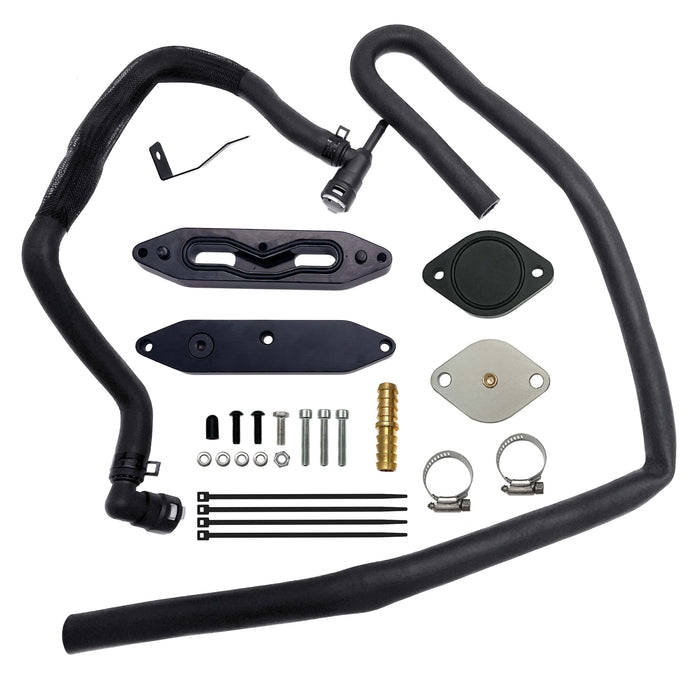
- Material and construction: The same CNC 6061-T6 billet aluminum with a high-temp gasket, but built as a dual-layer plate with an internal bridge track for the most stable coolant flow under sustained heavy load.
- Coolant reroute: A molded quick-connect hose that plugs straight into the factory secondary cooling port — no cutting the line, no barb fittings, no worm clamps, just a factory-style connection.
- Why it matters for towing: If you haul heavy and hold high EGTs for long stretches, the bridge track and factory-fit hose are the setup that’s least likely to develop a leak or a hot cylinder down the road.
- Fitment: 2011–2023 F-250/F-350/F-450 Super Duty pickups.
Pick this one if you want the true plug-and-play install and plan to work the truck hard — the dual-layer design is the more robust choice for a towing rig.
What a Delete Doesn’t Fix
Deleting the EGR cooler solves the clog and the crack — but it doesn’t touch the 6.7L’s other independent weak point, the CP4 high-pressure fuel pump. The CP4.2 can fail and send metal shavings through the entire fuel system, an $8,000–$12,000 repair. That’s why the sensible move for a deleted 6.7L is to pair the EGR delete with a CP4 disaster prevention bypass kit.
TruckTok’s CP4 Disaster Prevention Bypass Kit is a purely mechanical kit that contains any pump debris before it reaches the injectors — no tune required, no check-engine light, and it’s the cheapest insurance against the one failure an EGR delete won’t save you from.
Prevention: Keeping the Clog From Forming in the First Place
The Air Filter is Critical
If you’re staying stock, the clog is the failure you can slow down, and the single biggest lever is the air filter. A neglected intake filter raises soot output and adds abrasive load throughout a system that recirculates its own exhaust — more soot in means more soot caked into the cooler. A fresh diesel air filter is the cheapest preventive step on a 6.7L.
The Habits That Matter:
Cut idle time (low exhaust temp is exactly when soot sticks to the cooler walls), run sustained highway load to burn deposits clean, change coolant on the factory interval (depleted additives corrode the cooler from the coolant side), and address any small coolant loss immediately. TruckTok’s 2011–2016 6.7L Powerstroke fuel, oil, air & transmission filter kit bundles the filters that keep soot and wear down in one order.
The Legal Reality: Read This Before You Commit
An EGR delete removes federally mandated emissions equipment. On a truck driven on public roads, that violates the Clean Air Act (42 U.S.C. § 7522), and individuals can face fines around $5,911 per violation. There is no off-road or competition exemption under federal law — the “off-road use only” label doesn’t make it legal to drive a deleted truck on the highway. Check your local, state, and federal laws before modifying any emissions-related component.
Conclusion: Get the Right Fix for Your 6.7L EGR Cooler
The whole repair decision collapses into one question: is your coolant disappearing? If it’s not, you’re chasing a clog — scan for P0401, try a cleaning, and plan around the fact that hardened 6.7L soot rarely washes out clean. If it is, you have a crack — stop driving it before coolant fills a cylinder, and decide between a replacement cooler and a delete.
If you’re tired of the cooler failing either way, the Trucktok delete is the permanent answer: it removes the clog and the crack as possibilities in one job. Pair it with a CP4 bypass kit to cover the other weak point, and a fresh filter set to keep the intake clean, and you’ve addressed the whole failure chain on the 6.7L instead of just the symptom in front of you.
Related Blogs:
-
6.7L Powerstroke Delete: The 5 Mistakes That Cost You Twice
- 6.7L Powerstroke CP4.2 Pump: The $8,000 Failure You Can't Detect
- After a 6.7L Powerstroke Delete: What Still Breaks
- 6.7L Powerstroke P0401 / P0402: What the EGR Codes Tell You
- 2011–2022 6.7L Powerstroke: EGR, DPF & CCV Upgrades
- 2011–2016 6.7L Powerstroke Fuel, Oil & Air Filter Guide
- What Problems Does a 2011-2023 6.7L Powerstroke EGR Upgrade Solve?
Frequently Asked Questions
How do I know if my EGR cooler is clogged or cracked?
Check the coolant. A clog leaves the coolant level alone and throws a P0401 code; a crack drops the coolant with no puddle and often throws no code at all. The coolant level is the single fastest discriminator between the two.
Why doesn’t a cracked EGR cooler throw a code?
Because the ECM monitors EGR flow and position, not coolant intrusion. A crack that leaks coolant into the exhaust often reads as a generic airflow or fuel-trim fault, or nothing at all, which is why the white smoke and coolant loss are the real diagnostic.
Can I clean an EGR cooler instead of replacing it?
Only if it’s clogged and still structurally sound. Cleaning can open a soot-blocked passage, but it can’t weld a crack shut. If the failure is thermal fatigue, the cooler has to be replaced or deleted.
What’s the difference between a clog and a crack in symptoms?
A clog shows high EGTs, power loss, and a P0401 code with no coolant loss. A crack shows white smoke, a sweet smell, and coolant disappearing without a puddle. They present almost nothing alike.
Is the 6.7L EGR cooler worse than the 6.0L?
The 6.0L fails from an upstream oil cooler clogging and starving the EGR cooler of coolant. The 6.7L runs a dual cooling system where the secondary loop fatigues and cracks first. Different root causes, same end result, and the 6.7’s crack is the one that silently loses coolant.
What is hydrolock and why is it dangerous?
Hydrolock is coolant pooling in the intake and getting drawn into a cylinder, where a piston tries to compress an incompressible liquid. The result is a bent connecting rod, and it’s the difference between a $1,200 cooler and a $15,000+ rebuild.
Does an EGR delete need a tune?
Yes. Removing the cooler and valve triggers codes and derate unless you flash a delete tune that shuts off the EGR monitoring. The hardware is mechanical; the tune is what keeps the truck running cleanly.
What does an EGR delete not fix?
The CP4 fuel pump. The CP4.2 can fail independently and contaminate the whole fuel system, and no EGR delete touches it. That’s why a CP4 disaster prevention bypass kit is worth pairing with the delete.
Do I need to replace the secondary cooling radiator too?
On a stock repair, yes. The 6.7’s secondary cooling loop fails first, and replacing only the main cooler leaves that leak in place, so the symptoms return within 50,000 miles. Treat the dual cooling system as one unit.
How can I prevent the EGR cooler from clogging?
Keep the air filter fresh, cut idle time, run sustained highway load to burn deposits clean, and change coolant on schedule. More soot in means more soot caked into the cooler, and those habits directly reduce it.
For off-road / competition use only. Not legal for on-road use in emissions-regulated areas. Check your local, state, and federal laws before modifying any emissions-related component.