
Home > News > 6.7L Powerstroke CP4.2 Pump: The $8,000 Failure You Can't Detect

6.7L Powerstroke CP4.2 Pump: The $8,000 Failure You Can't Detect
The CP4.2 isn’t the kind of failure that gives you a heads-up. There’s no dashboard light, no code, no knock — just a truck that runs fine right up until the pump has quietly eaten itself and pushed metal through your entire fuel system. By the time you get a hard start or a rail-pressure code, the damage is already done, and the bill is five figures. This is the one failure on the 6.7L Powerstroke where the problem isn’t if it gets expensive — it’s that you won’t know it’s coming.
What the CP4.2 Is, and Why It’s Buried Where You Can’t See It
The Pump Itself
The Bosch CP4.2 is the high-pressure fuel pump bolted to every 6.7L Powerstroke since 2011. It builds injection pressure up to roughly 30,000 psi using two pumping plungers driven by roller lifters riding on a camshaft.
The pump was designed around European diesel, which carries more lubricity than what’s sold at American pumps. U.S. ultra-low-sulfur diesel (ULSD) has had most of its lubricating properties stripped out to hit emissions targets. The CP4 runs on a thinner margin here than it was ever engineered for — and that margin is where the failure starts.
Why It’s Buried in the Valley
It lives deep in the engine valley, under the intake — which is exactly why a failure is such a nightmare to clean up. Reaching it means pulling the intake plenum off first, and the metal it sheds travels through components with internal passages measured in microns.
Why You Can’t Detect It: It Eats Itself While Running Fine
Here’s the part that makes the CP4 different from nearly every other failure on this engine.
The Roller Skates Instead of Rolling
The failure begins at the roller-and-cam interface. Under the wrong conditions — a dry start, one bad tank, or accumulated wear — the roller can rotate 90 degrees on the cam lobe. Instead of rolling, it skates, and now two hardened steel parts are grinding each other into fine metal dust.
It Keeps Working While It Fails
The ugly part: the pump keeps working while it’s doing this. It still builds pressure, still runs the truck fine, still hits target rail pressure — the whole time it’s pushing metal downstream at injection pressure and circulating it back through the return system.
- No sensor watches the roller.
- No code fires.
- The truck doesn’t limp — it just drives.
By the Time You Feel It, It’s Too Late.That’s the “you can’t detect” part of the title. By the time you feel a hard start, a crank-no-start, or a loss of power, the metal has already toured the entire fuel system.
The Blast Radius Is the Real Cost
A CP4 that fails mechanically but doesn’t contaminate the system would be a routine $1,000–$2,000 pump swap. That’s not what usually happens.
The Metal Goes Everywhere the Fuel Goes
Once the pump starts making metal, that metal travels everywhere the fuel travels — both fuel rails, all eight injectors, the high-pressure lines, the low-pressure system, and back to the tank. The accepted fix, and what Ford’s own service procedure calls for, is replacing essentially the entire fuel system. There’s no reliable way to flush every particle out of components with internal passages measured in microns.
A “Pump Failure” Turns Into a Five-Figure Bill
| Line item | Typical cost |
|---|---|
| CP4 pump replacement | $1,000–$2,000 |
| Injectors (set of 8) | $3,000–$5,000 |
| Fuel rails, high-pressure lines, sensors | $1,000–$2,000 |
| Tank drop, flush, and labor | $2,000–$3,000+ |
| Total | $8,000–$12,000+ |
The spread depends on one question: did metal reach the injectors and rails, or was it caught near the pump?
The Honest Counterpoint: Failure Rate Isn’t the Problem
Before this turns into a doom post, the honest number matters. Forum members who track this closely estimate the CP4 failure rate at roughly 1% — out of roughly 2 million 6.7L trucks built since 2011, that’s maybe 20,000 failures, not a plague on every truck.
But here’s the thing one owner put it better than any marketing copy:
“I don’t believe the failure rate is the problem. The issue with CP4 failures is the damage done to the entire fuel system. Replacing a $1,500 pump is straightforward. What leaves a bad taste is all the injectors are trashed, along with the fuel rails, dropping and cleaning the tank.”
That’s the real math. The probability is low, but the consequence is total — and it’s unpredictable. Some pumps die before 30,000 miles. Others run 330,000 miles on the original. There’s no schedule, no warning, and no way to know which side of that coin you’re on until the tow truck shows up.
The Symptoms: All of Which Come Too Late
When a CP4 does telegraph trouble, it looks like any other fuel-system problem — which is why it gets missed:
- Hard starting, long cranking, or a flat no-start — the pump can’t build enough pressure to fire the injectors.
- Sudden power loss or stumbling — the pump is starving the injectors.
- Rail-pressure fault codes — P0087, P0088, P0191. Not a smoking gun on their own, but worth taking seriously.
- Metal glitter in the fuel filter — if you ever see this, stop driving immediately.
None of these show up until the metal is already loose in the system. That’s the whole argument for prevention.
The Only Detection That Actually Works: Cut the Filter Open
You can’t detect a CP4 failure with a scanner. What you can do is catch it early — earlier than any symptom — by looking for metal in the fuel filter.
Next time you change your fuel filter, don’t just toss the old one. Cut it open and pull the media apart under good light:
- Glittery metal flakes — the classic “disco party” debris that means the pump is already chewing itself up.
- Fine, graphite-like dust — less obvious, just as bad. Tiny particles from early roller wear.
Clean diesel residue is one thing. Metallic sparkle is a five-alarm fire. If you see glitter, don’t keep driving — every mile pushes more debris into your injectors.
Your Three Options, at Three Price Points
There’s no wrong answer here, just different budgets and risk tolerances. Here’s the whole landscape at a glance:
| Option | What it does | Stops the pump from failing? | Cost | Best for |
|---|---|---|---|---|
| DPK bypass kit | Re-routes return fuel through a dedicated filter; contains debris | No — contains the blast radius | $200–$400 | Budget insurance; daily drivers |
| DCR conversion | Replaces the CP4 with a Stanadyne pump | Yes — failure point removed | ~$2,400 | Permanent fix; no more CP4 |
| CPX pinned pump | Pins the lifter buckets so they can’t rotate | Partly — fixes the root cause | $999–$1,899 | Drop-in CP4 replacement |
Option 1: A Disaster Prevention Bypass Kit (~$200–$400)
This is the cheapest insurance in diesel. A bypass kit changes the pump’s internal plumbing so that the pumping elements and the pump case each get their own independent supply of clean, filtered fuel — then routes everything leaving the pump case through a dedicated return filter before it can reach the tank, lines, or injectors.
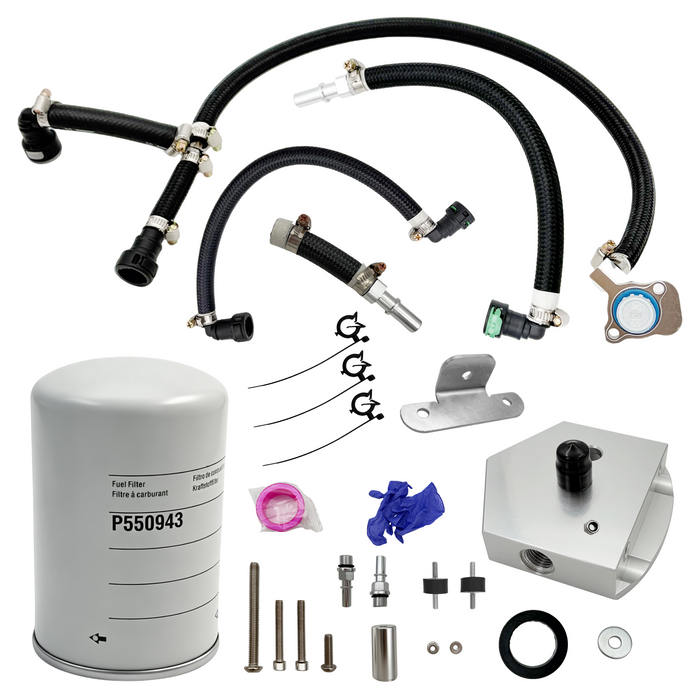
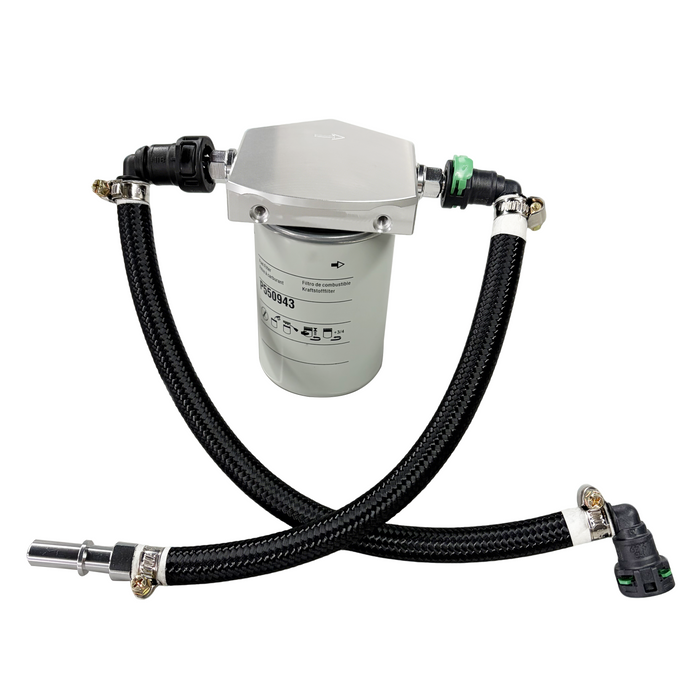
2011-2022 Ford 6.7L F250 F350 F450 F550 CP4 Disaster Prevention Bypass Kit
The CP4 Disaster Prevention Bypass Kit ($199.99) does exactly what the name says: it reroutes the CP4’s return fuel through a dedicated filtration path so that, if the pump fails, the metal debris is captured before it can circulate through the rails, injectors, and tank.
Why it fits the “can’t detect” problem specifically:
- 100% mechanical, no tuning. It’s transparent to the ECU — no custom calibration, no check-engine light, no impact on emissions readiness monitors. You can bolt it on a completely stock daily-driven truck.
- Dedicated return filter. A high-efficiency spin-on catches metal before it reaches the tank. When you suspect a failure, spin it off, cut it open, and read the media for glitter — that’s your early warning system.
- Fits the full 6.7L range. 2011–2022 F-250, F-350, F-450, and F-550 Super Duty.
It’s roughly half the price of the name-brand kit for the same fundamental job — containing a failure that, unprotected, runs $8,000 to $15,000.
It Does Not Stop The Pump From Failing
What it does is contain the blast radius. When the CP4 lets go with a bypass kit installed, the metal ends up in a $15–$20 spin-on filter instead of a $6,000 injector set. Your repair becomes “replace the pump and the return filter” instead of “replace the entire fuel system.”
Option 2: A DCR Conversion (~$2,400)
If you want the failure point gone entirely, a DCR (Disaster-resistant) pump conversion yanks the fragile CP4 and drops in a Stanadyne-designed two-piston pump that doesn’t share the CP4’s roller-and-cam weakness. It’s the sleep-at-night permanent fix — no tuning required, emissions-compliant, plug-and-play.
Option 3: A CPX “Pinned” Pump ($999–$1,899)
RCD Performance builds a CP4.2 with the lifter buckets physically pinned so they can’t rotate — eliminating the root cause of the roller skate that starts the whole failure chain. It’s a drop-in replacement pump, available in stock, +10%, and 10.3mm stroker displacements. It’s still a CP4 architecture, but it addresses the specific defect that kills them.
Why There’s No CP3 Swap for the Ford 6.7
The CP3 earned its bulletproof reputation on the LML Duramax and older Cummins. But it doesn’t work on the Ford 6.7L, and the reason is packaging: the CP3 won’t physically fit in the Powerstroke valley where the CP4 lives. The only way to mount one is off the front of the engine on a belt drive — which trades a known failure mode for a new one (a broken belt now shuts the whole truck down).
Don’t Confuse the Platforms
One correction worth making, because it comes up in the forums: the 6.4L Powerstroke did not use a CP4. The 6.4L ran a Siemens K16 pump, which had its own nasty habit of disassembling itself — but it’s a different pump, a different failure, and a different generation. The CP4.2 story is strictly 2011-and-newer 6.7L.
And across brands, the CP4 family shows up in a few places: the 2011–2016 LML Duramax (same CP4.2), and the 2019–2020 Ram 6.7L Cummins (a CP4 that went so badly it triggered a recall, and Ram went back to the CP3). Ford is the one still running it today.
Why Choose the TruckTok Kit
The disaster-prevention category is dominated by one name-brand kit at $400+. The TruckTok bypass kit does the same fundamental job — containing a CP4 failure before it spreads — for roughly half the price. Here’s the honest breakdown of why it’s the smarter buy for most owners:
- Same job, half the cost. At $199.99, you get the same containment logic: dedicated return filtration, bypass routing, and a spin-on filter that turns a $8,000–$15,000 repair into a pump and a $20 filter.
- Truly plug-and-play. It’s 100% mechanical and transparent to the ECU. No tuning, no CEL, no emissions impact — bolt it on a bone-stock daily driver and drive.
- Full platform coverage. 2011–2022 F-250, F-350, F-450, and F-550 — one kit covers the entire 6.7L Powerstroke run.
- The filter is the feature. The dedicated return filter isn’t just protection — it’s your diagnostic tool. Cut it open and read the media to catch a failure before it costs you injectors.
The one thing to be clear about, same as any DPK: this kit doesn’t make the pump unbreakable. No bypass kit does. What it does is contain the damage when the pump lets go — and for $199.99, that’s the cheapest insurance you’ll ever bolt to a 6.7L.
Installation Reality: A Careful Half-Day, Cleanliness Above All
The install is hand tools and a careful half-day, and the hardest part isn’t the routing — it’s getting the intake off to reach the pump in the valley. Here’s the full walkthrough.
Tools You’ll Need
- 8mm, 10mm, and 12mm sockets and ratchet — plus deep-well for the plenum studs
- T25 Torx — metering-unit bolts
- 4mm and 5mm Allen — bypass block and distribution fittings
- 7mm socket or nut driver — intercooler and plenum clamps
- 11/16" and 15mm wrenches — feed-line and filter-head fittings
- Pick set — electrical connectors and Christmas-tree clips
- Brake clean + compressed air — cleaning before you open the pump
- Heat gun or butane torch — 2020+ heat-shrunk feed hose only
- Torque wrench (in-lb) — for the metering unit
Step 0: Disconnect and Clean
- Disconnect both battery negatives.
- Clean the area around the metering unit with brake clean and compressed air before you open the pump. Any debris that falls in is downstream of the fuel filter — straight into the injectors.
Step 1: Remove the Intake
- On 2017+ trucks, pull the upper and lower intake plenums (and the intake throttle) to reach the metering unit on top of the pump.
- 2011–2016 trucks separate the upper and lower plenum differently, and the throttle stays in place.
Step 2: Pull the Metering Unit and Inspect the Screen
- Unplug the volume-control (metering) connector and remove the two T25 bolts.
- Lift the metering unit out carefully — it’s an O-ring fit.
- Inspect the screen on the metering unit. If it already shows metal, the pump has failed and the kit won’t help — the system needs a full contamination repair, not a bypass.
Step 3: Install the Bypass Block
- Install the bypass block between the pump and the metering unit, with the 90° fitting facing the driver’s side.
- Reinstall the metering unit on top with the longer supplied Allen bolts.
- Torque to 60 in-lb — not foot-pounds. Don’t strip the threads in the pump.
Step 4: Route the Feed and Return Lines
- Split the feed so the pump elements get their own filtered supply.
- Route the return line through the dedicated spin-on return filter so metal is captured before it reaches the tank.
- On 2020+ trucks, cut off the heat-shrunk factory feed hose and replace it with the supplied quick-connect section.
Step 5: Mount the Return Filter Head
- 2011–2016: mount the filter head on top of the cowl.
- 2017+: mount it below the cowl with the supplied spacer and washer.
Step 6: Prime the System
Cycle the key at least three times, letting the lift pump run its full 30 seconds each cycle, to push air out of the system. A starved CP4 on first start is a self-inflicted failure.
After It’s Installed: How to Care for It (and Your CP4)
The kit itself is nearly maintenance-free — but the habits around it are what keep the whole fuel system alive. Here’s what to do once it’s on.
Change the Return Filter on Schedule
The bypass kit adds a return filter, and it’s your early-warning system. Change it on the same schedule as your other fuel filters — every third oil change, or roughly 15,000–22,500 miles — and cut the old one open. Clean media means the pump is happy; glitter means it’s time to act.
Run Good Fuel From High-Turnover Stations
The CP4’s biggest enemy is low-lubricity fuel with water in it. Buy from busy stations where the diesel turns over fast and doesn’t sit long enough to absorb moisture. This is the single cheapest thing you can do for a CP4.
Add a Lubricity Additive Every Fill-Up
ULSD has been stripped of most of its lubricating properties. A good lubricity additive every fill — or every other fill — restores the film strength the CP4 was designed for. It won’t make the pump indestructible, but it gives it a fighting chance.
Don’t Let the Truck Sit on a Low Tank
Water condenses in a mostly-empty tank, and water is a CP4 killer. Keep the tank topped up through cold or humid months, and drain the water separator on schedule.
Watch for the Early Signs
- Hard starting or long cranking — get the filter cut open.
- Any rail-pressure code (P0087, P0088, P0191) — don’t dismiss it.
- Metal glitter in any filter — stop driving immediately.
Keep the Rest of the Fuel System Clean
The CP4 isn’t the only thing that hates dirty fuel. Keep up on the factory fuel filter, water separator, and injector maintenance — a clean system downstream means less stress on the pump.
The Bottom Line
The CP4.2 isn’t a guarantee that your 6.7L will fail. It’s a low-probability, high-consequence gamble where you can’t see the cards. The pump eats itself silently, gives you no code and no warning, and then turns a $1,500 pump swap into an $8,000–$15,000 fuel-system replacement — often out of warranty, often denied over fuel quality.
You can’t detect the failure before it happens. What you can do is shrink the blast radius to a pump and a $20 filter. For $200, that’s the cheapest insurance you’ll ever bolt to a 6.7L Powerstroke — and it’s the difference between a bad day and a totaled fuel system.
For the full 6.7L Powerstroke lineup — CP4 protection, filter, and delete hardware built for the Super Duty — head to TruckTok.com.
Related blogs
-
6.7L Powerstroke Delete — Race Pipe, EGR and CCV, Why Do Them Together?
- 2011-2016 6.7L Powerstroke CP4 Bypass Kit: Stop the $10,000 Wipeout
- Why Does a CP4 Pump Fail Silently, and What Actually Stops It?
Frequently Asked Questions
Q1: Will a bypass kit stop my CP4 from failing?
A: No. The kit doesn’t improve the pump’s internal durability or prevent it from failing. It contains the failure — the metal debris gets trapped in the return filter instead of destroying your injectors, rails, lines, and tank.
Q2: How do I know if my CP4 failed after the kit is installed?
A: Cut open the return filter and inspect the media. Metal in the filter means the pump is failing or has failed — and it also means the kit did its job by containing the debris.
Q3: Does the bypass kit require tuning?
A: No. It’s a 100% mechanical fluid-routing upgrade, transparent to the ECU. It won’t trigger a check-engine light or affect emissions readiness.
Q4: What does a CP4 failure actually cost?
A: A contaminated failure typically runs $8,000–$12,000, and up to $10,000–$15,000 for heavy contamination, because it requires replacing injectors, rails, lines, and often dropping the tank. A failure caught before contamination may cost far less.
Q5: Why can’t the metal just be flushed out?
A: Common-rail systems have internal clearances measured in microns. Fine particles get trapped inside rails, injectors, and connectors, and a flush can’t guarantee every particle is gone — which can lead to another failure.
Q6: What year Ford has the CP4 pump?
A: Every 6.7L Powerstroke from 2011 through the present uses the CP4.2. The earlier 6.4L used a different Siemens K16 pump, not a CP4.
Q7: Does a lift pump or fuel additive save my CP4?
A: They help the odds by feeding clean, consistent, lubricated fuel, but they can’t fix the design flaw. Run them with a bypass kit, not instead of it.
Q8: Can I replace the CP4 with a CP3?
A: Not on the Ford 6.7L — the CP3 won’t fit in the valley. The alternatives are a DCR conversion (~$2,400) or a pinned CPX pump, not a CP3 swap.
Q9: How often does the return filter need changing?
A: On the same schedule as your other fuel filters — every third oil change, or about 15,000–22,500 miles. Cut the old one open each time to check for metal.
Q10: Does metal on the metering/control valve screen mean my CP4 failed?
A: Yes. If metal debris is found on the pump's control valve screen, it is a strong indicator that the pump is beginning to fail or has already failed. A high-pressure common-rail system is pristine from the factory—there is no such thing as "manufacturing metal residue."