

Home > News > 6.4L Powerstroke Filter Kit: Fuel, Oil & Air Filters — Triple Protection


6.4L Powerstroke Filter Kit: Fuel, Oil & Air Filters — Triple Protection
Most 6.4L Powerstroke owners fixate on one threat at a time. That’s the mistake. Three separate ways this engine destroys itself, three separate filters that stop it:
-
Contaminated fuel → kills the K16 high-pressure pump. Water and abrasive debris reach a pump running at 26,000+ PSI with single-digit-micron internal clearances. The pump grenades, sends metal shrapnel through all eight injectors, and the repair bill is $8,000-$12,000.
-
Degraded oil → kills the bearings. The DPF regeneration cycle injects raw diesel into cylinders 7 and 8 during the exhaust stroke. Some of that fuel washes past the piston rings into the crankcase, thinning the oil while EGR soot simultaneously loads it with abrasive carbon. The rod and main bearings — separated from the crankshaft by an oil film thinner than a human hair — lose their protection.
-
Ingested dust → kills the turbo and cylinder walls. The single Garrett variable-geometry turbocharger’s compressor wheel spins at over 100,000 RPM at the very mouth of the intake tract. Any dust that slips past the air filter becomes a microscopic sandblaster aimed at the compressor blades, the intake manifold, and the cylinder walls.
This guide covers all three filtration systems, the installation mistakes that silently defeat them, and why the third filter — the air filter — is the one most owners neglect to the point of self-destruction.
The Air Filter — The Neglected Third Leg
Fuel filters and oil filters get attention because their failures are loud and expensive. But the air filter is the quiet killer of the 6.4L — and it’s the filter most owners change too late, or change wrong.
How an Air Filter Actually Works — It’s Not a Sieve
Most people picture an air filter as a fine mesh that blocks big particles and lets small ones through. That’s only about one-third of the story. The reality, from the physics of filtration, involves three separate capture mechanisms working simultaneously:
-
Interception (sieving). The largest particles are physically too big to fit through the gaps between filter fibers. They’re blocked outright, like a kitchen strainer.
-
Inertial impaction. Medium-sized particles are small enough to squeeze through the gaps, but they’re heavy enough that they can’t follow the air as it twists and turns through the tangled fiber pathways. Their own momentum carries them off-course, and they crash into the fibers and stick.
-
Brownian motion (diffusion). The smallest, lightest particles should slip through everything — but they don’t. They’re so tiny that air molecules constantly buffet them in random directions. This jittering motion (Brownian motion) eventually causes them to collide with a fiber and get captured.
The counterintuitive result: it’s not the smallest particles that are hardest to filter — it’s the medium-sized ones. Particles that are too small to be caught by inertia, but too large to be caught by Brownian motion, are the ones that penetrate a filter. This is why filter manufacturers test with mid-range particle sizes, not the extremes.
Why Dust Is a Death Sentence for the 6.4L Turbo
The 6.4L Turbo
The 6.4L’s turbocharger sits at the front of the intake tract, and its compressor wheel is the first rotating component that ingested air touches. At full boost, that wheel spins well past 100,000 RPM. At those speeds, the tips of the compressor blades are moving at roughly the speed of a rifle bullet.
Now Introduce Dust
A single grain of sand hitting a compressor blade at 100,000 RPM doesn’t just bounce off — it erodes. Over thousands of miles, microscopic pitting accumulates on the blade surfaces, roughening the aerodynamic profile that the turbo relies on to compress air efficiently. A roughened compressor wheel moves less air per revolution, spins up slower, and produces less boost at every engine speed.
The Result
-
The classic 6.4L symptom that owners chase for months: low-boost hesitation, sluggish throttle response, and elevated exhaust gas temperatures — all from a filter that was overdue by 10,000 miles.
-
Dust that makes it past the turbo doesn’t stop there. It travels through the intercooler, into the intake manifold, and into the combustion chambers, where it scores the cylinder walls and accelerates piston ring wear.
-
And there’s a second-order effect unique to a DPF-equipped diesel: ingested dust increases soot production, which loads the DPF faster, which triggers more frequent regeneration cycles, which injects more raw diesel into the oil, which accelerates the bearing wear that the oil filter is supposed to prevent.
The air filter isn’t just protecting the turbo — it’s protecting the oil filter’s job, too. This is why the three filters can’t be treated as independent decisions. They’re a system.
The Dirty Filter Paradox — When “New” Isn’t Automatically Better
Here’s a finding that surprises most owners: a slightly used air filter often filters better than a brand-new one.
As a filter accumulates a thin layer of trapped dust, that dust cake itself becomes part of the filtration media — it narrows the gaps between fibers and actually increases the filter’s particle-capture efficiency. A Car and Driver comparison test using identical vehicles found that a car with a 3,000-mile used filter produced identical horsepower to one with a brand-new filter, and slightly better fuel economy.
The practical takeaway for the 6.4L:
Don’t panic-replace your filter every 5,000 miles out of fear. But in a dusty environment — gravel roads, construction sites, off-road, or the desert Southwest where the 6.4L platform is most common — inspect it every oil change and replace it the moment you see heavy, caked-on accumulation or pleat deformation.
The Oil Filter — Protecting the Bearings from an Engine That Poisons Its Own Oil
The oil filter’s job on a 6.4L is harder than on almost any other diesel because the engine actively contaminates its own lubricant through two emissions-driven mechanisms:
Fuel Dilution From DPF Regeneration
During active regeneration, the ECU commands the injectors on cylinders 7 and 8 to fire a post-combustion pulse of raw diesel into the exhaust stroke, sending it through the exhaust valves into the DPF to burn off soot. Some of that diesel washes past the piston rings and into the crankcase, thinning the 15W-40 oil below its rated viscosity.
The experienced mechanics check the dipstick before draining the oil:
If the level has risen since the last change, the crankcase is contaminated with diesel. Some 6.4Ls gain one to two quarts between changes, all of it fuel.
Soot Loading From EGR Recirculation
The EGR system routes exhaust gas back through the intake and into the combustion chambers, where carbon soot enters the oil as blow-by. Carbon is abrasive at the micron level — it accelerates camshaft and lifter wear and loads the oil filter media faster than any non-emissions diesel.
The Cooling Load Nobody Accounts For
Add to both of those the fact that the 6.4L relies on its 15 quarts of oil to perform roughly 40% of the engine’s total cooling — packed as it is into an engine bay originally designed around the smaller 6.0L. Dilute the oil, load it with soot, and restrict its flow through a clogged filter, and you’ve cut the engine’s cooling capacity on three fronts at once. That’s an oil filter fighting a battle on every front.
The “Do Not Reuse Cap” Trap
Some aftermarket oil filters ship with a taller filter and a matching taller cap. If a standard-length OEM-spec filter is later installed into that taller cap, the filter never seats against the drain valve at the bottom of the housing. The oil drains back on every shutdown, every cold start becomes a dry start, and oil can bypass the filter element entirely.
The Fuel Filter — The K16 Pump’s Last Line of Defense
The fuel side is the most expensive failure on the 6.4L, and the one most owners have heard about.
Why the K16 Pump Is So Fragile
The Siemens K16 high-pressure common-rail pump generates injection pressures north of 26,000 PSI, where diesel is the only lubricant separating metal plungers from metal bores. Introduce water — and that film collapses. Introduce abrasive particles — and they become precision cutting tools spinning at pump RPM.
The Failure Cascade, Step by Step
Water reaches the K16, metal-to-metal contact begins, the pump manufactures its own abrasive shrapnel, that shrapnel circulates through both common rails at full pressure, the piezo-electric injectors are scored or blocked, and finally the pump grenades — sending metal through all eight injectors, both rails, the high-pressure lines, and back through the return circuit to the tank.
Ford’s official repair procedure requires replacing everything that touched high-pressure fuel. The bill: $8,000-$12,000, potentially $15,000 on a cab-off job.
The Two Filters That Stop It
The two filters that prevent this are the HFCM primary (frame rail, 10-micron, integrated water separator) and the engine-bay secondary (5-micron, the K16’s final defense). Together they strip solids to the 5-micron level and remove up to 98% of emulsified water.
Two Details That Separate Good Filters from Half-Working Ones
-
The bleed hole and alignment tab: the tab indexes the filter so the bleed hole sits at the highest point, allowing trapped air to escape so fuel contacts the full media height. Without it, an air pocket stays trapped at the top, and only the bottom third of the filter does any filtering.
-
The water-separating outer webbing: the coalescing wrap forces water droplets to combine and drop out before the fuel reaches the media. Aftermarket filters missing this webbing filter particles but not water — and water is the K16’s primary killer.
The TruckTok 3-in-1 Kit — One Box, Five Filters, Complete Protection
The 6.4L’s three filtration systems hit their service intervals at different mileage points — oil every 3,000-5,000 miles, fuel every 10,000-15,000 miles, air every 15,000-30,000 miles — but they converge. Buy the truck used, or fall behind on maintenance, and all three are due at the same time. The TruckTok all filters maintenance kit puts everything in one shipment, one price, one garage session.
2008-2010 6.4L Ford Powerstroke Fuel, Oil & Air Filters Maintenance Kit
Complete three-filter coverage in one box:
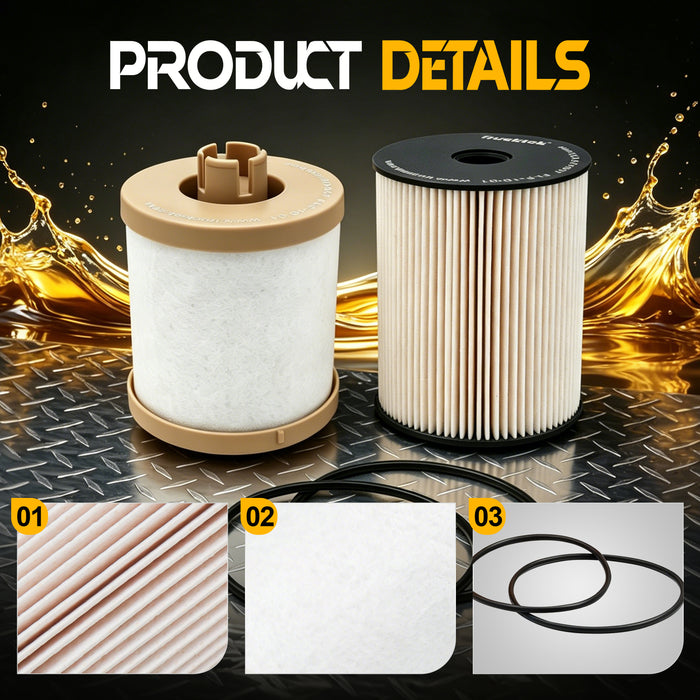
The dual-stage fuel filter set (HFCM primary water separator + engine-bay secondary), the high-capacity engine oil filter, and the heavy-duty cylindrical air filter. Every filter and every housing-cap O-ring, shipped together.
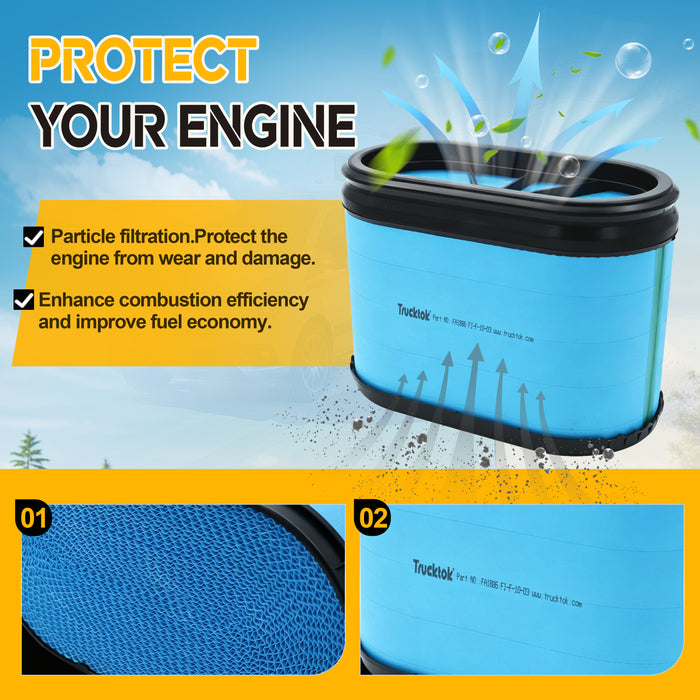
Air filter — high-dust-holding cellulose media (FA1886):
This element is engineered for high dust-holding capacity — critical for a turbo diesel that ingests more air per mile than any gasoline engine. The thick sealing gasket is on the engine side, matching the factory seal interface so no unfiltered air bypasses around the edges. Protects the turbocharger’s compressor wheel from dust erosion and prevents the low-boost hesitation that follows a scored impeller.
Oil filter — 99% efficiency to 25 microns with high-capacity synthetic media (FL2016):
Deep-pleated synthetic media handles the 6.4L’s elevated EGR soot load without restricting flow. Standard OEM form factor — no “Do Not Reuse Cap” conversion, no mismatched cap-and-filter combination. Bottom seal geometry matches the factory standpipe and drain valve interface.
Fuel filters — 98% water separation, filtration down to 3 microns (FD4617):
The primary strips emulsified water and abrasives to 10 microns before the lift pump; the secondary provides the final fine-filtration pass immediately before the K16 inlet. Both filters include the alignment tab, bleed hole, and water-separating outer webbing that match the OEM filtration path.
If your records show one filter is newer than the others, TruckTok also offers 2-filter kits covering just fuel and oil, so you don’t pay for a filter you don’t need yet. Not sure which kit configuration fits your maintenance schedule? Our full 2008–2010 6.4L filter kit buyer’s guide breaks down every part number and fitment decision before you order.
Why a Kit Beats Buying Filters Separately
You can buy these three filters individually — from the dealer, from three different parts stores, or across three separate online orders. But doing it that way costs more, takes more time, and opens the door to exactly the kind of mismatch mistakes this guide has been warning about. Here’s why the consolidated kit wins on every dimension that matters.
The Price: One Shipment, One Shipping Fee
Buy the five elements individually and you’re paying five separate markups. The dealer price for a Motorcraft FL2016 oil filter, a pair of FD4617 fuel filters, and an FA1886 air filter routinely tops $150 before tax and shipping. The TruckTok kit delivers all five filters and every O-ring for $107.10, shipped free. That’s the same filtration spec and the same fit for roughly a third less.
The Convenience: One Order, One Box, One Garage Session
The 6.4L’s three filtration systems hit their intervals at different mileage points, but on a used truck — or any truck that’s fallen behind on maintenance — they converge. All three are due at once. A kit means one order to place and one garage session to knock out the entire powertrain filtration in under an hour. No three separate runs to the parts store, no discovering halfway through the fuel filter job that you forgot the oil filter.
The Timing: Never Run Out When You Need It
Filters have a way of hitting their interval at the worst possible moment — usually 500 miles into a road trip, or the week before you need the truck for a tow. Having all three filters on the garage shelf means the moment you notice the air filter is loaded, or the oil level is rising, or the WIF light comes on, you can fix it the same afternoon instead of waiting for a shipment — or worse, driving 2,000 miles on a filter that’s already done. This is exactly the “on-time maintenance” argument owners on the forum keep coming back to — here’s how consistent filtration actually saves a 6.4L, straight from the shop floor.
The Fit: No Mismatched Caps, No Wrong Part Numbers
This is the quiet killer of buying filters separately. Buy three different brands across three different stores and the odds of getting one of these wrong go up dramatically. A kit removes the guesswork — every element is pre-verified against the factory form factor, cross-referenced to the OEM part numbers, and matched to the correct housings.
The only time a kit doesn’t make sense is if you’ve genuinely just changed one filter recently. In that case, TruckTok’s 2-filter/ 1-filter kit so you don’t pay for something you don’t need.
Installation — Air Filter, Oil Filter, and Both Fuel Filters
This section covers the complete triple-filter service, with the air filter steps from the 2008-2010 F-250 6.4L specifically.
The Air Filter (FA1886) — Under Five Minutes, Zero Tools
The 6.4L’s air filter is a round panel that sits in the round airbox on top of the engine. This is one of the easiest air filter replacements on any truck — no tools required.
-
Release the two clamps. The airbox lid is held by two spring clamps — one on the front, one on the back. Pop both off.
-
Lift the lid and remove the intake hose. The lid slides straight up. There’s a hose connected to it — slide it off and set the lid aside.
-
Remove the old filter. Slide it back toward you, then lift straight up.
-
Clean the airbox. Before dropping in the new filter, look inside the housing. If it’s dusty, vacuum it out or wipe it with a clean shop towel. Installing a clean filter into a dirty airbox is self-defeating — the loose dust gets sucked straight into the fresh filter the moment the engine starts. Bosch maintenance studies put the filter-life benefit of this single step at 25-30%.
-
Orient the new filter correctly. This is the step most people get wrong. The FA1886 has a thicker, squishier gasket on one side and a narrower, harder plastic edge on the other. The thick gasket side faces the engine — it seals against the duct that leads to the turbo. If you install it backwards, the filter won’t seal, and unfiltered air will bypass around the edges straight into the turbo.
-
Seat it fully. Line the filter up and push it down until it drops into its recess and sits flush. If it’s not fully seated, the lid won’t clamp down easily — that’s your signal that something’s misaligned.
-
Reinstall the lid. Put the hose back on, line the lid up, slide it down all the way, and re-clamp both sides. If the clamps don’t engage easily, the filter isn’t seated — open it back up and reseat it.
The pro check: Before closing the lid, shine a bright flashlight from behind the filter. If you can see a faint glow through the pleats, the filter is still serviceable. If the light can’t penetrate at all, it’s loaded — replace it.
The Oil Filter (FL2016) — Remove It First
On the 6.4L’s top-mounted cartridge design, roughly one quart of dirty oil sits trapped in the filter housing above the drain valve. Pull the oil filter before draining the pan — otherwise that quart of dirty oil drains down through the engine into your fresh pan and immediately contaminates the new oil.
Step 1 — Identify the right cap. The oil filter cap is the rounded cap near the engine centerline. The fuel filter cap is more squared-off and sits offset toward the driver’s side. Both use a 36mm socket, but the filters inside are not interchangeable.
Step 2 — Crack the cap loose. Fit the 36mm socket and loosen the cap. Confirm the shape before turning — fuel will be present if you grabbed the wrong cap.
Step 3 — Remove the cap and filter together. Pull the cap straight up. The filter should come out snapped into the cap. If the filter stays behind in the housing, you have a mismatched cap-and-filter combination (see Part 2’s “Do Not Reuse Cap” warning) — resolve it before proceeding.
Step 4 — Inspect the standpipe. Look down into the housing at the center standpipe. A cracked standpipe causes low oil pressure. If it’s damaged, it needs replacement before you install the new filter.
Step 5 — Replace the O-ring. Pry the old O-ring out of the cap groove with a pick tool. Clean the groove, install the new O-ring, and lubricate it with a thin film of clean oil or diesel. A dry O-ring binds and rolls during installation, creating a leak path.
Step 6 — Snap in the new filter. The new filter clicks into the cap’s retaining snaps and should sit firm, not wobble.
Step 7 — Pre-fill the housing. Pour about half a quart of fresh oil into the housing before installing the cap. This primes the system so the oil pump doesn’t have to fill an empty housing before building pressure on the first start.
Step 8 — Reinstall the cap. Start the threads by hand to avoid cross-threading plastic into aluminum. The cap is spring-loaded against the filter — push down while turning. Torque to 18-20 ft-lbs (25 Nm). Do not overtighten; a cracked plastic cap bleeds oil pressure and causes a no-start.
The Fuel Filters (FD4617) — Upper First, Then Lower, Then Bleed
The 6.4L has two fuel filters that must be changed as a pair: the upper (secondary) filter on top of the engine, and the lower (primary) filter in the HFCM on the frame rail. Change the upper first, then the lower, then bleed the system.
Step 1 — Upper (secondary) Fuel Filter
- The upper filter is the squared-off cap on top of the engine, offset toward the driver’s side. Fit the 36mm socket and loosen the cap slowly — the housing is full of fuel, so have rags ready.
- Pull the cap straight up, then snap the old filter out of the cap.
- Snap the new filter in, replace and lubricate the cap O-ring, and reinstall. Torque to 27 Nm (about 20 ft-lbs).
Step 2 — Drain The Lower (primary) Filter
The lower filter lives in the HFCM on the driver-side frame rail. Before removing it, open the yellow water separator drain lever on the bottom of the HFCM. Route a hose from the drain nipple into a bottle to avoid a diesel shower, and let it drain completely.
Step 3 — Lower (primary) Fuel Filter
- Access the cap from behind the skid plate, between the brake lines and wiring harness, using a 36mm socket on a long extension. Crack the cap loose, then remove it.
- Pull the old filter straight out — do not twist or angle it, because it’s wrapped around the fuel pump pickup, and snapping the plastic tip off the pump is a several-hundred-dollar repair.
- Install the new filter, replace and lubricate the O-ring, and reinstall the cap. Torque to 25 Nm (about 18.5 ft-lbs). Close the drain valve.
Step 4 — Bleed The System (non-negotiable)
- Cycle the key to ON for 30 seconds, then OFF — six times — to purge air through the return circuit.
- For a more thorough bleed, connect a fuel pressure tester to the Schrader valve behind the coolant reservoir and purge until the stream runs pure diesel with no air bubbles.
Skipping this step risks a no-start that extended cranking only makes worse.
How Often Should You Change Each Filter?
The 6.4L’s three filters run on three different clocks, and stretching any of them has a different — but equally expensive — consequence.
| Filter | Normal Interval | Severe Use Interval | The Consequence of Skipping |
|---|---|---|---|
| Air Filter (FA1886) | 30,000 miles | 15,000 miles (dusty/off-road) | Dust erosion on the turbo compressor wheel, low-boost hesitation, scored cylinder walls, more soot → more DPF regens → more fuel dilution |
| Oil Filter (FL2016) | 5,000 miles | 3,000 miles | Fuel-diluted, soot-loaded oil starves the rod and main bearings; the 6.4L’s DPF regen makes this worse than any non-emissions diesel |
| Fuel Filters (FD4617 x2) | 15,000 miles | 10,000 miles (7,500 heavy towing) | Water and debris reach the K16 pump, trigger the metal-shrapnel cascade, and the $8,000-$12,000 fuel system replacement follows |
Inspect the air filter at every oil change — it takes 60 seconds with a flashlight. Drain the HFCM water separator at every other oil change, or immediately if the WIF light comes on. If you bought the truck used and don’t know the filter history, replace all three now and start tracking from zero.
Conclusion
The 6.4L Powerstroke’s reputation is earned, but it’s also preventable. The engine has three real design vulnerabilities — a high-pressure fuel pump with zero contamination tolerance, an emissions system that poisons its own oil, and a turbocharger that lives or dies by the cleanliness of its intake air. All three are addressed by the same intervention: regular filter changes with quality media.
The filter kit is less than 1% of the cost of any single repair it prevents. If your 6.4L’s filters are anywhere near their intervals — or if you don’t know when they were last changed — order the kit and do all three this weekend. The engine you save is the one you’re driving.
Why TruckTok? Complete Filtration for a Truck That Needs All of It
TruckTok is built around the same premise that drives this series: the 6.4L Powerstroke doesn’t give you a “change your filters” warning light. By the time the symptoms show up — hard starts, low-boost hesitation, rising oil level, the fuel pump losing its battle against water — the damage is already done.
Every filter in the maintenance kit is engineered to meet or exceed the OEM specification, from the multi-layer melt-blown fuel media that strips water and abrasives before they reach the common rail, to the high-capacity synthetic oil media that handles a working EGR system’s soot load, to the high-dust-holding cellulose air media that protects a turbocharger spinning past 100,000 RPM. The form factors match the factory housings — no cap conversions, no directional confusion, no mismatched lengths.
And at $107.10 with free shipping for all five filters and every O-ring in one box, complete powertrain filtration isn’t a decision between maintenance and the mortgage. It’s a decision between an hour in the driveway this weekend and a flatbed ride next month.
Frequently Asked Questions
Q1: Which filters does the F-10-01/7-02/10-03 kit replace?
All three systems in one box: the dual-stage fuel filter set (HFCM primary water separator + engine-bay secondary), the deep-pleated engine oil filter, and the heavy-duty cylindrical air filter. The fuel elements strip water and micro-abrasives to protect the common rail, the oil filter captures carbon soot to prevent high-pressure oil valve sticking, and the air filter blocks dust from scoring the turbocharger’s compressor wheel.
Q2: Does the 6.4L have twin turbos?
No. The 2008-2010 6.4L Powerstroke uses a single Garrett variable-geometry turbocharger (VGT). Some aftermarket builds add a compound twin-turbo setup, but the factory engine has one turbo. Don’t be misled by product copy that says “twin-turbo” — the compressor wheel you’re protecting is a single unit spinning at over 100,000 RPM.
Q3: How do these filters compare to Motorcraft versions from the dealer?
Every element in the TruckTok kit is engineered to meet OEM specifications for micron ratings, media surface area, housing fit, and seal geometry. The fuel filters include the bleed hole, alignment tab, and water-separating outer layer; the oil filter uses the standard OEM form factor; the air filter matches the factory round-panel seal interface.
Q4: Do I need all five filters at once, or can I buy fewer?
If your records show one filter is newer than the others, you can opt for a 2-filter kit covering just fuel and oil. But the three systems tend to hit their intervals at the same mileage — especially on a used truck — and shipping everything in one box costs less than ordering separately later.
Q5: What’s the biggest air filter installation mistake on a 6.4L?
Installing the filter backwards. The FA1886 has a thick, squishy gasket on one side and a narrower, harder plastic edge on the other. The thick gasket side must face the engine, where it seals against the duct leading to the turbo. Installed backwards, the filter won’t seal, and unfiltered air bypasses around the edges straight into the compressor wheel. If the lid clamps don’t engage easily, the filter isn’t seated or is oriented wrong.
Q6: Should I use an oiled cotton “performance” air filter on my 6.4L?
For a daily-driven, tow-oriented 6.4L, a high-quality dry cellulose filter is the better choice. Oiled cotton filters flow more air but capture less fine dust — and the oil can migrate onto the mass air flow sensor, contaminating it and causing false readings, rough idle, and poor fuel economy.
Q7: How do I know if my air filter is actually dirty, not just “used”?
Use the flashlight test: shine a bright light from behind the filter. A faint glow through the pleats means it’s still serviceable — even a light dust layer is fine, and may actually filter slightly better than new. No light penetration means it’s loaded and needs replacement.
Q8: Why does the oil filter need to be removed before draining the oil pan?
Because roughly a quart of dirty oil sits trapped in the top-mounted filter housing above the drain valve. If you drain the pan first and then pull the filter, that quart of dirty oil drains down through the engine and into your fresh oil, immediately contaminating it. Pull the filter first, let the housing drain, then drain the pan.
Q9: What’s the difference between the oil filter cap and the fuel filter cap on a 6.4L?
The oil filter cap is rounded and sits approximately on the engine centerline. The fuel filter cap is more squared-off and sits offset toward the driver’s side, near the degas bottle. Both use a 36mm socket, but the filters inside are different sizes, different part numbers, and not interchangeable. Confusing them is a common mistake on a first oil change.
Q10: Is changing the air filter really worth doing myself?
Yes — it’s the single easiest maintenance task on a 6.4L, requiring zero tools and under five minutes. A shop will charge you a markup on a filter that costs $20-$40 at retail, plus labor for a job that literally involves popping two clamps. The only things to get right: orientation (thick gasket toward the engine) and seating (clamps should engage easily).
This guide is for informational purposes only. All maintenance procedures should be performed in accordance with the vehicle manufacturer’s specifications. The high-pressure common-rail fuel system operates at pressures that can cause serious injury — do not attempt high-pressure fuel system repairs without proper training and equipment. Always use jack stands on level ground when working under a vehicle.