

Home > News > Clogged Fuel Filter Symptoms You Should Never Ignore
Clogged Fuel Filter Symptoms You Should Never Ignore
A fuel filter costs somewhere between $15 and $60 on most diesel trucks. A high-pressure common-rail injection pump — the CP3 on earlier Duramax and Cummins engines, or the CP4 on later models — runs anywhere from $1,800 to $3,500 for the part alone. Add injectors, flush the lines, replace the tank module, and a fuel contamination event can eat $5,000 to $8,000 before the truck runs again.
The fuel filter stands between those two numbers. When it works, you don’t think about it. When it clogs, the symptoms are easy to misdiagnose — which is why so many owners chase injector issues, turbo problems, and sensor faults before checking the simplest component in the fuel system. This guide covers what a clogged fuel filter actually feels like from behind the wheel, how to diagnose one with a pressure gauge and a breath test, and why diesel fuel filters demand replacement intervals that would shock a gasoline owner.
What a Diesel Fuel Filter Actually Does — and Why It’s Nothing Like a Gasoline Filter
The Basics Are The Same:
-
fuel passes through a pleated media element that traps dirt, rust flakes, and particulates before they reach the injectors.
-
On a gasoline engine, the worst case is a clogged injector or a lean-running cylinder. Annoying, but rarely catastrophic.
When a filter clogs and fuel flow drops, the pump cavitates. It’s running dry against its own internal clearances, which are measured in microns. A CP4 pump can destroy itself in seconds once it starts ingesting air instead of fuel.
The failure mode is particularly ugly: the pump’s internal roller tappet rotates in its bore and the cam lobe slams into the lifter, shaving metal into the fuel supply. That metal then travels to the injectors, the fuel rail, the return lines, and back to the tank.
Water, Diesel Bug, and the Fuel That’s Already Contaminated When You Pump It
A fuel filter’s job isn’t just catching dirt. It’s catching water. And water in diesel fuel is a much bigger problem than most owners realize.
Where the Water Comes From
Condensation
your fuel tank breathes as temperatures cycle, drawing in humid air that condenses on the cold tank walls. This is worse in coastal regions and during seasonal transitions. A truck parked outside in the Southeast will accumulate measurable water in the tank within weeks during spring and fall.
the fuel itself
Diesel at the pump is never perfectly dry. Underground storage tanks collect condensation, and rural stations with low fuel turnover may have water sitting at the bottom of their tanks for months. When a delivery truck drops fresh fuel into those tanks, it stirs up the water layer and sends it right into your fill neck.
Biodiesel
B5 and B20 blends are hygroscopic — they actively attract and hold water from the air. The higher the biodiesel content, the more bound water the fuel can carry. This water doesn’t separate out in the filter housing until the fuel cools and the saturation point changes.
What Water Does Inside a Common-Rail System
A common-rail diesel pump (CP3 or CP4) generates 23,000 to 30,000 PSI at the rail. At those pressures, water doesn’t behave like a liquid — it flashes to steam inside the pump’s internal clearances, which are measured in single-digit microns. The steam collapses instantly when pressure fluctuates, creating microscopic cavitation bubbles that erode the polished surfaces of the pump’s pistons and bores.
Water also eliminates the fuel’s lubricity. ULSD (ultra-low sulfur diesel) already has reduced lubricity compared to pre-2006 diesel — the sulfur compounds that provided natural lubrication were removed in the refining process. Water strips away the lubricity additives that replace them, leaving metal-to-metal contact inside the pump.
The result: a pump that was designed to run for 200,000+ miles fails at 80,000 because it’s been ingesting water-saturated fuel intermittently for years, and no one ever drained the water separator.
The WIF Light: What It Means and What It Doesn’t
The Water-In-Fuel (WIF) warning light on your dash is triggered by a sensor in the bottom of the filter housing. Water, being denser than diesel, sinks to the bottom. When enough water accumulates to reach the sensor probes, the light comes on.
What it means:
drain the water separator immediately. Don’t wait until the weekend. Don’t plan to do it at the next oil change. Water that’s reaching the sensor is water that’s a fraction of an inch from being drawn into the fuel supply line.
What it doesn’t mean:
the filter is fine otherwise. If the WIF light comes on and you drain water out of the separator, you’ve removed the symptom but not the cause. The filter media has already been exposed to water-saturated fuel. If the light comes on repeatedly — you drain, it goes off, it comes back in a few hundred miles — the filter media is saturated and needs to be replaced.
Diesel Bug: When Your Fuel Tank Becomes a Biology Experiment
Microbial contamination — diesel bug — is a colony of bacteria and fungi that lives at the interface between diesel fuel and accumulated water in the bottom of a tank. The organisms feed on hydrocarbons in the fuel and excrete acidic byproducts that corrode steel tanks, clog filters with biomass, and produce a slime that coats everything it touches. A severe diesel bug infestation will clog a brand-new fuel filter within hours.
Treatment
It requires a biocide additive and a complete fuel system flush. It’s rare on well-maintained daily drivers but common on trucks that sit for months (farm trucks, seasonal rigs, project trucks).
Six Clogged Fuel Filter Symptoms Every Diesel Owner Should Know
These symptoms develop in a predictable order as the filter accumulates restriction. The key to catching a filter before it catches your pump is recognizing the pattern.
1. Hard Starting — Especially Cold
This is often the first sign. On a healthy diesel, the fuel pump primes the system within a second or two of key-on, bringing the low-pressure side to 5-10 PSI before the engine cranks. A clogged filter restricts that initial fill. The pump fights against the blockage, pressure builds slowly, and the engine cranks longer before catching.
If the filter is severely clogged, the engine may start, run for a second, and die. That’s the fuel that was already downstream of the filter being consumed, followed by the pump hitting the restriction and starving the rail.
2. Hesitation or Stumble Under Acceleration
This is the classic diesel fuel filter symptom. At idle, the engine needs only a small volume of fuel. A partially clogged filter may still deliver enough flow at idle to maintain rail pressure. But when you roll into the throttle, fuel demand spikes. The filter can’t keep up.
The engine hesitates. It stumbles. RPMs waver for a moment before picking up. It feels like a boost leak or a sticking VGT vane, and plenty of owners have spent $400 on a turbo cleaning only to find the problem was a $45 filter the whole time.
The difference between a turbo issue and a fuel filter issue is throttle sensitivity. A turbo issue typically shows up at a specific RPM range regardless of load. A fuel filter issue gets worse the harder you push the pedal — the higher the fuel demand, the deeper the pressure drop.
3. Power Loss Under Heavy Load
As the filter accumulates more restriction, the symptoms move from hesitation to outright power loss. The truck feels flat — you press the accelerator and the engine responds like it’s towing 5,000 pounds more than it actually is.
This is where the pressure-gauge test becomes definitive. A healthy fuel system maintains low-pressure supply at 5-10 PSI under all conditions. With a clogged filter, pressure that looks normal at idle drops to 2-3 PSI — or lower — under load. The high-pressure pump is ingesting a restricted supply and the rail pressure starts to sag. The engine pulls timing and fuel to protect itself, and you feel it as a truck that’s suddenly down 50 or 60 horsepower.
4. Rough Idle and Misfire
When fuel flow becomes inconsistent — not just restricted but choppy, as debris shifts around the filter element — the engine’s idle quality suffers. You’ll feel vibration through the cab floor and steering wheel at a stoplight. The tach needle wavers slightly. It’s a subtle roughness, easy to dismiss as “just a diesel being a diesel,” but a healthy common-rail engine idles smoothly.
Misfires at idle or light throttle are the next stage. One or two cylinders fail to fire because the injector didn’t receive enough fuel on that particular stroke. A misfire that happens intermittently and clears up when you back off the throttle is classic fuel starvation behavior.
5. Engine Stalling — Especially Under Load or at Low Speed
A filter that’s progressed to the stalling stage has been sending warning signs for a while. The stall typically happens when fuel demand changes abruptly: you crest a hill and lift off the throttle, the pump’s output briefly exceeds demand, the pressure surges, the regulator opens, and then when you tip back into the pedal the clogged filter can’t recover fast enough. The engine quits.
6. Check Engine Light and Lean Codes
A clogged filter doesn’t have a dedicated sensor. There’s no “P0-FILTER-CLOGGED” code waiting in the ECM. But the downstream effects — low fuel rail pressure, lean air-fuel ratios at the oxygen sensor — do trigger codes. On a diesel, the most common code associated with a starving fuel system is P0087: Fuel Rail / System Pressure Too Low.
On some trucks, especially those with wideband O2 sensors, you’ll see P0171 (System Too Lean) or specific cylinder misfire codes like P0301 through P0308. These codes show up because the injectors can’t deliver the commanded fuel quantity — not because the injectors are failing, but because the supply feeding them is choked off.
How to Diagnose a Clogged Fuel Filter
Three methods, in order of reliability.
Method 1: Fuel Pressure Gauge (The Definitive Test)
This is the gold standard. Connect a fuel pressure gauge to the low-pressure supply line — the line feeding the high-pressure pump. On a Duramax, the test port is typically on the fuel filter housing or the supply line near the engine. On a Cummins, there’s often a Schrader valve on the filter head.
-
Key on, engine off: pressure should build to 5-10 PSI within one to two seconds. If it takes four or five seconds, the filter is restricting the initial fill.
-
Engine idling: pressure should hold steady at the pump manufacturer’s specification — typically 5-15 PSI on the low-pressure side.
-
Snap the throttle: this is the diagnostic moment. On a clean filter, pressure stays constant or rises slightly with RPM. On a clogged filter, pressure drops — and the drop gets deeper with each successive throttle snap. A filter that drops from 10 PSI to 3 PSI under load is done. Replace it.
Method 2: The Blow Test (Quick and Dirty)
Remove the filter, drain the fuel, and blow through the inlet. A clean filter offers minimal resistance — it feels like blowing through a straw into an empty cup. A clogged filter feels like trying to inflate a balloon. If you can’t push air through it with your mouth, the fuel pump — which generates far more pressure than your lungs — has been struggling against that same resistance.
The limitation: you need a baseline for what a clean filter of that specific type feels like, and if you’ve already removed the filter, you might as well install a new one.
Method 3: Visual Inspection (If Your Housing Is Transparent)
Some diesel filters — particularly aftermarket units with clear bowls — let you see the element directly. Dark, discolored media. Visible debris in the bowl. Water sitting at the bottom rather than being separated out. Any of these means it’s time for a new filter. But factory filter housings on most diesel trucks are opaque. You can’t see what’s inside until you open it.
When to Replace Your Diesel Fuel Filter
The owner’s manual for most diesel trucks recommends 15,000 to 20,000 miles for fuel filter replacement. In practice, the diesel community has settled on shorter intervals for a reason: filters are cheap, high-pressure pumps are not.
| Service Interval | Who It’s For | Rationale |
|---|---|---|
| Every oil change (5K-7.5K miles) | Heavy towers, high-mileage trucks, CP4-equipped engines | CP4 pumps have zero tolerance for fuel restriction; an extra $30-60 every oil change is cheap insurance against a $3,500 pump replacement |
| Every other oil change (10K-15K miles) | Daily drivers, moderate towing, CP3-equipped engines | CP3 pumps are more tolerant of mild restriction, but injector health still depends on clean fuel |
| 15K-20K miles | Manufacturer recommendation | The minimum. Don’t exceed this. If you drive unpaved roads, fuel up at rural stations, or live somewhere with seasonal diesel formulation changes, go shorter |
If you own a 2011-2019 Powerstroke with the CP4.2 pump, consider the fuel filter non-negotiable at every oil change. The CP4’s failure mode — read this TruckTok Forum deep dive on CP4 pump failure and fuel filtration.
If you just bought a used diesel truck and there’s no service record showing when the filter was last replaced, replace it immediately. Same goes for the first service after any major fuel system work. A clean filter is the baseline for every diagnosis that follows.
The Right Filter for Your Truck
Fuel filters are not universal. A spin-on filter for a 2006 Duramax won’t fit a 2018 L5P cartridge housing, and a Powerstroke uses a two-filter HFCM system that no GM truck ever had. Here are the TruckTok fuel filters that match the three most common diesel platforms on the road today — all in stock, all with free shipping, all replacing the OEM part number directly.
2008-2010 6.4L Ford Powerstroke Diesel Fuel Filter
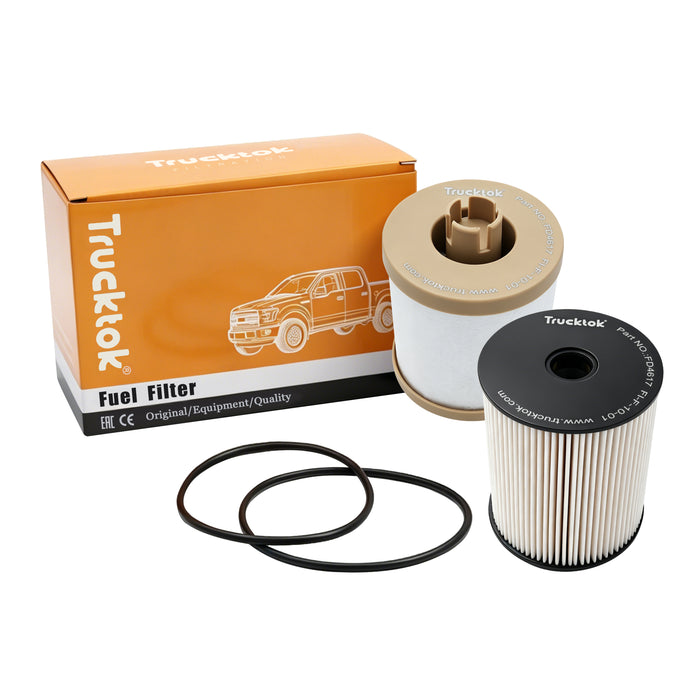
- The 6.4L Powerstroke fuel filter uses a two-stage filtration architecture: a frame-rail-mounted HFCM primary filter that handles water separation, and an engine-bay secondary cartridge for fine filtration.
- TruckTok’s set includes both. High-density pleated fiberglass media captures particles at micron level while stripping up to 98% of emulsified water.
- Heavy-duty O-rings included for both housings.
- Replace as a matched pair every 15,000 miles — or every 10,000 under heavy towing, biodiesel, or rural fueling conditions.
2001-2016 6.6L Silverado Sierra Duramax Fuel Filter
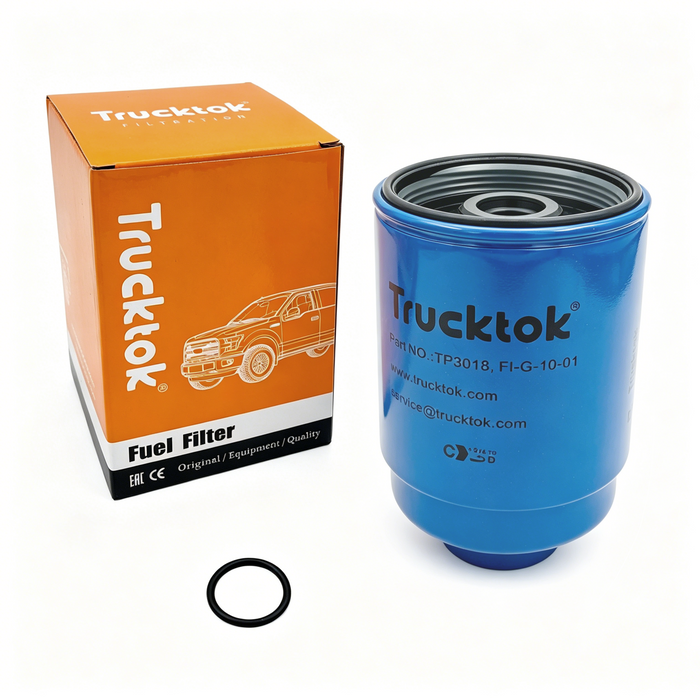
- The 6.6L Duramax fuel filter for every Duramax from the first LB7 through the last LML.
- Dual-layer progressive media: a 15-micron outer layer traps coarse debris, a 5-micron inner core catches the fine abrasive particles that score injector internals.
- 98% water separation efficiency, heavy-duty steel housing rated for pressure spikes and sub-zero thermal cycling. Fresh O-rings included.
- Do not pre-fill the filter — install it dry and use the factory primer pump on the housing to bleed the system.
2017-2026 6.6L Silverado Sierra Duramax Fuel Filter
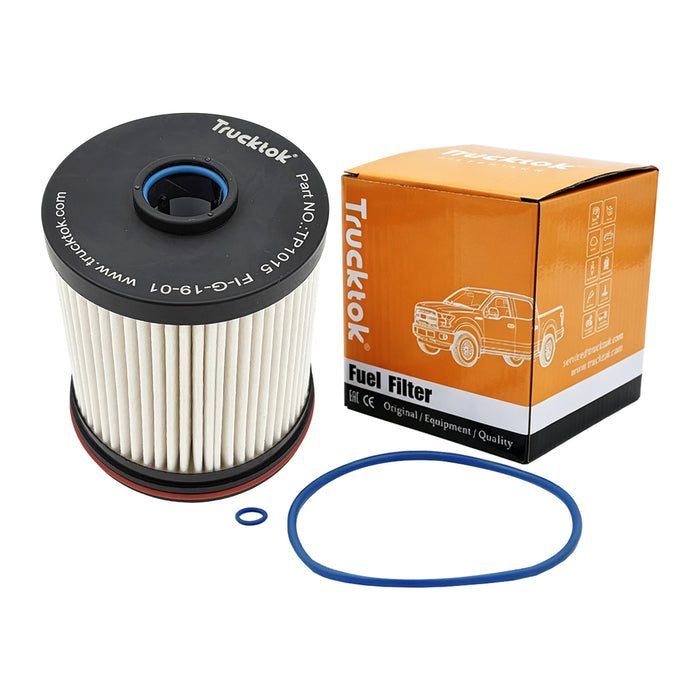
- The 6.6L Duramax fuel filter' s multi-layer coalescing media achieves 98%+ water separation — critical for the L5P’s high-pressure Bosch CP4.2 pump.
- High-strength composite end caps resist thermal expansion cracking through cold-start to full-tow temperature swings.
- No special tools required: standard socket on the housing cap, old cartridge lifts out by hand, new one drops in.
- Includes fresh O-rings for the cap seal.
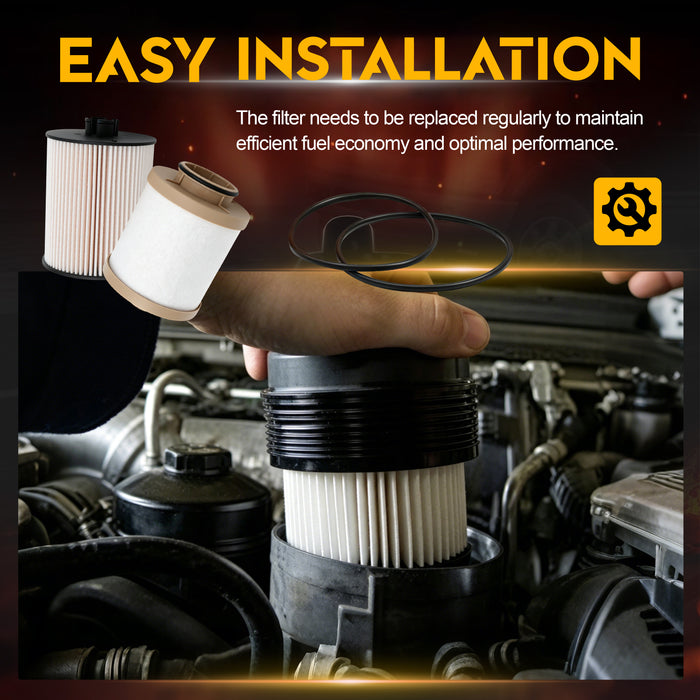
How to Replace a Diesel Fuel Filter — Without Making a $3,000 Mistake
A fuel filter replacement is one of the easiest maintenance tasks on a diesel truck. It’s also one of the easiest to get wrong in ways that matter.
Step 1: Drain the water separator first.
Every diesel fuel filter housing has a drain
- A petcock valve on the bottom of the canister (Duramax)
- A hex plug on the HFCM module (Powerstroke)
- A drain screw on the filter bowl (L5P)
Place a clear container underneath, open the valve, and let fuel run until it flows clean with no water beads visible. Water is heavier than diesel — you’ll see it as distinct droplets settling at the bottom of the container.
Step 2: Remove the old filter.
-
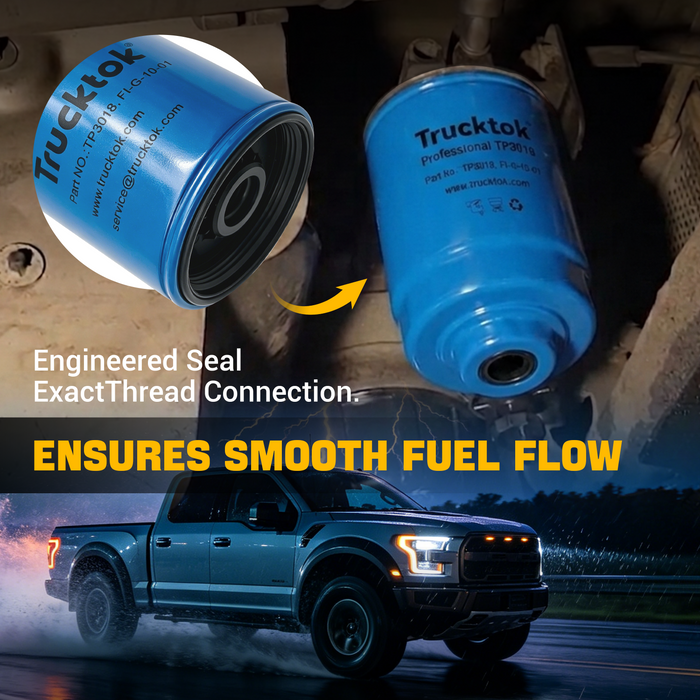
Spin-on (Duramax 2001-2016): Use a filter wrench or strap wrench. Unscrew counterclockwise. Expect fuel to spill — have a catch pan ready. Remove the old O-ring from the housing base and wipe the sealing surface clean.
-
Cartridge (Duramax 2017-2026 L5P): Socket on the hex cap at the bottom of the black plastic housing. Unscrew, cap drops down, old cartridge lifts out by hand. A small amount of fuel stays in the housing.
-
Two-filter set (6.4L Powerstroke): Frame-rail HFCM primary first — accessible from under the driver’s door. Hex socket on the cap, unscrew, remove. Then the engine-bay secondary on top of the engine.
Step 3: Install the new filter and prime, don’t pre-fill.
This is the step that separates people who change filters from people who change injectors.
For spin-on filters :
install it dry. Do not pour diesel into the center hole before threading it on. Spread a thin film of clean diesel on the rubber gasket with your finger (this prevents the gasket from binding and tearing during tightening), thread the filter on by hand until the gasket contacts the housing, then snug it no more than three-quarters of a turn past contact.
Once the filter is on, use the factory primer pump — a black rubber button on top of the Duramax filter housing — to fill the system. Pump until it goes firm. You’ll hear fuel moving through the lines. Open the bleeder screw on the housing, pump until fuel comes out bubble-free, close the bleeder, and you’re done.
For cartridge filters:
Drop the new cartridge in, install the fresh O-rings on the cap (lightly lubed with clean diesel), thread the cap back on, and torque to spec. The L5P will self-prime when you key on — but cycle the key to “run” for 30 seconds, then off, then repeat twice, before cranking. This gives the in-tank lift pump time to fill the filter housing.
For HFCM two-filter sets:
The 6.4L Powerstroke HFCM module has a built-in electric pump. Key on for 30 seconds without cranking and the pump will cycle fuel through both filters automatically. You’ll hear it running. Do this three times before starting.
What a Fuel Contamination Event Actually Costs
People skip fuel filter changes because the filter seems fine and the truck runs. Here’s what happens when “it seemed fine” turns into a pump failure.
| Repair Item | Cost (Parts + Labor) |
|---|---|
| High-pressure fuel pump (CP3, reman) | $1,200-$1,800 |
| High-pressure fuel pump (CP4.2, new) | $2,200-$3,500 |
| Set of 6-8 fuel injectors (reman) | $1,800-$3,200 |
| Set of 6-8 fuel injectors (new, OEM) | $3,600-$5,000 |
| Fuel rail flush and lines cleaned | $400-$800 |
| Fuel tank dropped, cleaned, and resealed | $600-$1,200 |
| Fuel cooler and return lines replaced | $200-$500 |
| Total (CP3 failure, reman injectors) | $4,200-$7,500 |
| Total (CP4.2 failure, OEM injectors) | $7,000-$14,000 |
The CP4.2 failure, in particular, is known as a “complete fuel system replacement” event. When the roller tappet rotates and the cam lobe smashes into the lifter, metal shavings contaminate the rail, all eight injectors, the return lines, the fuel cooler, and the tank. Insurance companies routinely total trucks over this repair — a 2015 F-250 with 180,000 miles might be worth $18,000, and a $12,000 fuel system job puts it at 67% of the vehicle’s value.
Against those numbers, a $30 fuel filter and 20 minutes of driveway time every other oil change is not maintenance. It’s insurance.
Conclusion
The fuel filter is the cheapest component in the entire diesel fuel system — and the only one designed to be routinely sacrificed to protect everything downstream. A clogged filter shows you warning signs for thousands of miles before it causes a failure: the longer crank, the hesitation, the flat spot under load. Catching it at that stage costs you a filter and half an hour. Ignoring it until the truck stalls or throws a P0087 can cost you a high-pressure pump, a set of injectors, and weeks of downtime.
Whether your truck takes a spin-on, a cartridge, or a two-filter set, the math is the same: $30 to $40 and a filter change beats $3,000 and a pump replacement. TruckTok stocks direct-fit replacements for all three platforms — Powerstroke, Duramax and Cummins. All ship free, all in stock, all replace the OEM part directly.
Frequently Asked Questions
Q1: Can a clogged fuel filter cause a no-start condition?
A1: Yes, but only when the filter is nearly 100% blocked. Before that point, you’ll see hard starting, extended cranking, or a start-then-stall pattern. A complete no-start from a filter usually means the fuel pump can’t pressurize the line at all — and at that stage, the pump itself may already be damaged from running dry.
Q2: Will a clogged fuel filter always trigger a check engine light?
A2: No. The filter itself has no sensor. The codes that do appear — most commonly P0087 (low rail pressure) or P0171 (lean condition) — are downstream effects that could also be caused by a failing pump, leaking injectors, or a bad pressure regulator. A P0087 code without a check engine light is possible if the pressure drop is brief and intermittent.
Q3: What’s the difference between a diesel fuel filter and a gasoline fuel filter?
A3: Filtration rating. Diesel filters trap particles down to 2-5 microns; gasoline filters typically stop at 10-20 microns. Diesel filters also almost always include a water separator with a drain valve, which gasoline filters rarely have. You can’t substitute one for the other — a gasoline-rated filter on a common-rail diesel will pass particles large enough to score injector internals.
Q4: How do I drain water from a diesel fuel filter?
A4: Most diesel filter housings have a petcock valve or drain screw at the bottom. Place a clear container underneath, open the valve, and let fuel flow until you see clean diesel with no water separation. Water is heavier than diesel and will appear as beads or a distinct layer at the bottom of the container. Do this monthly during winter months when condensation is worst.
Q5: Does a clogged fuel filter affect fuel economy?
A5: Indirectly, yes. When the ECM detects low rail pressure from a restricted supply, it compensates by commanding longer injector pulse widths to deliver the same fuel quantity. The engine runs less efficiently — unburned fuel exits the exhaust, fuel trims shift, and you burn more diesel to make the same power.
Q6: Can I clean a diesel fuel filter and reuse it?
A6: No. Modern diesel fuel filters use pleated cellulose or synthetic media that traps particles within the fiber matrix. Once those pores are filled with debris, cleaning — whether with solvent, compressed air, or backflushing — will not restore the original filtration rating. Don’t gamble a $3,000 pump on a part that costs $30.
Q7: Should I pre-fill a new fuel filter with diesel before installing it?
A7: No. The center hole on a spin-on filter is the clean-side outlet. Any fuel poured in there bypasses the filter media and goes directly to the injector supply line — carrying whatever contaminants were in your fuel jug straight into the high-pressure pump. Install the filter dry, then use your truck’s factory primer pump to fill the system with filtered fuel.
Q8: Do I need to replace the fuel filter after a high-pressure pump failure?
A8: Yes — along with everything else. A failed CP3 or CP4 pump sends metal shavings through the entire fuel system: the rail, the return lines, the fuel cooler, and back to the tank. Replacing only the pump will destroy the new pump within hours as residual metal in the lines gets pulled back through.