

Home > News > 6.0L Powerstroke Fuel & oil Filters kit: Covers Your Next Two Oil Changes
6.0L Powerstroke Fuel & oil Filters kit: Covers Your Next Two Oil Changes
The 6.0L Powerstroke wants its oil changed every 5,000 miles. Its fuel filters? Every 15,000 miles — exactly every third oil change. So when you buy a kit that includes the oil filter plus both fuel filters, you’re not just saving on shipping. You’re stocking your next three oil changes with everything that needs to be under the hood at least once.
And on a 6.0L, what’s under the hood matters more than most owners realize. This engine runs a HEUI injection system where high-pressure oil — not a high-pressure fuel pump — fires the injectors. That means the oil filter isn’t just protecting your bearings. It’s protecting your entire injection system. And the fuel filters? They’re the only thing standing between a CP4 pump failure or scored injectors and the diesel you just pumped at a rural truck stop.
What’s in the 6.0L Powerstroke Fuel & Oil Filters Kit

A complete kit contains:
| Component | OEM Part # | Location | Function |
|---|---|---|---|
| Oil Filter | FL2016 | Top of engine, passenger side | 99% @ 25 microns synthetic media; filters 15 quarts of 15W-40 |
| Primary Fuel Filter / Water Separator | FD4616 (HFCM) | Driver-side frame rail | 3-layer fiberglass, 98% water separation, 10-15 micron |
| Secondary Fuel Filter | FD4616 (Engine) | Top of engine, next to oil filter | Final polish before fuel hits injectors |
| O-Ring (Oil Cap) | — | Oil filter housing cap | Seals the element housing |
| O-Ring (Engine Fuel Cap) | — | Upper fuel filter housing cap | Seals the secondary filter |
| O-Ring (HFCM Cap) | — | Frame rail fuel cap, 36mm | Seals the primary water separator |
Three elements, three O-rings, one delivery. The oil filter gets changed every 5,000 miles — every oil change, no exceptions. Both fuel filters get changed every 15,000 miles under normal conditions, or every 10,000 under severe duty. That means one kit handles two full oil changes, plus a fuel filter change somewhere in the middle.
Why the 6.0L Is Filter-Sensitive: It’s All HEUI
If you came from a 7.3L Powerstroke or a 5.9L Cummins, the 6.0L’s maintenance requirements feel aggressive. They are. Here’s why.
The 6.0L Uses A HEUI (Hydraulic Electronic Unit Injection) System
Unlike common-rail diesels where a high-pressure fuel pump sends diesel at 25,000+ PSI to the injectors, the HEUI system uses high-pressure engine oil to drive the injectors. The fuel side operates at a relatively modest 45-60 PSI from the frame-mounted lift pump. The oil side — the high-pressure oil pump, or HPOP — pushes oil at up to 3,600 PSI through tiny passages inside each injector to intensify fuel pressure at the nozzle tip.
What this means for filtration:
-
Oil contamination doesn’t just wear bearings. Dirty oil sludges the HPOP, scores intensifier pistons inside the injector bodies, and clogs the IPR (Injection Pressure Regulator) valve — a spool valve with clearances measured in thousandths of an inch. When the IPR clogs, the truck doesn’t start. Period.
-
Fuel contamination doesn’t just smoke a little. Water in the fuel rail rusts injector plungers from the inside. Abrasive particulate in the 5-15 micron range scours nozzle orifices, degrading the spray pattern until the truck develops a persistent misfire that no tuner can fix.
-
Both systems fail silently. There is no “check filter” light on a 6.0L dashboard. The first symptom of filter neglect is often a no-start in a parking lot or a tow bill.
This is why the 6.0L Powerstroke Fuel & Oil Filters Kit isn’t optional maintenance — it’s the barrier between your engine and a five-figure repair.
Why Installing This Kit Beats the Alternatives
The value of a bundled 6.0L Powerstroke Fuel & Oil Filters Kit isn’t just in the price — it’s in what you avoid by using the right parts in the right combination. Here’s what changes when you install this kit instead of piecing things together from the parts counter:
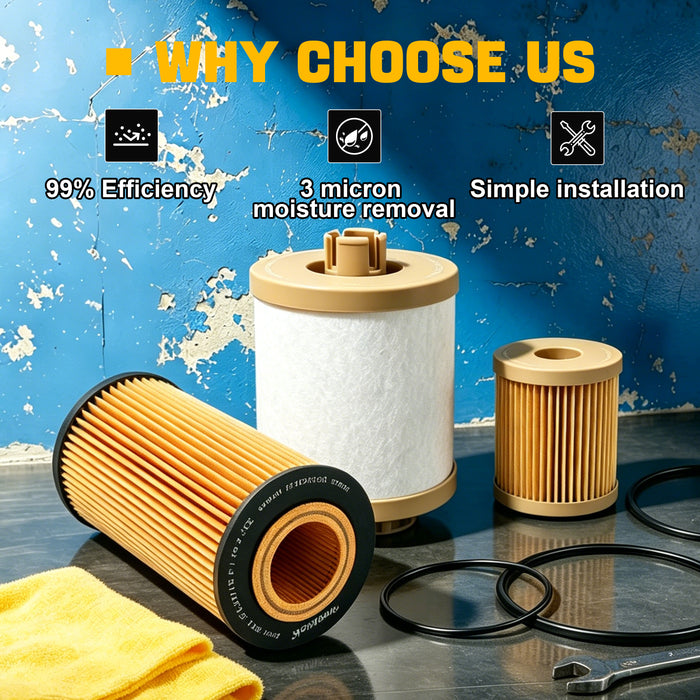
One Shipment Covers Two Oil Changes
Order once. Open three times. No chasing down a fuel filter at 8 PM on a Saturday because you realized you’re at 14,800 miles and towing tomorrow. No forgetting the O-ring and reusing the old one because the parts store didn’t have it in stock. Everything you need for the next 15,000 miles of maintenance is in one box.
The FL2016 Oil Filter Closes The Drain Valve — Guaranteed
The correct bare-element design with the OEM-depth felt seal presses the canister drain valve fully closed every time. You don’t have to wonder if the aftermarket filter with the “Do Not Reuse Cap” warning is seating properly. You don’t have to cross your fingers on cold starts and watch the oil pressure gauge. The filter fits the factory cap, the depth is right, the valve seals, pressure builds. Simple.
No Rubber Debris In The IPR Valve
The premium temperature-resistant rubber O-rings at the bottom of the FL2016 element — unlike the rubber O-ring on cheaper filters — doesn’t embrittle, crack, or shed fragments into the oil. Every rubber seal that breaks down inside a 6.0L oil system eventually ends up in the IPR screen, and an IPR clog is a tow-truck repair.
The Fuel Filters Actually Use 100% of Their Media
The weep hole and locating tab on the HFCM primary filter allow the housing cavity to fill completely, putting the full pleated surface area in contact with fuel. Cheap filters without the weep hole use about 30% of their media — the rest sits dry and clean while the active 30% clogs prematurely.
$44.10 Delivered vs. $180-250 At The Dealer.
The financial comparison isn’t subtle. Even if you value your time at $100/hour — highly unlikely, since this is a 30-minute job — you’re still saving over $85 per service compared to a dealer quote. Over 100,000 miles (20 oil changes, ~7 fuel filter changes), DIY with the bundled kit saves roughly $2,500-3,500 in labor alone.
Free Shipping Means No Parts-counter Markup.
The kit ships to your door. No driving to the dealer, no standing in line behind someone buying wiper blades, no “we don’t have the HFCM O-ring but we can order it” — it arrives, you install it, you’re done.
You Eliminate The Three Most Expensive 6.0L Failures
- Dirty oil kills HPOPs and injectors.
- Water in fuel rusts injector internals.
- Rubber debris jams the IPR.
The filters in this kit are designed specifically to prevent those three failures — 99% oil filtration at 25 microns and 98% water separation in the primary fuel filter. Every oil change with this kit is an insurance payment on a $14,000 engine.
DIY Installation: Three Housings, 30 Minutes
This is one of the most accessible maintenance jobs on the 6.0L. Both engine-bay filters sit in top-mounted housings. The frame rail filter requires crawling under the truck but no special equipment. Here’s the concise guide:

Tools
- 24mm socket or 15/16" (engine oil filter cap — a 1/2" ratchet square drive also fits)
- 36mm socket with extension (HFCM cap — 4WD models need a long extension to clear the front driveshaft)
- Drain pan (1+ gallon)
- Rags
- 6mm Allen wrench (HFCM water drain plug — optional, use with caution, strips easily)
Engine Bay: Oil Filter + Secondary Fuel Filter (15 minutes)
- Let the engine cool for 10 minutes after shutdown. Hot oil under pressure is not your friend.
- Oil filter cap: 24mm socket or 1/2" ratchet square drive in the cap recess. Remove by hand once loose. Pull the old element straight up.
- Fuel filter cap: same 24mm socket. Remove, pull the old element.
- Clean both caps. Remove old O-rings. Install new O-rings from the kit — roll them into the groove, lubricate with clean diesel or oil.
- Oil filter: snap the new element into the cap, lower the assembly onto the standpipe. The filter bottom must seat against the drain valve. Tighten to 14 Nm (printed on the cap).
- Fuel filter: hollow side goes onto the center stem. Tighten cap to 14 Nm.
Frame Rail: HFCM Primary Filter (15 minutes)
- Crawl under the driver-side door. The HFCM is on the inside of the frame rail.
- Optional: drain the water separator with a 6mm Allen. One thread. Gentle. 25 seconds of flow.
- 36mm socket, loosen the cap slowly. Fuel will run down the frame rail — position rags.
- Pull the cap and filter straight back, watch the brake line.
- Clean the cap, replace the O-ring, lubricate with fuel.
- Insert the new filter with the locating tab toward the frame rail, then rotate upward until it catches. The weep hole must face UP.
- Tighten to 25 Nm (printed on the cap).
Priming
Cycle the key ON for 20 seconds, OFF, repeat 4-6 times. The fuel pump runs during key-on, filling both filter housings. Start the engine, idle for 2-3 minutes, check both caps and the HFCM for leaks.
The Oil Filter: FL2016 and the Drain Valve Nobody Talks About
The oil filter is not just a filter. It’s a valve actuator.
Inside the oil filter housing, at the bottom of the canister, sits a spring-loaded drain valve. When you pull the old filter element out, the valve opens and drains the residual dirty oil out of the housing. When you insert a new filter and seat it against the standpipe, the bottom of the filter element presses that valve closed, sealing the oil circuit so the engine can build pressure.
Here’s What Happens When You Use The Wrong one:
-
The OEM Motorcraft FL2016 oil filter is a bare element. It comes without a cap — you reuse the factory cap that snaps onto the filter body. The depth of the element is precisely calibrated so that when the cap is tightened down, the felt seal at the bottom of the filter presses the drain valve fully closed. Oil flows through the filter media, out the standpipe, and into the engine.
-
Aftermarket filters that come with their own cap — the kind that say “Do Not Reuse Cap” in big letters — are a different depth. The element is shorter or the cap recess is shallower. When you tighten the cap down, the bottom of the filter either barely touches the drain valve or doesn’t reach it at all. The valve stays cracked open.
An open drain valve is hydraulically identical to a hole in the side of your engine block. Oil pressure bleeds off through the open drain before it ever reaches the HPOP reservoir, the turbo bearings, or the main galleries. The gauge might show pressure. The engine might even run — for a while. But the HPOP is starving, the IPR is hunting to compensate, and the injectors are firing on borrowed time.
The Fuel Filters: Two-Stage Defense and the Weep Hole Trap
The 6.0L’s fuel filtration is a series system. Fuel flows from the tank → HFCM primary filter/water separator (frame rail) → engine-mounted secondary filter → injectors. Each stage has its own failure mode.
Primary (HFCM) Filter: The Weep Hole Screw-Up
The HFCM filter element has two critical design features:
- A weep hole (vent hole) on one side of the element body
- A locating tab that corresponds to the weep hole position
When installed correctly, the locating tab catches an internal stop inside the housing and locks the weep hole in the UP position. This allows the entire filter cavity to fill with fuel, using 100% of the filtration surface area. The filter seals with an O-ring inside the housing bore — a compression seal, not a butt-seal against the face.
Don't Buy The Cheap One
Cheap aftermarket filters — omit the weep hole entirely. Without it, the housing cavity never fills. The filter media uses approximately 30% of its surface area before flow restriction triggers symptoms. The remaining 70% sits dry and unused while the truck develops hard starts and throttle hesitation that drivers blame on the injectors.
Secondary (Engine Bay) Filter: The Last Line
The engine-mounted secondary filter catches what the HFCM misses — typically particulate in the 2-5 micron range that passes through the primary’s coarser media. If the primary filter is bypassing or has a poor seal, the secondary takes the full load. That’s the design intent. But if the secondary filter is also a low-quality part with inferior media and a lower bypass valve threshold, that debris reaches the injectors.
On the 6.0L’s fuel side, the stakes are lower than the oil side — 45-60 PSI delivery pressure means the mechanical forces are modest. But the injectors themselves cost $250-400 each, and eight of them make for a bill that exceeds the value of many running 6.0L trucks. A $44 filter kit is significantly cheaper than finding that out the hard way.
The Math: $44.10 vs. a $14,000 Engine
Here’s the comparison that every 6.0L owner should tape to their toolbox:
| What You Pay | What You Risk |
|---|---|
| 6.0L Fuel & Oil Filters Kit: $44.10 (free shipping) | — |
| Dealer oil + fuel filter change: $180-250 | — |
| Single HEUI injector (installed): $800-1,500 | Failed oil filter → IPR starvation → injector scoring |
| Full set of 8 injectors: $4,000-6,000 | Contaminated oil circulating for thousands of miles |
| HPOP replacement: $1,200-1,800 | Soot-laden oil grinding the pump’s internal clearances |
| IPR valve: $200-300 (part only, labor extra) | Rubber seal fragment from cheap filter |
| Remanufactured 6.0L long block: $8,000-14,000 | Catastrophic oil starvation from open drain valve |
The math isn’t dramatic — it’s undramatic. That’s what makes it dangerous. Dirty oil doesn’t knock. A partially clogged fuel filter doesn’t trigger a check engine light. The engine just wears faster, starts harder, and runs rougher, mile by mile, until one day it doesn’t.
2003-2007 6.0L Ford Powerstroke Fuel & Oil Filters Maintenance Kit

One box. Three filters. Three O-rings. Covers your next two oil changes.
- Oil Filter (FL2016): Deep-pleated synthetic media, 99% efficiency at 25 microns. Anti-collapse core for cold-start oil pressure. Direct drop-in — bare element fits the factory cap with the correct felt seal that closes the drain valve.
- Primary Fuel Filter (HFCM): 3-layer melt-blown fiber, strips 98% of emulsified water down to 3 microns. Includes the locating tab and weep hole for proper housing fill. O-ring seals inside the housing bore — not a butt-seal.
- Secondary Fuel Filter: Final polish before the injectors. Matches OEM micron rating and flow rate.
- Three premium O-rings: Oil cap, engine fuel cap, HFCM cap. Lubricate with clean oil before install.
This 6.0L Powerstroke fuel & oil filter kit fits all 2003-2007 6.0L Powerstroke F250-F550 Super Duty and 2003-2005 Excursion. Direct replacement for Motorcraft FD4616 and FL2016.
When to Shorten Your Intervals
Ford’s published intervals — 5,000 miles for oil, 15,000 for fuel filters — are averages across all operating conditions. Here’s when to pull them forward:
| Condition | Oil Filter | Fuel Filters |
|---|---|---|
| Heavy towing (>75% of GCWR) | 3,000-4,000 miles | 7,500-10,000 miles |
| High-idle hours (PTO, job site) | 3,000 miles | 7,500 miles |
| Biodiesel blends above B5 | — | 7,500 miles |
| High-humidity climate (PNW, Southeast) | — | 10,000 miles |
| Rural/off-brand fuel stations | — | 10,000 miles |
| Performance/tuner use | 3,000 miles | 10,000 miles |
The severe-service fuel filter interval — 10,000 miles — is Ford’s own recommendation, not an aftermarket upsell. If any two of the conditions above apply to your truck, use the severe schedule.
Conclusion
The 6.0L Powerstroke earned its reputation honestly — it’s an engine that punishes neglect faster than most. But that reputation also created a community of owners who learned, adapted, and figured out exactly what keeps these trucks alive. And the first lesson, repeated by every experienced 6.0L tech and every owner who’s crossed 300,000 miles on the original injectors, is this: oil and fuel filtration is not where you save money.
The TruckTok Fuel & Oil Filters Kit packages the lesson into a single SKU: $44.10, free shipping, three OEM-spec filters, three O-rings, one box. It covers your next two oil changes and the fuel filter service in between. Every order ships free, every product is in stock, and the TruckTok Forum has install guides, tuning advice, and a diesel community that’s already solved the problem you’re working on.
Don’t be the guy who saved $20 on a filter and paid $4,000 for the consequences. Change all three. Change them on time. And use the kit that comes with the right seals, the right weep hole, and the right depth.
Frequently Asked Questions
Q1: Can I reuse the O-rings if they look fine?
No. The HFCM O-ring in particular lives in a hot, vibration-heavy environment on the frame rail. Micron-level compression set is invisible to the naked eye but enough to cause a fuel weep. The three O-rings in the kit cost less than the diesel you’d lose from a slow leak on a long tow.
Q2: What’s the difference between the filter that comes with a cap and the bare element in this kit?
The cap-attached filters are aftermarket. They’re a different depth than OEM, which means they may not properly close the drain valve at the bottom of the oil filter housing. An open drain valve = no oil pressure. The FL2016 bare element in this kit is the correct depth with the correct felt seal — it closes the drain valve and stays closed.
Q3: How do I know if my truck has an aftermarket oil filter cap?
Read the top of the cap. If it says “Do Not Reuse Cap” in raised or printed letters, it’s aftermarket. If you have this cap, you cannot install an OEM-style bare element — the depth won’t match. Order a replacement Motorcraft cap, then install the correct filter.
Q4: Can I just change the oil filter and skip the fuel filters until the next change?
The oil filter is non-negotiable — it comes out every time. The fuel filters are every third change. If you’re at or near 15,000 miles since the last fuel filter service, change them now. If you’re at 10,000 but you tow heavy or fuel at rural stations, change them now. Pushing fuel filters past their interval saves $15 and risks an injector.
Q5: Are the filters in this kit equivalent to Motorcraft?
The kit is engineered to meet OEM specifications for micron rating, flow rate, and physical dimensions. The fuel filters include the locating tab and weep hole that cheap aftermarket filters omit. The oil filter uses the correct felt seal and OEM-compatible depth. You get all three filters, all three O-rings, and free shipping — which is more than the parts counter gives you for less money.
Q6: What do I do with the old filters?
Used oil filters can be drained for 24 hours and disposed of with household waste in most jurisdictions — check local regulations. Many auto parts stores accept used filters for recycling. The diesel-soaked fuel filters should go to a hazardous waste facility or the same parts store drop-off. Do not throw diesel-saturated filters in household trash.
Q7: Does changing these myself void my warranty?
No. The Magnuson-Moss Warranty Act prohibits manufacturers from voiding a warranty because you performed your own maintenance. Keep receipts for the filter kit and record the date and mileage of each change. If a warranty claim arises, documentation of proper maintenance intervals is your defense.