

Home > News > 2008-2010 6.4L Powerstroke Fuel & Oil Filter Kit Buys Your Engine More Time

2008-2010 6.4L Powerstroke Fuel & Oil Filter Kit Buys Your Engine More Time
The 6.4L Powerstroke doesn’t have one fatal flaw. It has two.
On one side, you have the Siemens K16 high-pressure common-rail pump — a precision device running at 26,000+ PSI with internal clearances measured in single-digit microns. Any water or abrasive particle that reaches the K16 initiates a metal-shrapnel cascade through the entire fuel system that ends with an $8,000-$12,000 repair bill.
On the other side, you have an engine that actively poisons its own oil. The DPF regeneration cycle injects raw diesel into cylinders 7 and 8 during the exhaust stroke. Some of that fuel washes past the piston rings into the crankcase.
This guide covers why both filtration systems matter equally, what the lab data and video builders have proven about installation, and why cutting corners on either filter is the most expensive money you’ll ever save.
The Fuel Side — Why Your K16 Pump Lives and Dies by the Filter
The 6.4L Powerstroke (2008-2010) was Ford’s first common-rail diesel in the Super Duty platform, and it arrived with a Siemens K16 high-pressure pump that generates injection pressures north of 26,000 PSI. At those pressures, diesel isn’t just fuel — it’s the only lubricant separating metal plungers from metal bores inside the pump.
When clean, dry diesel flows through the K16, the fuel film maintains a hydrodynamic boundary that prevents metal-to-metal contact. Introduce water, and that film collapses. Introduce abrasive particles — rust flakes from a corroded tank, sand from a dusty fill neck, metal debris from a deteriorating lift pump — and those particles become precision cutting tools spinning at pump RPM.
The failure cascade that follows is well-documented and universally expensive:
-
Water enters through a saturated or never-drained water separator. The HFCM’s yellow drain lever is the most neglected maintenance point on any 6.4L.
-
Water displaces diesel in the K16’s internal clearances. Metal-to-metal contact begins. Microscopic scoring appears on plunger surfaces.
-
Scoring generates metal particles. The pump is now manufacturing its own abrasive media. These particles circulate through both common rails at full system pressure.
-
Particles reach the piezo-electric injectors. Nozzle orifices in the 100-micron range are scored, eroded, or blocked. Spray patterns collapse. Combustion goes uneven.
-
The K16 grenades. When the pump fails catastrophically, it sends a cloud of metal shrapnel through all eight injectors, both fuel rails, the high-pressure lines, the fuel cooler, and back through the return circuit to the tank. The bill: $8,000-$12,000, potentially $15,000 on a cab-off job.
The two filters standing between clean diesel and this failure cascade are the HFCM primary (frame rail, 10-micron, with integrated water separator and lift pump) and the engine-bay secondary (5-micron, the K16’s last line of defense). Together, they strip solid particles down to the 5-micron level and remove up to 98% of emulsified water before the fuel reaches the high-pressure pump.
The fuel filter flow test (as illustrated in following figure):
A 300,000-mile filter cut open revealed media that was black, caked, and stiff enough to hold its shape. When he poured diesel through it alongside a brand-new filter, the new filter passed fuel almost instantly. The clogged filter barely dripped — the fuel sat on top of the media like it was hitting a solid wall.
The Oil Side — Why Your 6.4L Oil Gets Destroyed Faster Than You Think
If the fuel system is the 6.4L’s first vulnerability, the oil system is its second — and it’s arguably the more insidious one, because the damage accumulates silently.
Why the 6.4L is Harder on Oil Than Any Other Powerstroke
The 6.4L’s DPF Regeneration Cycle Is The Root Cause
During active regeneration, the ECU commands the injectors on cylinders 7 and 8 to fire a post-combustion pulse of raw diesel into the exhaust stroke. This fuel travels through the exhaust valves into the DPF, where it ignites and burns off accumulated soot at 1,000+°F. But some of that raw diesel washes past the piston rings and into the crankcase.
The result: diesel thins the oil, dropping its viscosity below the 15W-40 spec. The oil film between rod bearings and the crankshaft — measured in ten-thousandths of an inch — thins to the point where metal touches metal on every power stroke.
This is why professional 6.4L mechanics check the dipstick before draining the oil: if the oil level has risen since the last change, the crankcase is contaminated with diesel fuel. Some 6.4Ls gain one to two quarts of “oil” between changes — all of it diesel.
The EGR System
The EGR system is recirculating exhaust soot through the intake and into the combustion chambers, where some of it inevitably enters the crankcase as blow-by. Carbon soot is abrasive at the micron level. It thickens the oil, accelerates wear on the camshaft lobes and lifter rollers, and loads the oil filter media faster than a non-EGR diesel engine.
The 6.4L Runs Hot
Packaged into an engine bay originally designed around the smaller 6.0L, with less airflow around the block and less heat dissipation capacity, the 6.4L relies on its 15 quarts of oil to perform roughly 40% of the engine’s total cooling. When the oil is diluted, oxidized, or restricted by a clogged filter, that cooling capacity drops — oil temperature rises — and the thermal breakdown accelerates.
What Lab Data Says About Oil Filters and Dry Starts
Lake Speed Jr. — a certified tribologist — ran a controlled experiment that every 6.4L owner should know about: Does pre-filling an oil filter matter?
The Particle Count Test:
- Fresh oil straight from a sealed bottle was sent to a lab for ISO cleanliness testing. The result: 16/15/12 — meaning very few particles at the 4-micron, 6-micron, and 14-micron thresholds.
- The same oil was run through the engine’s oil filter (engine primed but never fired). The filtered oil came back at 19/18/15 — significantly more particles than the fresh oil from the bottle.
The oil filter’s own media released fibers during the first pass. Fresh bottle oil is cleaner than oil that has passed through a brand-new filter once.
The Dry-start Timing Test:
- With an empty oil filter installed, the engine was primed using the starter — no fuel, no combustion, just oil pump rotation. It took 4-5 seconds for oil pressure to register on the gauge.
- With a pre-filled filter, pressure built instantly.
During those 4-5 seconds of zero oil pressure, the rod bearings, main bearings, camshaft journals, and turbocharger shaft are all rotating with nothing but residual oil film from the last shutdown — a film that may already be degraded from fuel dilution.
The cold-start bypass myth: With cold 15W-40, the Delta P (pressure before the filter minus pressure after the filter) was only 1.5 PSI. As the oil warmed and thinned, the Delta P increased — reaching about 7 PSI at operating temperature — because thinner oil flows faster through the engine’s internal clearances, creating more flow through the filter. The bypass valve only opens when the filter is actually clogged. If your bypass valve opens, your filter is overdue.
The Oil Filter Mistake That Destroys 6.4L Engines
The 6.4L uses a cartridge-style oil filter housed in a plastic cap on top of the engine. The filter snaps into the cap, and the cap threads onto the oil filter housing. This seems simple. It is not. The aftermarket has introduced a failure mode that professional mechanics see regularly enough.
The “Do Not Reuse Cap” Problem:
Some aftermarket oil filter brands sell a complete assembly that includes a taller filter with its own cap. The cap is permanently marked “Do Not Reuse Cap” in large letters. The taller filter requires the taller cap, and the taller cap is only compatible with that specific taller filter.
What happens when someone later buys a standard-length Motorcraft-style filter and tries to use it with the aftermarket cap?
- The filter is too short. It doesn’t engage the drain valve at the bottom of the housing.
- The oil drains back into the crankcase every time the engine shuts off — so every cold start is a dry start, with the oil pump having to refill the entire housing before building pressure.
- Because the filter doesn’t seat against the housing floor, oil can bypass the filter element entirely, flowing around the filter rather than through it.
The same mechanic who documented this also flagged two other differences between Motorcraft and common aftermarket filters:
-
The bottom seal material: Motorcraft uses a felt seal on the bottom of the filter element that mates with the standpipe. Aftermarket filters use a rubber seal.
-
The bottom surface profile: Some aftermarket filters have a raised surface on the bottom that places added pressure on the plastic drain valve inside the oil filter housing. Over time, this can crack the drain valve, requiring replacement of the entire oil filter housing assembly — not just the filter.
The Practical Rule:
If your 6.4L currently has an aftermarket cap with “Do Not Reuse Cap” printed on it, you need to buy a Motorcraft or OEM-spec cap before you can switch back to standard-length filters. The TruckTok kit uses standard OEM-spec dimensions that match the factory cap — no conversion required.
The Fuel Filter Mistake — Why Half Your Filter Might Not Be Working
On the fuel side, the most common mistake isn’t the filter brand — it’s a missing design feature that separates a properly designed filter from one that only uses half its media.
The factory Motorcraft FD4617 lower fuel filter has two features that many cheaper aftermarket filters omit:
The Bleed Hole And Alignment Tab
The tab indexes the filter in the housing so that the bleed hole is positioned at the highest point. As the housing fills with fuel, air rises to the top and escapes through this hole. Without the bleed hole, an air pocket remains trapped at the top of the housing — and the fuel only contacts the bottom portion of the filter media. Inspect a filter that’s been run without a bleed hole, and you’ll see it’s black and loaded on the bottom third while the top two-thirds look nearly new.
The Water-Separating Webbing
The outer wrap on the Motorcraft filter isn’t just packaging — it’s a coalescing layer that forces water droplets to combine and drop out of the fuel stream before the fuel reaches the filter media. Aftermarket filters that lack this webbing still filter particles, but they don’t separate water — and on a 6.4L, water is the K16’s primary killer.
The TruckTok filter set includes both the bleed-hole geometry and the water-separating outer layer on the primary element, matching the OEM filtration path.
The TruckTok 2-in-1 Maintenance Kit — One Box, Three Filters, Done
If you own a 2008-2010 6.4L Powerstroke, you need to change the oil filter every 3,000-5,000 miles and both fuel filters every 10,000-15,000 miles. That’s at least three separate part numbers to track, order, and store — and the consequences of running the wrong filter in any position range from reduced filtration to catastrophic engine failure.
The TruckTok fuel & oil filter kit consolidates all three into one shipment, one price, and one garage session.
2008-2010 6.4L Ford Powerstroke Fuel & Oil Filters Maintenance Kit
-
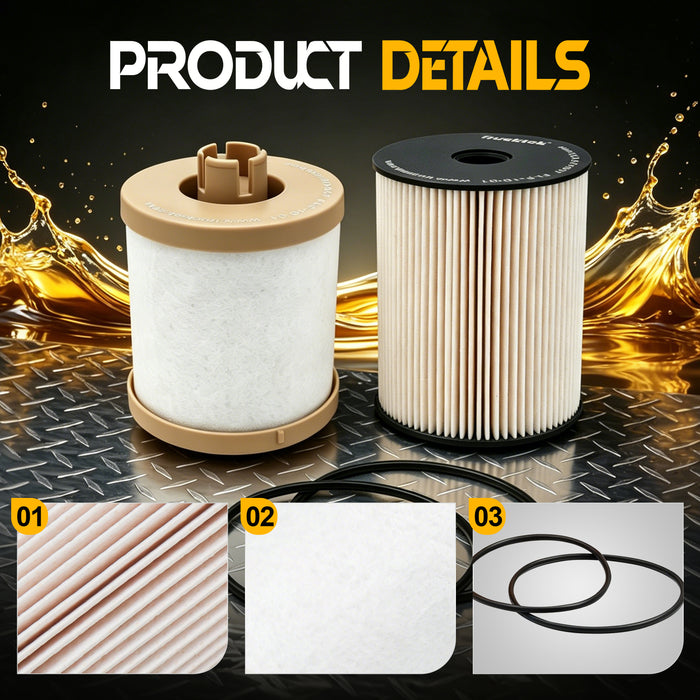
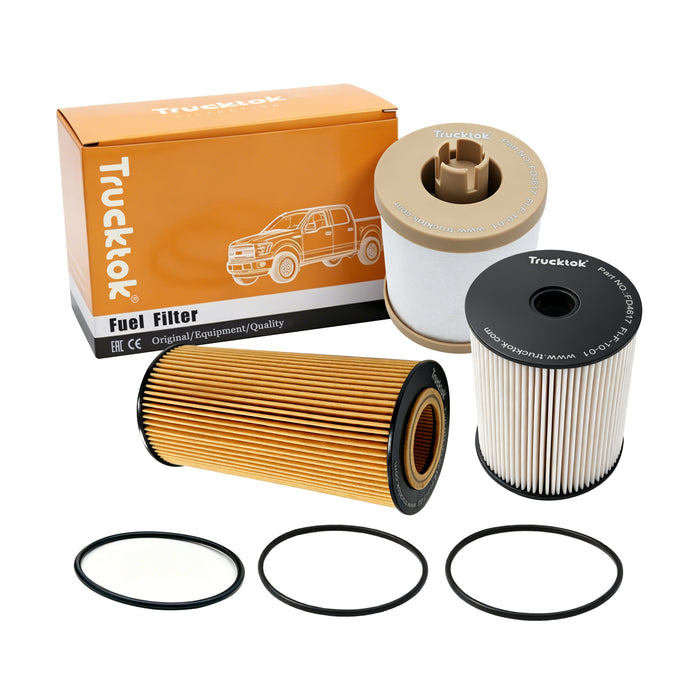
Complete three-filter coverage in one box: Includes the dual-stage fuel filter set (HFCM primary water separator + engine-bay secondary fine-filtration cartridge) AND the high-capacity engine oil filter. No hunting for separate part numbers. No discovering mid-job that the filter you bought doesn’t match your cap.
-
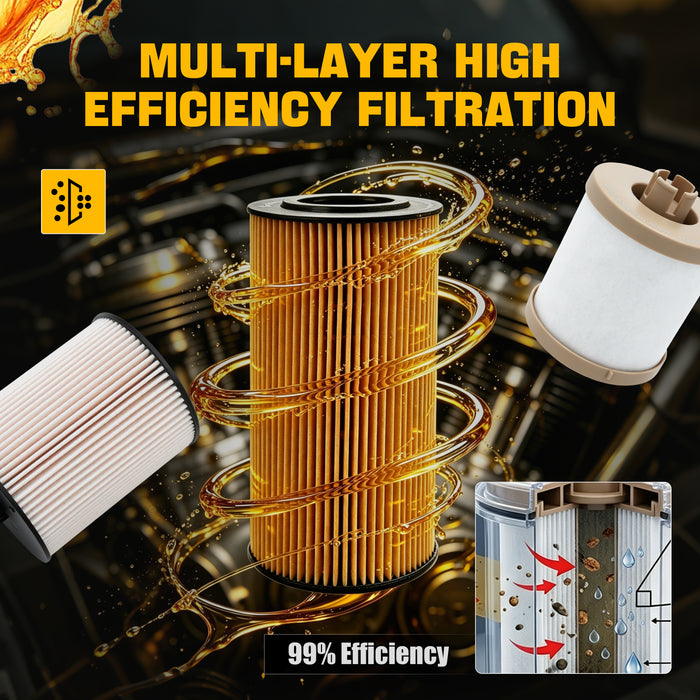
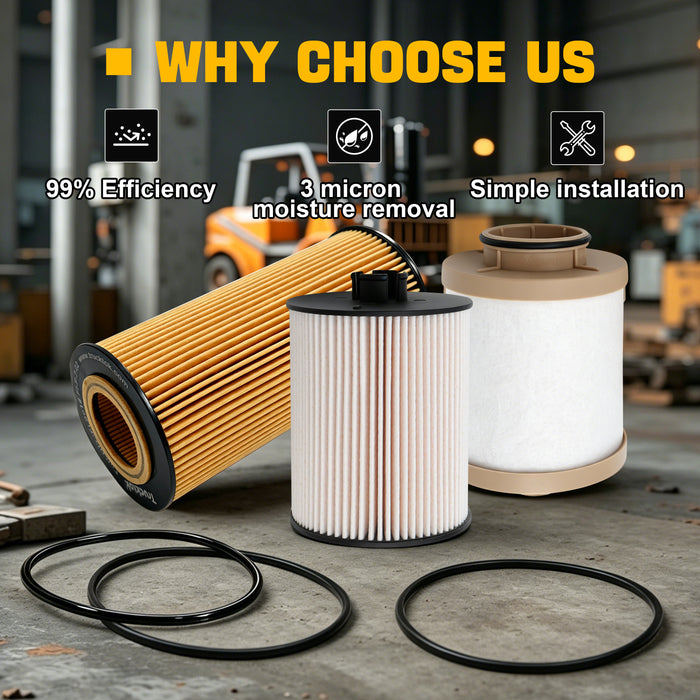
Fuel filters — 98% water separation with multi-layer melt-blown media: The primary filter strips emulsified water and abrasive particles down to 10 microns before fuel reaches the lift pump. The secondary filter provides a final 5-micron pass immediately before the K16 high-pressure pump inlet.
-
Oil filter — 99% filtration efficiency to 25 microns with high-capacity synthetic media: Designed to handle the 6.4L’s elevated soot load from EGR recirculation without restricting flow. The deep-pleated element provides maximum surface area in the factory housing dimensions. The bottom seal geometry matches the factory standpipe and drain valve interface — no “Do Not Reuse Cap” conversion required.
-
OEM cross-references — Fuel: FD4617, 8C3Z9N184A, 8C3Z9N184C, PF7934, FK48002, CS10263, L4609F, 1848522C93, 33950. Oil: FL2016, 3C3Z-6731AA, 1840752C91, PF1704, P7235, CH9549, 57311, P550528, LF16166, ML1034.
If your air filter is due as well, step up to the 3-in-1 Fuel + Oil + Air Filter Kit — same fuel and oil filters plus the FA1886 air filter, all in one shipment. Not sure which kit configuration fits your maintenance schedule? Our full 2008–2010 6.4L filter kit buyer’s guide breaks down every part number and fitment decision before you order.
Installation — Combined Oil Change and Fuel Filter Replacement
This procedure integrates the 6.4L oil change with the dual fuel filter replacement into one workflow. Expect about one hour for a first-timer, 35-45 minutes with experience.
Tools needed:
- 36mm socket (same socket does the oil filter cap AND both fuel filter caps)
- 3/8" ratchet with short and long extensions
- 19mm socket or wrench (oil pan drain plug)
- Drain pan with 18-20 quart minimum capacity (6.4L oil level may be higher than 15 quarts due to fuel dilution)
- Flathead screwdriver or pick tool (for removing old O-rings)
- Brake parts cleaner
- Rags or paper towels
- Rubber gloves (diesel penetrates skin and doesn’t wash off easily)
- Drain hose and collection bottle (for HFCM water separator drain)
- Funnel
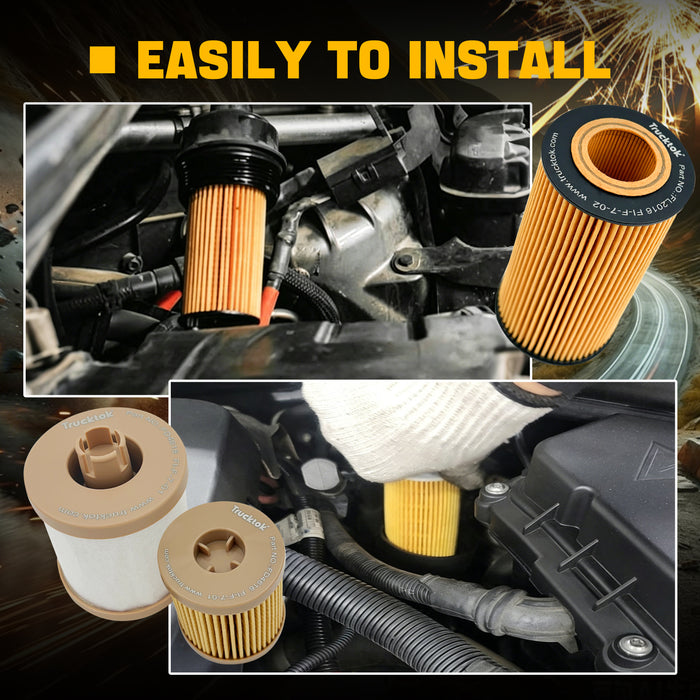
Step 1: Remove the Oil Filter First
On a 6.4L with a top-mounted cartridge filter, approximately one quart of dirty oil is trapped in the filter housing above the drain valve. If you drain the oil pan first and then pull the filter, that quart of dirty oil drains down through the engine and into your fresh oil pan — immediately contaminating the oil you’re about to refill.
-
Remove the oil filter cap first. The oil filter housing is the rounded cap located near the centerline of the engine.
-
With the 36mm socket, crack the cap loose. Pull the cap and filter out together. Let the housing drain. Inspect the standpipe in the center of the housing for cracks — a cracked standpipe will cause low oil pressure. Remove the old O-ring from the cap with a pick tool, clean the cap groove with brake parts cleaner, and install the new O-ring. Lubricate the new O-ring — a thin film of clean engine oil or diesel is sufficient.
-
Snap the new oil filter into the cap. The filter should click into place and not wobble.
-
Pre-fill the oil filter housing. Pour approximately half a quart of fresh oil into the housing before installing the cap. This is the 6.4L’s version of pre-filling the filter — the housing acts as the canister, and pre-filling it means the oil pump doesn’t have to fill an empty housing before building pressure on the first start.
-
Install the cap. The threads should start by hand — do not cross-thread plastic into aluminum. The cap is spring-loaded against the filter; push down while turning to engage the threads. Torque to 18-20 ft-lbs (approximately 25 Nm). Do not overtighten — plastic caps crack, and a cracked cap is a no-start waiting to happen as oil pressure bleeds out.
Step 2: Drain the Oil
With the 19mm socket, remove the oil pan drain plug. Because the 6.4L can accumulate fuel in the oil, the total drain volume may exceed 15 quarts — ensure your drain pan can handle 18-20 quarts. Replace the drain plug and torque to factory spec. Wipe the area clean.
Step 3: Replace Both Fuel Filters
The upper (secondary) fuel filter is the squared-off cap offset on top of the engine.
Remove it with the 36mm socket — fuel will be present in the housing, so have rags ready. Pull the old filter out of the cap (it snaps in), install the new filter, replace the O-ring on the cap, lubricate the O-ring, and reinstall. Torque to 27 Nm (approximately 20 ft-lbs).
The lower (primary) fuel filter is in the HFCM on the driver-side frame rail.
Open the yellow water separator drain lever on the bottom of the HFCM — attach a hose to the nipple and route it into a collection bottle to avoid a diesel shower. Let it drain completely. Use the 36mm socket with a long extension — accessed from behind the skid plate between the brake lines and wiring harness. Crack the cap loose and remove it. Pull the old filter straight out — do not twist or angle it. Install the new filter, replace the O-ring, lubricate, and reinstall. Torque to 25 Nm (approximately 18.5 ft-lbs). Close the drain valve.
Step 4: Refill Engine Oil
The 6.4L takes approximately 15 quarts of 15W-40 diesel engine oil meeting API CJ-4 or higher specification. (In extreme cold climates, 5W-30 may be specified — check your owner’s manual.) Pour approximately 14 quarts, then check the dipstick and top off to the full mark.
Step 5: Bleed the Fuel System
This step is non-negotiable. The low-pressure side of the fuel system is now full of air, and if that air reaches the K16 high-pressure pump during cranking, the pump will cavitate — best case, extended cranking. Worst case, pump damage.
Method 1 (Schrader valve — most reliable): Connect a fuel pressure tester with a drain valve to the Schrader valve on the low-pressure fuel line behind the coolant reservoir.
- Turn the key to ON (do not crank) — the HFCM lift pump runs for approximately 30 seconds. Open the drain valve; air and diesel will sputter out. Close the drain, key OFF, then key ON again. Repeat 3-5 times until the stream is pure diesel with no air bubbles.
- Close the drain, cycle the key 3-4 more times with the drain closed to pressurize the line to the K16 inlet, then remove the tester and cap the Schrader valve.
Method 2 (key cycling — simpler, slightly less thorough): Turn the key to ON for 30 seconds, then OFF. Repeat six times. The lift pump pushes fuel forward and the air eventually works back to the tank through the return circuit. This method works but doesn’t provide visual confirmation that the air is fully purged.
Step 6: Start and Verify
Start the engine. The oil pressure gauge should rise within 2-3 seconds — if it doesn’t register within 5 seconds, shut down and investigate.
- Check for leaks around the oil filter cap, both fuel filter caps, and the HFCM drain valve.
- The oil light may flicker briefly on the first start, particularly if the housing wasn’t pre-filled — this should resolve within seconds.
- Let the engine idle for a minute, shut it down, wait five minutes for the oil to settle, and check the dipstick. Top off as needed.
How Often Should You Change These Filters?
The 6.4L doesn’t give you a “change filter” light. The maintenance intervals are shorter than what most owners expect, and the consequences of stretching them are invisible until they’re catastrophic.
| Filter | Normal Interval | Severe Use Interval | Notes |
|---|---|---|---|
| Oil Filter (FL2016) | 5,000 miles | 3,000 miles | Replace with every oil change. The 6.4L’s EGR soot load and DPF fuel dilution degrade oil faster than a non-emissions diesel. If your dipstick shows the oil level rising, you have fuel dilution — change immediately. |
| Fuel Filters (FD4617 x2) | 15,000 miles | 10,000 miles (7,500 for heavy towing) | Replace both filters together, every time. Never replace just the primary or just the secondary. Drain the HFCM water separator at every other oil change — if the WIF light comes on, drain immediately. |
| Air Filter (FA1886) | 15,000-30,000 miles | Inspect every oil change | A clogged air filter increases exhaust smoke and can trigger more frequent DPF regeneration cycles — which means more fuel dilution in your oil. |
If you bought your 6.4L used and don’t know the filter history, replace all three filters immediately and start tracking from zero. This is cheap insurance. The alternative is discovering at 70 mph that your K16 pump has been running on unfiltered fuel for the last 10,000 miles.
Conclusion
The 6.4L Powerstroke’s reputation as a problem engine isn’t entirely fair — and it’s not entirely wrong. The engine has two genuine design vulnerabilities: a high-pressure fuel pump with zero tolerance for contamination, and an emissions system that actively degrades the engine oil. But both vulnerabilities are addressable with the same tool: regular filter changes with quality media.
The math isn’t complicated. A fuel system replacement following a K16 failure costs $8,000-$12,000. A bottom-end rebuild from oil starvation or bearing wear costs roughly the same. Three filters that prevent both failure modes cost $51.30 and take an hour to install. The filter kit is less than half a percent of the cost of either repair it prevents.
Why TruckTok? Filters That Don’t Wait for a Warning Light
TruckTok is a diesel performance and maintenance parts company built on a simple premise: the 6.4L Powerstroke doesn’t have a “change your filters” warning light, and by the time the symptoms of a clogged filter show up — hard starts, hesitation under load, rising oil level, the oil pressure gauge flickering at idle — the damage to the K16 pump or the engine bearings is already in progress.
Every filter in the F-10-01/7-02 kit is engineered to meet or exceed the OEM filtration specification: the multi-layer melt-blown fuel media strips water and abrasives before they reach the common rail, and the high-capacity synthetic oil media handles the soot load from a working EGR system without restricting flow. The form factors match the factory housings — no cap conversions, no mismatched lengths, no discovery mid-job that the filter you ordered doesn’t seat against the drain valve.
And at $51.30 with free shipping for all three filters and every O-ring in one box, staying on schedule isn’t a decision between maintenance and the mortgage. It’s a decision between a filter change this weekend and a flatbed ride next month.
Frequently Asked Questions
Q1: What’s included in the TruckTok F-10-01/7-02 kit?
The kit contains a complete dual-stage fuel filter set (HFCM primary water separator + engine-bay secondary filter) and a deep-pleated synthetic-media engine oil filter. Every housing cap O-ring is included. One box covers both critical fueling locations and the oil filtration system — three filters, all required seals, one shipment.
Q2: Do I really need to pre-fill the oil filter housing?
Yes. The lab data proves it: a dry filter housing takes 4-5 seconds to build oil pressure on the first start, during which the bearings are rotating with only residual oil film. A pre-filled housing builds pressure instantly. The 6.4L’s cartridge design actually makes pre-filling easier than a spin-on filter — pour half a quart of fresh oil into the housing before installing the cap.
Q3: Can I reuse my old oil filter cap if it says “Do Not Reuse Cap”?
Only if you continue using the same brand and model of aftermarket filter that came with it. That cap is designed for a taller-than-stock filter. If you want to switch back to OEM-spec filters (including the TruckTok kit), you must replace the cap with an OEM Motorcraft cap. Using a standard-length filter with a tall aftermarket cap leaves the filter unseated — the drain valve stays open, oil drains back on shutdown, and every start is a dry start.
Q4: What’s the difference between the oil filter cap and the fuel filter cap on a 6.4L?
The oil filter cap is rounded and sits approximately on the engine centerline. The fuel filter cap is more squared-off and sits offset toward the driver’s side, near the degas bottle. They both use a 36mm socket. Do not confuse them — the filters inside are different sizes, different part numbers, and not interchangeable.
Q5: Why does the fuel filter need a bleed hole?
Without the bleed hole, air trapped at the top of the fuel filter housing prevents fuel from contacting the upper portion of the filter media. The filter only uses the bottom half of its capacity. When you remove a filter that was run without a bleed hole, you’ll see the bottom third is black while the top two-thirds look unused. This means the filter clogs in half the time and the K16 pump sees unfiltered fuel sooner.
Q6: How do I know if my 6.4L oil has fuel dilution?
Check the dipstick before draining. If the oil level is above the full mark — and you didn’t overfill it — diesel is entering the crankcase. The oil may also smell like diesel fuel and feel thinner than expected between your fingers. Fuel dilution on a 6.4L is most commonly caused by incomplete DPF regeneration cycles (short trips that don’t allow the regen to finish). Change the oil immediately if you suspect dilution, and consider shortening your oil change interval.
Q7: How does the TruckTok filter kit compare to buying Motorcraft individually?
The TruckTok filters are engineered to meet OEM specifications for micron ratings, media surface area, housing fit, and seal geometry. The fuel filters include the bleed hole, alignment tab, and water-separating outer layer that match the factory filtration path. The oil filter uses the standard-length OEM form factor — no “Do Not Reuse Cap” conversion, no mismatched cap-and-filter combinations. The consolidated kit ships all three filters and all O-rings in one box with free shipping.
Q8: Can I change just the oil filter without touching the fuel filters?
Yes, and you should — the oil filter gets changed with every oil change (3,000-5,000 miles), while the fuel filters are on a longer interval (10,000-15,000 miles). But when the fuel filter interval arrives, replace both fuel filters together. Never replace just the primary or just the secondary — they work as a staged pair.
Q9: What happens if I get air in the K16 high-pressure pump during bleeding?
You’ll have a no-start condition that extended cranking won’t fix, and extended cranking pushes more air through the pump — compounding the damage. If air reaches the high-pressure side, you’ll need a scan tool capable of commanding the injectors open for a high-pressure purge cycle. This is why the low-pressure bleeding procedure before the first crank is mandatory. The six-key-cycle method prevents this entirely.
Q10: What API oil rating does the 6.4L require?
API CJ-4 or higher. The “C” stands for compression ignition (diesel). Gasoline oils use an “S” rating (spark ignition) — do not use gasoline-rated oil in a 6.4L. CJ-4 was the specification when the 6.4L was new; newer ratings like CK-4 are backward-compatible and acceptable. Most 15W-40 diesel oils on the shelf meet this specification, but verify before you pour.
This guide is for informational purposes only. All maintenance procedures should be performed in accordance with the vehicle manufacturer’s specifications. The high-pressure common-rail fuel system operates at pressures that can cause serious injury — do not attempt high-pressure fuel system repairs without proper training and equipment. Always use jack stands on level ground when working under a vehicle.