
Home > News > L5P EGR Delete First? The Order That Clogs DPF Faster

L5P EGR Delete First? The Order That Clogs DPF Faster
If you’re deleting a 2017–2023 L5P Duramax on a budget and trying to figure out which half to do first, here’s the straight answer: don’t delete the EGR first. Deleting the EGR while the DPF stays in place is the one sequence that actively makes the DPF clog faster — and it’s the mistake a surprising number of first-time owners make because “EGR first” sounds cheaper and simpler.
The correct order is exhaust first (DPF/SCR out), or both at once. Do the EGR by itself and you leave a filter in the exhaust that now has no way to clean itself. Here’s exactly why, and how to spot the damage if you’re already down that path.
Why Order Matters: EGR and DPF Are One Calibrated System
The first thing to unlearn is the idea that EGR and DPF are two independent parts you can remove in any order. They’re not. The factory ECM runs them as a single aftertreatment strategy, tied together by airflow, temperature, pressure, and soot-load calculations.
-
The EGR routes exhaust back into the intake to lower combustion temperature and cut NOx. It trades a dirtier intake for lower NOx.
-
The DPF traps soot downstream and burns it off during regeneration. It trades exhaust restriction for lower particulate matter.
Pull one out and leave the other, and the ECM is now running a calibration built for a system that no longer exists. That mismatch — not some simple “more soot” story — is what clogs the DPF faster.
What Actually Happens When You Delete EGR First
This is the sequence nobody warns you about, and it has two layers.
Layer One: The Soot Keeps Coming, but the Regen Is Gone
When you delete (or even just tune out) the EGR, the DPF is still sitting in the exhaust, and it’s still receiving soot. But here’s the catch: the regeneration strategy that used to burn that soot off has now been disabled or thrown out of sync. The result is a filter that loads up and never gets cleaned.
As one master tech put it bluntly, “the DPF will plug its face off.” A filter that used to burn itself clean every few hundred miles is now just accumulating — and on a high-mileage L5P, the ash that was already in there compounds the problem.
Layer Two: The Calibration Drift (The Real Culprit)
The deeper issue is that an EGR delete doesn’t always physically create more soot — what it does is break the ECM’s soot model.
The ECM estimates soot load using a stack of inputs: MAF airflow, MAP boost, EGT, NOx feedback, differential pressure, and regen history. When the EGR is gone but the calibration still expects EGR flow, the airflow numbers stop lining up. The computer can then:
- Command regen too late or too often
- Misread the actual soot load
- Fail to reach the temperature window needed for a clean burn
What starts as a data problem becomes a physical restriction. The filter isn’t necessarily dirtier — the truck just stopped managing it correctly.
The Codes That Give It Away
If you (or the previous owner) deleted the EGR first and left the DPF, the dashboard tells the story. These are the codes to look for:
| Code | Meaning | What It Signals |
|---|---|---|
| P2463 | DPF soot accumulation excessive | The filter is loading and not getting cleaned |
| P242F | Ash accumulation / restriction | Long-term mineral buildup; regen can’t fix it |
| P2002 | DPF efficiency below threshold | Filter substrate compromised or badly loaded |
| P0101 / P0106 | MAF / MAP plausibility | The airflow model no longer trusts itself — the fingerprint of a calibration that doesn’t match the hardware |
That last pair — P0101 and P0106 — is the tell. When you see airflow plausibility codes alongside a soot code, the root cause usually isn’t the filter at all. It’s the ECM running factory logic against deleted hardware.
What Happens When You Delete the DPF First
Flip the order and the picture changes — but it’s not a clean win either. Deleting the DPF first is the better half-step, which is why it’s the default recommendation. Here’s what actually happens, good and bad.
The Immediate Gains Are Real
Remove the DPF/SCR section and the biggest restriction in the exhaust is gone:
-
Backpressure drops, so the VGT turbo spools faster and throttle response sharpens.
-
EGTs fall under load, which is the single biggest reliability win on a truck that tows hard.
-
Regen cycles stop. No more post-injection fuel dumps, no more interrupted pulls, no more fuel dilution in the oil.
-
Fuel economy recovers, because the truck is no longer burning diesel just to clean a filter.
This is the “80% of the benefit for a fraction of the cost” move — a race pipe is the cheapest delete option, and it delivers the most noticeable seat-of-the-pants change.
But the EGR Side Is Still Working Against You
The catch is that deleting the DPF solves the exhaust side and leaves the intake side untouched:
-
The EGR is still recirculating soot into the intake. The intake manifold, valves, and throttle body keep collecting carbon. The soot plus the oil vapor from the CCV keeps turning into the sticky sludge that clogs the intake tract.
-
The EGR cooler is still in there. That’s the failure point that cracks and dumps coolant into the intake. Deleting the DPF doesn’t touch it.
-
You still need a staged tune. The EGR has to be shut off in software while the hardware stays put, which means a calibration that accounts for the DPF being gone and the EGR being present. It’s a specific configuration, and not every tuner builds for it cleanly.
In short:
The DPF-first is a staging move, not a finish. It gets you most of the power and reliability gains immediately, but it leaves the intake side dirty and leaves a known failure point (the cooler) still installed. That’s fine as a budget step — as long as you understand it’s half a job, and the EGR side still needs to come out eventually.
Why Deleting Both at Once Is the Smart Move
The honest recommendation for an L5P is simple: do both at once. Here’s why the combined job beats any staged sequence, even a “correct” one.
-
One tune, not two. On the L5P, the locked ECM is the most expensive line item. Paying for a second calibration later — on a truck that already had its airflow model changed once — is throwing money away. A single unified tune covers the exhaust, the EGR, and the CAN bus terminations in one pass.
-
One teardown, not two. The intake and exhaust both come apart through the same real estate — the Y-bridge comes off, the turbo area is open, the downpipe is accessible. Doing it once is dramatically cheaper in labor and downtime than opening the same area twice, weeks apart.
-
No half-finished system left to misbehave. The whole problem this article is about — a system where one part is deleted and the other is still running factory logic — disappears when you remove both sides at the same time.
-
The CAN bus plugs get handled correctly. The L5P needs its J1939 network terminated for the removed NOx and DEF sensors. That’s a natural part of the combined job, not an afterthought you bolt on later.
-
Cleaner air in, freer exhaust out, at the same time. The intake stops getting soot at the same moment the exhaust stops holding it. The engine cools down across the board instead of half of it improving while the other half still fights.
If the budget allows it and the truck is headed off-road anyway, “both at once” is the cheapest-per-mile, lowest-headache answer.
When It’s OK to Delete One First
Not everyone can drop the full budget at once, and there are a couple of legitimate cases for staging the job. The rule that keeps either case safe is the same: your tuner has to know the other system is still in place and build the calibration around it.
When DPF-First Makes Sense
This is the default if you have to split the job.
-
You’re chasing the biggest immediate gain. The DPF is the main exhaust restriction. Removing it first gives you faster spool, lower EGTs under load, and the end of regen interruptions — the most noticeable seat-of-the-pants change.
-
You’re on a tight budget. A race pipe is the cheapest exhaust option, and it removes the restriction without leaving a filter waiting to clog.
-
The EGR cooler is still healthy. If the cooler isn’t leaking and isn’t causing intake sludge problems yet, you can leave it in place for a while — the tune simply shuts the EGR valve off while the hardware stays put.
The catch to remember: leaving the EGR cooler installed means that failure point is still there. It can still crack and dump coolant later. DPF-first is a staging choice, not a permanent one — plan to finish the EGR side.
When EGR-First Makes Sense
There’s really only one scenario where EGR-first is the right call, and it’s not about saving money:
- The EGR cooler is already leaking coolant. If coolant is disappearing, or you’re getting white smoke and the telltale sweet smell, the cooler is on its way to hydrolocking the engine. That’s an immediate, expensive failure — you address it now, before it takes out the whole motor.
Even then, the warning applies harder than anywhere else: your tuner must build a staged calibration that accounts for the DPF still being in the exhaust. Skip that, and you’ve traded a coolant leak for the Layer Two calibration-drift problem — the DPF will start loading and misbehaving within months.
What “Just Tuning It Out” Doesn’t Solve
A related shortcut is to leave all the hardware in place and only tune the systems off. That works — for a while. But the EGR cooler is still there, still prone to cracking and dumping coolant. The DPF is still in the exhaust, still able to face-plug. Tuning it out without physically removing it is a temporary fix with the same failure points still installed.
The Product: One Kit That Does It in the Right Order
This is why a combined kit makes the sequencing question disappear. Instead of buying an EGR kit now and a DPF pipe later — and paying for two tunes and two teardowns — you delete the exhaust and the EGR in a single pass.
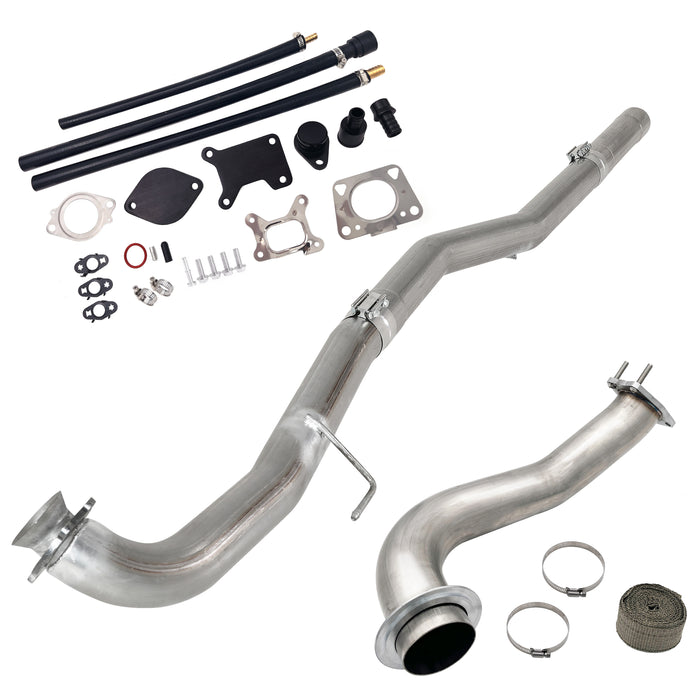
The 2017–2023 6.6L Duramax L5P 4" DPF Pipe, 3.5" Downpipe & EGR Delete Kit covers the whole job in one box:
- 4" mandrel-bent DPF/SCR pipe replaces the restrictive emissions canisters, ending regen and dropping EGTs.
- 3.5" high-flow downpipe clears the restrictive bend right off the turbo, so the VGT spools noticeably faster.
- Full EGR valve and cooler delete removes the soot source and the coolant-leak failure point at the same time.
Fitment is 2017–2023 Silverado/Sierra 2500HD and 3500HD L5P — not Cab & Chassis. As always on this platform, a delete tune is mandatory; the hardware without a calibration throws codes and drops the truck into limp mode.
Conclusion:
Deleting the EGR first is the order that clogs the DPF faster — not because you’re making more soot, but because you’re leaving a filter in the exhaust that no longer has a functioning regen strategy, and an ECM whose soot model no longer matches reality.
Delete the exhaust first, or delete both at once. That’s the sequence that keeps the truck clean, keeps the codes away, and stops you from paying for a second tune and a second teardown six months down the road. And if you’re already seeing P0101 or P0106 alongside a soot code after an EGR-first delete, the answer isn’t a new DPF — it’s finishing the job the way it should have been done in the first place.
For the full L5P lineup — combined DPF pipe, 3.5" downpipe, and EGR delete kits built specifically for the 2017–2023 Duramax, plus the CAN bus plug kits, EGR deletes, and tuners that complete the job — head to TruckTok. Every kit is engineered for the L5P’s locked-ECM and dual-emissions layout, ships free, and is backed by fitment guidance for your exact cab and bed configuration, so you’re never paying for a calibration twice.
Relate Blogs:
-
L5P Duramax EGR Delete: How to Beat a $2,500 Cooler Repair
- L5P DPF & CAT Race Pipe vs Full Exhaust Delete — the Honest Comparison
- L5P Duramax Delete Install: The ECM Unlock You Can’t Skip
Legal Notice: Removing or tampering with emissions-control equipment may violate the federal Clean Air Act and state emissions regulations. Penalties can include fines up to $5,911 for individuals. This content is for off-road, race, and competition use only. Check your local and state laws before modifying emissions equipment on any vehicle driven on public roads.
Frequently Asked Questions
Q1: Can I delete the EGR and keep the DPF?
Technically yes, but it’s the one combination that clogs the DPF faster. Without the regen strategy properly recalibrated, the filter loads up and never gets cleaned. If you must, your tuner has to build a staged calibration specifically for it.
Q2: Which is harder to install — EGR or DPF delete?
The EGR is usually the harder of the two on the L5P. The DPF/SCR section comes out relatively cleanly, while the EGR cooler sits buried and requires coolant line rerouting.
Q3: Can I just tune out the EGR and DPF without removing hardware?
You can, but the failure points stay installed. The EGR cooler can still crack and leak coolant, and the DPF can still face-plug. It works short-term but isn’t a real fix.
Q4: Why does my truck regen more often after an EGR delete?
Because the soot-load calculation and airflow model no longer match the hardware. The ECM commands regen at the wrong times, or can’t hit the temperature window needed to finish it.
Q5: What does P0101 or P0106 mean after a delete?
Those are MAF/MAP plausibility codes. They mean the ECM no longer trusts its airflow model — a sign the calibration wasn’t properly adjusted for the deleted EGR, not a hardware failure on the sensor itself.
Q6: Do I need to delete both to see power gains?
The power comes from the tune, not the hardware. But deleting both — with one unified calibration — gives the tune the cleanest map to work from, and avoids the drivability problems of a half-finished system.
Q7: Is the DPF delete legal for street use?
No. Removing emissions equipment from a road-driven truck violates the Clean Air Act and can carry fines. These parts are for off-road, race, or competition use only.
Q8: What’s the cheapest way to start if I’m on a budget?
If you can only afford one step, delete the exhaust first (a race pipe is the cheapest exhaust option). It removes the biggest restriction and doesn’t leave a filter waiting to clog. Save the EGR for when you can do the full job.