
Home > News > 1986-1995 Ford EGR Delete: Stop the Check Engine Light
The Real-life Case

1986-1995 Ford EGR Delete: Stop the Check Engine Light
Here’s the thing most guides skip: deleting the EGR on an OBS Ford is two separate jobs. The block-off plate seals the hole in the intake manifold — that’s the easy half. The simulator fools the engine computer into thinking the EGR is still there — that’s the half that actually turns off the check engine light. Do only the first and you’ve traded a running problem for a glowing dash light. Do both and the light stays off. This guide walks through both, plus the one thing to check before you buy anything.
Disclaimer: Removing or tampering with emissions equipment may violate the federal Clean Air Act and state regulations. These kits are sold for off-road, show, and competition use only. Check your local and state laws before modifying any emissions component.
What the EGR Does on These Trucks — and Why It Always Fails
The Exhaust Gas Recirculation system routes a small amount of exhaust back into the intake to lower combustion temperature and cut NOx emissions. On paper it’s clever. On a 30–40-year-old Ford, it’s the source of a lot of grief.
-
Carbon clogs the valve and passages. Decades of soot build up inside the EGR valve and the intake runners until the valve sticks — either open (rough idle, hesitation, stalling) or closed (which sets the code).
-
Vacuum lines turn brittle and crack. The EGR is vacuum-operated, and the rubber lines that feed it are the first things to fail on a truck this old. One cracked line anywhere in the vacuum network throws the whole system off.
-
The EVP sensor quits reading. The EGR Valve Position sensor sits on top of the valve and reports its position to the computer. When the valve or the sensor stops moving, the EEC-IV computer flags it.
The codes you’ll see on these OBD-I trucks are two- and three-digit Ford codes — not the OBD-II P-codes. The EGR-related ones are 31, 33, 34, and 332. If a guide or scan tool tries to hand you a P0401, it’s reading the wrong generation.
First, Diagnose: A 332 Code Is Not Always a Bad Valve
Before you rip the EGR out, here’s the honest truth that saves owners money: a 332 code often has nothing to do with a broken EGR valve.
The Real-life Case
One how-to video chased a 332 on a 1994 F-150 and found the real culprit was a cracked vacuum line hidden under the heat shield near the evap canister. The EGR valve never got the vacuum signal to open, so the computer read “no EGR flow” and set the code. The fix was a $2 vacuum-line splice — not a $80 valve, not a delete kit.
A Second Quirk of These Trucks
Most auto-parts-store code readers can’t pull OBD-I codes reliably. They often come back “no codes” even when the light is on. The reliable method is reading the flashes on the check engine light itself — that’s how the owner found the 332. So before you spend money, read the actual code and chase the vacuum first.
The point: deleting the EGR is a legitimate fix for a genuinely failed system, but it’s not a shortcut around diagnosis. A cracked vacuum line is cheaper than a kit, and it keeps the truck closer to stock.
The Three Ways to Delete
There are three distinct approaches, and they differ in both hardware and outcome:
| Method | What It Includes | Check Engine Light | Rough Cost | Best For |
|---|---|---|---|---|
| Block-off plate only | Plate + gasket + bolts | ⚠️ Stays on | ~$15–25 | Already-tuned trucks, pure race rigs |
| Delete kit | Plate + hardware, no simulator | ⚠️ Stays on | ~$50–60 | Custom-tuned trucks (tuner disables EGR) |
| Simulator / eliminator kit | Plate + electronic simulator | ✅ Stays off | ~$60–80 | Daily drivers, trucks in emissions-test states |
The difference between “delete kit” and “simulator kit” is the electronic module. If your truck has a custom ECU tune that already disables EGR monitoring, the plain delete kit is enough — the tuner handles the light. But most OBS Fords don’t have custom tunes, and that’s exactly when the simulator kit is the right call, because it’s the only plug-and-play way to keep the light off without a tuner.
The Two Halves of a Delete: Physical and Electrical
Once you’ve confirmed the EGR itself is the problem and you want it gone, understand that “delete” means two things working together.
The Physical Half — The Block-off Plate
The EGR valve bolts to the intake manifold, and an EGR tube runs down to the exhaust manifold (or crossover). When you remove the valve, you’re left with an open port. A block-off plate seals it so you don’t have a vacuum leak. On engines where the EGR tube connects at the exhaust, you cap or plug that port too. This is pure hardware — a flat plate, a gasket, and bolts.
The Electrical Half — The Simulator
The EEC-IV computer runs a self-test that checks for the EVP (EGR Valve Position) sensor signal. Remove the valve and that signal goes missing, so the computer lights the check engine light and stores a code. The simulator is a small plug-in module that connects to the factory 3-pin EVP harness and sends back a fixed “valve is closed and working” voltage signal. The computer is satisfied, the light stays off, and there’s no cutting or splicing.
That’s why the title of this article isn’t “how to remove the EGR” — it’s “how to stop the check engine light.” The plate is the easy part; the simulator is what finishes the job.
What Happens If You Do Only Half
Because the plate and the simulator solve two different problems, doing just one leaves the other problem wide open. Here’s the breakdown, in both directions.
Simulator Without a Block-Off Plate
If you install the simulator but skip the plate, you’ve fooled the computer — but not the engine.
-
The check engine light stays off, because the module is feeding the EEC-IV a clean EVP signal.
-
But the physical side is still broken. If you removed the EGR valve and left the intake port open, you now have a vacuum leak: rough idle, possible stalling, and a skewed air-fuel ratio. If you left the old valve in place and it’s stuck open, it keeps dumping exhaust into the intake, and the rough idle it was causing never goes away.
-
The simulator only tells the computer “everything’s fine” — it can’t plug a hole or un-stick a valve. It deceives the electronics, not the vacuum.
In short: a simulator without a plate keeps the light off while the actual problem continues under the hood.
The Simulator Alone
If you’ve already got a plate installed (or made your own) and the only thing left is that stubborn check engine light, this EGR Simulator Eliminator Delete is the piece you’re missing. It’s the electrical half of the delete, sold by itself.
- What it does: it’s a direct plug-and-play harness bridge. It connects to the factory 3-pin EVP (EGR Valve Position) sensor harness and sends back a fixed closed-position voltage signal, convincing the EEC-IV computer that the EGR valve is still installed and working. That clears the stored 31, 33, and 34 codes and keeps the light off.
- No cutting, no splicing, no tuning. It uses the factory locking connector and is built for under-hood heat, so it’s a ten-second install instead of a soldering job.
- Fitment: covers the 2.8L V6, 4.9L inline-six, 5.0L and 5.8L small-block V8s, and 7.5L big block in the 1986–1995 F-150, F-250, and Bronco — plus the Mustang 5.0L and 2.3L. It fits any of these trucks equipped with the Ford EEC-IV (OBD-I) computer and a 3-pin EVP plug.
Block-Off Plate Without a Simulator
Flip it around and install the plate but skip the simulator, and the opposite happens.
-
The port is sealed — no vacuum leak, no exhaust getting into the intake. The physical problem is solved.
-
But the computer now knows something’s missing. The EEC-IV self-test looks for the EVP sensor signal, finds nothing, and lights the check engine light with a stored 31, 33, or 34 code.
-
On a truck in an OBD-inspection state, that single light is enough to fail you — even though the engine runs fine.
In short: a plate without a simulator fixes the engine but leaves the dash glowing.
The Takeaway
Neither half is optional if you want both the problem gone and the light off. The plate solves the mechanical side; the simulator solves the diagnostic side. It’s only when both are in place that you get a clean-running engine and a dark dashboard.
The Complete Kit: Simulator + Block-Off Plate
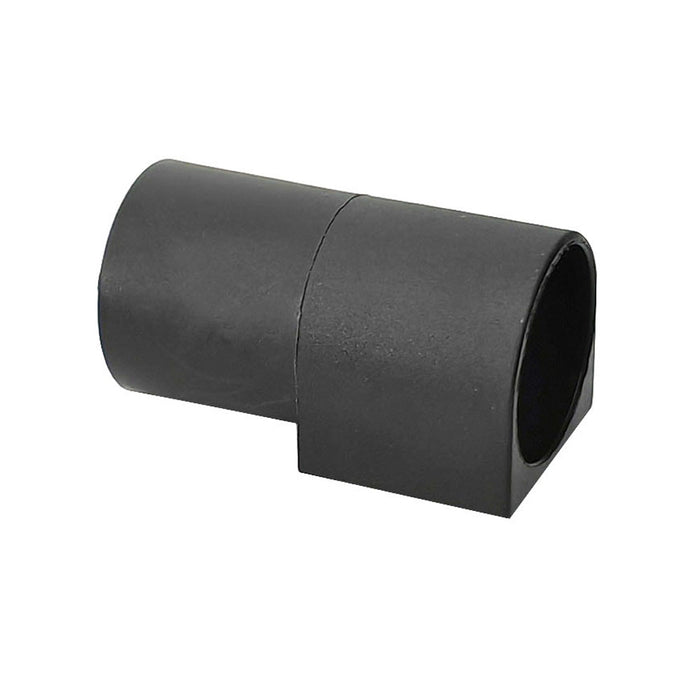
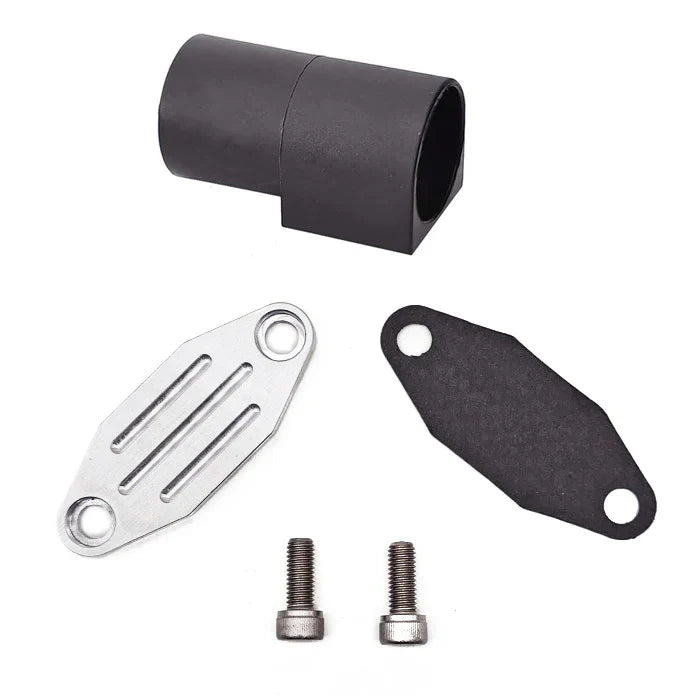
If you’re deleting the EGR for the first time and want it done in one order with no warning light, this EGR Simulator Eliminator/Block Off Plate is the kit to get. It bundles both halves of the job — the physical plate and the electrical simulator — so you don’t end up with a sealed port and a glowing dash.
- The block-off plate is precision CNC-machined from aircraft-grade 6061-T6 billet aluminum. The T6 tempering and the plate thickness are the whole point: this one stays flat under clamping force and seals against the intake manifold for good.
- The simulator plugs into the factory 3-pin EVP harness and sends the computer a fixed “valve closed, all normal” signal, so the check engine light stays off without any tuning, cutting, or splicing.
- What’s in the box: the plate, gasket, stainless steel hardware, and the simulator module.
- Fitment: 1986–1995 Ford F-150, F-250, F-350, and Mustang — but remember to measure your baffle’s bolt spacing before ordering, since it varied across years and engines.
The short version: starting from scratch, get the complete kit and cover both halves in one shot. Already have the port sealed and only fighting the light? The standalone simulator is all you need.
A Word on Fitment: Measure Before You Order
These trucks had variations across years and engines, and the bolt spacing on the EGR mount changed at certain points. More than one owner has bought an eBay plate, found the holes didn’t line up, and had to drill a new hole to make it fit — which defeats the point of a “precision” plate.
The product listing for a proper kit tells you to measure the pitch (bolt spacing) of your baffle before ordering. Do it. And remember: “1986–1995 Ford” does not mean every engine uses the same plate. The 4.9L inline-six, the 5.0L/5.8L small-blocks, and the 7.5L big block are different engines with different mounting patterns. Match the plate to your exact engine, not just your truck.
The 75-Ohm Resistor Trick vs. a Real Simulator
You’ll see a DIY alternative floating around forums: solder a 75-ohm resistor across the connector pins for the EGR, TAD, and TAB solenoids. This is the same principle as a simulator — it gives the computer a fixed resistance so it doesn’t flag an open circuit. A resistor fakes it for about a dollar.
The trade-off is real and worth stating plainly:
- The resistor trick is cheap — a few dollars for a pack — and works for people comfortable soldering under the hood. But it’s a hack: exposed resistors, heat-shrink, and the risk of a loose joint rattling out later.
- A purpose-built simulator is sealed and plug-and-play. It uses the factory locking connector, is built for under-hood heat, and installs in seconds with no soldering, no cutting, no guessing at the correct resistance value.
Both achieve the same electrical result. The question is whether you want to solder resistors into 30-year-old wiring or plug in a sealed module. For a daily driver you care about, the simulator is the cleaner, more reliable path.
Install Step by Step
Installing the full plate-plus-simulator kit is a 60–90 minute job with basic hand tools. Here’s the sequence.
Tools: 13mm (and often 10mm) sockets, flathead screwdriver, penetrating oil (PB Blaster), gasket scraper or razor blade, shop rags.
Step 0 — soak it a week ahead. These bolts have been heat-cycled for three decades. Soak the EGR valve bolts, the EGR tube fitting, and any exhaust-side fitting with penetrating oil and let it sit. Guys who skip this snap bolts off in the intake or the head — that’s a manifold or head repair, not a delete.
Step 1 — disconnect the battery. Negative terminal off. This prevents shorts and resets the computer, which you want after the install.
Step 2 — locate the EGR valve. On the 5.0L and 5.8L V8 it’s on the passenger side of the intake near the throttle body. On the 4.9L inline-six it’s on the driver’s side between runners 3 and 4. On the 7.5L big block it’s at the front of the intake plenum near the distributor.
Step 3 — remove the EGR valve and tube. Disconnect the vacuum line, unplug the EVP sensor connector, and remove the two bolts holding the valve. If the tube runs down to the exhaust manifold or crossover, break it loose — if it’s rusted solid, cut it rather than snap a fitting in the manifold.
Step 4 — clean the mounting surface. Scrape every bit of old gasket material off the intake. Any leftover means a vacuum leak, and a vacuum leak on an OBS Ford is a new problem you just created.
Step 5 — bolt on the block-off plate. Use the included gasket (or a thin bead of high-temp RTV) and the stainless bolts. Torque to about 12–15 ft-lbs — snug is enough. Over-tightening strips the soft aluminum intake threads.
Step 6 — cap the exhaust-side port. If the kit includes a cap for the exhaust manifold or crossover, install it with anti-seize on the threads.
Step 7 — plug in the simulator. Connect the simulator module to the factory 3-pin EVP harness. Mount it somewhere cool and away from the exhaust, using zip ties or the bracket. This is the step that turns the light off.
Step 8 — reconnect and test. Battery back on, start it, let it idle for 5–10 minutes while you watch for vacuum leaks. Take a test drive. With the simulator, the light stays off; with a plate-only kit, expect it on (and understand that’s expected, not a defect).
The Bottom Line
On an OBS Ford, the EGR system is usually more trouble than it’s worth — but that doesn’t mean you should rip it out the moment a code appears. Diagnose first: a 332 is often a $2 vacuum leak, not a dead valve.
When the EGR genuinely has to go, remember it’s two jobs. The block-off plate seals the port; the simulator is what actually turns off the check engine light by faking the EVP signal the EEC-IV computer wants to see. Skip the simulator and you’ve just traded one problem for a glowing dash light.
For the full lineup of OBS Ford EGR delete and simulator kits, head to TruckTok.com.
Related Blogs
- How to Clean Up Your 1983-1997 Ford Truck's Engine Bay After Removing the EGR System
-
What Happens When the EGR System Fails on a 1986-1995 Ford Truck?
- 1986-1995 Ford F150 EGR Delete: Simulator & Block-Off Plate Guide
Frequently Asked Questions
Q: Will deleting the EGR turn on my check engine light?
A: A plate alone will, yes. The EEC-IV computer runs a self-test that looks for the EVP sensor signal, and without it the light comes on. The fix is a simulator module that plugs into the 3-pin EVP harness and sends back a “valve closed, all normal” signal — that’s what keeps the light off.
Q: What codes does a bad EGR set on an OBS Ford?
A: These are OBD-I trucks, so the codes are Ford’s two- and three-digit numbers, not P-codes. The EGR-related ones are 31, 33, 34, and 332. If a reader gives you a P0401, it’s the wrong-generation tool.
Q: Does a 332 code mean my EGR valve is bad?
A: Not necessarily. A 332 means insufficient EGR flow, which is often caused by a cracked vacuum line rather than a failed valve. Chase the vacuum network first — a $2 splice fixes more 332s than a new valve does.
Q: Does an EGR delete add horsepower?
A: No. The EGR is closed at wide-open throttle, so peak power is unchanged. What you gain is smoother idle and part-throttle response, a cleaner engine bay, and one less system to fail — not dyno numbers.
Q: What’s the difference between a delete kit and a simulator kit?
A: A delete kit has the block-off plate and hardware but no electronic module, so the light stays on unless you have a custom tune. A simulator kit adds the plug-in module that fakes the EVP signal, keeping the light off without any tuning.
Q: Can I just use a 75-ohm resistor instead of a simulator?
A: Yes, that’s the DIY equivalent — the resistor fakes the solenoid load the computer expects. It works and costs pennies, but it’s a soldering hack with exposed wiring. A sealed, plug-and-play simulator does the same thing more reliably and installs in seconds.
Q: Is the EGR delete reversible?
A: Yes. The plate bolts on using the factory mounting points, so you can unbolt it and reinstall a stock EGR valve, gasket, and vacuum lines for an inspection or sale. No cutting, welding, or permanent modification required.
Q: Which engines do these kits fit?
A: The 2.8L V6, 4.9L inline-six, 5.0L and 5.8L small-block V8s, and 7.5L big block — plus the Mustang 5.0L/2.3L. But fitment is by engine, not just truck name, and bolt spacing changed across years, so measure your baffle before ordering.
Q: Is an EGR delete legal for street use?
A: No. Removing or disabling emissions equipment on a road-driven vehicle violates the federal Clean Air Act, and a missing EGR valve fails visual inspections in states like California, New York, and Colorado. These kits are for off-road, show, and competition use — check your local laws.
Q: Why is my idle higher after the delete?
A: A slightly higher idle is common and usually harmless, but first check for a vacuum leak at the plate or an uncapped vacuum line. If the plate isn’t seated or a line is left open, that’s a leak — not a normal side effect of the delete.
Disclaimer: Removing or tampering with emissions equipment may violate the federal Clean Air Act and state regulations. These kits are sold for off-road, show, and competition use only. Check your local and state laws before modifying any emissions component.