

Home > News > 6.4L Powerstroke Fuel Filter Is Cheap Insurance Against a Siemens K16


6.4L Powerstroke Fuel Filter Is Cheap Insurance Against a Siemens K16
Let’s get one thing straight upfront: the 6.4L Powerstroke doesn’t have a CP4 pump. It has a Siemens K16. But the analogy holds perfectly — the K16 is just as aggressively sensitive to fuel contamination as the CP4.2 that would later appear on the 6.7L, and the consequences of a failure are identical: metal shrapnel through the entire fuel system, all eight injectors destroyed, fuel lines and tank contaminated, and a repair bill that starts around $8,000 and climbs from there.
The only thing standing between that K16 pump and a catastrophic, wallet-emptying failure is a pair of fuel filters that cost about $40 combined and take 45 minutes to swap. That’s the whole premise of this article. The math isn’t complicated — $40 every 15,000 miles versus $10,000 once. But to understand why the filter matters this much on the 6.4L specifically, you need to understand what Ford and Navistar built into this engine.
The 6.4L Fuel System: Why It’s on a Knife Edge
The 6.4L Powerstroke (2008-2010) was Ford’s first common-rail diesel in the Super Duty platform. The Siemens K16 high-pressure pump generates injection pressures north of 26,000 PSI. At those pressures, the internal clearances inside the pump — between the plungers and the bores, inside the check valves, across the metering unit — are measured in single-digit microns.
When clean diesel flows through the K16, the fuel itself acts as a lubricant. The pump runs on that thin film of diesel separating metal from metal. Introduce water, and that film breaks down. Introduce abrasive particles — and those particles become a precision cutting tool spinning at pump speed.
The Failure Cascade Goes Like This:
-
Water enters the fuel system — usually from a gas station’s aging underground tank, condensation in a partially filled truck tank, or a water separator that was never drained.
-
Water displaces diesel in the pump’s internal clearances — metal-to-metal contact begins. Microscopic scoring appears on the plunger surfaces and inside the cylinder bores.
-
As scoring deepens, metal particles break off — the pump is now generating its own abrasive media. These particles circulate through the high-pressure lines.
-
Particles reach the injectors — the 6.4L’s piezo-electric injectors have nozzle orifices in the 100-micron range. Metal debris blocks, scores, or erodes these orifices. Spray patterns collapse. Combustion goes uneven.
-
The pump seizes or grenades — when the K16 fails catastrophically, it sends a cloud of metal shrapnel downstream at full system pressure. Every component the high-pressure fuel touches is contaminated: all eight injectors, both fuel rails, the high-pressure lines, the pressure regulator, and back through the return circuit to the tank.
Ford’s official procedure for a confirmed K16 failure calls for replacing the high-pressure pump, all eight injectors, both common rails, all high-pressure lines, the fuel cooler, and flushing or replacing the tank. Independent shops quote $8,000-$12,000 for the complete job. Some owners report bills closer to $15,000 when including labor on a cab-off job.
This is why the 6.4L has a duel-filter setup. It’s not redundant. It’s not overengineered. It’s the bare minimum protection for a pump that has zero tolerance for contamination.
The Dual-Filter Architecture: HFCM + Engine Bay
The 6.4L Powerstroke uses two fuel filters in series, and they have distinct jobs:
Filter 1: The HFCM (Horizontal Fuel Conditioning Module) — Frame Rail
Mounted on the driver-side frame rail, roughly under the driver’s door area. This is the primary filter — and it’s the one that matters most. It houses:
-
The fuel filter element itself — a pleated cellulose or synthetic media cartridge that captures solid particles down to the micron level.
-
The water separator — a coalescing stage that forces water droplets to combine and settle to the bottom of the housing, where they can be drained through the yellow lever at the bottom of the module.
-
The fuel pump — the HFCM contains the electric lift pump that pulls fuel from the tank and pushes it forward to the engine bay. If this pump is weak or failing, the K16 high-pressure pump will be starved for fuel at its inlet — destroys high-pressure pumps almost as quickly as contamination does.
This filter does the heavy lifting. It catches the big stuff and strips the water before the fuel ever reaches the engine.
Access Difficulty: Moderate.
The HFCM is tight against the frame rail, partially blocked by the front driveshaft on 4x4 trucks. You’ll need a 36mm socket on a long extension to reach the cap. The socket and ratchet will be working from behind the crossmember, sometimes by feel rather than sight.
Filter 2: The Engine Bay Secondary Filter
Mounted on top of the engine, near the center of the engine bay. This is the secondary filter — a finer filtration stage that catches whatever made it past the primary. It sits immediately before the high-pressure pump, giving the K16 one last line of defense. Access is straightforward — it’s right on top, next to (but not to be confused with) the oil filter housing.
Critical note: If your truck has 4x4, the front driveshaft makes the HFCM filter harder to reach. If it’s 2WD, you’ll have noticeably more room to work. Plan accordingly.
What a Clogged Filter Looks Like — and What It Does to Your Pump
ChrisFix’s famous fuel filter flow test tells the visual story better than any description. He cut open a 300,000-mile filter — the media was black, caked, and stiff enough to hold its shape. He then poured diesel through it alongside a brand-new filter. The new filter passed the fuel almost instantly. The 300,000-mile filter barely dripped.
Now imagine your K16 high-pressure pump trying to pull fuel through that. The lift pump in the HFCM has to work exponentially harder. The inlet pressure to the K16 drops. At low inlet pressure, the high-pressure pump cavitates — vapor bubbles form and collapse inside the pump chambers. Cavitation damage looks like someone took a ball-peen hammer to the internals of your pump. And the pump makes its own metal debris as it’s destroying itself.
This Is Where The “$40 Filter” Math Gets Real
| Scenario | Cost |
|---|---|
| TruckTok FD4617 fuel filter set (both filters + O-rings) | ~$40 |
| One K16 high-pressure pump (part only) | $1,200-$1,800 |
| Complete fuel system replacement (pump + 8 injectors + rails + lines + tank flush + labor) | $8,000-$12,000 |
| Cab-off labor for engine-out fuel system repair | +$2,000-$4,000 |
The filter is 0.3% of the cost of the repair it prevents. There isn’t a better ROI in diesel maintenance.
Step-by-Step: Replacing Both Filters on a 6.4L Powerstroke
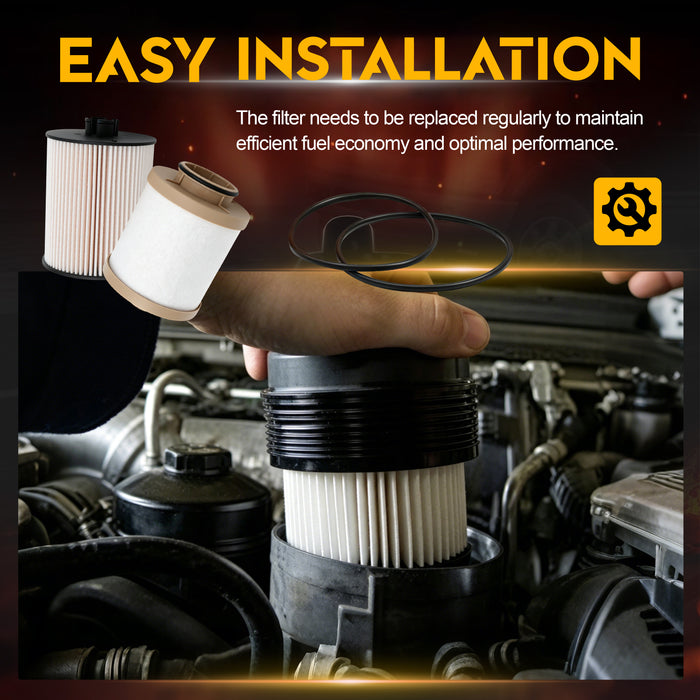
This procedure combines the most reliable methods from multiple video walkthroughs. Expect about 45 minutes for a first-timer, 20-30 minutes once you know the routine.
Tools Needed:
- 36mm socket (same size as the oil filter cap)
- 3/8" ratchet with short and long extensions
- Flathead screwdriver
- Brake parts cleaner
- Rags or paper towels
- Drain pan or empty water bottle (for catching drained fuel)
- Fuel pressure tester with drain valve (for bleeding — see below)
- Rubber gloves (diesel does not wash off easily)
Primary Filter (HFCM — Frame Rail)
-
Locate the HFCM. It’s on the driver-side frame rail, roughly under the driver’s door. If the truck is 4x4, the front driveshaft will be in your way — you’ll be reaching around it.
-
Drain the water separator. At the bottom of the HFCM housing, there’s a yellow (or black) lever. Flip it open. Fuel will drain out. Some builders attach a length of clear hose to the drain nipple and route it into a bottle — this keeps diesel off your face and the driveway. Let it drain until it slows to a drip.
-
Crack the cap loose. With the 36mm socket and a long extension, break the cap free. Don’t remove it yet — just crack it loose so air enters and speeds the draining. The O-ring holds the cap firmly even after it’s unthreaded, so expect some resistance.
-
Clean before opening. Spray brake parts cleaner around the cap area. You’re about to expose the inside of the filter housing to the outside world, and you don’t want road grime falling into your clean fuel system.
-
Remove the cap. Thread it out completely. Pull the old filter straight out — it will be suctioned in place, so pull firmly.
-
Install the new filter. Push the new filter into the housing until it seats with a positive click. It shouldn’t wobble. If it wobbles, it’s not seated — check the stem alignment.
-
Replace the O-ring on the cap. The kit includes a new O-ring. Remove the old one, clean the cap groove with brake parts cleaner, and roll the new O-ring into place. Coat it lightly with clean diesel fuel before reinstallation — this lubricates the O-ring and prevents it from rolling or pinching as you tighten the cap.
-
Reinstall the cap. Thread it on straight — plastic cap, plastic threads, do not cross-thread. Torque to 25 Nm (18.5 ft-lbs). If you can’t fit a torque wrench into the frame rail — and you usually can’t — bottom the cap out and give it a firm hand-snug. Don’t crank it; these caps crack when over-torqued.
-
Close the drain valve and spray the area with brake parts cleaner. You’ll check for leaks after bleeding.
Secondary Filter (Engine Bay)
-
Locate the filter housing. On top of the engine, near center. You’ll see two 36mm caps — one is the oil filter housing, one is the fuel filter housing. The fuel filter housing is the one that’s not the oil filter housing. (Look at the lines — if diesel lines run to it, it’s the fuel filter.)
-
Remove the cap. Same 36mm socket. Because you already drained from the HFCM, this housing won’t be completely full — but there will still be fuel in it. Have a rag ready. Pull the old filter out. This filter is larger than the primary and has a different part number.
-
Install the new filter, replace the O-ring, reinstall the cap. Same procedure as the primary. Torque to 27 Nm (20 ft-lbs) — slightly higher than the HFCM because the cap is a slightly different size.
Bleeding: The Step That Separates a Clean Start from a Hydrolocked Pump
This is where most DIY 6.4L filter changes go wrong. The low-pressure side of the fuel system — everything upstream of the high-pressure pump — is now full of air. If that air pocket reaches the K16, the pump will try to compress air instead of diesel, and since air compresses and diesel doesn’t (practically), the pump will cavitate violently on the first crank. Best case: extended cranking. Worst case: pump damage.
The 6.4L has a Schrader valve on the low-pressure fuel line — it’s behind the coolant reservoir, with a black cap. This is your bleed point.
Bleeding Procedure (Low-Pressure Side Only)
-
Connect a fuel pressure tester with a drain valve to the Schrader valve. If your tester doesn’t have a drain, you’ll need to improvise — the key is that you need a way to release air and fuel while the pump is running.
-
Turn the key to the ON position (do not crank). You’ll hear the HFCM lift pump hum — it runs for about 30 seconds. While it’s running, open the drain on your pressure tester. Air and diesel will spit out. Close the drain before the pump stops.
-
Key OFF, then ON again. Repeat the drain cycle. You’re looking for the stream to transition from sputtering air/fuel mix to a steady stream of diesel with no air bubbles. If you have a clear drain hose, you’ll see the bubbles disappear. This typically takes 3-5 cycles on the first try, more if the system had significant air in it.
-
Once the air stream stops and you’re getting clean diesel, close the drain and cycle the key 3-4 more times with the drain CLOSED. This pressurizes the low-pressure side against the closed high-pressure pump inlet. You’re pre-filling the line between the secondary filter and the K16.
-
Check the pressure. You’re looking for 3-8 PSI with the key on and the pump running. The running spec is 38 PSI at idle, but with just the lift pump and the system static, 3-8 PSI is normal.
-
Remove the tester, cap the Schrader valve.
-
Start the truck. It should fire within 1-2 seconds of cranking. If it doesn’t start within 5 seconds of cranking, stop — you still have air in the system, and extended cranking is pushing that air through the K16. Re-bleed.
Alternative method (simpler, used by many owners):
Cycle the key ON (not crank) for 30 seconds, then OFF. Repeat 6-10 times. The lift pump runs during each cycle and pushes fuel — and the air — forward through the system. The air eventually works its way back to the tank through the return circuit. This method works but doesn’t give you the visual confirmation that the drain-and-gauge method provides.
Do NOT attempt to bleed the high-pressure side.
The K16 generates pressures that can inject diesel through your skin. If air reaches the high-pressure side of the K16 — which happens when the low-pressure side wasn’t bled properly and you crank the engine — you’ll need a scan tool to command the injectors open for a high-pressure purge, or the truck will crank endlessly without firing.
How Often Should You Actually Change These Filters?
Ford’s official recommendation varies by model year and service bulletin, but the practical consensus from owners and shops who work on 6.4Ls daily settles on this:
| Operating Condition | Replacement Interval |
|---|---|
| Normal — daily driving, highway commuting, occasional towing | 15,000 miles or 12 months |
| Severe — frequent heavy towing (10,000+ lbs), extended idle, biodiesel above B5, dusty environments, filling up at low-turnover rural stations | 10,000 miles |
| Known water contamination event — bad tank of fuel, water-in-fuel light, HFCM drain showed significant water | Immediately — drain the HFCM, replace both filters |
The 5,000-mile-every-oil-change interval that some forum members advocate is excessive for a properly maintained truck using clean fuel. But if you bought your 6.4L used and don’t know the filter’s history, replace both filters immediately. Then start tracking from zero.
The Tips: Always replace both filters at the same time. Never replace just the primary or just the secondary. They work as a pair, and a fresh secondary filter behind a clogged primary is still a restriction.
The TruckTok FD4617 Replacement Set: One Box, Both Filters, Done
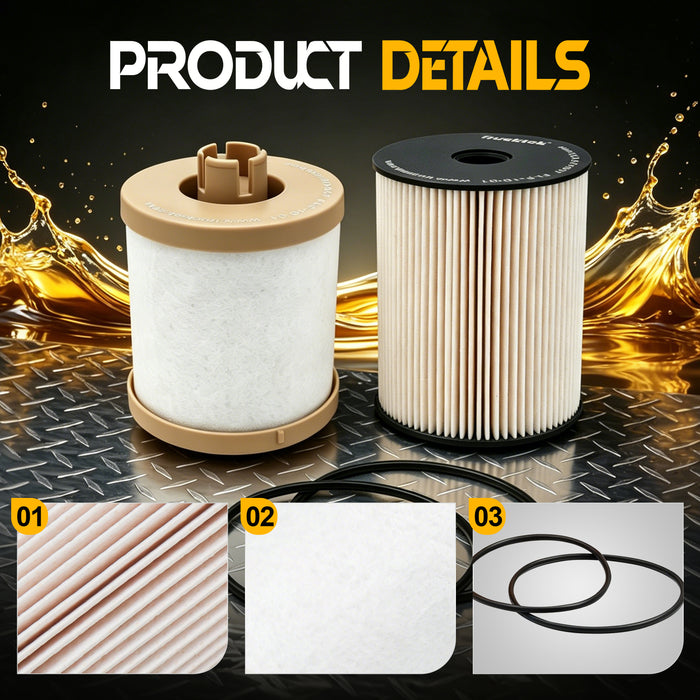
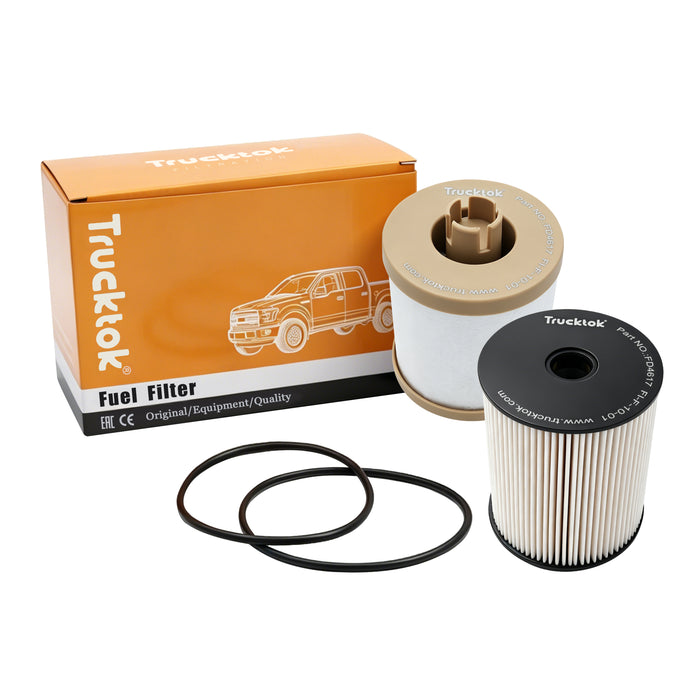
If you’re going to do this job — and if you own a 6.4L Powerstroke, you should — the TruckTok FD4617 set puts both filters, both O-rings, and everything you need in a single package. No hunting for separate part numbers, no cross-referencing, no discovering mid-job that the aftermarket filter you bought doesn’t have the stem that seats into the housing.
2008-2010 6.4L Ford Powerstroke Diesel Fuel Filter Replaces FD4617
-
Complete two-filter configuration: HFCM frame-rail primary water separator + engine-bay secondary fine-filtration cartridge — covers both critical fueling locations in one box.
-
High-density pleated fiberglass media: Engineered to capture abrasive particles at the micron level — the same contamination that, if allowed to reach the K16 pump, initiates the metal-shrapnel cascade described above.
-
Up to 98% water separation: The primary 6.4L Powerstroke fuel filter’s coalescing media forces water droplets to combine and settle out of the fuel stream before fuel reaches the high-pressure pump.
-
Precision-fit cartridge profiles: Direct drop-in replacement — no modifications to the factory housings. The primary filter includes the stem-and-O-ring configuration that seats into the bottom of the HFCM housing, matching the OEM FD4617 form factor that some aftermarket brands omit.
-
Heavy-duty rubber O-rings included: Both housing cap O-rings are in the box. These O-rings seal the filter housing against fuel pressure and prevent air ingress on the suction side.
If you want a photo-illustrated walkthrough of the exact swap before you pull the first cap, the 2008–2010 6.4L fuel filter installation thread on the TruckTok forum covers the FD4617 replacement step by step with the same torque specs and bleed sequence.
What Happens If You Don’t Change Them? The Five-Stage Failure Chain
The filter doesn’t fail suddenly. It degrades progressively, and each stage brings you closer to the $10,000 repair:
Stage 1 — Restriction Begins (10,000-15,000 miles past interval):
The pleats are loading up with trapped particles. Flow capacity is reduced, but the lift pump compensates by working slightly harder. You won’t notice anything. The truck runs normally. This is the stage where filter changes are still preventative maintenance, not emergency repairs.
Stage 2 — Intermittent Starvation (15,000-20,000 miles past interval):
Under heavy throttle or sustained high-speed driving, the fuel demand exceeds what the restricted filter can supply. You’ll feel a brief hesitation or stumble when pulling a grade or merging onto the highway. The symptom disappears when you back off the throttle. Most owners dismiss this as “the truck being cold” or “bad fuel.”
Stage 3 — Hard Starting and Rough Idle (20,000+ miles past interval):
The filter is now significantly restricted. At idle, fuel flow is barely adequate. The engine stumbles, surges, or threatens to stall. Cold starts require extended cranking because the low-pressure side can’t build pressure quickly enough to supply the K16. The water separator — if never drained — is now saturated and passing water through to the secondary filter.
Stage 4 — Low Inlet Pressure to the K16 (any point after Stage 2):
This is the stage where pump damage begins. The K16 high-pressure pump requires a minimum inlet pressure from the lift pump to prevent cavitation. When the filter restriction drops inlet pressure below that threshold, the K16 is running dry on every stroke. Metal-to-metal contact begins. Scoring starts. The pump is now generating its own metal debris internally. You won’t hear it, but the damage is accumulating.
Stage 5 — K16 Catastrophic Failure:
The pump seizes, or the plungers score deeply enough that pressure collapses entirely. The engine stalls and won’t restart. Metal debris from the destroyed pump has traveled through both common rails, through all eight injectors, and through the return circuit to the tank. The repair is a complete fuel system replacement. Every component that touched high-pressure fuel must be replaced. The bill: $8,000 to $12,000.
The transition from Stage 1 to Stage 5 can happen within a single oil change interval on a truck that’s working hard or running questionable fuel. The filter doesn’t send a warning light. There’s no “change fuel filter” message on a 6.4L dash. By the time the symptoms are obvious, you’re already in Stage 3 or 4.
Conclusion
The 6.4L Powerstroke’s fuel system is a study in precision engineering paired with a hair-trigger vulnerability to contamination. The Siemens K16 pump — running at 26,000+ PSI with internal clearances in the single-digit microns — is fully dependent on the fuel that passes through it being clean and dry. It runs on whatever the dual-filter setup sends it, and when that filter set is overdue, degraded, or bypassed by a poorly-fitting aftermarket part, the K16 receives fuel that’s carrying abrasive particles and emulsified water.
A pair of 6.4L Powerstroke fuel filters costs $39.99 and takes 45 minutes to swap. The replacement interval — 15,000 miles under normal conditions, 10,000 miles under severe use. The filter is less than half a percent of the cost of the failure it prevents. If your 6.4L’s filters haven’t been changed in the last 15,000 miles — or if you don’t know when they were last changed — change them this weekend. The alternative is a repair bill that starts with the number 10.
Why TruckTok? Parts Built for the Owner Who Doesn’t Wait for a Warning Light
TruckTok is a diesel performance and maintenance parts company built around one idea: the factory didn’t give you a “water in fuel” warning light on your 6.4L, and by the time the symptoms show up, the damage is already in progress. The parts that prevent catastrophic failures are filters, not sensors — and they need to be affordable enough that staying on schedule is never a financial decision.
What you’ll find at TruckTok:
-
Fuel filter sets for 6.4L Powerstroke (2008-2010), 6.7L Powerstroke (2011-2023), 6.6L Duramax (2001-2023), and 6.7L Cummins (2007.5-2023) — complete kits with O-rings, water separators, and OEM-spec media in a single box.
-
EGR delete kits, DPF delete pipes, CCV reroute kits, and CAN bus plugs — the hardware that addresses the root causes of the problems, not just the symptoms. For off-road and competition use.
-
Performance intake elbows, exhaust systems, and supporting hardware — everything downstream of the filter that benefits from clean, unrestricted airflow and fuel flow.
-
Complete filter maintenance bundles — oil, fuel, air, and cabin filters in one order. One box, one garage session, one less thing to track.
Frequently Asked Questions
Q1: How does the fuel filter protect the 6.4L’s high-pressure injection system?
The 6.4L was Ford’s first common-rail diesel in a Super Duty, and the Siemens K16 pump operates at pressures where abrasive debris acts like a sandblaster inside the pump internals. The dual-filter setup — HFCM primary with water separation plus engine-bay secondary — strips solid particles at the micron level and removes up to 98% of emulsified water before the fuel reaches the high-pressure pump. Clean, dry diesel is the K16’s only lubricant.
Q2: What are the warning signs of clogged fuel filters on a 6.4L?
Early signs include rough or surging idle (especially during cold starts), reduced power under heavy throttle, and extended engine cranking. As restriction worsens, you’ll feel hesitation pulling grades or merging onto the highway. A severely restricted filter drops inlet pressure to the K16, which causes cavitation damage that accumulates silently until the pump fails.
Q3: Can I replace just one filter?
No. The HFCM primary and engine-bay secondary are a matched pair. A new secondary behind a loaded primary is still a restriction. A new primary in front of a clogged secondary still passes debris. Replace both filters together, every time.
Q4: Do I need to drain the water separator even if I’m not changing the filter?
Yes. The HFCM drain should be opened every oil change — or at minimum every other oil change. Water accumulates in the bottom of the HFCM housing whether the filter is new or old. If the water level rises high enough to reach the filter media, the media saturates and water passes through to the K16. Drain it regularly.
Q5: Is the TruckTok FD4617 filter set as good as Motorcraft?
The TruckTok FD4617 set is engineered to meet OEM specifications for form factor, filtration efficiency, and water separation performance. It includes the stem-and-O-ring configuration on the primary filter that seats into the HFCM housing, matching the factory fit. The kit includes fresh O-rings for both housings. For a service part that should be replaced every 15,000 miles, the $39.99 price point makes it practical to stay on schedule.
Q6: Can I pre-fill the filters with diesel before installing them?
No. On the 6.4L, the fuel enters the filter housing from the outside of the filter element and exits through the center — unfiltered fuel is on the dirty side. Pre-filling the housing introduces unfiltered fuel directly to the clean side, bypassing the filter media entirely. Install the filters dry and let the lift pump fill the system during the bleeding procedure.
Q7: What happens if I get air in the high-pressure side of the K16?
You’ll have a no-start condition that extended cranking won’t fix — and may make worse. The K16 cannot compress and purge air effectively on its own. You’ll need a scan tool capable of commanding the injectors open for a high-pressure purge cycle, or you’ll need to crack the high-pressure lines at the injectors (hazardous — do not attempt without proper training and equipment). This is why the low-pressure bleeding procedure before first crank is non-negotiable.
Q8: How do I know if my 6.4L has already suffered K16 damage?
The most reliable indicator is metal in the fuel. Remove the secondary filter, pour the fuel from the filter housing into a clean glass jar, and look for metallic particles — they’ll appear as fine glitter suspended in the fuel. A magnetic drain plug on the HFCM can also catch ferrous debris. If you find metal, stop driving the truck and have the fuel system inspected before the pump fails catastrophically.
Q9: Can I run biodiesel through the TruckTok filters?
The TruckTok FD4617 media is compatible with diesel blends up to B20. For biodiesel above B5, the replacement interval shortens to 10,000 miles — biodiesel is a stronger solvent than petroleum diesel and can loosen deposits in the tank and lines, loading the filter faster. Some owners running high biodiesel blends change filters every 5,000 miles until the system runs clean.
Q10: What’s the difference between the 6.4L filter setup and the 6.0L?
Different architecture entirely. The 6.0L uses an HFCM with a single filter on the frame rail (plus an in-tank pickup screen). The 6.4L added the engine-bay secondary filter specifically because the K16 common-rail pump requires cleaner fuel than the 6.0L’s HEUI injectors. The two platforms use different filter part numbers and the filters are not interchangeable.