

Home > News > 6.0L Powerstroke Fuel Filter Change: Don't Stretching Intervals Past 15K!


6.0L Powerstroke Fuel Filter Change: Don't Stretching Intervals Past 15K!
There is a debate that has been running on diesel forums since 2005. It goes like this:“I changed my fuel filters at 30,000 miles and they looked almost new.” Followed by:“I changed mine at 12,000 and the frame filter was full of what looked like fine sand.”
Both statements are from real 6.0L owners, within hours of each other. Both are telling the truth. Both are right — for their trucks, their fuel stations, and their regions.
This is why the 6.0L Powerstroke fuel filter change interval printed in your owner’s manual is not a magic number. It’s a compromise — the lowest common denominator Ford could print, knowing their trucks would operate everywhere from the bone-dry highways of Arizona to the condensation-heavy fuel tanks of coastal Oregon.
What the 6.0L Powerstroke Two-Filter System Actually Does
The 6.0L Powerstroke uses a two-stage fuel filtration architecture. Most owners know they have two filters. Fewer understand why both matter — or what happens when the wrong one gets installed backward.
Frame-mounted HFCM — The Primary Filter:
This lives on the driver’s side frame rail, roughly under the driver’s door. It’s your first line of defense.
It does three things:
- separates water from diesel
- filters out larger particulate in the 10-15 micron range
- pumps fuel toward the engine bay
Water is the enemy:
Diesel station storage tanks accumulate condensation — especially in regions with high humidity, wide day-night temperature swings, or low-traffic stations where fuel sits for weeks. The HFCM’s water separator bowl catches what the station tanks miss.
Engine-Mounted Secondary Filter:
This is the cartridge under the black plastic cap on top of the engine, right next to the oil filter housing.
It does things:
It catches finer particles in the 2-5 micron range — the ones that can score an injector nozzle. On a HEUI-injected 6.0L, those injectors fire at 3,000+ PSI of high-pressure oil and need clean fuel on the supply side. Even microscopic abrasive in the fuel stream shortens nozzle life.
What Gets Trapped — and Why Geography Matters More Than Mileage
| Contaminant | Source | Which Filter Catches It |
|---|---|---|
| Water (free and emulsified) | Station tank condensation, delivery disturbance | HFCM primary (water separator bowl) |
| Fine particulate (sand, silt, rust) | Station tank sediment, pipeline transit | HFCM primary + engine secondary |
| Asphaltenes (fuel degradation sludge) | Old fuel, low-turnover stations, summer diesel in cold weather | Engine secondary |
| Microbial growth (“diesel bug”) | Water-diesel interface in storage tanks | HFCM primary + engine secondary |
| Wax crystals (cold-weather gelling) | Winter diesel below cloud point | HFCM primary — can saturate in hours |
Actual Situation
A truck fueling at high-volume I-10 truck stops in Arizona may show nearly clean filters at 25,000 miles. The same truck refueling at a rural station in coastal Washington through a wet winter may have a water-saturated HFCM filter and microbial sludge at 10,000. Same engine. Same filter. Completely different risk profile.
This is why the maintenance guides recommend a split schedule: 15,000 miles for normal conditions, 10,000 miles for harsh conditions (towing, off-road, dusty environments, short trips that never reach operating temperature).
6.0L Powerstroke Fuel Filter Change: The 15-Minute Driveway Job
What You Need
| Tool | Why |
|---|---|
| 36mm socket (or 35mm) | HFCM cap and oil filter cap |
| 24mm or 25mm socket, or 1/2" drive ratchet | Engine-mounted filter cap — the cap has a 1/2" square molded in |
| 6mm Allen bit | HFCM water drain plug — do not strip this |
| 8" extension | For 4WD trucks — reaches past the front driveshaft to the HFCM cap |
| Swivel-head ratchet | Clears the crossmember around the HFCM |
| Drain pan (1+ quart) | Diesel will spill. Accept this now |
| Rags or shop towels | Frame rail fuel runoff; lay them before you crack the cap |
| Small pick or screwdriver | Prying old O-rings off the caps |
| Torque wrench | Optional but ideal: 25 Nm on HFCM, 14 Nm on engine cap |
| Fuel filter set FD-4616 | Includes both filters + both O-rings |
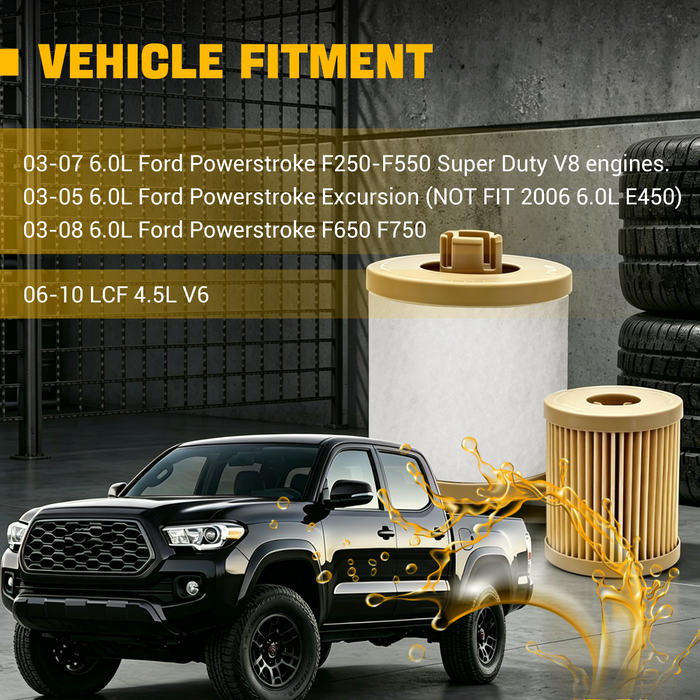
A Premium 6.0L Powerstroke Fuel filter
- This desel fuel filter direct drop-in replacement for the Motorcraft FD-4616 two-filter set.
- High-density 3-layer pleated fiberglass media strips up to 98% of emulsified water in the HFCM primary.
- Includes both filters, both fuel-resistant elastomeric O-rings.
- Fits every 2003-2007 6.0L Powerstroke — F250 through F550 Super Duty, 2003-2005 Excursion, and F650/F750. No adapters, no modifications.
Step 1: Drain the HFCM Water Separator
The HFCM is on the driver’s side frame rail, mounted horizontally. On 4WD trucks, the front driveshaft blocks direct access — you’ll use an extension to reach past it. Locate the Allen plug on the bottom of the module. It’s 6mm.
Before you touch it, know this:
There is only one thread of engagement in the housing. If the plug has already been replaced by a previous owner, it may be a 19mm or 3/4" hex instead of the factory T40 Torx.
If you do drain it:
place a drain pan underneath, loosen the plug slowly, and let it stream for about 25 seconds — that’s Ford’s specification for clearing the bowl. If the fuel separates into liquid and clear beads, that’s water. The separator did its job.
The Tips: if you live in a dry climate and have never seen a water-in-fuel light, you can skip this step.
Step 2: Remove the HFCM Cap and Filter
The HFCM cap takes a 36mm socket. A 35mm works too — the tolerances are loose enough. For 4WD trucks, use an 8-inch extension to reach through the gap behind the front driveshaft.
- Before you crack the cap loose: lay rags along the frame rail. The cap is horizontal, fuel runs backward along the frame, and if you don’t channel it with towels, it runs down the front of your shirt.
- Crack the cap loose with the ratchet, then unscrew the rest by hand.
- Pull it straight off — be conscious of the brake line running nearby. The filter pulls straight out of the housing.
- If the O-ring stays behind, fish it out.
Step 3: The Weep Hole — The Detail That Separates Good Filters From Garbage
Before you install the new HFCM filter, understand this. It’s the single most important detail in the entire procedure, and it’s the reason cheap aftermarket filters destroy themselves prematurely.
The HFCM filter has a small weep hole (also called a vent hole) near the end that inserts into the housing. This hole must face upward when the filter is installed.
- When oriented correctly, fuel fills the entire filter canister and flows through the full surface area of the media.
- When the weep hole faces down — or when the filter doesn’t have one at all — the upper portion of the filter never fills with fuel. The media in that dead zone sits dry, and the entire fuel load gets forced through the lower 30% of the filter surface.
Step 4: Install the New HFCM Filter
-
Before inserting the new filter, wipe out the inside of the HFCM housing. Dirt collects at the lowest point of a horizontal module, and you don’t want to push the new filter through a layer of grit.
-
Replace the O-ring on the cap. The old one sits in a groove above the threads — pick it out, clean the groove thoroughly, and roll the new O-ring into place.
-
Insert the filter: tab toward frame rail, push in, rotate upright until it stops. Thread the cap back on by hand first. Then tighten with the socket.
Before you consider the frame rail done: double-check the drain plug is tight. Not Hulk-tight — just tight. One thread.
Step 5: Replace the Engine-Mounted Filter
The secondary filter is under a black plastic cap on top of the engine, directly next to the oil filter housing. You have two ways to remove it:
- 24mm or 25mm socket on the hex molded into the cap
- 1/2" drive ratchet inserted directly into the square drive molded into the cap — no socket needed
Unscrew the cap, lift it out. The filter cartridge clips onto the cap stem — a firm pull frees it. Let the residual fuel drain into the housing. Replace the O-ring (the smaller of the two in the fuel filter kit), lubricate it, snap the new filter onto the cap stem, and reinstall. The spec: 14 Nm. Also stamped on the cap.
The Tips: don’t do this step immediately after shutting off a hot engine. One owner’s warning: “Don’t shut it off and come out here and grab this cap. It could have some pressure in there that’ll spray all over your engine bay.”
Step 6: Prime the System and Start
The 6.0L fuel system is self-bleeding. You do not need to crack open any lines. In fact, don’t — this is a high-pressure system, and opening a fitting introduces a leak path where there wasn’t one.
Instead, cycle the key:
- Key ON (not start) — 20-30 seconds
- Key OFF — 5 seconds
- Repeat 4-6 times
You’ll hear the HFCM electric lift pump change tone as it transitions from moving air (“struggling”) to moving fuel (“steady”). After the last cycle, check both filter housings for leaks. Then start it. It should fire immediately. If it doesn’t, cycle the key three more times and try again.
Let it idle for 2-3 minutes. Check underneath — the HFCM cap is the most common leak point if the O-ring pinched during install. Check the engine bay — the engine cap is the second most common.
6.0L Powerstroke Fuel Filter Change Interval: How Often Should You Actually Do It?
Strip the debate down to what matters, and the answer is simpler than the forums make it look:
| Your Situation | Recommended Interval | Why |
|---|---|---|
| Highway commuter, dry climate, name-brand truck stops | 15,000 miles | Ford’s published normal-service interval — safe when fuel quality is consistently good |
| Mixed driving, some towing, varied fuel sources | 12,000 miles | Splits the difference; catches seasonal fuel changes |
| Heavy towing, rural fuel, humid climate, biodiesel | 10,000 miles | Ford’s published severe-service interval for a reason |
| High-horsepower tune, frequent short trips, dusty environment | Every other oil change (~7,500-10,000 miles) | The 6.0 owner’s rule — “every second oil change” — that many seasoned mechanics endorse |
Here’s The Real-world Decision Tree:
if you can describe your driving with any of the phrases “I tow heavy,” “I fuel at whatever station is closest,” “I live where it rains a lot,” or “I don’t know when these were last changed” — change them now and set your interval at 10,000 miles going forward. If you’re a highway-only driver in a dry climate who fuels exclusively at high-turnover truck stops, 15,000 miles is fine.
What Happens If You Skip Your 6.0L Powerstroke Fuel Filter Change
The fuel filter is one of the few components on a diesel truck that gives you zero audible warning before it causes a four-figure repair. Here’s the failure chain — in order:
Stage 1: Gradual Restriction (No Symptoms)
The filter media is doing its job — trapping particulate, separating water — and the trapped material is slowly reducing the available flow area. You won’t notice anything. The truck starts fine, idles fine, pulls fine. This is the dangerous stage, because nothing feels wrong and you talk yourself into pushing the interval another 5,000 miles.
Stage 2: Intermittent Power Loss (Subtle)
The filter is approaching saturation. Under light throttle, the HFCM pump can still push enough fuel through. Under heavy load — merging onto a highway, pulling a grade with a trailer — the pump can’t maintain supply volume. The symptom: a momentary hesitation, a “soft” spot in the throttle at 2,200 RPM that wasn’t there before. Most owners dismiss it as bad fuel or a transmission hiccup.
Stage 3: Hard Start and Rough Idle
The filter is now significantly restricted. At key-on, the HFCM pump struggles to build pressure before cranking. The engine cranks longer than it used to — 4-5 seconds instead of the instant fire you’re used to. At idle, rail pressure wavers. The engine lopes slightly. If you drain the HFCM bowl at this stage, the fuel comes out dark.
Stage 4: Bypass Valve Opens
The valve opens. Unfiltered fuel flows around the clogged media and straight into the engine-mounted secondary filter. That secondary filter, designed to catch what the primary missed at 2-5 microns, is now facing raw fuel with suspended sediment. It clogs faster. If the secondary filter’s bypass also opens — which can happen within a few hundred miles of the primary bypassing — unfiltered fuel reaches the injectors directly.
Stage 5: Injector and Pump Damage
This is where the repair bill goes from $53 to five figures.
-
Injector nozzle erosion: Abrasive particulate in the 5-15 micron range — sand, silt, rust — scours the nozzle orifice. The spray pattern degrades. The injector starts to dribble instead of atomize. Combustion becomes uneven. The truck develops a persistent misfire at idle. One injector: $800-1,500 installed.
-
Injector tip failure: Water in the fuel flashes to steam inside the injector at combustion temperatures. The steam bubble collapses, creating a micro-shockwave that pits the nozzle tip. This is cavitation damage, and it’s not repairable — the injector is scrap.
-
HFCM pump failure: “As the filter gets restricted, it puts a lot of strain on the pump. The engine might run fine, but you’ll take out a fuel pump.” A new Motorcraft HFCM module: $400-600. A tow truck when it fails on the highway: more.
-
Full fuel system contamination (worst case): If the HFCM pump ingests enough abrasive and begins shedding metal, that metal travels downstream. It enters the secondary filter. If the secondary filter bypasses, it enters the injectors and the fuel return system. Cleaning it out means flushing the lines, replacing the tank module, and potentially replacing all eight injectors. Bill: $4,000-6,000.
The Timeline
Under consistently bad conditions — water-heavy fuel, high biodiesel, short trips — a filter can go from new to bypass threshold in under 10,000 miles. Under ideal conditions — dry climate, clean fuel, highway miles — the same filter might last 25,000 miles before restriction becomes measurable.
What it will not do: last 30,000 miles when you tow heavy, fuel at rural stations, and live in a humid climate. The filter doesn’t care what the forum post said.
Conclusion
The 6.0L Powerstroke’s fuel filter interval has been argued since 2003 and will be argued long after the last one leaves the road. But the argument misses the point: the only interval that matters is the one that matches your fuel, your region, and your driving — not the one printed in the manual.
A $53 filter set and 15 minutes of your time is the cheapest insurance a diesel owner can buy. The 6.0L community learned this the hard way — from scored injectors, from HFCM pump failures, and from tow-truck bills that cost more than a lifetime of fuel filters.
Browse TruckTok 6.0L Powerstroke Fuel Filters → | Visit TruckTok.com →
Frequently Asked Questions
Q1: The manual says 15,000 miles. Why change sooner?
Because Ford’s number is an average — and your fuel may not be average. If you tow heavy, fuel at rural stations, or live somewhere humid, your filters work harder than the manual assumes. The severe-service schedule (10,000 miles) is Ford’s own recommendation for those conditions.
Q2: Can I change just the frame filter and skip the engine filter if it looks clean?
No. The filters work in series — HFCM catches the coarse stuff and water, engine filter catches what slips through. Skipping the clean-looking one means leaving old media in place that may have absorbed moisture or begun degrading. The FD-4616 kit includes both. Change both. Every time.
Q3: Is Napa Gold really that bad?
Yes. The desert Southwest mechanic demonstrated it on camera: no weep hole, no locating tab, and a seal design that doesn’t match the internal housing geometry. The filter only uses the bottom third of its media area. Motorcraft or a known-good equivalent with a weep hole and locating tab only.
Q4: Does the weep hole direction actually matter that much?
Yes. The weep hole must face upward so the entire filter canister fills with fuel. When it faces down, the upper portion of the filter stays dry and unused — you’re effectively running a filter one-third the size. The locating tab on Motorcraft filters ensures correct orientation.
Q5: What if my drain plug is already stripped?
You’re not alone — the 6mm Allen plug has a single thread of engagement and strips easily. Replacement options: an aftermarket plug in 19mm or 3/4" hex. If you live in a dry climate and never see a water-in-fuel light, many experienced mechanics skip the drain step entirely and just swap the filter. Wade from Thoroughbred Diesel: “If you don’t want to fool with it, don’t fool with it.”
Q6: Do aftermarket fuel filters void the warranty?
They can. On a 6.0L this is mostly a moot point — these trucks are long out of factory warranty. But if you’re on an extended service plan, using non-Motorcraft filters gives the warranty administrator a reason to deny a fuel system claim.
Q7: How many times do I really need to cycle the key?
Four to six cycles, 20-30 seconds each. Five different YouTube mechanics converged on the same procedure — it’s not superstition. Listen for the HFCM pump tone to change from uneven (air) to steady (fuel). Then start it. If it doesn’t catch, cycle three more times.
Q8: What torque values?
HFCM cap: 25 Nm (stamped on the cap). Engine cap: 14 Nm (also stamped). In the real world — as one mechanic put it — “we just snug it up.” But if you own a torque wrench, use it. A cracked HFCM cap leaks fuel onto a hot exhaust.