

Home > News > Why Your 6.7L Cummins Intake Manifold Elbow Is Holding You Back?

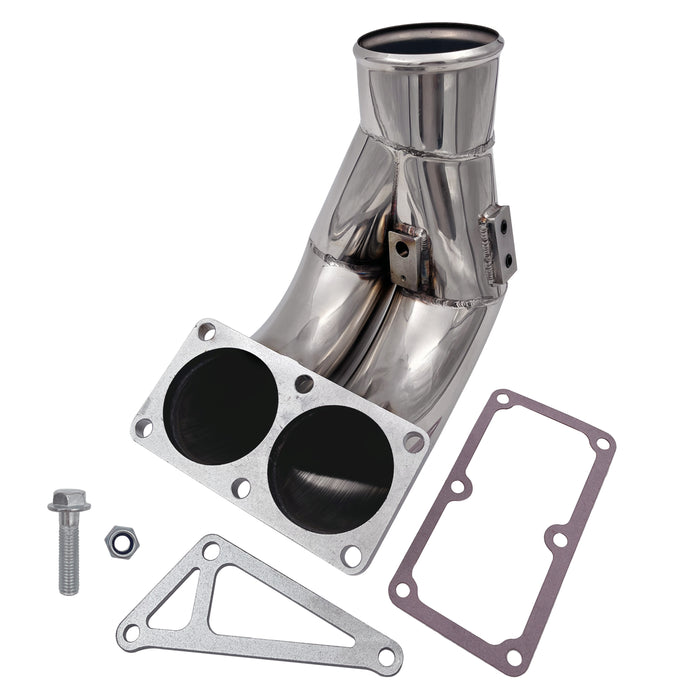
Why Your 6.7L Cummins Intake Manifold Elbow Is Holding You Back?
On a bone-stock 6.7L with the factory tune, the intake horn is usually not your bottleneck — the engine makes no more power with a bigger one. On a tuned, deleted, or high-airflow build, it can absolutely become one of the last restrictions left in the intake path. And separate from power entirely, the factory horn carries a mechanical risk — the “killer bolt” in the grid heater — that justifies an upgrade on its own for a lot of owners.
For off-road / competition use only. Not legal for on-road use in emissions-regulated areas. Check your local, state, and federal laws before modifying any emissions-related component.
What the Intake Manifold Elbow Actually Is
Before anything else, clear up the naming — because “intake” gets used for two different parts on this engine, and mixing them up leads to buying the wrong thing.
-
The intake horn / manifold elbow is the cast or welded piece that sits on top of the intake manifold, on the driver’s side, right behind the fuel filter housing. It’s part of the charge-air system — it carries compressed, post-intercooler air from the cold-side pipe down into the cylinder-head plenum.
-
The air intake most people picture — the filter housing and tube — is on the opposite side of the engine, feeding the turbo’s compressor inlet at ambient pressure.
The horn you’re considering upgrading is the first one: the pressurized side. It has the throttle valve bolted underneath it and, on an emissions-intact truck, the EGR valve on top of it. That placement is the whole story — the factory horn’s shape exists to clear the EGR plumbing, the fuel rail, and the injector lines, not to flow air efficiently.
Why the Factory Horn Looks the Way It Does
The stock 6.7L horn is a compromise part, and it’s worth understanding the compromises because they’re what an upgrade actually addresses.
The Flattened Profile and the Sharp Bend
The factory piece has a flattened, pinched profile with a sharp 90-degree turn in it.
The reason is packaging: a fuel line runs right through the area where the air wants to flow, and the horn has to duck under it. That tight bend and the internal transitions create turbulence and a measurable pressure drop — the compressed air coming out of your intercooler loses a little of its pressure and, more importantly, some of its density before it reaches the intake valves.
The Grid Heater Sitting in the Path
There’s also the grid heater. The factory horn bolts down on top of a grid-heater plate, and the grid itself is a deliberate restriction sitting directly in the airflow path. That restriction is small when the heater is clean, but on a high-mileage engine it packs with soot and oil sludge and gets noticeably worse.
None of this is a mistake — Ford-era Ram and Cummins engineers were balancing cost, emissions compliance, cold-start reliability, and packaging. But it does mean the factory horn was never designed as a flow-optimized part.
The Physics: Why “CFM” Is the Wrong Number
This is where most of the confusion comes from, and it’s worth getting right because it explains the entire debate.
Mass Flow vs. Volume: Why CFM Misleads
A naturally aspirated gas engine pulls air in by vacuum, so its airflow is usefully described in cubic feet per minute (CFM) — volume. But your 6.7L Cummins is forced induction: a turbocharger compresses the air, so the number that actually matters to the engine is mass flow — pounds of air per minute — not volume.
Gale Banks put this plainly in his intake-manifold testing:
A stock 6.7L moves roughly 50 pounds of air per minute through the whole system, from the compressor inlet to the intake valves. That mass stays constant. What changes at each stage is the density — the compressor squeezes the air, the intercooler cools it back down (recovering density), and then everything downstream — boost tubes, throttle, horn, manifold — can only lose density through pressure drop and heat.
The takeaway that matters to you:
anything in the intake path that doesn’t add density either preserves it or bleeds it away. A restrictive horn bleeds density. That’s the real mechanism — not “more CFM through a bigger pipe,” but less pressure lost between the intercooler and the head.
Why Flow-Bench Numbers Don’t Translate to Power
This is also why flow-bench numbers can mislead. A bench can show a big “CFM gain” at a fixed pressure drop, but that gain only translates to real power if the engine is actually demanding more air than the stock horn can pass at the pressure your turbo is producing. On a stock truck, it usually isn’t.
Why a Stock Truck Usually Doesn’t Gain Power
The ECM Governs the Turbo
Your 6.7L’s variable-geometry turbo is governed by the ECM. The computer isn’t commanding “X pounds of boost” — it’s commanding a target air mass flow, calculated from the tune’s maps, and it moves the VGT vanes to hit that target. If you bolt on a freer-flowing horn. It might spool a little easier, but the ECM adjusts the turbo to deliver the same air the engine was already asking for.
Where the Real “Gains” Come From
One shop owner who runs these trucks daily put it directly: on a stock engine with a stock tune, an aftermarket intake horn “is not going to make any significant difference in overall power output.” The guys who report a real seat-of-the-pants improvement after an upgrade are usually experiencing two things at once:
-
They removed a soot-packed grid heater. On a high-mileage or heavy-idle engine, the factory grid and horn are coated in carbon sludge from years of EGR recirculation. Cleaning all that out — regardless of what you bolt back on — makes the engine respond better.
-
They also deleted the EGR or tuned the truck at the same time, and credited the horn for what the tune did.
When the Horn Does Become a Real Bottleneck
So when does this upgrade actually earn its keep? The answer is when the engine is moving meaningfully more air than stock.
-
Tuned trucks — once a calibration asks for more fuel and more boost, the stock horn’s pressure drop stops being academic and starts eating into the boost your turbo is producing.
-
Deleted trucks — when you remove the EGR, you stop feeding hot, sooty exhaust back into the intake. The horn is the natural next restriction to open up so the now-clean air charge flows without the factory’s sharp bend.
-
Big-turbo / high-airflow builds — a compound or aftermarket turbo setup pushing toward 600+ horsepower is flowing enough air that every pound of pressure lost in the horn is horsepower left on the table.
-
Owners who want the cold-side clean — even without chasing power, pairing the horn with an EGR delete is the cleanest way to end the intake carbon buildup that the EGR was causing in the first place.
The stock horn is not the first thing you upgrade — tune, turbo, and exhaust all come first. But it’s the part you eventually replace when the rest of the intake path has been opened up and the horn is the one piece still pinching.
Here’s the Whole Decision in One Table:
| Your Truck | Is the Horn the Bottleneck? | What You Can Expect |
|---|---|---|
| Bone-stock, stock tune | Usually no | Almost no power gain; slightly crisper throttle feel |
| Tuned (aftermarket calibration) | It can be | Supports the extra air the tune is asking for |
| Deleted (EGR removed) | Yes | Cleans up the intake and frees the now-soot-free charge path |
| Big-turbo / 600+ hp build | Definitely | Every pound of pressure lost is horsepower left on the table |
The “Killer Bolt”: A Separate Reason to Look at This Part
Independent of any power argument, the factory intake setup carries a documented mechanical risk that’s worth knowing about.
How the Bolt Fails
The factory grid heater is held together by a stud and nut that carry a large electrical current, sitting directly in the airflow path. Over years of heat cycling that hardware can deform, loosen, or snap. If the nut or bolt breaks free, it falls straight down the intake tract and into a cylinder.
The damage is catastrophic: a piece of hardened steel in cylinder #6 can destroy the piston, valves, and often the head. Repair costs run $10,000 and up. This is not a forum myth — multiple owners and diesel shops have documented it happening.
A Real Risk, But Not an Epidemic
The honest caveat, though: it’s a rare failure, not an epidemic. The right response is to inspect the heater connection and hardware, especially if you drive in cold weather, and to weigh the risk against your own truck’s age and duty cycle. Upgrading to a horn that relocates or replaces the heater — or simply deleting the heater where your climate allows — removes that failure point entirely.
What an Upgrade Actually Changes (The Honest List)
Strip away the marketing and here’s what a quality high-flow elbow realistically delivers:
-
Cleaner airflow path. A 3.5-inch mandrel-bent tube with smooth transitions replaces the factory’s sharp bend and pinch points, reducing turbulence and pressure drop.
-
Slightly faster spool and throttle feel. Because the turbo reaches its target airflow with less effort, throttle response can feel a touch crisper — this is the “snappier” sensation owners report.
-
Lower EGTs under heavy load — on the right build. On a tuned or towing truck that’s actually moving more air, reduced intake restriction lets the engine breathe easier, which can hold EGTs down. But treat any specific temperature claim as a direction, not a guarantee — it depends on tune, turbo, load, and grade.
-
The cold-side cleanup. If you’re already deleting the EGR, doing the horn at the same time finishes the job and stops the intake sludge at the source.
-
One less failure point. Relocating or deleting the grid heater removes the killer-bolt risk.
What it does not do: it won’t add a guaranteed horsepower number on a stock truck, it won’t magically clean carbon that’s already in your intake, and it won’t fix a boost leak, a bad MAP/IAT sensor, or a stuck VGT actuator. Those are separate problems with their own fixes.
T304 Stainless vs. Aluminum: Which Material
Both materials work — the choice is about durability and use, not about making power. The charge-air cooler, compressor efficiency, and engine-bay heat dominate the temperature of the air entering the engine.
-
Aluminum (usually 6061-T6) is the most common choice. It’s lightweight, easy to machine into complex cast shapes, and has decades of proven service across the diesel aftermarket. It’s an excellent choice for daily drivers, towing trucks, and moderate builds.
-
T304 stainless steel brings better corrosion resistance and higher fatigue strength. For trucks that live in road-salt regions, tow heavy, or see sustained high engine-bay heat, stainless holds up longer. It’s also rigid, which matters when the manifold is fighting boost pressure and vibration.
The practical line: aluminum is the lightweight, proven default; T304 stainless is the pick when long-term durability, corrosion resistance, and heavy-duty use are the priority. If you plan to keep the truck past 200,000 miles or run it hard, stainless is the safer long-term bet.
| If You… | Choose |
|---|---|
| Daily-drive, light-to-moderate build, want light weight | Aluminum (6061-T6) |
| Tow heavy, live in road-salt country, plan to keep it 200k+ miles | T304 Stainless Steel |
2007-2018 6.7L Dodge RAM 2500 3500 Cummins Diesel 3.5inch High Flow Intake Manifold Elbow Tube Horn
If you’ve decided the horn is the right move — whether for a tuned build, an EGR delete, or the heater-bolt risk — the TruckTok 3.5" High-Flow Intake Manifold Elbow is built as a direct, no-nonsense replacement.
What You Will Get:
- T304 stainless steel construction, TIG-welded, with a consistent 3.5-inch mandrel-bent pathway from inlet to outlet. It won’t crack, flex, or corrode under boost and engine-bay heat.
- A machined mounting flange with an integrated O-ring groove for a clean seal against the factory intake manifold.
- Pre-tapped NPT sensor ports — for a boost gauge, a water-methanol nozzle, or whatever else your setup needs.
- Grid-heater compatibility — it accepts the factory grid heater directly, or an aftermarket grid-heater delete plate. Your choice, based on your climate.
- Complete hardware — bolts, washers, and the O-ring gasket are in the box.
Fitment covers 2007.5–2018 Ram 2500 and 3500 with the 6.7L Cummins (and the 2011–2018 4500/5500), so it matches the platform’s most common years.
One thing to plan for: the elbow moves the IAT sensor to a new location, and the factory harness is short and rigid — it may not reach without stretching. The IAT Sensor Extension Harness gives you the plug-and-play length without cutting or splicing factory wiring.
Don’t Blame the Horn Before You Diagnose
The single biggest mistake buyers make is throwing a $110–$450 manifold at symptoms that have nothing to do with the horn. Hesitation, rough idle, or a “lazy” throttle can just as easily come from:
- A charge-air boot leak — the boots crack, oil-saturate, and blow open under boost. This is the most common real cause of a “restricted” feeling.
- A dirty or failing MAP or IAT sensor — caked with soot, it reads sluggish and the ECM mis-meters airflow.
- Low battery voltage — which drags down the glow-plug and grid-heater relays on cold starts.
- Cold-weather fuel gelling — a winter symptom that no intake part fixes.
- A stuck VGT actuator — carbon jambs the vanes and kills boost, looking exactly like an airflow problem.
Pull codes first. Check boost and rail pressure if you can. Confirm the battery and heating system are healthy. Only after you’ve ruled those out should you decide the intake horn is the culprit — and even then, the honest conclusion is usually “it’s a worthwhile supporting upgrade.”
| Symptom | Check This First (Not the Horn) |
|---|---|
| Lazy throttle / hesitation | Charge-air boot for cracks or leaks |
| Rough idle | MAP / IAT sensor for soot buildup |
| Hard cold starts | Battery voltage and grid-heater relay |
| Winter no-start | Fuel gelling |
| Low boost / turbo feels dead | Stuck VGT actuator |
How to Install It: Step by Step
This is one of the most straightforward bolt-ons you can do on a 6.7L — 45 minutes to an hour with basic hand tools. The only real traps are a tight rear bolt and a torque spec you must not exceed.
Tools You’ll Need
- 10mm socket and ratchet (short and deep)
- 10mm ratcheting wrench — the middle lower bolt is the tight one, and this is the MVP tool
- 11mm socket or wrench — for the boost-tube clamp
- Flathead screwdriver — electrical connectors and coupler separation
- Magnetic pickup tool — the rear flange bolts sit under the horn body and are hard to grab
- Straight-edge razor blade — cleaning old gasket residue off the sealing surface
- Torque wrench — in the 8–25 ft-lbs range
- Clean rags and MAF/MAF-safe cleaner — for the MAP sensor while it’s out
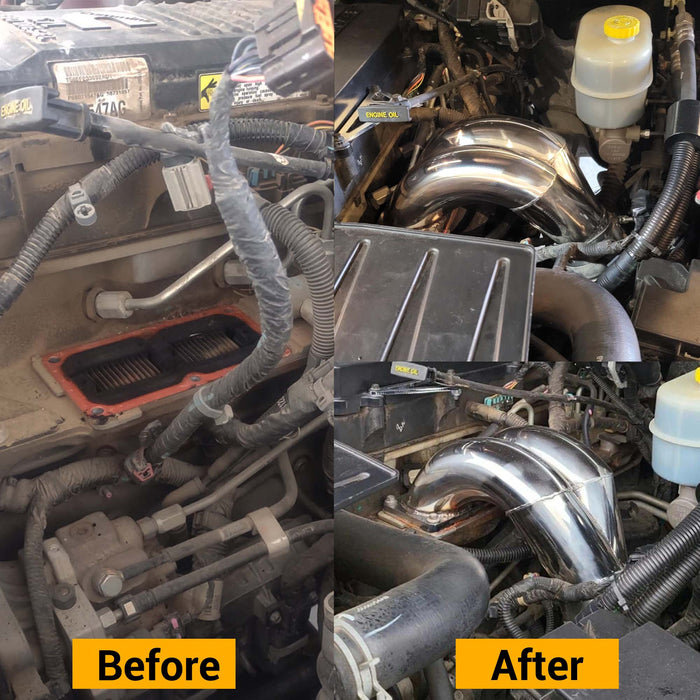
Step 1: Remove the Stock Horn
- Work on a cold engine, and disconnect the negative battery terminal before touching anything electrical.
- Locate the horn on top of the intake manifold, driver’s side, behind the fuel filter housing.
- Disconnect the cold-side intercooler tube, the grid-heater power cable, the IAT sensor, the MAP sensor, and the rear wiring-harness clip.
- Remove the six 10mm bolts holding the horn down. The two rear bolts and the center lower bolt are buried near the firewall and injector lines — take your time so you don’t drop hardware into the engine bay.
- Lift the horn off, remove the old O-ring gasket, and clean the sealing surface with a razor blade — not just a rag. Leftover gasket residue creates boost-leak paths.
Step 2: Transfer the Grid Heater (or Delete It)
The factory grid heater is bolted to the bottom of the stock horn. Remove its two bolts and lift it off. The new elbow accepts the factory heater directly, or you can install an aftermarket grid-heater delete plate instead. If you start the truck in sub-freezing temperatures, keep the heater.
Step 3: Install the New Elbow
- Seat the new O-ring gasket in its groove, making sure it sits evenly with no twists or gaps.
- Lift the dipstick tube slightly as you lower the elbow into position — it gives you the half-inch of clearance you need.
- Hand-thread all six bolts first — a couple of turns each — to avoid cross-threading into the heli-coil inserts in the plenum.
- Snug the bolts down in a cross pattern, then torque to 18 ft-lbs only. These bolts thread into heli-coil inserts, and over-tightening strips them. Exceed 18 ft-lbs and a 45-minute job becomes a long weekend of insert extraction.
Step 4: Reconnect and Check
Reconnect the grid-heater cable, IAT sensor (using the extension harness if it’s short), MAP sensor, and the rear harness clip. Reconnect the intercooler tube — and while it’s off, inspect the boot for cracks or oil saturation. Tighten the band clamp, then reconnect the battery.
- Start the engine and let it idle 2–3 minutes, listening for any hiss or whistle at the flange — that’s a boost leak.
- Take a 10-minute drive and watch throttle response and boost behavior.
- After it’s heat-soaked, pop the hood and re-torque the flange bolts to 18 ft-lbs while the manifold is hot — thermal expansion can open gaps that weren’t there cold, and a leak that’s silent at idle shows up under boost.
The Cold-Side Pipe: The Other Half of the Job
While the horn is off, there’s one more weak link worth checking: the cold-side intercooler pipe.
On 2013+ trucks, the factory cold-side pipe is plastic, and under high boost or just with age it can burst — leaving you stranded. It’s the “elephant in the room” that a horn upgrade alone doesn’t fix. Most owners who upgrade the horn also replace the cold-side pipe at the same time, since you’re already disassembling that area and it bulletproofs the whole boost path in one session.
Even if you keep the stock pipe for now, at minimum inspect it for cracks, oil saturation, and dry rot while it’s disconnected — and plan to replace it if it shows age.
The Legal Reality (Read Before You Commit)
A high-flow intake elbow that retains the factory grid heater, EGR, throttle valve, sensors, and OBD functions is generally a different legal proposition from a kit that removes or disables emissions hardware. Replacing the horn for airflow alone, while keeping the emissions and heating systems intact, is the compliant path.
But if you use the horn to delete the grid heater or the EGR system, you’re modifying or removing emissions-related equipment — and that’s a different job with different rules. Removing or disabling emissions controls on a vehicle operated on public roads can violate the federal Clean Air Act (42 U.S.C. § 7522) and most state laws. Those deletes are for off-road, competition, and closed-course vehicles not registered for street use.
For off-road / competition use only. Not legal for on-road use in emissions-regulated areas. Check your local, state, and federal laws before modifying any emissions-related component.
Conclusion:
The 6.7L Cummins intake horn is one of the most argued-about parts in the diesel aftermarket, and the truth is more nuanced than either side admits.
On a stock truck, it’s not your bottleneck. The factory tune and VGT turbo deliver the same air whether the horn is stock or aftermarket, so you won’t gain real horsepower from the swap. What you can get is slightly crisper throttle feel, a cleaner intake path, and the removal of a documented $10,000 failure point.
On a tuned, deleted, or high-airflow build, it’s a real supporting upgrade. Once you’re moving meaningfully more air, the stock horn’s sharp bend and pinch points become a genuine restriction, and a 3.5-inch high-flow elbow is the right way to finish the job — especially alongside an EGR delete, which stops the intake sludge at its source.
The honest play is to diagnose first, understand what the part does and doesn’t do, and treat it as a supporting reliability-and-airflow upgrade. If that’s the frame you buy it in, the 3.5" High-Flow Intake Manifold Elbow is a clean, durable, direct-fit answer in TruckTok .
Frequently Asked Questions
Q1: Will a 3.5" intake horn add horsepower to my 6.7 Cummins?
A: Not on a stock truck. The factory VGT turbo is ECM-governed to deliver a target air mass flow, so the engine makes essentially the same power with a stock or aftermarket horn. On a tuned or high-airflow build, the freer path can support the extra air the engine is actually demanding.
Q2: Do I need a tune after installing an intake horn?
A: No, if you’re only swapping the horn for airflow and keeping the grid heater, EGR, and sensors intact. The ECM’s MAP, IAT, and barometric sensors adjust within their normal range. If you’re also deleting the grid heater or EGR, that’s a different job that can set codes without a tune.
Q3: Will this lower my EGTs when towing?
A: It can help on a truck that’s actually moving more air — the engine breathes easier and the turbo works less. But treat any specific temperature drop as a direction, not a guarantee. EGT depends on fueling, boost, turbo efficiency, load, and grade, not the horn alone.
Q4: Is the “killer bolt” grid-heater failure real?
A: Yes. The grid heater’s stud and nut carry high current and sit in the airflow, and over years of heat cycling they can loosen or snap, dropping hardware into a cylinder and causing catastrophic damage. It’s rare, but it’s documented — and it’s the main reliability reason owners replace the factory horn.
Q5: Can I just delete the grid heater entirely?
A: You can, but only if you don’t need cold-start heat. In freezing weather, a diesel without pre-heat struggles, smokes, and can fail to start. The middle ground is a horn that relocates the heater or uses a coil-style element with no bolt to fall out.
Q6: Do I need the IAT sensor extension harness?
A: Usually yes. The new elbow moves the IAT sensor bung, and the factory harness is short and rigid — it may not reach without stretching. The extension harness gives you the length for a secure connection without cutting or splicing factory wiring.
Q7: Is T304 stainless better than aluminum for an intake horn?
A: Both work. Aluminum is lightweight and proven; T304 stainless brings better corrosion resistance and fatigue strength for road-salt regions and heavy-duty use. Neither material lowers intake temperature or makes power — the difference is durability.
Q8: Will this fit my 2019+ or 2024 Ram?
A: Not this specific elbow — it’s built for 2007.5–2018. The newer trucks changed fuel-line routing, sensor placement, and heater hardware, so a 2007.5–2018 horn won’t drop onto them. Match the part to your exact year and chassis.
Q9: Will I get a check engine light after installing it?
A: If you only swap the horn and keep the grid heater, EGR, and sensors connected, no. If you use the swap to delete the grid heater or EGR, you’ll set codes unless you tune the truck to account for the removed hardware.
Q10: Do I need new gaskets?
A: The elbow ships with an O-ring gasket. If you’re deleting the grid heater, use the delete plate’s supplied gasket. Always clean the sealing surface with a razor blade so the new gasket seats properly and doesn’t leak boost.