

Home > News > Why Your 6.7L Cummins DPF & EGR Delete Won’t Fit: Cab & Chassis vs Pickup


Why Your 6.7L Cummins DPF & EGR Delete Won’t Fit: Cab & Chassis vs Pickup
A 6.7L Cummins Cab & Chassis (3500/4500/5500) and a standard Ram pickup share the same engine block — but their delete kits do not interchange. The split is the frame, the exhaust routing, and the Aisin transmission, not the displacement. Buy the wrong pipe and it won’t clear the crossmembers; buy the wrong tune and the transmission de-fuels on you. Here’s exactly where the fitment actually breaks down.
For off-road / competition use only. Not legal for on-road use in emissions-regulated areas. Check your local, state, and federal laws before modifying any emissions-related component.
Is It Even the Same Engine?
Short answer: the bottom end is, and a lot of the rest isn’t.
A 6.7L Cummins is a 6.7L Cummins from the head gasket down. The block, cylinder head, pistons, and crankshaft are the same casting between a pickup and a chassis cab of the same generation. What differs is everything bolted around it — and on a delete, it’s the “everything bolted around it” that decides whether the parts land.
Here’s what actually changes between the two trucks:
- Aftertreatment — the DPF/SCR canister layout and pipe routing differ because the frame behind the cab is a different animal.
- Injectors and turbo — the hardware is largely shared, but the calibration is not.
- Transmission — pickups run the 68RFE (or an optional Aisin); chassis cabs are Aisin, and that single fact rewrites the entire tuning conversation.
So the “can I use pickup parts on a chassis cab?” question is more precise than it sounds: the engine internals don’t care, but the exhaust, the fuel tank, the frame, and the transmission absolutely do.
Why the Chassis Cab Makes Less Power (on Purpose)
Here’s a detail that catches a lot of owners off guard: the chassis cab is detuned from the factory.
A 2018 Ram 3500 pickup 6.7L Cummins is rated 385 hp and 930 lb-ft. The 2019 chassis cab version of the same engine is rated 360 hp and 800 lb-ft. Ram doesn’t do that by accident — the chassis cab is meant to live its life as a work truck, so it’s tuned conservatively for longevity. Lower cylinder pressures, lower heat, longer service life.
It’s still a monster, and 800 lb-ft will pull just about anything you point it at. But if you’re planning a delete expecting to chase big horsepower, understand the ceiling starts lower here, and the transmission keeps it there.
Where the Fitment Actually Breaks Down
The cleanest way to think about it is to split the kit into two halves, because they fail for different reasons.
The EGR Side Is Mostly Shared
The EGR valve, cooler, and block-off plates bolt to the engine — and since the engine is the same, the plates land the same. The exhaust block-off plate bolts to the rear passenger-side exhaust manifold, and the intake plate seals the driver-side intake port. That geometry doesn’t move between a pickup and a chassis cab.
The DPF/Exhaust Side Is chassis-specific
The Cab & Chassis delete pipe is mandrel-bent to clear the commercial frame crossmembers, the fuel tank, and the rear axle on a 3500/4500/5500 — and a pipe cut for that routing will not line up on a pickup bed truck. The reverse is just as true: a pickup DPF pipe won’t clear a chassis cab’s frame rails.
The Aisin Transmission: The Wall You Don’t See Coming
Chassis cabs run the Aisin automatic, and the Aisin’s TCM has torque-limiting parameters that will de-fuel the truck to protect the transmission. The TCM sees torque it doesn’t like and pulls fueling to save the box.
Worse, the software to unlock the C&C Aisin TCM essentially doesn’t exist. Owner consensus on the forums is blunt: don’t go higher than a tow tune (roughly 50 hp) on a chassis cab. A full-power delete tune that a pickup would happily eat will leave a chassis cab de-fueling itself and fighting the transmission.
What this means for your build is concrete:
| Platform | Transmission | Realistic Tune Ceiling | Why |
|---|---|---|---|
| 2500/3500 Pickup | 68RFE (or optional Aisin) | Full delete tunes, 100+ hp | 68RFE widely supported; Aisin pickup still tunable |
| 3500/4500/5500 Cab & Chassis | Aisin only | Tow tune (~50 hp) | TCM torque limiting, no unlock software |
So a chassis cab delete is a reliability and driveability play, not a horsepower play. You’re removing the regen cycles, the soot ingestion, and the EGR cooler failure point — not chasing a dyno number. The delete still matters a lot.
Why the Frame Is the Real Divider
If you’ve ever looked at a pickup next to a chassis cab from underneath, the difference is immediate, and it’s the whole story.
-
Pickup = tube-style frame. It’s built to carry a bed, and it dips down at the cab and changes section along its length. Plenty of room to hide wiring and route a pickup exhaust, but it’s not meant to be upfitted.
-
Chassis cab = C-channel frame. It runs flat and straight from the back of the cab all the way to the tail, on purpose. That straight rail is what lets a flatbed, service body, or dump body bolt on without a fight.
The chassis cab also carries hardware the pickup doesn’t: a heavier leaf pack with overload springs, a factory rear anti-sway bar, and a much higher payload rating — north of 6,300 lbs on a 3500 chassis cab. That extra capability is paid for with a different frame, and a different frame means a different exhaust path underneath it.
What “Pick Up Model Only” Actually Means
You’ll see a 2013–2018 Ram Cummins EGR delete instruction set marked “pick up model only.” That phrase is a note about the document, not about the coverage. It tells you which body style the photographs and the step-by-step order were shot on — the pickup was on the lift when they took the pictures. It is not the record that decides whether the parts bolt to your engine.
Two records answer two different questions:
- The fitment record (the coverage table) answers “does this kit fit my truck?”
- The instruction set answers “what did this job look like on the truck it was documented on?”
Read the fitment record for coverage, and use the instruction set for procedure — following the sequence while reading the locations off your own truck. Mix the two up and you’ll talk yourself out of a kit that fits.
The Honest Numbers: What a Chassis Cab Delete Actually Changes
Every delete article on the internet throws horsepower numbers around. Here’s the version that survives a chassis cab reality check, with the numbers pinned to their source.
| Metric | 2500/3500 Pickup | 3500/4500/5500 Chassis Cab |
|---|---|---|
| Factory rating | 385 hp / 930 lb-ft | 360 hp / 800 lb-ft (detuned) |
| Transmission | 68RFE (or optional Aisin) | Aisin only |
| Tune ceiling | 100+ hp (full tuner support) | ~50 hp tow tune (Aisin de-fuels past it) |
| Does the delete add power? | No — the tune does | No — the tune does |
| What you actually gain | Power + reliability | Reliability only |
-
The delete itself doesn’t add horsepower. The tune does. Removing the DPF and EGR removes restriction and failure points; the power comes from the calibration you flash afterward. That’s the same rule as every other 6.7 Cummins.
-
On a chassis cab, that tune is capped at roughly 50 hp. The Aisin’s torque-limiting TCM de-fuels the truck past a tow tune, and there’s no software to unlock the C&C Aisin. So the 100+ hp delete numbers a pickup owner posts are real — but they’re a pickup’s numbers, on a pickup’s transmission.
-
What you do get is reliability, and it’s not nothing. Three specific failures stop happening at once: the regen cycle stops wasting fuel and diluting oil, soot stops caking the intake manifold, and the EGR cooler stops waiting to crack and dump coolant into a cylinder.
If your goal is a cleaner-running, more durable workhorse, a chassis cab delete is exactly right. If your goal is a big number on a dyno, you’re on the wrong platform — and no kit is going to change that.
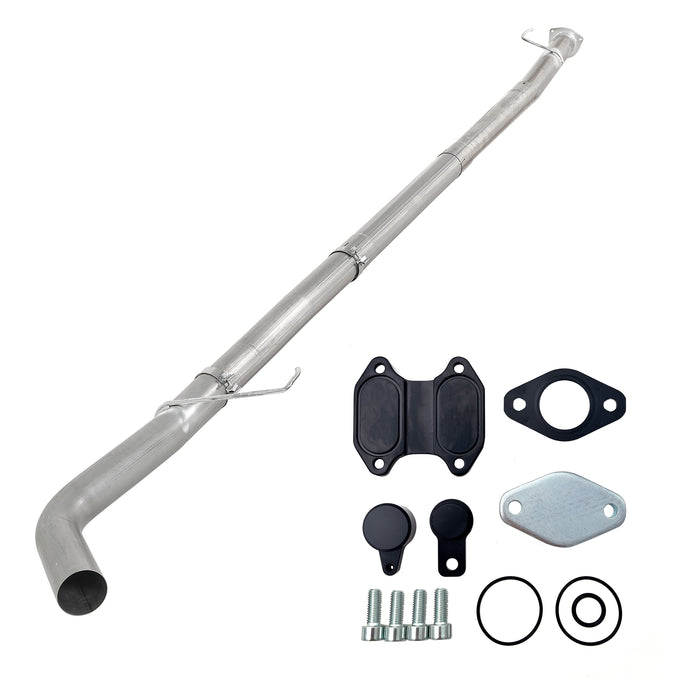
2013-2019 6.7 Ram Cummins Cab & Chassis 4" DPF Delete pipe & EGR Delete Kit
The 2013–2019 6.7L Cummins Cab & Chassis 4" DPF & EGR Delete Kit is built specifically for the commercial chassis — 3500, 4500, and 5500 cab & chassis trucks from 2013–2019 — and it’s a case study in why this split matters.
What’s in the box, and why it’s chassis-specific:
-
4" free-flow DPF delete race pipe — precision mandrel-bent to clear the commercial frame crossmembers, fuel tank, and rear axle. This is the part that won’t interchange with a pickup pipe.
-
Heavy-duty solid block-off plates — CNC-machined billet aluminum and steel, sealing against factory manifold pressure. The exhaust plate bolts to the rear passenger-side manifold; the intake plate seals the driver-side intake port.
-
Commercial-grade EGR delete — removes the EGR valve and cooler, stopping intake soot and eliminating the internal cooler leak risk.
-
409 stainless construction with thick mounting flanges, built to take commercial towing and work-site abuse.
The kit replaces the factory DPF/SCR & EGR assembly, connecting between the stock downpipe (or front pipe) and the rear tailpipe section using the factory rubber hanger locations. And — the part worth repeating — it requires custom ECM tuning to prevent fault codes and reduced-power modes after install.
What the Install Looks Like on a Chassis Cab
The job is the same shape as a pickup delete — remove the EGR, remove the DPF/SCR, flash the tune — but the details diverge in ways worth knowing before you’re on your back.
-
The exhaust has to be cut to fit. Unlike a pickup, where the pipe bolts up, a chassis cab delete pipe is cut to length for your specific cab-to-axle (CA) dimension. A 60" CA truck is not the same as an 84" CA truck.
-
One EGR coolant line comes out from under the block. On the chassis cab, blocking the water lines means pulling one line out from beneath the block, not just capping at the top. It’s a reach-and-find step a pickup doesn’t have.
-
2018+ trucks need a security gateway bypass. Chrysler locked down the OBD-II port on the 2018+ Rams with a Security Gateway Module, so flashing a delete tune requires a bypass cable (repinning two wires at the DLC).
-
The factory downpipe is 4" with a flattened section. Owners report the stock chassis cab downpipe has a crush-for-clearance spot that pinches flow, which is why an aftermarket true-4" downpipe is a common first step alongside the delete.
None of this is exotic. It’s just the difference between a part built for a truck that’s meant to be upfitted, and one built for a truck that’s meant to carry a bed.
A Simple Install Walkthrough
The order matters more than any individual step, because a 6.7 Cummins delete done out of sequence leaves the ECM throwing codes the moment it can’t find the hardware. Here’s the shape of a chassis cab job, start to finish.
Step 0 — Flash the tune first. Sort the tuning before you turn a single wrench. On a 2018+ truck, install the Security Gateway bypass cable and flash the delete calibration while the truck is still complete, so the ECM is already expecting the emissions hardware to be gone. This is the step that prevents the immediate limp mode.
Step 1 — Remove the EGR valve and crossover tube. Two 10mm bolts, one 8mm bracket, and one EGR temperature sensor connector. The tube runs from the EGR valve to the EGR cooler.
Step 2 — Remove the EGR cooler. Two 10mm bolts and one 15mm on the exhaust side, plus the coolant lines. This is the chassis cab-specific step: one coolant line runs down to the block and comes out from underneath, not from the top.
Step 3 — Install the block-off plates. The exhaust plate bolts to the rear passenger-side manifold, and the intake plate seals the driver-side intake port. Use a fresh gasket or copper spray — exhaust gaskets don’t like being reused, and a leak here undoes the whole job.
Step 4 — Drop the DPF/SCR and hang the delete pipe. Disconnect the sensors and the DEF injector line, unbolt the factory canister, then cut the new 4" race pipe to your cab-to-axle length and bolt it to the factory hanger locations.
Step 5 — Refill, bleed, and road-test. Refill the coolant, bleed the system, tuck and zip-tie the orphaned connectors, and take it on a short shakedown to confirm no codes and no leaks.
That’s the whole job in six moves. Nothing in it is hard — but the tune-first order, the coolant line from under the block, and the cut-to-fit exhaust are the three places a chassis cab bites someone who’s done a pickup delete before and assumes it’s the same.
The Tuning Question You Have to Answer First
A chassis cab delete is only as good as the tune behind it, and the tune is where the platform bites back. Before you order hardware, nail down the tuning path — whether you even need a tuner for a 6.7 Cummins EGR delete is a question you want answered before the wrenches come out, not after.
On a chassis cab specifically:
-
Confirm the tune is C&C-specific. Not every tuner writes calibrations for the chassis cab platform, and the Aisin TCM is the reason. Owner reports are consistent: some well-known tuners don’t do custom C&C tuning at all.
-
Stay at a tow tune. Push past ~50 hp and the Aisin de-fuels. A tow tune removes the emissions faults and smooths out drivability without fighting the transmission.
-
Sort the 2018+ bypass cable first. If your truck is 2018 or newer, the Security Gateway Module has to be bypassed before any flash happens. It’s a thirty-minute harness job, but it’s a prerequisite, not an afterthought.
Get the tune sorted and confirmed before you tear anything apart, and the rest of the job is just wrenching.
The Legal Reality (Read Before You Commit)
Removing or tampering with emissions equipment on a road-registered vehicle violates the federal Clean Air Act (42 U.S.C. § 7522). Individual penalties can reach roughly $5,911 per violation under the statutory base — and recent EPA guidance has cited higher inflation-adjusted figures in commercial enforcement actions. Delete kits are sold for off-road, competition, and closed-course use; that designation does not create a legal exemption for a truck that sees public roads.
For off-road / competition use only. Not legal for on-road use in emissions-regulated areas. Check your local, state, and federal laws before modifying any emissions-related component.
Get the Right Kit for Your Chassis Cab
The whole point of this article is one sentence: the engine is the same, but the truck is not. A 6.7L Cummins in a 3500/4500/5500 cab & chassis needs a chassis-specific delete pipe, a C&C-aware tune, and a clear-eyed view of the Aisin transmission’s ceiling. Get any of those three wrong and you’ll be fighting fitment, fault codes, or a transmission that de-fuels under load.
If your chassis cab is a 2013–2019 3500/4500/5500, the Cab & Chassis DPF & EGR Delete Kit is built for exactly that truck. Match your model year off the door jamb, confirm your body style off the frame behind the cab, and the fitment question is already settled.
From there, the rest of the platform is covered too — which delete kit fits your 6.7 Cummins, the DPF-side breakdown, and the tuner question that decides whether the whole job even works. At TruckTok, every kit is engineered for the exact platform it ships to — pickup or chassis cab.
Frequently Asked Questions
Does a 6.7L Cummins Cab & Chassis delete kit fit a standard Ram pickup?
No. The chassis cab uses a different frame (C-channel vs tube-style), different fuel tank placement, and different exhaust routing, so a chassis-specific delete pipe will not line up on a pickup bed truck. The EGR block-off plates are shared because the engine is the same, but the DPF/exhaust pipe is chassis-specific and does not interchange.
Is the 6.7L Cummins engine itself different in a Cab & Chassis?
The block, cylinder head, pistons, and crankshaft are the same as a pickup of the same generation. What differs is the aftertreatment routing, the injector and turbo calibration, and the transmission. The bottom end doesn’t care whether it’s in a pickup or a chassis cab.
Why does the chassis cab make less power than a pickup?
It’s detuned from the factory for longevity. A 2019 chassis cab is rated 360 hp and 800 lb-ft versus 385 hp and 930 lb-ft on the 2018 pickup, because the chassis cab is meant to work hard and last. Ram trades peak output for service life on the commercial trucks.
Can I run a full-power delete tune on a Cab & Chassis?
Generally no. The chassis cab runs the Aisin automatic, and its TCM has torque-limiting parameters that de-fuel the engine to protect the transmission. There’s no real software to unlock the C&C Aisin TCM, so the realistic ceiling is a tow tune around 50 hp. Push past that and the transmission fights you.
What does “pick up model only” on the instructions mean?
It’s a note about the document, not the coverage. It tells you the photographs and step order were shot on a pickup, and it is not the record that decides whether the parts bolt to your engine. Read the fitment record for coverage and the instruction set for procedure.
Does a delete kit add horsepower?
The delete itself doesn’t — the tune does. Removing the DPF and EGR removes restriction and failure points, but the power gain comes from the calibration you flash afterward. On a chassis cab, that tune is capped by the Aisin transmission, so don’t expect pickup-sized numbers.
Do I need a tuner for a Cab & Chassis delete?
Yes, always. Removing emissions hardware without a supporting tune leaves the ECM throwing fault codes and likely entering a reduced-power mode. On 2018+ chassis cabs you also need a Security Gateway Module bypass cable before any flash.
What years does the Cab & Chassis delete kit cover?
The TruckTok chassis cab kit covers 2013–2019 Ram 3500, 4500, and 5500 cab & chassis trucks with the 6.7L Cummins. EGR delete coverage for the platform runs 2010–2024 on pickups and 2013–2024 on cab & chassis, but the exhaust pipe is where the chassis-specific fitment matters.
Is the install different on a chassis cab?
Yes, in a few concrete ways: the exhaust has to be cut to fit your cab-to-axle length, one EGR coolant line comes out from under the block rather than capping at the top, and 2018+ trucks need the security gateway bypass. The factory downpipe is also 4" with a flattened section worth replacing.
Is deleting a Cab & Chassis legal?
Not on public roads. Removing emissions equipment on a road-registered vehicle violates the federal Clean Air Act, and many chassis cabs face DOT visual inspections that pickups don’t. These kits are for off-road, competition, and closed-course use only — check your local laws and duty cycle first.
What should I actually gain from deleting a chassis cab?
Reliability, not horsepower. You eliminate regen cycles (which waste fuel and dilute oil), stop soot from caking the intake, and remove the EGR cooler as a failure point. On a truck that idles long and works hard, that’s the delete that pays for itself — but it’s capped around a 50 hp tow tune by the Aisin.