
Home > News > Why Do You Need LML Duramax EGR Delete — Fix the Wet Soot Problem for Good

Why Do You Need LML Duramax EGR Delete — Fix the Wet Soot Problem for Good
Ask most LML owners why they’d delete the EGR, and you’ll hear the same tired answer: “to make more power.” That’s not it. The LML’s EGR delete is not a horsepower mod — the EGR valve is already shut at wide-open throttle, so it’s barely costing you peak power anyway.
The real reason to delete the EGR on a 2011–2016 6.6L Duramax is something far more expensive to ignore: wet soot. Recirculated exhaust soot mixing with crankcase oil vapor into a thick, sticky sludge that chokes your intake, glues your EGR valve shut, and — when it packs into the EGR cooler and the thermal cycling cracks the thin passages — dumps coolant straight into your intake. That’s the problem a delete actually fixes, and that’s what this guide is about.
What “Wet Soot” Actually Is
The term gets thrown around the forums, but most people picture dry, powdery carbon. That’s only half of it — and it’s the half that makes deleting the EGR only half a fix.
What’s Happening Inside a Stock LML:
-
The EGR feeds soot into the intake. Exhaust gas is pulled off the manifold, run through a liquid-cooled EGR cooler, metered by the EGR valve, and dumped back into the intake stream to lower combustion temps and cut NOx. That recirculated gas is loaded with fine soot — the powder.
-
The CCV feeds oil vapor into the same intake. The crankcase ventilation system routes blow-by gases — carrying an oily mist — back into the turbo inlet so they get burned instead of vented to atmosphere. That oil mist is the glue.
On their own, neither is catastrophic. Dry soot is light and doesn’t stick well; oil vapor is just a film. But the LML routes both into the same intake tract, and that’s where the trouble starts.
Soot + Oil Vapor = Wet Soot
The oil acts as a binder that turns loose carbon into a thick, sticky, concrete-like sludge. It doesn’t just sit there — it adheres. To the intake runners. To the EGR valve pintle and seat. To the inside of the EGR cooler tubes. And once it’s baked on by engine heat, it hardens into a crust that no amount of spray cleaner is going to dissolve from the outside.
This is the single most important thing to understand about the LML’s EGR problem: it’s not the soot alone, and it’s not the oil alone. It’s the combination. Which is why the honest, permanent fix has to address both — more on that below.
The Two Ways Wet Soot Kills Your LML
Wet soot doesn’t fail in one dramatic moment. It fails in two slow, compounding ways, and both are expensive.
1. The EGR Cooler Cracks
The LML’s EGR cooler is a heat exchanger that runs engine coolant through passages separated from 1,000°F+ exhaust gas by thin internal walls. Its job is to cool the exhaust before it re-enters the intake. The problem is the material science: thin metal walls, hot exhaust, cold coolant, and thermal cycling are a recipe for fatigue.
Its consequences:
Add wet soot into the equation and it gets worse. As sludge packs into the cooler’s narrow passages, it restricts flow, creates hot spots, and accelerates the thermal stress. Eventually the walls crack. When that happens, coolant leaks internally — into the exhaust and intake side — and you’re now burning coolant.
This is the LML’s most common emissions failure, and the worst part is that a replacement OEM cooler is built exactly the same way and will fail exactly the same way. You’re not fixing the weak part by swapping it; you’re buying time.
2. The EGR Valve Sticks and the Intake Chokes
Even before the cooler cracks, years of wet soot cake the EGR valve and the intake manifold with hard carbon. The EGR valve’s pintle and seat get coated until the valve sticks — open, closed, or somewhere in between. A stuck valve means:
- Rough idle and surging
- Reduced airflow into the engine, which hurts throttle response and makes the engine work harder for the same power
- Fault codes — P0401 (insufficient flow), P0402 (excessive flow), P0404 (circuit/range), and P046C (position sensor) are the usual suspects
- Limp mode in the worst cases, leaving you stranded mid-tow
And the intake manifold itself? Pull an intake elbow off a high-mileage LML and you’ll likely find the runners half-choked with black crust. That’s years of wet soot doing its job — and every bit of it is airflow your engine is no longer getting.
The Failure Chain: From Wet Soot to a $1,500+ Bill
Let’s lay the whole thing out as one chain, because that’s how it actually happens:
- The truck runs — EGR feeds soot, CCV feeds oil vapor, both hit the intake.
- Wet soot forms — the sludge starts caking the valve, the cooler, and the runners.
- Airflow degrades — throttle response dulls, fuel economy creeps down, the engine works harder.
- The cooler clogs and cracks — thermal fatigue, accelerated by the packed sludge, splits the thin passages.
- Coolant leaks internally — sweet-smelling white smoke from the tailpipe, a coolant reservoir that keeps dropping with no visible external leak, and rising temps.
- You overheat, or worse — on a diesel, sustained overheating is how a cracked head or a hydrolocked engine starts.
The cost floor is real: an EGR cooler replacement runs $1,500+ in parts and labor — and that’s for a part built to fail again. A delete kit, by contrast, removes the failure point entirely, and it costs a fraction of one cooler replacement.
Symptoms: How to Know It’s Already Happening
Wet soot and a failing cooler don’t announce themselves loudly — until they do. Here’s what to watch for, in roughly the order it shows up:
- Coolant level dropping with no visible leak — the classic internal cooler crack signature. The reservoir goes down, but there’s no puddle under the truck.
- Sweet-smelling white smoke from the tailpipe — that’s coolant being burned in the exhaust. A little on a cold start is one thing; persistent white smoke is the cooler.
- Rough idle or surging — the EGR valve starting to stick.
- Throttle response going dull — the intake choking with carbon, the engine working harder for the same power.
- Overheating under load — low coolant from the internal leak finally catching up with you, especially towing.
- Check engine light + EGR codes — P0401, P0402, P0404, P046C. If you’re chasing these, the delete conversation has already started.
If you’re seeing coolant loss and white smoke together, don’t keep driving it. Internal coolant leaks don’t heal themselves, and on a diesel the next stop after “running hot” is a cracked head.
Not Every Symptom Is the EGR — What to Rule Out First
Here’s the honest catch: these same symptoms can come from a half-dozen other places, and some of them are bigger problems than the EGR. Buying a delete kit because you saw white smoke — and having it turn out to be a head gasket — is an expensive way to learn the wrong lesson. Before you commit, rule these out:
White Smoke + Coolant Loss Is Not Always The EGR Cooler
- A failed head gasket produces the exact same signature — coolant pushed into the combustion chamber, burned as white smoke, with the reservoir slowly dropping.
- Turbo oil seals can leak and push oil into the exhaust, giving a blue-white haze.
The diagnostic that separates them: a degas-bottle (coolant reservoir) pressure/bubble test. Combustion gas bubbling through the coolant points to a head gasket; coolant loss with no combustion gas in the system points back to the cooler. A cooling-system pressure test also tells you whether the leak is internal or external.
Rough Idle and Soft Throttle Are Not Always the EGR Valve
- Injector balance issues on a high-mileage LML can cause the same stumble.
- A restricted fuel filter (or low rail pressure from a tired CP4.2) can make the truck feel lazy under load.
- Dirty MAF or MAP sensors, or a boost leak in the intercooler piping, will dull throttle response every bit as much as a carbon-choked intake.
Overheating Is Not Always The EGR Cooling Circuit
- A stuck thermostat, a clogged radiator, or a failing fan clutch will run the truck hot with the EGR system perfectly intact.
P0401/P0402 Codes Are Not Always a Bad Valve or Cooler
- The EGR differential-pressure sensor itself can fail and throw flow codes even when the valve and cooler are fine.
- A wiring or connector problem on the EGR circuit reads the same on a scanner.
The takeaway: scan for live data, pressure-test the cooling system, and run the degas-bottle check before you spend a dollar. White smoke plus coolant loss should be diagnosed, not assumed.
What an EGR Delete Actually Does
Let’s be precise about what the hardware does, because “delete” is a loose word.
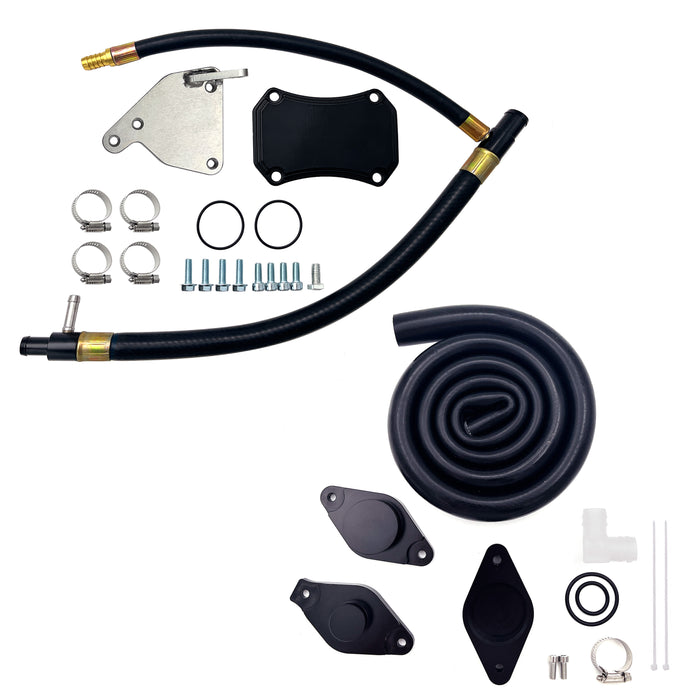
A proper LML EGR delete physically removes the failure-prone components and seals every port. The core pieces:
-
EGR valve block-off plate — seals the valve port on the intake side so no exhaust gas re-enters. Look for billet aluminum or thick steel, not thin stamped metal.
-
EGR cooler delete plate — seals off the cooler mount so the whole assembly can come out.
-
Coolant bypass / reroute fittings — this is the part cheap kits skip, and it matters. The factory coolant loop ran through the cooler; remove it and you have to reroute the coolant circuit so the system stays sealed and full. Skip it and you’ve got a dead leg that traps air and cooks the engine.
-
High-temp gaskets — multi-layer steel or equivalent, rated for exhaust-side temps. Paper gaskets on a delete plate mean doing the job twice.
-
A matching ECU tune — non-negotiable. The LML’s ECM expects EGR flow, and physically removing it without a tune throws codes and can drop the truck into limp mode. The hardware and the tune go together, always.
What the delete does not do is magically add horsepower. We’ll get to that next.
The Honest Answer: Does It Add Horsepower?
No — not by itself. And anyone telling you an EGR delete alone is worth “15–30 HP” is selling you something.
Here’s the truth, and it’s worth understanding so you buy for the right reason:
-
The EGR valve is closed at wide-open throttle. The ECM shuts EGR flow during heavy acceleration precisely so the engine makes full power. So on the top end, the EGR isn’t costing you anything to begin with.
-
EGR runs at warm idle and light cruise — the low-power operating window — where its whole job is to dilute the intake charge and lower combustion temps. That’s where the soot gets introduced, and that’s where the wet-soot problem lives.
-
The power gains from a “delete” come from the tune, not the block-off plates. A matched delete tune can optimize fueling and boost now that emissions compliance isn’t constraining the calibration — that’s where a proper full delete finds its 40–60 HP and 80–100 lb-ft.
So the honest framing is this: an EGR delete is a reliability modification, not a performance modification. Its value is eliminating the #1 coolant-loss failure point, keeping your intake clean, and stabilizing your cooling system — not squeezing out more peak horsepower.
The real-world benefit owners actually notice? Cooler, cleaner intake air — intake temps drop 30–50°F under tow load when hot exhaust stops dumping back in — and a cooling system that holds steady instead of slowly bleeding itself dry.
Why “For Good” Needs Both Sides
Deleting the EGR removes the soot — the powder. But it leaves the CCV oil vapor — the glue — still feeding into your intake.
Think about it. You block off the EGR, the soot stops, and the wet-soot sludge stops forming. Good. But the crankcase ventilation system is still routing oily blow-by vapor into the turbo inlet. Without the soot to bind to, that oil is less catastrophic — you won’t get the concrete-like sludge anymore — but you’ll still get an oily film coating your turbo inlet, intercooler piping, and intake boots. Over time, that residue attracts whatever dust and particulate is in the air and turns into its own mess.
That’s why the complete fix — the one that actually lives up to “for good” — addresses both sources:
- EGR delete removes the soot (the powder)
- CCV reroute removes the oil vapor (the glue)
Do both, and your intake, turbo, and intercooler stay dry and clean — not just “less dirty,” but genuinely clean, because neither the powder nor the glue is entering the system anymore.
If you’re already tearing into the top of the engine to do the EGR delete, the CCV reroute is cheap insurance to do at the same time. It’s the difference between a fix that mostly works and one that actually solves the wet-soot problem permanently.
Know Your LML: 2011–2016 in One Look
The LML ran from 2011 through 2016 in the Silverado and Sierra 2500HD/3500HD. A couple of things to pin down before you order:
-
It’s the most emissions-complex Duramax before the L5P. Where the LMM it replaced ran EGR and DPF, the LML added a full SCR/DEF system on top — four overlapping emissions systems, all watched by the ECM. That’s why partial deletes (EGR-only, or DPF-only without a tune) create headaches: pull one piece and the ECM throws codes.
-
The engine itself is strong. 397 hp and 765 lb-ft, and the short block is one of the toughest GM ever built. The problem isn’t the engine — it’s the emissions hardware strapped to it.
-
One fitment note if you’re also touching the exhaust: the turbo downpipe connection changed midway through 2015. Early 2011–2015 trucks use a V-band clamp; 2015.5–2016 trucks switched to a 3-bolt flange. If you’re pairing the EGR delete with a DPF pipe or downpipe, confirm which style you have before ordering — it’s the single most common returned-part mistake on LML builds.
-
The CP4.2 fuel pump is a separate problem. The LML’s Bosch CP4.2 high-pressure pump has its own well-known weakness, but an EGR delete doesn’t touch it. If fuel-system reliability is on your list, that’s a CP3 conversion conversation, not an EGR one.
The Install: What You’re Signing Up For
Be honest with yourself going in: an LML EGR delete is an intermediate-to-advanced DIY job. The engine bay is tight, the cooler is buried against the valley on the driver’s side, and the coolant reroute is where patience pays off. Plan a full weekend for a first-timer.
The short version of the workflow:
- Tune first. Load the EGR-delete calibration before you unbolt anything — the ECM needs to know the EGR is gone before the truck runs without it. Keep a battery charger on during the flash; a voltage drop mid-write can corrupt the ECM.
- Drain the coolant enough to get below the cooler connections. The LML’s cooler lines hold more than you’d expect — have a catch pan ready.
- Clear the intake path. The intercooler inlet pipe and air ducting come out to reach the cooler and valve.
- Remove the EGR valve and cooler. Work methodically — the bay is cramped, and a rushed move cracks a coolant fitting. This is the part where most people bleed.
- Install the block-off plates and reroute the coolant. Torque plates evenly so they don’t warp, and confirm the coolant reroute is sealed before refilling.
- Refill and burp the cooling system. Air pockets here are how you cook an engine after an otherwise clean install.
- Clear codes and verify no limp mode before the first real drive.
One recurring gotcha from real installs: the up-pipe bolts love to snap. If you’re removing the up-pipe (to eliminate the EGR feed port), hit the threads with penetrating oil well ahead of time, and coat the new bolts with copper anti-seize — a snapped up-pipe bolt turns a 4-hour EGR delete into a full turbo-pull job. Trust us, that’s the path nobody wants.
The Products: Two Ways to Fix the Wet Soot
Both of these kits are built specifically for the 2011–2016 LML, and they represent the two tiers of the fix: the EGR delete alone, and the complete both-sides solution.
1. TruckTok 2011–2016 LML EGR Valve & Cooler Delete Kit — ER-0181 ($66.49)
This is the core fix — it removes the failure-prone cooler and valve, and it’s the right call if you want the wet-soot problem addressed at the source without going further. The TruckTok LML EGR Valve & Cooler Delete Kit pairs a CNC-machined anodized aluminum intake plate with a stainless steel exhaust plate to block the EGR cycle, and includes the custom coolant hose that accelerates flow and lowers engine temps.
- What it stops: the EGR soot feed — the powder half of the wet-soot equation — and the coolant-leak risk from the cracking cooler.
- Best for: owners who want the #1 failure point gone and a cleaner intake, on a budget.
- Fitment: 2011–2016 6.6L Chevy/GMC Duramax LML 2500HD/3500HD.
2. TruckTok 2011–2016 LML CCV/PCV Reroute & EGR Delete Kit — ER-0237 ($151.99)
This is the complete “for good” solution. The TruckTok LML CCV/PCV Reroute & EGR Delete Kit deletes the EGR cooler and reroutes the crankcase blow-by vapor out of the intake entirely — attacking both the soot and the oil vapor in one package.
- What it stops: both halves of the wet-soot equation. Delete the EGR and you remove the soot; reroute the CCV and you remove the oil that was binding it. The intake, turbo, and intercooler stay dry and clean — not just less dirty.
- Best for: owners who want the permanent fix and are already doing the EGR work — it’s the cheap upgrade that makes the delete actually live up to “for good.”
- Fitment: 2011–2016 6.6L Chevy/GMC Duramax LML 2500HD/3500HD.
The honest recommendation: if you’re tearing into the top of the engine anyway, go with the reroute package. The EGR delete alone stops the sludge from forming, but the CCV reroute is what keeps the intake genuinely clean long-term — it’s the difference between “better” and “fixed.”
The Legal Reality (Read This Before You Commit)
Let’s be direct: removing emissions equipment on a street-driven truck is illegal in the U.S.
The Clean Air Act — 42 U.S.C. § 7522(a)(3)(A) — makes it unlawful to remove or render inoperative any emissions-control device on a vehicle used on public roads, and the EPA actively enforces against both sellers of defeat devices and the owners who install them. Individual penalties can reach $5,911 per vehicle under the tampering provisions, and commercial cases run far higher.
These kits are sold strictly for off-road, race, and competition use. A deleted truck will fail emissions inspections in states that run them, and may not be registerable or resalable in those markets.
If your LML is a street-driven daily driver, a tow rig, or a work truck that has to stay legal, the compliant path is proper diagnosis and repair — replace the failed cooler or valve, clean the intake, and keep the system intact. Delete only where it’s lawful for your use, and know your local rules before you turn a wrench.
Conclusion
The 2011–2016 LML Duramax is a genuinely tough engine hiding behind a genuinely fragile emissions stack — and the EGR cooler is the weakest link in that stack. The problem isn’t horsepower; it’s the wet soot that forms when recirculated exhaust soot binds with crankcase oil vapor, cakes your intake and valve, and eventually cracks the cooler so coolant pours into your intake.
A proper EGR delete removes that failure point at the source — for a fraction of what one cooler replacement costs. And the complete fix — deleting the EGR and rerouting the CCV — removes both the soot and the oil, so the intake stays clean for good, not just cleaner for a while.
For the full lineup of LML EGR delete kits, CCV reroute packages, DPF pipes, and tuning support — built specifically for the 2011–2016 Silverado and Sierra HD — head to TruckTok.com. Every kit is fitment-verified for the LML platform, ships free, and is engineered to stop the wet-soot problem at its source. Whether you’re deleting for off-road reliability or just want your towing workhorse to stop slowly choking itself, TruckTok has the right part to fix it for good.
Frequently Asked Questions
Q1: Will an LML EGR delete throw a check engine light?
A: Not if it’s tuned. The hardware delete must be paired with a matching ECU tune that disables EGR monitoring — otherwise the ECM throws codes and can drop the truck into limp mode. The hardware and the tune go together, always.
Q2: Does an EGR delete add horsepower?
A: Not by itself. The EGR valve is closed at wide-open throttle, so it isn’t costing you peak power to begin with. Any power gain comes from the matched tune, not the block-off plates — this is a reliability mod, not a performance mod.
Q3: What’s the difference between a block-off and a full cooler delete?
A: A block-off stops exhaust flow but leaves the cooler in place, so the coolant-leak risk and the failure point remain. A full delete removes the cooler entirely and reroutes the coolant — that’s the right move for any serious truck, because it eliminates the leak at the source.
Q4: Why do I also need a CCV reroute for a truly clean intake?
A: EGR soot is the “powder” and CCV oil vapor is the “glue” — together they form wet sludge. Deleting the EGR removes the soot, but the oil vapor still feeds the intake. Rerouting the CCV removes both, so the intake stays dry and clean instead of just less dirty.
Q5: How much does an LML EGR delete cost?
A: A hardware kit runs well under $100–$150, which is a fraction of the $1,500+ a single OEM cooler replacement costs. Factor in the required tune, and you’re still ahead of one failed cooler — and you never have to do it again.
Q6: What are the signs my LML EGR cooler is already failing?
A: Watch for coolant dropping with no visible leak, sweet-smelling white smoke from the tailpipe, rough idle or surging, dull throttle response, and EGR codes like P0401, P0402, P0404, or P046C. Coolant loss plus white smoke is the classic internal-crack signature.
Q7: Is an EGR delete legal to drive on the street?
A: No. Removing emissions equipment violates the federal Clean Air Act for on-road vehicles, and can carry fines up to $5,911 for individuals. These parts are for off-road, race, and competition use only — check your local laws first.
Q8: Does deleting the EGR fix the LML’s CP4 fuel pump problem?
A: No. The CP4.2 high-pressure fuel pump is a separate issue entirely, and an EGR delete doesn’t touch the fuel system. If fuel-system reliability is your concern, that’s a CP3 conversion conversation.
Q9: Can I revert to stock after a delete?
A: Yes, if you keep all the factory hardware and your tuner supports flashing the stock calibration back. It’s doable on the LML, but it’s extra labor — which is why most owners who delete commit to the off-road use case upfront.
Q10: Do I need to delete the DPF at the same time as the EGR?
A: Not strictly, but they’re part of the same emissions stack, and a partial delete without proper tuning creates fault codes. Many owners do the full delete (EGR + DPF + DEF) at once since the truck only needs to be tuned once and every weak point gets addressed together.