

Home > News > Do Exhaust Tips Change Sound? Truth About Tone, Volume & Size


Do Exhaust Tips Change Sound? Truth About Tone, Volume & Size
If you have spent any time browsing truck forums or scrolling through parking lot groups, you have seen them: big, polished exhaust tips bolted to diesel pickups. They promise a meaner look, and some claim a deeper growl. But does that 7-inch outlet actually change anything you can hear?
The short answer: Yes, exhaust tips change sound. But they are not a muffler delete, and they will not turn a stock truck into a straight-piped monster. What they do is more like the bell of a trumpet — they shape how the sound already being produced leaves the pipe. Understanding that difference is the difference between a smart upgrade and wasted money.
In this guide, we are going deeper than the usual “tips are just cosmetic” or “bigger tips make it louder” one-liners. We have pulled together acoustic science, real-world test data from owners and YouTube builders, and hands-on experience with diesel applications. If you want to match the right tip to your engine, your exhaust setup, and the exact tone you are chasing, this is the guide.
How Exhaust Sound Is Created (and Why the Tip Matters)
Step 1: Combustion Pulses
Every cylinder fire sends a pressure wave through the exhaust system. These waves are the raw material of your exhaust note. Engine layout, firing order, and RPM set the fundamental frequency — that is why a V8 Powerstroke does not sound like an inline-six Cummins, even with identical tips.
Step 2: The System Shapes the Wave
By the time sound waves reach the tailpipe, they have already passed through the exhaust manifold, downpipe, catalytic converter or DPF, resonator, and muffler. Each of these components absorbs, reflects, or cancels specific frequencies. The muffler and resonator do the heavy lifting — they are the reason a stock truck is quiet and a straight-piped truck barks.
Step 3: The Tip — The Final Stage
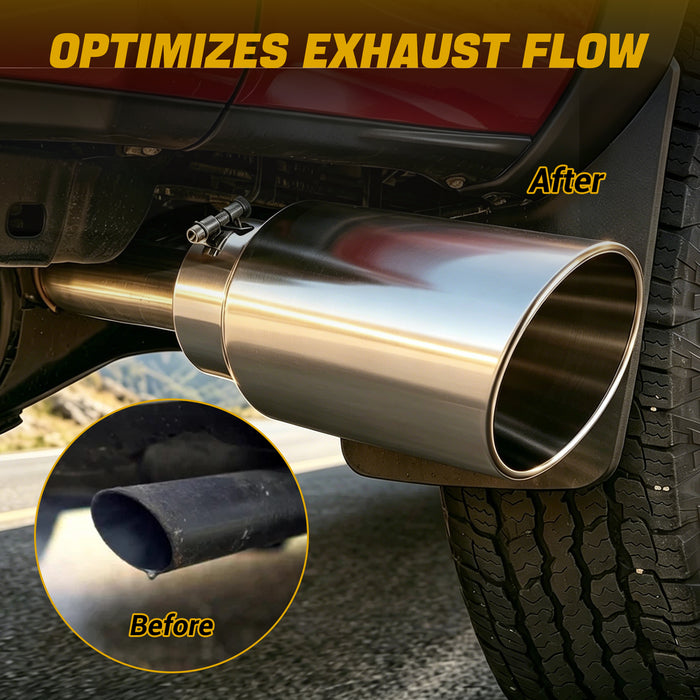
The tip is not just a decorative sleeve. It is the terminal acoustic geometry — the last thing sound waves pass through before expanding into open air. Think of it as the bell at the end of a trumpet or the flare on a tuba. Changing that geometry changes how sound radiates. It will not rewrite the note the muffler already created, but it absolutely influences:
- Perceived depth (how “full” the tone feels)
- High-frequency rasp (how sharp or smooth the edge is)
- Directional projection (where the sound goes — pavement, bumper, open air)
- Resonance near the outlet (air column effects from tip length)
The effect is subtle on a quiet stock system. On a diesel with a 5-inch DPF-back straight pipe? You will hear the difference.
How Much Can an Exhaust Tip Really Change? The Data
The internet is full of competing claims, so let us look at actual test results.
Real Test #1: TitanTalk Owner (Deaf, Relies on What He Can Perceive)
A TitanTalk forum member who is deaf posted that he ran the same Flowmaster 44 muffler with two different tips — first a 4-inch diameter, 18-inch long, 45-degree cut tip, then a 2.5-inch diameter tip on new piping. Same muffler, same truck.
His verdict: the smaller tip made the exhaust “so much quieter” that he noticed immediately, despite having difficulty distinguishing sounds.
This matters because his hearing limitation means he would be less likely to perceive subtle differences, not more. If he could tell, the change was real — and the mechanic who told him “bigger tips do nothing” was wrong.
Real Test #2: YouTube — Largest vs Smallest Exhaust Tip (7.3 Powerstroke)
A 7.3L Powerstroke owner with a 5-inch turbo-back straight pipe tested three configurations back-to-back:
- 3-inch tip stuffed into 5-inch pipe: Direct, concentrated exhaust stream — sharper, tighter note
- 5-inch straight pipe (no tip): Clean baseline sound
- 10-inch tip installed: Diffuse, rolling exhaust flow — fuller, more spacious tone
The 3"→10" span (7-inch diameter difference) created a clearly audible change in both tone character and exhaust flow pattern. The bigger tip did not make the truck louder in a dB-meter sense; it changed how the sound dispersed and how “round” the tone felt. This is the megaphone effect in action.
Real Test #3: No Tip vs 7" Tip (6.7 Powerstroke, 5" Straight Pipe)
A 6.7 Powerstroke owner ran controlled RPM tests (1000 / 2000 / 3000 rpm) and acceleration runs with the same 5-inch straight pipe, first bare, then with a Sinister Diesel 5"-inlet / 7"-outlet dual-wall tip. He concluded the turbo whistle became more pronounced with the tip installed, though he noted the difference was harder to hear from inside the cab than from outside.
Real Test #4: 8th Gen Civic (1.8L NA, Stock Exhaust)
A Honda Civic owner slid a $35 universal bolt-on tip over his stock tailpipe expecting zero sound change. He got one anyway: a slightly raspier tone that he could hear and was not expecting. On the smallest-engine, quietest-exhaust scenario possible, the tip still made an audible difference — proving that tip geometry affects sound even in the weakest-signal conditions.
Real Test #5: Exhaust Tip Before & After Sound Comparison
For a clean A/B comparison with no variables other than the tip itself, watch this before-and-after demo: Exhaust Tip Sound Comparison — Before vs After Installation. Same truck, same exhaust system, recorded from the same position — first without the tip, then with it installed. The difference in tone depth and exhaust note character is audible even through phone speakers, which tells you the in-person difference is more pronounced.
What This Tells Us
The effect is real, measurable, and reported by owners across engine types. The degree of change depends on how much sound energy reaches the tip in the first place. On a stock-muffled gas commuter car, it is subtle. On a deleted diesel with a 5-inch pipe, it is noticeable.
Exhaust Tip Design: How Each Factor Affects Sound
Tip Type Comparison at a Glance
Every tip design affects sound differently. Here is a quick-reference breakdown of what to expect:
| Tip Type | Tone Change | Perceived Volume | Best For |
|---|---|---|---|
| Straight Cut | Neutral — clean, balanced projection | No change | Stock replacement, OEM-plus look |
| Angle / Slant Cut | Sharper perceived edge; sound direction shifts downward or sideways | Slight — changes what bystanders hear by redirecting sound waves | Mild upgrade, trucks with rear-exit exhaust |
| Rolled Edge | Softer exit edge; may slightly smooth high-frequency bite | No change | Finishing touch on show trucks |
| Double Wall | Fuller, rounder exit note — sound reverberates between inner and outer layers | Subtle — tone richness increases, not raw loudness | Daily drivers, any truck where tone depth matters |
| Turn-Down | Quieter rearward — sound reflects off pavement instead of projecting horizontally | Moderate reduction in rearward perception | Reducing drone, keeping the bumper cleaner, quieter setup |
| Resonated | Dampens high-frequency rasp; can add low-end fullness | Reduces harsh frequencies; may or may not sound “better” depending on the exhaust setup | Daily drivers with drone issues; turbo-equipped engines |
Important: A resonated tip is the only type that actively filters specific frequencies. All other tip types affect sound through geometry alone — diameter, length, shape, and wall construction. Results vary by exhaust setup: on a straight-piped diesel with strong raw pulses, any of these differences are easier to hear than on a stock-muffled gas truck.
Diameter (Outlet Size)
This is the single most impactful tip variable. A larger outlet creates what mechanical engineer calls the megaphone effect: as exhaust gases expand from a smaller internal pipe into a larger tip opening, the sudden expansion makes lower-frequency sound waves more prominent. The result is a deeper, more open-sounding exit note.
- Near-stock outlet (~2.5–3"): Tight, direct, sharper edge
- Moderate enlargement (4–5"): Fuller low-end, rounder tone
- Large enlargement (6–7"+): Deep, rolling, diffuse character
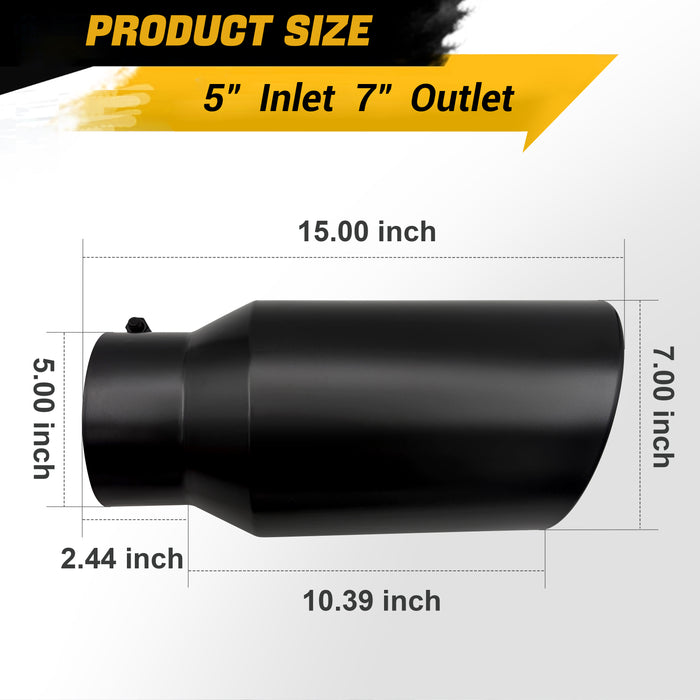
Key insight from Market Prospects: an oversized tip on a small internal pipe can create a hollow, boomy impression rather than a clean deep tone. Match the outlet to your system — a 4-inch inlet to 5-6-inch outlet is a sweet spot for many diesel trucks.
Length
Basic acoustic physics: any pipe section acts as an air column with resonant frequencies that depend on its length. A longer tip acts like an extension of the tailpipe resonator:
-
Longer tips (12–18"): Smoother, mellower exit tone. More time for high-frequency sharpness to dissipate. Can slightly deepen low-end perception.
-
Shorter tips (6–10"): More direct, crisper edge. The shorter tips can sound subjectively louder because sound waves reach the listener with less compression and attenuation.
Wall Design: Single vs Double
-
Single-wall: One layer of metal — lighter, thinner edge, slightly crisper and more direct tone. Slimmer visual profile.
-
Double-wall: Outer sleeve wrapped back over itself — thicker rolled edge, fuller and more rounded tone as sound reverberates slightly between layers. Heavier, more substantial appearance. Also stays cooler externally.
Most sources agree: double-wall tips add a hint of “richness” to the exit note. The sound difference between single and double wall is subtle — most owners choose based on visual preference and the thicker, more finished look of double-wall.
Shape and Cut
-
Straight cut: Clean, direct projection. The most neutral sound profile.
-
Slant cut / angle cut: Directs sound slightly downward or sideways depending on angle. Changes what you and bystanders perceive, even if measured output is unchanged.
-
Rolled edge: Softer exit edge. Visually more finished, acoustically subtle but may reduce the sharpest high-frequency bite.
-
Turn-down: Points sound at the ground. Reduces rearward perception noticeably, it can also reduce drone resonance off the rear bumper and keep the bumper cleaner.
Resonated vs Non-Resonated Tips
A resonated tip has an internal chamber — usually a perforated core surrounded by sound-absorbing packing — built into the tip body. This is the only tip type that can actively filter specific frequencies rather than just shaping sound through geometry.
-
Non-resonated: Subtle tone shaping through diameter, length, and wall design. Mostly visual upgrade.
-
Resonated: Dampens high-frequency rasp and can add low-end fullness. Best for reducing drone on daily drivers or smoothing out aggressive straight-pipe setups.
Important caveat: B2 Fabrication’s real-world testing found resonated tips “almost always make the exhaust system sound worse.” But results depend heavily on the exhaust setup. On a turbo-equipped engine or smaller-displacement vehicle, they tend to perform better. On a large-displacement V8 with an already aggressive muffler, the effect can be unpredictable.
Special Case: The Venturi / “Funky” Duramax Tip
You may have noticed the unusual-looking exhaust tip on newer Duramax trucks (LML, L5P) — it has vent openings around the body rather than a smooth pipe. This is not a sound device. It is a safety feature.
A Venturi Effect
During DPF active regeneration, exhaust gas temperatures can reach approximately 550°C (1022°F). Those vents create a Venturi effect: as hot exhaust gas flows past, it pulls cool outside air into the tip, mixes it, and exits a significantly cooler stream.
The purpose is protecting nearby vehicles, brush, and anyone walking behind the truck from third-degree burns or fire.
Other applications — including Ford Powerstroke trucks and some semi-trucks — use similar designs, though often more discreetly integrated. If your truck has been DPF-deleted, this tip type offers no functional benefit and can be replaced without concern.
Does the Exhaust System Itself Change How Tips Sound?
Yes — and this is the part most guides skip. A tip’s effect is multiplied or suppressed by what is upstream:
- Stock muffler + resonator + DPF/cat intact: Near-zero — the system is too quiet upstream for tip changes to be audible
- Performance muffler only: Low to moderate — some character gets through
- DPF / muffler delete, straight-pipe: Moderate to high — raw combustion pulses reach the tip and the tip’s geometry is the final shaper
- Turbo-back 5" system + open muffler: High — maximum sound energy at the exit means the tip makes the most difference
The single best scenario for hearing a tip difference: a turbo-diesel with a straight-pipe or minimal-muffler system. The raw sound energy is strong, and the tip is the last acoustic filter it passes through.
What Changes Sound Dramatically (vs What Tips Do)
For context, here is a realistic ranking of sound-modification impact:
| Modification | Sound Impact | Typical Decibel Change | Character Change |
|---|---|---|---|
| Muffler delete / swap | High | +10–20 dB | Complete tonal rewrite |
| Resonator delete | Moderate–High | +3–8 dB | Adds rasp, drone, crackle |
| DPF / cat delete | High | +5–15 dB | Freer flow, deeper base note |
| Full cat-back / turbo-back | High | +8–18 dB | System-wide transformation |
| Pipe diameter change | Moderate | +2–5 dB | Deeper or sharper depending on size |
| Exhaust tip swap | Subtle–Moderate | +0–3 dB | Tone refinement, projection, edge tuning |
The tip is the final polish, not the foundation. But on a truck that already has an upgraded exhaust, the right tip can be the difference between “good” and “exactly the tone you wanted.”
When an Exhaust Tip Won’t Fix Your Sound (And What Will)
Knowing what a tip can do is half the picture. Just as important is recognizing the problems a tip cannot solve — so you do not spend money on the wrong fix.
Problem 1: “I Hate the Fundamental Tone of My Engine”
If your diesel sounds too clattery, too tractor-like, or just not aggressive enough at idle and cruise, a tip will not change that. The fundamental tone is baked in by the engine’s firing order, the exhaust manifold design, and the muffler. A tip shapes the exit — it does not rewrite the source material.
What actually helps: A performance muffler swap is the most direct fix. Chambered mufflers deepen the note; straight-through designs add aggression; turbo-style mufflers balance flow with tone. A full cat-back or turbo-back system changes the entire acoustic pipeline.
Problem 2: “I Have Drone at Highway Speeds”
Drone — that low-frequency boom that vibrates through the cab at 1,800–2,200 RPM — is caused by standing waves in the exhaust system. A tip cannot cancel a standing wave. That requires engineered acoustic cancellation upstream.
What actually helps:
- A resonator (also called a Helmholtz or J-pipe resonator) is purpose-built to cancel the specific RPM frequency causing drone.
- A different muffler with more aggressive sound cancellation can reduce drone at the source.
- Pipe routing changes — sometimes simply extending or shortening a pipe section shifts the resonance point outside your cruising RPM range.
Problem 3: “My Truck Is Just Too Quiet”
A tip will not make a stock-muffled truck loud. The muffler and DPF/catalytic converter are absorbing or trapping almost all sound energy before it ever reaches the tailpipe. Putting a 7-inch tip on the end is like putting a megaphone on someone who is whispering — the megaphone can only amplify what is already there.
What actually helps:
- Muffler delete or swap — the single biggest volume lever.
- DPF / catalytic converter delete — removes a major restriction that also absorbs sound.
- Full exhaust system upgrade — larger-diameter piping + free-flow muffler = transformative volume.
This is why the TitanTalk deaf owner’s test was so instructive: he heard a difference between 4" and 2.5" tips because he already had a Flowmaster 44 muffler sending strong sound energy to the exit. On a stock truck, the same tip swap might have been inaudible.
Problem 4: “There Is a Rattle, Hiss, or Leak Sound”
If you hear a ticking, fluttering, or high-pitched hiss — especially on cold starts or under load — you likely have an exhaust leak, not a tone problem. A loose clamp, cracked weld, or blown gasket creates a direct escape path for exhaust pulses before they reach the muffler, which sounds harsh and metallic.
What actually helps: Inspect the full exhaust path. Check flange gaskets, slip-joint clamps, flex pipes, and weld seams. Fix the leak. A tip — even a resonated one — cannot fix a hole upstream.
Problem 5: “My Tip Is Buzzing Against the Bumper”
If your new tip sits too close to the rear bumper or body panel, sound waves reflect off the surface and create a buzzing, vibrating echo.
What actually helps: Extend or adjust the tip so there is at least 1–2 inches of clearance from the bumper or body. If the tip is correct length but the hanger is sagging, replace the exhaust hanger or add a stiffer one. In some cases, a turn-down tip solves this completely by directing sound at the ground instead of the bumper.
The Bottom Line
Tips refine. They do not rescue. If your exhaust sounds fundamentally wrong — wrong tone, too quiet, droning, leaking, buzzing — fix that problem at its source first. Then pick the tip that puts the perfect edge on a sound you already like.
TruckTok Exhaust Systems: Give Your Tip Something to Work With
We offer complete performance exhaust systems that create the strong, clean sound your diesel was meant to make — giving your tip choice the foundation it needs to actually be heard.
2019-2024 6.7L Ram Cummins 4" DPF Delete Downpipe-Back Exhaust
1. 2019-2024 6.7L Ram Cummins 4" DPF Delete Downpipe Back Exhaust
Cummins Power Unleashed
This complete system replaces everything from the downpipe back, eliminating the restrictive factory DPF and muffler that stifle your Cummins' natural sound. The 4-inch mandrel-bent piping is tuned to provide a deep, authoritative rumble that's all business—no artificial enhancement needed.
Sound Characteristics:
- Deep, clean diesel tone without excessive rasp
- Aggressive acceleration note that builds with boost
- Quiet cruise capability for daily driving comfort
- No artificial drone at highway speeds
Why It Works:
By removing the major restrictions and allowing your Cummins to breathe freely, the engine's natural combustion pulses create an authentic, powerful sound that no bolt-on tip could ever replicate.
2. 2011-2015 6.6L GM Duramax LML 4" Downpipe Back DPF Delete Race Pipe
LML Performance Sound
Engineered specifically for the LML Duramax, this race-inspired system takes a different approach to sound. The straight-through design and DPF deletion create a more aggressive, performance-oriented tone that matches the engine's capabilities.
Sound Profile:
- Crisp, immediate response to throttle inputs
- Pronounced turbo whistle on spool-up
- Clean, non-resonant tone under load
- Professional-grade sound quality
The Engineering Behind the Sound:
This system's carefully calculated pipe diameter and length are designed to work with the LML's firing order and turbo characteristics, creating a unique sound profile that's both aggressive and refined—something impossible to achieve with just a different tip.
3. 2011-2022 6.7L Ford Powerstroke 4" DP-Back DPF Delete Pipe
Powerstroke Signature Sound
Ford's 6.7L Powerstroke has a distinctive character, and this system is designed to enhance it, not change it. By replacing the factory DPF and restrictive piping, this 4-inch system lets the Powerstroke's true voice shine through.
Acoustic Results:
- Enhanced low-end rumble characteristic of Powerstrokes
- Smooth, linear sound increase with RPM
- Reduced interior resonance compared to some 5-inch systems
- Perfect balance of presence and civility
Authentic Sound Enhancement:
Instead of asking "will exhaust tips change sound?" in a superficial way, this system works with the Powerstroke's engineering to amplify its natural characteristics. The result is a more powerful version of the sound your truck was meant to make, not an artificial modification.
How to Choose the Right Exhaust Tip: A Practical Guide
Step 1: Measure Your Inlet Size First
The inlet (inner diameter) must match your tailpipe’s outer diameter. This is non-negotiable — wrong inlet = tip will not fit. Common diesel sizes:
| Tailpipe OD | Typical Tip Inlet |
|---|---|
| 3.0" | 3.0" inlet |
| 3.5" | 3.5" inlet |
| 4.0" | 4.0" inlet |
| 5.0" | 5.0" inlet |
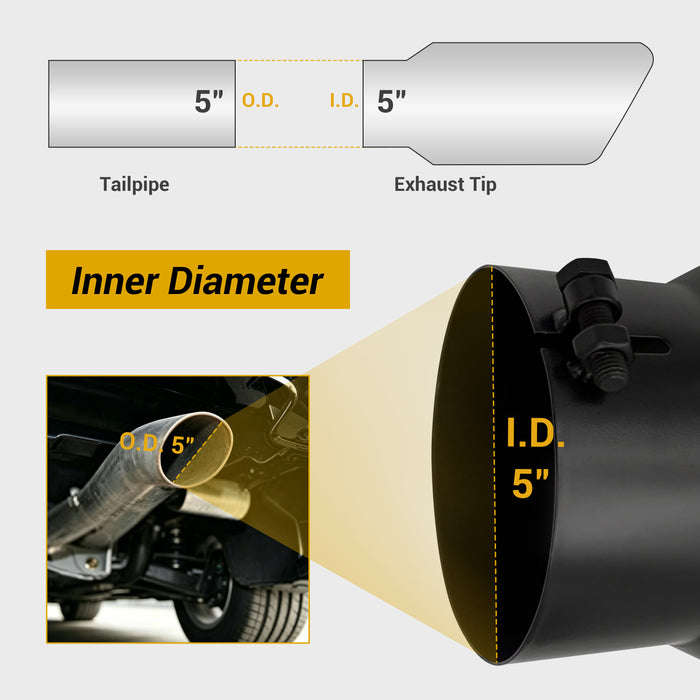
Measure with a caliper or tape measure. Do not guess.
Step 2: Choose Your Outlet Based on Tone Goal
- Subtle factory-plus refinement: +1" over inlet (e.g. 4" in → 5" out)
- Noticeably fuller, deeper tone: +2–3" over inlet (e.g. 4" in → 6–7" out)
- Maximum presence (show truck): +3"+ over inlet (e.g. 4" in → 7–10" out)
Step 3: Pick Length, Wall, and Shape
- Daily driver / work truck: 12–15" double-wall, straight or slight angle cut. Smooth, durable, quieter in-cab.
- Performance / aggressive tone: 8–12" single-wall, angle cut. Crisper edge, more direct presence.
- Show / maximum visual impact: 15–18" double-wall, rolled edge, 6"+ outlet. Heaviest look, smoothest tone.
- Trying to reduce noise: Turn-down tip or resonated tip.
Step 4: Verify Fitment Style
- Clamp-on: Easiest install. Make sure the clamp range matches your tailpipe.
- Weld-on: Most permanent. Requires a welder or shop visit.
- Bolt-on: Some vehicle-specific tips bolt directly to factory hangers.
Conclusion: Tips Matter — Use Them Right
So, do exhaust tips change sound?
Yes. They shape the final tone, refine the edge, and influence how your truck’s exhaust note is perceived — from behind the truck, from the sidewalk, and from inside the cab. The differences are subtle, but they are real, measurable, and confirmed by owners across every diesel platform.
What they do not do: replace a muffler, delete a DPF, add horsepower, or turn a stock truck into a competition puller. If you want dramatic transformation, start with the exhaust system. Then choose the tip that puts the perfect finish on that sound.
Ready to build your truck’s voice? Explore complete performance exhaust systems at www.trucktok.com.
FAQs About Exhaust Tips and Sound
Q1: Do exhaust tips actually make your truck louder?
A1: Exhaust tips typically have minimal effect on overall volume. Real volume changes come from modifying mufflers, deleting resonators, or installing complete performance exhaust systems that reduce restriction.
Q2: What do exhaust tips do for performance?
A2: Most exhaust tips provide negligible performance benefits. Any claims of horsepower gains are typically marketing exaggeration. Real performance comes from complete system upgrades that improve exhaust flow.
Q3: Will exhaust tips change sound more on diesel vs gasoline engines?
A3: Diesel engines, with their distinct firing characteristics and turbochargers, might show slightly more noticeable high-frequency changes with different tips, but the fundamental sound profile is still determined by the complete exhaust system design.
Q4: What does an exhaust tip do that's actually useful?
A4: Exhaust tips primarily enhance appearance, protect the pipe end from damage, and can help direct exhaust gases away from the vehicle body. Any sound changes are secondary and subtle at best.
Q5: Can I combine a performance exhaust system with aftermarket tips?
A5: Absolutely. Once you've installed a quality performance exhaust system that creates the fundamental sound profile you want, adding tips can provide the finishing aesthetic touch and potentially fine-tune the very highest frequencies.
Q6: Single-wall or double-wall tip — which sounds better?
A6: Double-wall tips tend to produce a slightly fuller, smoother tone because the dual-layer construction adds mass and creates a small reverberation space between layers. Single-wall tips sound crisper and more direct. The audible difference is subtle; most owners choose based on visual preference and the thicker, more finished look of double-wall.
Q7: Do resonated exhaust tips actually work?
A7: Yes — resonated tips contain an internal chamber with perforated tubing and sound-absorbing packing. They can effectively reduce high-frequency rasp and sharpen the low-end character. However, results vary by exhaust setup. Best results are typically on turbo-equipped engines and daily-driver setups where rasp reduction is the goal.
Q8: Do short or long tips sound different?
A8: Shorter tips (6–10") tend to deliver a sharper, more direct edge because sound waves spend less time compressed in the tip body. Longer tips (12–18") produce a slightly smoother, more mellow tone with less high-frequency bite. The difference is not dramatic but can be noticeable, especially on trucks with minimal muffling.
Q9: Should I match my tip outlet to my system pipe diameter?
A9: The inlet must match your tailpipe outer diameter — that is a fitment requirement, not optional. The outlet can be any size you choose. A step-up of 1–3 inches from inlet to outlet is the most common sweet spot: it gives you the megaphone-effect depth without looking disproportionate or creating a hollow, boomy character.
Q10: Will exhaust tips change sound more on a diesel than a gas truck?
A10: Diesel engines, with their higher compression, turbochargers, and stronger exhaust pulses, tend to produce more sound energy at the tailpipe. That means tip changes are generally easier to perceive on a diesel than on a naturally aspirated gas engine.
Q11: Are turn-down tips quieter?
A11: Turn-down tips direct exhaust flow and sound waves toward the pavement rather than straight back. This typically reduces rearward noise perception because sound energy reflects off the ground rather than projecting horizontally. They can also reduce resonance off the rear bumper and help keep the bumper cleaner from soot accumulation.
Q12: Can an exhaust tip improve performance?
A12: No. An exhaust tip sits at the very end of the system and does not meaningfully change backpressure, flow velocity, or scavenging. Any performance improvement from a tip alone is within measurement error. Real performance gains come from system-wide upgrades: downpipe, DPF delete, larger-diameter piping, freer-flowing muffler.