

Home > News > 6.4L Powerstroke EGR & DPF Delete — The Complete Guide Before You Commit

6.4L Powerstroke EGR & DPF Delete — The Complete Guide Before You Commit
The 6.4L Powerstroke is the engine diesel guys love to argue about. One camp calls it the worst Powerstroke ever built — a throwaway motor with glass pistons and a DPF that melts them. The other camp points out that a deleted and mildly tuned 6.4L is one of the cheapest, most mod-friendly heavy-duty diesels on the used market today, capable of 600 wheel horsepower with three bolt-ons.
Both camps are right. That’s the whole point of this guide.
The 6.4L’s problems are real, and almost all of them trace back to one system: the emissions equipment. Specifically the DPF regeneration cycle and the pair of EGR coolers bolted to the back of the engine. Delete those, and you stop the single biggest cause of 6.4L catastrophic failure. If you’re going to commit, you should commit with your eyes open about what a delete fixes, what it doesn’t, and what it’s actually going to cost you.
The 6.4L Is Not a Normal Diesel — It’s a Compound Twin-Turbo
Before you can understand why deleting this engine matters so much, you have to understand what it actually is.
The 6.4L Powerstroke (2008–2010) was Ford and Navistar’s rushed replacement for the troubled 6.0L. It was only in production for three model years before Ford walked away from Navistar entirely and built the 6.7L in-house. In that short window, the 6.4L packed a lot of new technology:
-
Series-sequential compound twin-turbo. The 6.4L does not have a single turbo like the 6.0L, and it does not have two parallel “twin” turbos. It runs a compound setup: a small high-pressure (primary) turbo feeds a larger low-pressure (atmospheric) turbo, with variable-geometry on the small one. The result is 28–30 psi of boost in bone-stock form, and 40+ psi with a tune.
-
Siemens K16 high-pressure fuel pump. Not the Bosch CP3 that most competitors used, and not the CP4.2 that the later 6.7L got. The K16 actually outflows a CP3 by about 20% and feeds piezoelectric injectors at well over 30,000 psi. Stock output is 350 hp and 650 lb-ft.
-
A cast-iron block with a bed plate instead of main bearing caps, four valves per cylinder, and four torque-to-yield head bolts per cylinder (not studs).
That twin-turbo, big-fueling foundation is exactly why the 6.4L is so mod-friendly. But it’s also why the emissions system attached to it causes so much damage when it misbehaves.
Why the DPF Is the 6.4L’s Number One Killer
Every modern diesel has a DPF, but the 6.4L’s regen strategy is uniquely brutal, and it’s the root cause of the engine’s reputation.
How It Works
The DPF (diesel particulate filter) catches soot. When backpressure climbs to a threshold, the ECU triggers active regeneration — it dumps raw diesel fuel into cylinders #7 and #8 on the exhaust stroke. That fuel doesn’t burn in the cylinder; it gets pushed into the exhaust as a torch, driving exhaust gas temperatures past 1,200°F to burn the soot out of the filter.
That Single Strategy Causes A Cascade of Damage
1. It melts pistons. Cylinders #7 and #8 run violently hot during every regen. The 6.4L’s pistons are already thin and prone to cracking, and the regen heat is the direct trigger. Crack a piston and you lose compression, increase blow-by, and push more fuel into the oil.
2. It dilutes the oil. A lot of that post-injected fuel slips past the piston rings and down into the crankcase. One owner running 5,000-mile oil changes on a regen-active 6.4L reported draining 19–20 quarts out of an engine that only holds 15. That’s how bad the dilution gets. Ultra-low-sulfur diesel has poor lubricity, so diluted oil stops protecting the bearings, rods, and turbo.
3. It cooks the turbo. That 1,200°F heat waves straight up through the compound turbo setup, shortening its life and baking the wiring and hoses behind the engine.
4. It wrecks fuel economy. All that post-injected fuel is wasted heat, not motion. A 6.4L plowing, idling, or doing short city trips regens constantly and drinks fuel doing it.
This is why the “just delete it for MPG” framing misses the point. A 6.4L delete isn’t primarily about fuel economy — real-world MPG gains are modest, usually +1 to +3 mpg, and the 6.4L is a thirsty engine no matter what. The real reason to delete is that the regen process is physically destroying the engine from the inside.
EGR and DPF Are One System — Delete One, Delete Both
Here’s the trap that catches first-time 6.4L owners. Exhaust soot flows through them, gets cooled, and is fed back into the intake. When the DPF is still present, the EGR system works normally.
If The DPF Is Removed Separately
If you delete the DPF and leave the EGR coolers in place, the delete tune shuts the EGR valve 100% of the time. Now the soot that would have circulated through the coolers has nowhere to go — it just sits inside them and packs up. Within months, the coolers rupture from the buildup and the pressure. One owner on a DPF-deleted truck reported his horizontal EGR cooler blew out a few months after the DPF delete, dumping coolant on a cold morning.
This is the “EGR and DPF are interlocked” rule:
Deleting the DPF without deleting the EGR doesn’t protect the engine — it sets up the next failure. The two systems are one job. Any kit worth buying handles both.
The Up-Pipes: The 6.4L’s Other Exhaust Weak Point
While everyone’s focused on the DPF and EGR, the 6.4L has a quieter exhaust failure that’s worth knowing about before you dig in: the up-pipes.
The up-pipes are the short pipes that carry exhaust gas from the manifolds up into the compound turbocharger. On the 6.4L they run through the cramped firewall area, and the factory versions use flex bellows (corrugated sections) to absorb heat expansion. Over years of heat cycling and corrosion, those bellows crack.
What A Cracked Up-Pipe Does:
- It’s a pre-turbo exhaust leak. Unlike a downpipe leak, an up-pipe leak lets exhaust escape before it reaches the turbo — which directly robs boost and spool.
- Soot in the engine bay. Exhaust escapes around the firewall and leaves a telltale black film near the back of the engine.
- Hissing or whistling under load. The classic symptom — a whistle that follows boost, often mistaken for turbo noise.
- Slower spool and lost response. Boost leaks here mean the turbos work harder for less result.
Why This Matters for Your Delete:
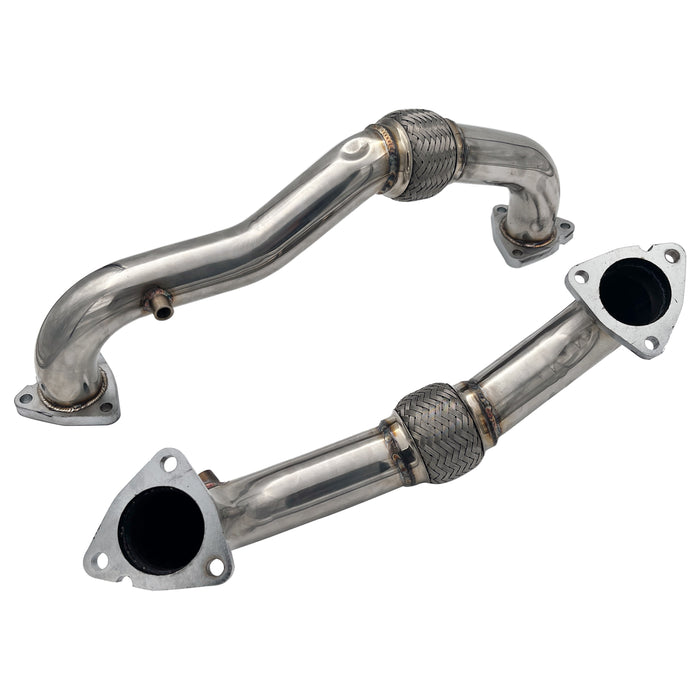
When you’re already in behind the firewall pulling the EGR coolers, the up-pipes are right there. If yours are high-mileage, cracked, or simply old, swapping them during the delete is the cheapest way to do it — you avoid paying to tear into that same cramped area twice. A quality up-pipe upgrade uses T-304 stainless with inner-interlocking braided flex bellows, which handles the heat cycling far better than the factory corrugated bellows.
This is exactly why the most complete 6.4L delete kits bundle the up-pipes with the exhaust and EGR work into one job.
What a Delete Actually Fixes — The Practical Benefits
1. Stops The Regen Cycle
This is the single biggest win on the platform. No more post-injection, no more 1,200°F heat waves baking the pistons and turbo, and no more raw fuel washing past the rings into the oil. Oil dilution drops from the regen-heavy levels — back to normal diesel levels. That alone extends the life of every bearing, the turbo, and the bottom end.
2. Lowers EGTs
Removing the DPF/CAT restriction and opening the exhaust drops exhaust gas temperatures by 100–250°F, depending on the pipe size and tune. EGT is the diesel engine’s health gauge — the lower it runs, the less heat stress lands on the pistons, valves, and turbo.
3. Removes A Known Leak Point
The dual EGR coolers are a chronic failure point — they soot-clog, and when they crack, coolant leaks into the intake, producing white smoke and, in the worst case, hydrolocking a cylinder. Deleting them removes that entire failure mode. No cooler means no coolant in the intake, period.
4. Drops Weight
The DPF/CAT assembly is a heavy chunk of exhaust, and removing it saves roughly 80–100 lbs. On an 8,000-lb truck that’s not a dramatic change, but it comes off the back of the exhaust system where it reduces strain on the hangers and frees up under-body clearance for service.
5. Frees Up Modest Power and Response
What it does is remove exhaust backpressure and EGR flow so the compound turbos spool faster and the engine breathes more freely. Paired with a mild tune, the throttle-response improvement is immediately noticeable, even if the dyno peak doesn’t move much.
What It Does Not Do:
A delete alone will not give you 100 horsepower, will not turn a 6.4L into a fuel sipper, and will not fix anything inside the engine. The horsepower comes from the tune you pair it with, not the pipes.
What a Delete Won’t Fix — The “Bulletproof” Myth
This is the section most delete guides leave out, and it’s the reason this guide says “Before You Commit.”
1. Cracked Pistons
The 6.4L’s pistons are a known weak point — thin castings, a hard lip that collects heat, and questionable quality control. They crack on stock, low-mileage trucks, not just hot-tuned ones. A delete removes the regen heat trigger, but it doesn’t change the piston metallurgy. Owners who’ve had one crack often upgrade to the heavier-duty Navistar MaxxForce 7 pistons.
2. Lifter and Rocker Arm Wear
The 6.4L’s valve train wears prematurely. The first sign is a faint clicking from the intake. It’s a mechanical problem that no amount of deleting fixes — only regular quality oil changes slow it down.
3. Head Gaskets / head Bolts
The 6.4L uses torque-to-yield head bolts from the factory, not studs. They’re redesigned and better than the 6.0L’s, and they’re fine at stock power. But crank the power up and cylinder pressure can push the head off the block. If you plan to run a hot tune, upgraded head studs are a cab-off job you should budget for.
4. Bottom-End Bearing Failure
The 6.4L’s main and thrust bearings can spin in the housing — a catastrophic failure that wrecks the block and crank. It’s not emissions-related; it’s a bottom-end weakness a delete doesn’t address.
5. The K16 Fuel Pump
The Siemens K16 is a strong pump, but when it does fail — often from contaminated fuel or a dying lift pump starving it — it takes the expensive piezoelectric injectors with it. A $700–$800 lift pump added early is cheap insurance that a delete doesn’t provide on its own.
The Honest Summary:
A delete + mild tune removes the single biggest cause of 6.4L failure (the regen/EGR system), but the engine still has internal weak points that only a rebuild, upgraded parts, and disciplined maintenance address. If you go in expecting “bulletproof,” you’ll be disappointed.
How to Choose a Delete Kit: What Actually Matters
Not all 6.4L delete kits are equal, and the price tag doesn’t always tell you what you’re getting. Here’s what to actually look at before you buy.
1. Material and Construction
Stainless steel (T304 or T409) is the standard for a reason — it survives underbody heat and winter salt. Cheaper aluminized steel will rust out in 2–3 years in the salt belt. On the up-pipes specifically, look for inner-interlocking braided flex bellows rather than plain corrugated bellows, which are more prone to cracking.
2. Does It Include The EGR Delete
This is the big one. Because deleting the DPF forces you to delete the EGR (the valve shuts 100% and the coolers pack with soot), a kit that only gives you a DPF pipe is half a job. Buy a kit that handles both systems together, or be prepared to source the EGR hardware separately.
3. Does it include the up-pipes
If your up-pipes are high-mileage or already showing soot around the firewall, a kit that bundles the up-pipes saves you a second teardown behind the engine. This is where the 3-in-1 kits earn their price.
4. Is the tuner included or separate?
Most delete kits do not include a tuner — you’ll buy that separately (Mini Maxx, SCT, or EZ Lynk). Budget for it up front; a kit is useless without a delete tune.
5. Fitment matches your exact truck.
Crew Cab vs Cab & Chassis, short bed vs long bed, F-250/350 vs F-450/550 — these all affect which exhaust fits. A 5-inch downpipe-back system, for example, usually won’t fit a Cab & Chassis. Verify before ordering.
6. Does the listing publish real specs?
A seller that won’t tell you the pipe diameter, material, or what’s actually in the kit is hiding something. The good kits spell out the construction, the fitment, and the contents clearly.
The simplest way to get all six right at once is to buy a platform-specific complete kit — one designed for the 6.4L’s compound twin-turbo and dual-EGR layout, not a generic diesel pipe with a 6.4L part number slapped on it.
The Products: Two Ways to Delete, Both Built for the 6.4L
TruckTok carries two paths that map directly onto the decision above.
Option 1 — The 4-Inch Complete Kit (Exhaust + Up-Pipes + EGR Delete)
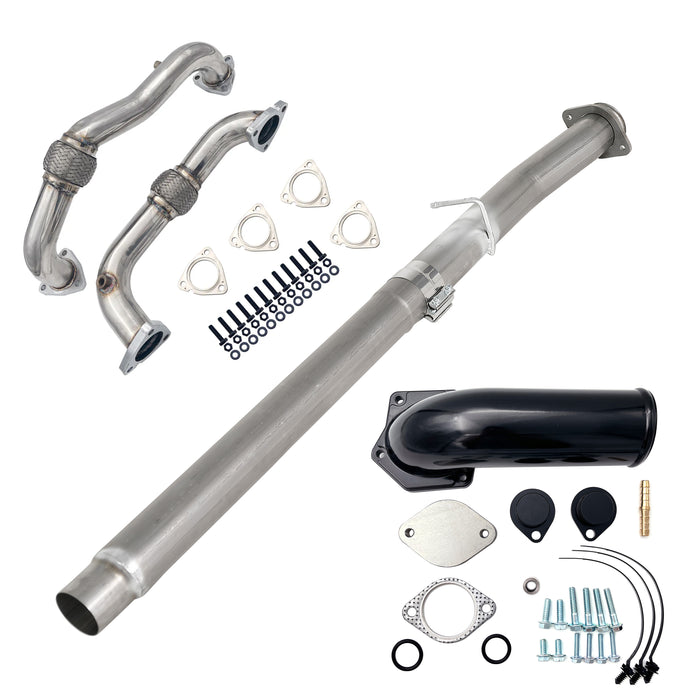
For the daily driver or mild-tune truck, the 2008–2010 6.4L Powerstroke 4" Cat & DPF Delete Pipe & EGR Delete Kit bundles everything into one job:
- 4" mandrel-bent straight pipe that removes the restrictive DPF/CAT and stops active regen cycles.
- Heavy-duty T-304 stainless up-pipes with inner-interlocking braided flex bellows — the exact fix for the cracked-up-pipe boost leak that plagues the 6.4L.
- Complete removal of both factory EGR coolers, eliminating the soot-in-the-intake and coolant-leak failure modes in one shot.
- Fits 2008–2010 F-250/F-350/F-450/F-550, including Cab & Chassis commercial trucks.
Because the up-pipes, EGR coolers, and exhaust all live behind the same cramped firewall, doing them as one kit saves you the duplicate labor of tearing into that area twice.
Option 2 — The 5-Inch Downpipe-Back System
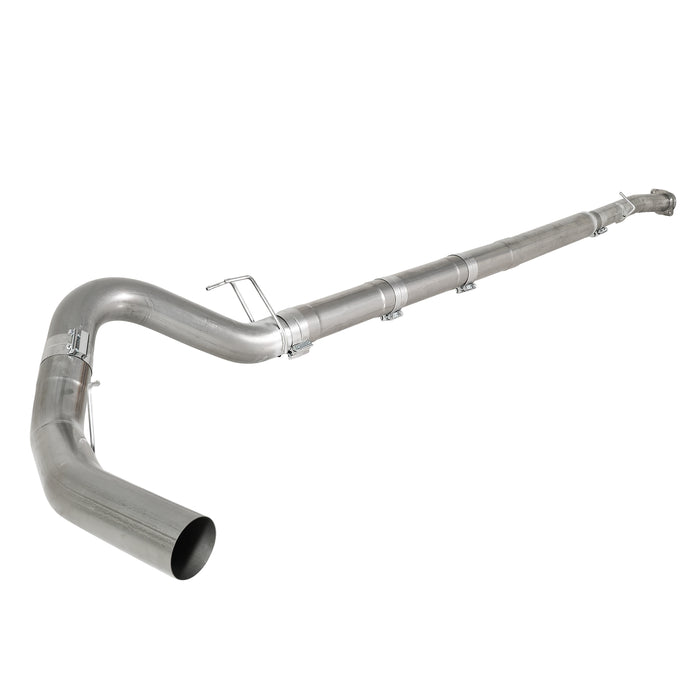
For the high-horsepower build, the 2008–2010 6.4L Powerstroke 5" Downpipe-Back DPF Delete Pipe is the full-tilt option:
- Colossal 5-inch T409 stainless from the downpipe exit all the way back, killing backpressure to zero.
- Drops EGTs 150–250°F under heavy load and gives the compound turbos room to breathe on big custom tunes.
- The deepest, most aggressive V8 diesel roar available for the platform — with the cab drone that comes with it.
- Fits Crew Cab short- and long-bed pickups; does not fit Cab & Chassis trucks.
Both kits require a delete tuner (the Mini Maxx is the common pairing) — that’s non-negotiable, as covered above.
The 4-Inch vs 5-Inch Decision
One of the first questions every 6.4L owner asks: should I go 4-inch or 5-inch?
The short answer: for most trucks, 4-inch is the right call. 5-inch is for high-horsepower builds and maximum sound.
Bigger Is Not Automatically Better:
-
4-inch removes the DPF/CAT restriction and opens up the exhaust enough for a mild-to-moderate tune. It keeps low-end exhaust gas velocity up, which preserves low-RPM torque, and it stays quieter in the cab — a real consideration on a truck you actually drive.
-
5-inch eliminates backpressure completely and shines under high-boost custom tunes, dropping EGTs by 150–250°F under load. But that oversized diameter slows low-RPM gas velocity, which can cost a little low-end grunt below 2,000 RPM on a light tune. And a 5-inch straight pipe drones — deep, bass-heavy drone under load that you’ll feel on every highway pull.
How To Choose: 4" vs 5"
| Dimension | 4-Inch | 5-Inch |
|---|---|---|
| Best for | Daily driving, mild tunes | High-horsepower builds, max sound |
| Low-end torque | Preserved (higher gas velocity) | Slightly softer below 2,000 RPM |
| EGT reduction | 100–150°F | 150–250°F |
| Cab noise | Quiet | Noticeable drone under load |
| Fitment | Broad (incl. Cab & Chassis) | Crew Cab short/long bed only |
| Power ceiling | Up to ~500 whp | 500+ whp |
The decision really comes down to tuning and intent.
- If you’re running a mild tow tune and driving the truck daily, 4-inch is the practical default.
- If you’re chasing 500+ wheel horsepower with a big custom tune and don’t mind the drone, 5-inch is the right foundation.
There’s also a fitment split worth knowing before you order: 5-inch downpipe-back systems typically don’t fit Cab & Chassis (commercial flatbed) trucks — they’re built for Crew Cab short- and long-bed pickups. If you’ve got an F-450/F-550 chassis cab, verify fitment before you buy.
The Honest Cost Math
What does a 6.4L delete actually cost? Here’s the real spread:
- Hardware (the kit): a 4-inch DPF/CAT delete pipe with EGR delete and up-pipes runs roughly $400–$650, depending on whether you bundle the up-pipe and EGR work. A 5-inch downpipe-back system runs $650+.
- Tuner: $400–$800 for a pre-loaded device, more for custom tuning.
- Supporting parts: a lift pump ($700–$800) and, if you’re going hot, head studs (cab-off labor on top).
Compare that to what the emissions system costs to keep:
- A dealer EGR cooler replacement runs $2,000–$4,000.
- A replacement DPF runs $1,000–$1,500 in parts alone, and it’ll clog again if the root cause isn’t fixed.
- A K16 pump failure that takes out the injectors is a $4,000–$6,000 repair.
| Line item | Delete path | Keep emissions |
|---|---|---|
| Hardware / kit | $400–650 | — |
| Tuner | $400–800 | — |
| Preventive lift pump | $700–800 | — |
| EGR cooler replacement | — | $2,000–4,000 |
| DPF replacement | — | $1,000–1,500 |
| K16 pump + injector failure | — | $4,000–6,000 |
| One-time total | ~$800–1,450 | $1,000–6,000+ (and recurring) |
The math lands where it always does on the 6.4L: a delete costs less than one round of emissions-system repairs, and it prevents the most expensive failure mode entirely. That’s the real “savings” argument — not fuel economy.
The Golden Rule: Tune First, Then Unbolt
This is non-negotiable, and it’s the most common DIY mistake on the platform.
First, Delete Tune Into The ECM
If you pull the DPF or EGR first and drive the truck, the ECM is still looking for regen and EGR flow — it throws a check-engine light and drops you into limp mode immediately. You’ll see codes like P2459 (regen frequency) and P0401 (EGR flow).
A Note On Tuners
A basic pre-loaded tune is fine for a delete; a custom tune ($500–$700) is worth it if you want the timing and fueling optimized for your exact setup. But the key point for reliability is to run a mild tune — the 250-hp-over-stock “hot” files are exactly how people crack pistons and lift heads on a 6.4L.
The Cooling System: 28–30 Quarts and a Burp You Can’t Skip
One Detail Specific to The 6.4L:
It has a big cooling system — 28–30 quarts — and deleting the EGR coolers means draining and refilling a meaningful chunk of it. If you leave air pockets in the system, you’ll get cavitation and hot spots, and the truck will overheat.
The Proper Fill – Vacuum Fill
It pulls air out and sucks coolant in with no bubbles. Without it, the manual “burp” is:
- Raise the driver’s side of the truck about 2 feet.
- Use a spill-free funnel and keep the coolant level constant and high.
- Run the engine until the thermostat opens (watch for bubbles to stop appearing in the funnel).
- Drive, let it cool, and top off the degas bottle — repeat until the level holds.
Skipping the burp is how a clean delete turns into an overheat on the first tow. Don’t skip it.
The Install: A Step-by-Step Walkthrough
The 6.4L delete is an advanced DIY job — the access behind the engine is extremely tight, and most people need a full day or more the first time. Here’s the full sequence, in the order that prevents mistakes.
Tools and Parts You’ll Need
- Sockets: 10mm deep (EGR hardware), 13mm and 15mm (clamps and flanges), plus extensions and swivels for the back-of-engine bolts.
- Torx bits and pry bars for brackets and stubborn components.
- Penetrating oil (PB Blaster or WD-40) — spray every exhaust flange, clamp, and bolt a day ahead.
- O2 sensor socket for removing the exhaust sensors without damaging them.
- Drain pan (2–3 gallons capacity for the coolant) and fresh coolant.
- Torque wrench for re-tightening clamps and flanges to spec.
- Ratchet strap — the DPF/CAT assembly is heavy and hangs up on its hangers; the strap lets you lower it safely.
Prep (Do This Before You Unbolt Anything)
- Park on flat ground, set the brake, and chock the wheels.
- Let the engine cool completely — you’ll be working around hot manifolds and coolant.
- Disconnect both negative battery terminals to kill power and prevent accidental starts.
- Drain 2–3 gallons of coolant into a clean pan (via the radiator petcock or lower hose).
- Confirm the delete tune is already flashed (see the Golden Rule above) before touching hardware.
Remove the DPF/CAT and Install the Race Pipe
- Lift the front of the truck if you need clearance, and support it on jack stands.
- Locate the downpipe-to-DPF flange, the DPF-to-midpipe connection, and the exhaust hangers.
- Unplug and label every sensor before you disconnect anything — the 6.4L has several, and labeling prevents reconnection mistakes.
- Loosen the clamps and bolts, support the DPF/CAT with the ratchet strap, and work it free of the hangers.
- Test-fit the race pipe, align it, and tighten the clamps front to back so the joints seat evenly.
Remove the EGR System
- On the driver’s side, remove the battery and tray, then the degas bottle and upper coolant hose for access.
- Pull the intake tubes, then the EGR valve and throttle body.
- Remove the upper EGR cooler, then the lower cooler — you may need to loosen the steering shaft for clearance.
- Install the block-off plates on the intake and exhaust ports, and the coolant reroute hardware so coolant still flows correctly through the now-open loop.
- Reassemble in reverse, refill the coolant, and run the burp procedure covered above.
Post-Install Checks
- Recheck every clamp and flange for tightness after the first heat cycle.
- Watch the degas bottle level over the first few drives and top off as air works its way out.
- Take it easy for the first drive to let the transmission and tune settle, then verify no codes and no leaks.
The three mistakes that bite most people: skipping the tune-first step (instant limp mode), not labeling the sensors (crossed plugs), and rushing the coolant burp (overheat on the first tow). Take your time on all three.
Conclusion
The 6.4L Powerstroke is a genuinely capable engine hiding behind a genuinely bad emissions system. The DPF regen cycle — dumping fuel into cylinders #7 and #8 to torch the filter at 1,200°F — is the root cause of the cracked pistons, oil dilution, and turbo failures that gave this engine its reputation. Deleting the DPF and the EGR coolers together stops that damage at the source, and it does so for less than the cost of a single dealer emissions repair.
But commit with clear eyes. A delete is a reliability mod, not a bulletproofing mod. The 6.4L still has internal weak points — pistons, valve train, bottom-end bearings — that no pipe can fix. The play that actually works is simple: delete both systems, run a mild tune, add a lift pump early, change the oil at 5,000 miles, and don’t chase big horsepower.
For the full lineup of 6.4L delete pipes, EGR kits, up-pipes, and tuners — built specifically for the 2008–2010 Super Duty — head to TruckTok.com. Every kit is engineered for the platform’s unique compound twin-turbo and dual-EGR layout, ships free, and is backed by fitment guidance for your exact cab and bed configuration.
Frequently Asked Questions
Q1: Will a delete improve my fuel mileage?
A: Modestly. Real-world gains are usually +1 to +3 mpg, and the 6.4L is a thirsty engine regardless. The real savings come from stopping the regen fuel waste and the oil dilution — not from a big MPG jump.
Q2: Do I have to delete the EGR if I delete the DPF?
A: Yes. If you delete the DPF and leave the EGR coolers, the tune shuts the EGR valve 100%, soot packs into the coolers, and they rupture within months. The two systems are one job.
Q3: Does deleting add horsepower?
A: The delete itself doesn’t. Removing backpressure frees up spool and response, but the power comes from the tune you pair with it. A mild tune gives you the best reliability-to-power balance.
Q4: Will deleting make my 6.4L bulletproof? A: No. It stops the biggest failure cause (regen/EGR), but pistons, valve train, and bottom-end bearings can still fail. Deleting + mild tune + good maintenance is the realistic recipe for longevity.
Q5: Can I install a delete without removing the cab?
A: Yes, most deletes can be done cab-on, but access behind the 6.4L is extremely tight — the up-pipes and EGR coolers sit right against the firewall. It’s an advanced DIY job; plan for a full day or more the first time. If you’re also doing head studs, that’s the one job that really wants a cab-off approach, since it needs the engine out.
Q6: What size exhaust should I choose, 4-inch or 5-inch?
A: 4-inch for daily driving and mild tunes — it stays quieter in the cab and preserves low-end torque. 5-inch is for high-horsepower builds and maximum sound, but expect noticeable drone and a slight low-RPM torque trade-off. If you run a mild tune, 4-inch is the practical default; go 5-inch only if you’re chasing big power and can live with the noise.
Q7: Is a delete legal to drive on the street?
A: No. Removing emissions equipment violates the federal Clean Air Act (42 U.S.C. § 7522) and can carry fines. These parts are for off-road, race, or competition use only — check your local laws.
Q8: What happens if I delete without a tune?
A: Instant check-engine light and limp mode, with codes like P2459 (regen frequency) and P0401 (EGR flow). The ECM is still looking for the regen and EGR systems that are no longer there. Always flash the delete tune before removing any hardware, and never drive the truck in between.
Q9: How much does a delete cost all-in?
A: Roughly $400–$650 for the hardware, plus $400–$800 for a tuner, and another $700–$800 if you add a preventive lift pump. That’s less than a single dealer EGR cooler or DPF replacement, which runs $1,000–$4,000. A full delete lands around $800–$1,450 all-in — still cheaper than one round of emissions repairs.
Q10: Does a 5-inch exhaust fit an F-450/F-550 chassis cab?
A: Usually not — 5-inch downpipe-back systems are built for Crew Cab short- and long-bed pickups, not commercial flatbeds. Cab & Chassis trucks need a kit that explicitly lists that fitment, or a 4-inch setup that covers F-450/F-550. Always verify your exact cab and bed configuration before ordering.