

Home > News > 6.0L Powerstroke EGR Cooler Delete vs Repair — Which Saves More?


6.0L Powerstroke EGR Cooler Delete vs Repair — Which Saves More?
The 6.0L Powerstroke is the diesel we love to hate. It earned a reputation as one of the least reliable diesels of the last 20 years, and plenty of owners have stared at a repair estimate that costs more than the truck is worth. But here’s the thing most people miss: the 6.0’s worst failure — the EGR cooler — isn’t really the EGR cooler’s fault. It’s a symptom of a cooling system that clogs upstream and takes the cooler down with it.
That distinction is exactly what decides the “delete vs repair” question. Delete the EGR and you remove the symptom. Fix the root cause and you might not need to delete anything. This guide lays out the real numbers, the real mechanisms, and the real decision — so you don’t pay for the same job twice.
The 6.0’s Weak Link: Why the EGR Cooler Fails
The 6.0L Powerstroke’s EGR cooler failure is a cascade, not an isolated part wearing out. Understand the chain and you understand everything else about this decision.
The chain works like this:
-
The oil cooler sits in the engine valley, a liquid-to-liquid heat exchanger that moves heat from the engine oil into the coolant before it heads to the radiator.
-
The block was sand-cast. That process leaves tiny silica (casting sand) particles trapped in the water jackets. Over thousands of miles, that sand loosens and circulates through the cooling system.
-
The oil cooler’s passages are narrow. That sand lodges in them and, over time, plugs the cooler completely. Coolant flow through the oil cooler drops toward zero.
-
The EGR cooler is downstream. Coolant that leaves the oil cooler normally flows into the EGR cooler to pull heat out of the exhaust gas. When the oil cooler clogs, the EGR cooler stops getting coolant and runs dry.
-
The EGR cooler overheats and ruptures. The factory unit is a brazed tube-and-shell design. Repeated dry heat cycles crack the braze joints, and coolant leaks into the intake — white smoke, coolant loss, and eventually hydraulic lock or a blown head gasket.
The key insight: the EGR cooler didn’t fail because it was old. It failed because the oil cooler upstream strangled it. A technician who only replaces the EGR cooler — and leaves the plugged oil cooler in place — is handing you a second failure. You’ll do the job twice.
The Real Choice: Repair It, or Remove It
When the EGR cooler goes, you have two genuine paths. They’re not morally equivalent, and they’re not legally equivalent — but they’re both real.
Path 1 — Repair (replace the cooler, keep the EGR system legal)
This is the road-legal option. You replace the failed EGR cooler, and — critically — you also replace or service the oil cooler that caused it. Many owners upgrade to an aftermarket cooler with a stronger core, which the factory unit simply doesn’t have.
Path 2 — Delete (remove the EGR system entirely)
This removes the EGR cooler and blocks off the exhaust-gas path, permanently eliminating the failure point. It’s the “never again” option — but it’s illegal on a public-road vehicle, voids the emissions portion of your warranty, and makes the truck harder to resell in states with emissions inspections.
A third path — bulletproof without deleting
It sits between them. You upgrade the oil cooler (or relocate it), install a coolant filter to catch the casting sand, and keep a legal, upgraded EGR cooler in place. It’s the most expensive upfront but keeps the truck street-legal.
The rest of this guide prices out each path and shows you which one actually saves money — because the answer isn’t as simple as “delete is cheaper.”
What Repair Actually Costs
The forum numbers are the most honest data we have, because they’re what real owners actually paid — not what a marketing page claims. From a long-running Ford forum thread where owners compared EGR cooler repair bills:
| Repair scenario | Reported cost | Notes |
|---|---|---|
| Dealer, full job (EGR cooler + oil cooler + flush + intake) | $3,100 | Gary’s 2004 Excursion; included hot-tanking the intake, new EGR valve, turbo clean |
| Dealer, cooler + radiator + flush | $2,200 | 2005 F-250, southern Mississippi |
| Dealer, cooler + oil change + flush | $2,000 | West Virginia |
| Independent, bulletproof cooler + new OEM oil cooler | $1,900 | Stroker22, with tax |
| Independent, bulletproof parts + labor | ~$2,000 | Jeff in Arizona, $400 labor at $65/hr |
| Independent, EGR delete + oil cooler + radiator + degas + flush | ~$1,000 | frizfreleng’s diesel mechanic |
The Takeaway:
Dealer repair runs $1,900–$3,100, and independent shops land $1,000–$2,000. The spread is almost entirely labor — the 6.0’s EGR cooler is buried in the engine valley, and reaching it means pulling the alternator, air intake, turbo, and intake manifold. That’s a 6–12 hour job even for someone who’s done it before.
The hidden cost nobody quotes: if you repair the cooler but don’t address the plugged oil cooler, you’ll pay this bill again. A “cheap” cooler-only repair is the most expensive option in the long run.
What Delete Actually Costs
Delete is mechanically simpler than repair because you’re removing the failure point instead of replacing it. The parts are cheaper, but the job still requires the same teardown — the EGR cooler lives in the same buried spot.
Typical Delete Breakdown:
-
EGR delete kit: $150–$500 for a complete kit (block-off plates, coolant reroute, hardware). Budget block-off-only kits run lower; billet aluminum kits with 304 stainless hardware run higher.
-
Tune: $300–$600. Removing the hardware without a supporting calibration leaves you with EGR-related diagnostic codes and, on some calibrations, limp mode. The tune is not optional.
-
Labor: 4–8 hours DIY, or shop labor if you’d rather not.
-
Total, DIY: roughly $500–$1,500 depending on kit quality and tune.
Why delete is appealing: it’s a one-time fix. There’s no cooler to rupture again, no cascade to repeat. The catch is everything else — legality, warranty, and resale.
Which Saves More? The Honest Math
| Path | Recurring risk | Legality | Best for |
|---|---|---|---|
| Dealer repair (cooler + oil cooler + flush) | Low if oil cooler is serviced; high if skipped | Fully legal | Street-driven trucks, warranty-sensitive owners |
| Independent repair | Same caveat | Fully legal | Street trucks on a budget |
| Delete (kit + tune, DIY) | None — failure point removed | Illegal on-road, $5,911 max individual fine | Off-road, race, farm, export only |
| Bulletproof without delete | Low | Fully legal | Long-term owners who want legal reliability |
The short answer:
-
If you want the cheapest one-time fix and the truck is for off-road/competition use — delete is cheapest. A $56 delete kit plus a tune and a weekend of your own labor removes the problem permanently.
-
If the truck is street-driven — repair, but repair it right. Replace or service the oil cooler in the same job, and add a coolant filter so the casting sand never clogs it again. A $1,900–$3,100 dealer repair that includes the oil cooler is cheaper in the long run than a $1,000 cooler-only patch that fails again in 20,000 miles.
-
Whichever path you pick, install a coolant filter. It’s the $100 part that stops the cascade at the source — and it’s the single highest-value dollar you’ll spend on a 6.0.
The real trap isn’t choosing delete vs repair. It’s choosing either one without fixing the oil cooler. Do that, and you’ll pay twice no matter which way you went.
Why So Many Owners Choose Delete Anyway
Given that delete is illegal on public roads, why do so many 6.0 owners still go that route? The reasons aren’t hard to understand once you’ve lived with a 6.0 for a while.
What a Delete Actually Gets You
The benefits are real, even if they’re often oversold as “more horsepower.” Strip away the hype and here’s what a delete genuinely delivers:
-
The failure point is gone — permanently. A repair puts a new cooler in the same vulnerable spot. A delete removes the cooler, so there’s nothing left to rupture. No more white smoke, no more coolant loss, no more cascade to repeat. That’s the single biggest draw.
-
No more coolant-in-the-cylinder risk. The 6.0’s EGR cooler failure is what leads to hydraulic lock and blown head gaskets. Delete the cooler and that entire chain of catastrophic outcomes is cut off at the source.
-
Cleaner intake for the life of the engine. Hot, soot-laden exhaust is no longer recirculated into the intake. The sticky diesel carbon that cakes the intake manifold, jams the EGR valve, and plugs the turbo’s VGT vanes stops accumulating the day you delete.
-
A lighter load on the cooling system. One less heat exchanger means the coolant isn’t fighting to shed the EGR cooler’s heat, and oil temps run more stable. For an engine already notorious for heat management, that’s meaningful.
-
A simpler, cleaner engine bay. The EGR system is a tangle of coolant hoses, hard lines, and sensors — all of them leak points on an aging truck. Delete removes a chunk of that, and fewer connections mean fewer future leaks.
Why Owners Are Willing to Accept the Trade-Off
-
They’ve been burned once already. The 6.0’s EGR cooler has a reputation for failing again after a repair, especially when the oil cooler wasn’t addressed. Owners who paid $2,000–$3,000 once and watched the same symptom come back are the ones most tempted to make it go away for good.
-
They have no intention of reselling. A used 6.0 sells for a fraction of what a comparable Duramax or Cummins commands. Many owners treat it as a work truck or a project, not a resale asset — so the “it hurts resale” argument matters less to them than to a new-truck buyer.
-
The 6.0 community normalizes it. Spend any time on a 6.0 forum and “bulletproof” and “delete” are treated as the default path to making the engine reliable. New owners get steered toward it early, often before they fully weigh the legal side.
-
The reliability payoff is undeniable. Whatever you think of the legality, a deleted 6.0 with a serviced oil cooler and a coolant filter is a more reliable engine than a stock one with a factory EGR cooler waiting to fail. Owners value that certainty.
The Honest Counterweight: none of these benefits change the law. Delete on a public-road vehicle violates 42 U.S.C. § 7522 and can make the truck unsellable or unregistrable in states with inspections. The benefits are real — but they’re for off-road, race, competition, farm, and export trucks, not for a daily-driven street rig.
Delete Doesn’t Add Horsepower
This is the most common misconception in the delete world, so let’s clear it up: removing the EGR cooler does not add horsepower by itself.
What an EGR delete actually does:
- Removes a failure point — no cooler to rupture, no coolant to leak into the cylinders.
- Reduces intake temperatures — hot, soot-laden exhaust is no longer recirculated back into the intake.
- Reduces carbon buildup — the sticky diesel soot that cakes the intake, the EGR valve, and the turbo’s VGT vanes stops accumulating.
- Lowers heat load on the cooling system — one less heat exchanger for the coolant to manage.
Any horsepower gain you’ve heard about comes from the tune, not the delete. And on a stock-headed 6.0, chasing big power is how you blow head gaskets — the factory used torque-to-yield head bolts with only four per cylinder, and once you add fuel and boost, they stretch. If power is your goal, head studs come first.
The Honest Framing: a delete is a reliability and heat-management modification, not a power modification. If someone sells it to you as a horsepower upgrade, they’re either confused or selling you a tune as part of the package.
The Hidden Variable: The Oil Cooler Runs the Show
Here’s the single most important point in this entire guide, and it applies no matter which path you choose: The oil cooler is the root cause. The EGR cooler is just the victim.
That means:
-
If you repair — replace the oil cooler (or at minimum service and flush it) in the same job, or the new EGR cooler dies the same way the old one did.
-
If you delete — you’ve removed the EGR cooler, but the plugged oil cooler is still there. And a plugged oil cooler doesn’t just kill EGR coolers; it raises oil temperature, which degrades oil, cokes the turbo, and stresses the whole engine.
How To know Oil Cooler Is Clogged — The Delta Test
Drive the truck at steady highway speed and watch two parameters with a scan tool or monitor: engine oil temperature (EOT) and engine coolant temperature (ECT). The factory tolerance is 15°F. If your oil temp runs more than 15°F hotter than the coolant temp at a steady cruise, the oil cooler is restricted and needs attention — even if the EGR cooler hasn’t failed yet.
The Cheapest Insurance Against The Whole Chain
A coolant filter catches the casting sand and rust flakes before they reach the oil cooler, so the oil cooler never clogs and the EGR cooler never runs dry. It’s a bypass-loop filter that purges sediment continuously without restricting radiator flow — and it’s the one mod that makes either the repair path or the delete path actually stick.
The Products: Three Ways to Fix the 6.0 the Right Way
TruckTok carries the exact hardware for both paths — and the filter that makes either one stick.
1. The Delete Kit — $ 56.14
If you’re going the delete route, this is the core piece.
2003-2007 6.0L FORD Powerstroke Diesel EGR Delete Kit Fits
- A CNC-machined billet aluminum and 304 stainless kit that permanently bypasses the factory EGR cooler.
- It blocks off the exhaust-gas path and reroutes coolant away from the fragile factory setup, eliminating the risk of internal coolant leaks into the cylinders.
- Fits 2003–2007 F-250/F-350/F-450/F-550 Super Duty, the Excursion, and 2005–2010 E-Series 6.0L vans — and not the 7.3L, 6.4L, or 6.7L.
- Installs in the engine valley beneath the intake manifold, so budget for the same teardown as a cooler replacement.
Why it fits this decision: it’s the one-time fix at the lowest parts cost. Pair it with a tune and a coolant filter, and the EGR cooler can never fail on you again.
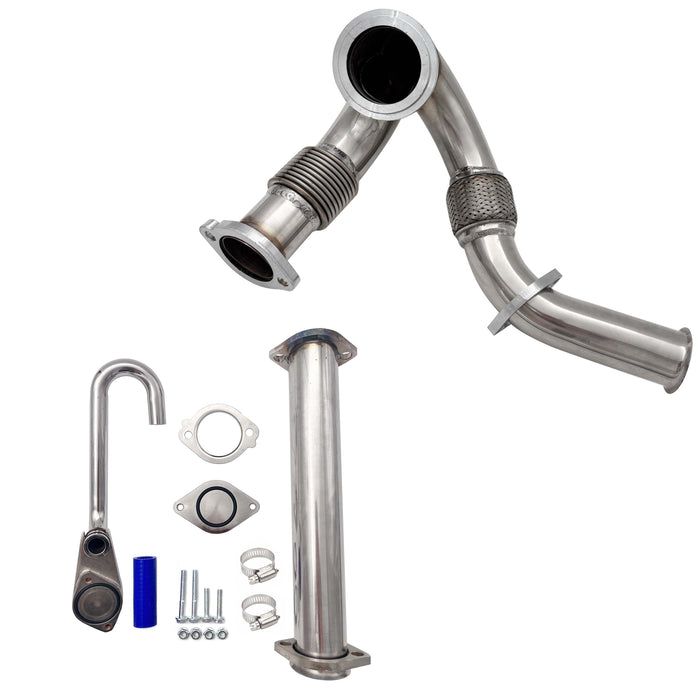
2. The Y-Pipe & Cooler Kit — $178.69
If you’re going to be in the valley anyway, this kit fixes two failure points at once.
2003-2007 6.0L Ford Powerstroke Y-Pipe & EGR Basic Cooler Kit
- Heavy-duty polished stainless up-pipes with reinforced flex joints, plus a high-flow EGR cooler bypass.
- It addresses the other 6.0 exhaust weakness — the factory up-pipe bellows that crack under repeated thermal cycling and leak exhaust before it reaches the turbo, causing underboost and sluggish acceleration.
- Restore turbo response, reduce boost loss, and eliminate the coolant-leak risk — all while you’re already in the hardest-to-reach part of the engine.
Why it fits this decision: the up-pipe bellows and the EGR cooler fail from the same cause (extreme heat cycling) and live in the same buried spot. If you’re deleting or replacing the cooler, doing the up-pipes at the same time avoids a second teardown later.
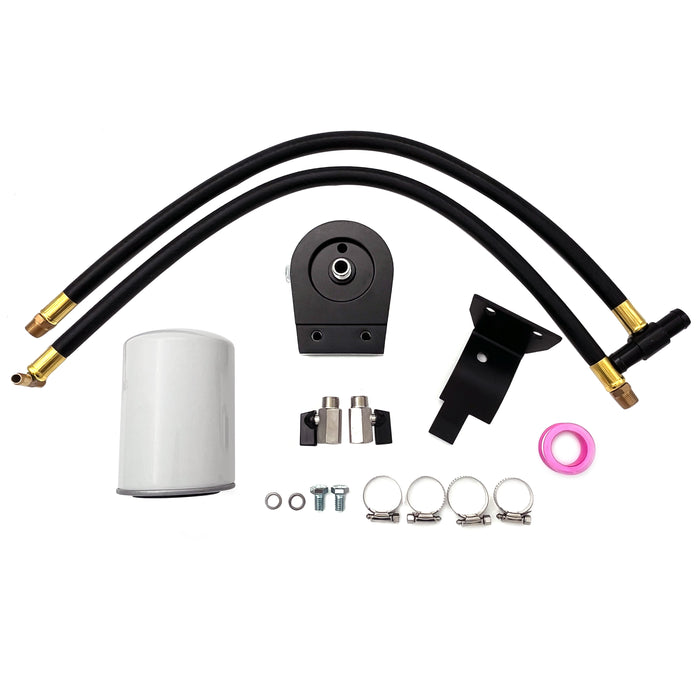
3. The Coolant Filtration Kit — $100.99
This is the part that makes either path actually last — and it’s the highest-value dollar you can spend on a 6.0.
2003-2007 6.0L Ford Powerstroke Coolant Filtration Filter Kit
- A 6061 billet aluminum filter base with a spin-on filter that runs on a non-restrictive bypass loop, continuously purging casting sand, rust, and mineral scale down to a few microns before they can clog the factory oil cooler.
- Includes inline brass ball valves for mess-free filter changes, and pre-cut reinforced silicone hoses.
- Fits 2003–2007 F-250 through F-550 Super Duty.
Why it fits this decision: the oil cooler is the root cause of the entire cascade, and this filter stops the casting sand before it reaches the oil cooler. Replace the first filter at 3 months / 3,000 miles (it’ll pull out a shocking amount of accumulated sludge), then once a year or every 15,000 miles. It’s fully compatible with — and highly recommended alongside — an EGR delete.
Does Your 6.0 Qualify? Fitment for 2003–2007
If You’re Going The Delete
The delete kits covered here fit the full 2003–2007 6.0L Powerstroke range — F-250/F-350/F-450/F-550 Super Duty, the Excursion, and 2005–2010 E-Series vans. One kit covers the whole span.
If You’re Going The Repair
The 6.0L Powerstroke ran from 2003 to 2007, but there’s a hard break inside that range you must get right before ordering any parts.
The round vs. square EGR cooler split:
-
Round cooler — trucks built before 9/22/2003 (2003 and early 2004).
- Square cooler — trucks built on or after 9/22/2003 (late 2004 through 2007).
The two do not interchange. Order the wrong one and it won’t bolt up, or it’ll leak. Confirm your build date (or the cooler shape) before buying anything.
Make Sure It’s Actually A 6.0L
These kits don’t fit the earlier 7.3L Powerstroke or the later 6.4L. The 6.0L is the only Powerstroke of this era that’s EGR-only — no DPF, no DEF, no SCR (those came with the 6.4L in 2008). If a parts listing or forum post talks about a “6.0L DPF delete,” it’s wrong.
How the Delete Goes In: A Quick Install Walkthrough
If you’ve decided to delete, here’s what the job actually looks like — condensed to the essentials. The EGR cooler lives in the engine valley, buried under the intake manifold, so the teardown is the real work. Budget a full weekend your first time.
What You’ll Need
- Sockets: 8mm, 10mm, 12mm, 13mm, plus a torque wrench and a couple of extensions
- A pry bar and a pick for the stubborn hose clamps and coolant fittings
- PB Blaster or similar — the valley bolts on a high-mileage 6.0 are heat-soaked and seized
- A clean drain pan and fresh coolant (the job drains several gallons)
- A tune ready to go — the calibration comes first, not last
The Steps, in Order
-
Flash the tune first. Disconnect nothing yet — write the delete calibration to the ECM while the truck is still complete. This prevents the EGR diagnostic codes and limp mode that come from running without the EGR while the ECM still expects it.
-
Disconnect the batteries and drain the coolant. Pull both negative cables, then drain at the radiator petcock into a clean pan. You’ll lose coolant the moment you crack the EGR cooler lines.
-
Clear the top of the engine. Pull the air intake, the air filter housing, and the alternator to open up room. On most 6.0s, the alternator has to come out to reach the valley.
-
Remove the turbo inlet and the intake manifold. This is the bulk of the labor — the intake manifold sits directly over the EGR cooler and has to come off to expose it.
-
Unbolt the EGR cooler. There are bolts on the top and along the bottom edge, and the coolant lines at each end. Expect the rear bolts to be the worst — heat-cycled and hard to reach.
-
Install the block-off plate and the coolant reroute. Bolt the block-off plate over the exhaust-gas opening, then plumb the coolant reroute (a J-tube or bypass hose) so the coolant circuit stays intact and free of air pockets.
-
Reassemble and refill. Put the intake, turbo inlet, alternator, and air intake back on, refill the coolant, and burp the system thoroughly — a trapped air pocket in a 6.0 shows up as an overheat on the first hot drive.
The Three Mistakes That Bite People
- Skipping the oil cooler. This is the single biggest one. The delete removes the EGR cooler, but the plugged oil cooler that caused the failure is still in there. Replace or service it in the same job, or the engine runs hot anyway.
- Not cleaning the mating surfaces. Coolant and exhaust both seal against flat machined faces. Leftover gasket material or corrosion means a leak you’ll chase for weeks. Scrape and clean every surface before the block-off plate goes on.
- Dropping the tune until the end. Flash first, then unbolt. Doing it backward is the fastest way to a check-engine light and a truck that won’t behave on the test drive.
Conclusion
The 6.0 Powerstroke EGR cooler question isn’t really “delete or repair.” It’s “will you fix the root cause, or just the symptom?”
- Fix the root cause — service or replace the oil cooler, and add a coolant filter — and either the repair or the delete path will hold.
- Skip the root cause — and you’ll pay for the same job twice, no matter which path you chose.
For a street-driven truck, the honest answer is repair done right: replace the cooler and the oil cooler, install a coolant filter, and drive it legally for years. For an off-road or competition-only truck, delete is the cheapest one-time fix — a $56 kit, a tune, and a weekend of work, backed by the same $100 coolant filter.
TruckTok has all three pieces for whichever way you go — the EGR delete kit, the Y-pipe & cooler kit for the while-you’re-in-there fix, and the coolant filtration kit that protects the oil cooler behind it all. All ship free and in stock, ready to keep your 6.0 on the road (or the trail) instead of in the shop.
Frequently Asked Questions
Q1: Is it cheaper to delete or repair a 6.0L EGR cooler?
A1: Delete is usually cheaper upfront — a $56 kit plus a tune and DIY labor runs $500–$1,500, versus $1,900–$3,100 at a dealer. But delete is illegal on-road, so for a street truck the “cheaper” option is a repair that also fixes the oil cooler.
Q2: Why do 6.0 EGR coolers fail so often?
A2: They rarely fail on their own. Casting sand from the block clogs the oil cooler, coolant flow to the EGR cooler stops, and the cooler runs dry and ruptures. The oil cooler is the root cause; the EGR cooler is the victim.
Q3: Do I have to replace the oil cooler too?
A3: Yes, in the same job. If you replace only the EGR cooler and leave a plugged oil cooler in place, the new cooler will fail the same way. The delta test (oil temp more than 15°F above coolant temp at cruise) confirms a clogged oil cooler.
Q4: Does an EGR delete add horsepower?
A4: No. The delete removes a failure point and lowers intake temps, but any power gain comes from a tune, not the delete itself. On a stock-headed 6.0, chasing power without head studs is how head gaskets blow.
Q5: Do I need a tune after a 6.0 EGR delete?
A5: Yes, in most cases. Removing the hardware without a supporting calibration leaves EGR-related codes and, on some calibrations, limp mode. Confirm the tuning plan before you start tearing down.
Q6: What’s the difference between the round and square EGR cooler?
A6: Trucks built before 9/22/2003 use a round cooler; those built on or after use a square cooler. They don’t interchange, so confirm your build date or cooler shape before ordering.
Q7: Does the 6.0L have a DPF or DEF?
A7: No. The 6.0L is an EGR-only platform — no DPF, no DEF, no SCR. Those came with the 6.4L in 2008. Any listing talking about “6.0L DPF delete” is wrong.
Q8: What’s the best cheap insurance for a 6.0?
A8: A coolant filter. It catches the casting sand before it clogs the oil cooler, which stops the whole cascade at the source. It’s the highest-value $100 you’ll spend on a 6.0, and it works with either a delete or a repair.
Q9: How does the 6.0L compare to the 6.4L for deletes?
A9: The 6.0L is EGR-only with a cooling-system problem; deleting it removes that failure point. The 6.4L has a DPF whose regeneration cycle dilutes the oil and damages the engine, so deleting a 6.4 is closer to life support than comfort.
Q10: Is an EGR delete legal?
A10: No, not on public roads. Federal law (42 U.S.C. § 7522) prohibits removing or disabling emissions equipment on a road-driven vehicle, with individual fines up to $5,911. Delete only applies to off-road, race, competition, farm, or export use where permitted.
Removing or tampering with emissions equipment on a vehicle driven on public roads violates federal law under 42 U.S.C. § 7522, with individual penalties up to $5,911. EGR delete content in this article applies strictly to off-road, race, competition, farm, or export use where permitted by law. Check your local and state regulations before modifying any emissions system on a public-road vehicle.