

Home > News > 2017-2019 L5P Duramax Air + Cabin Kit: Clean Engine and Cabin in One Box


2017-2019 L5P Duramax Air + Cabin Kit: Clean Engine and Cabin in One Box
The Silverado HD and Sierra HD owner is usually serious about maintenance. Oil changes happen on schedule, fuel filters get swapped on time, and every service reminder gets attention. But there are two filters that never trip a warning light — and they’re the two that quietly decide how long your turbo and your lungs stay healthy.
One sits in a black plastic airbox on the passenger side of the engine bay, guarding the turbo. The other sits behind the glove box, guarding every breath you take through the HVAC system. Neither one sends a dashboard alert. Both degrade so gradually that most owners adapt to the decline without ever noticing — until the truck feels a little soft pulling a trailer, or the A/C kicks on with that musty smell.
The Two Forgotten Filters — Why “One Box” Isn’t Just Convenience
The engine air filter and the cabin air filter protect two completely different systems, and the consequences of neglecting them play out in two completely different ways — but they share one thing in common: they’re both easy to forget, and both fail silently.
The Engine Air Filter Guards the Turbo
The 6.6L L5P Duramax runs a Garrett variable-geometry turbocharger that moves massive air volume under load. At full boost, the compressor wheel spins past 100,000 RPM. At those speeds, a dust particle doesn’t just scratch a compressor blade — it erodes it, gradually changing the blade profile and cutting boost efficiency over tens of thousands of miles.
The Air Filter Has Demanding Job:
Stop everything bigger than a few microns from reaching the turbo inlet, while still flowing enough air to support 445 horsepower and 910 lb-ft of torque. Too restrictive, and the turbo fights intake vacuum. Too porous, and dust gets through. That’s the balance a quality filter has to strike.
The Cabin Filter Guards Your Lungs
Behind the glove box, a rectangular panel filter processes every cubic foot of air entering the passenger cabin — whether it’s 95°F with the A/C maxed or 15°F with the heat blasting. It catches what the outside air carries: diesel soot from the truck stopped in front of you, cottonwood pollen off the county road, mold spores colonizing a filter that’s been in there two years too long.
Here’s The Part Most Owners Miss:
A cabin filter’s primary job is air quality, not cooling performance. The A/C can still blow cold through a filter that’s fully saturated with dust, pollen, and mold spores — the refrigerant system doesn’t care what the filter looks like. What changes is what you’re breathing, and the strain on the blower motor working against the restriction.
Why They Belong on the Same Schedule
The two filters degrade on different timescales — the air filter every 15,000–30,000 miles, the cabin filter every 12,000–15,000 — but the 15,000-mile mark is the natural checkpoint where both are worth inspecting. When you’re under the hood checking one, pop the glove box and pull the other. Having both in the garage eliminates the second trip to the parts store, and one box means one less thing to forget.
Know Your Generation: The Filter Split That Trips Up L5P Owners
This is the single biggest mistake owners make when buying L5P filters, and it’s worth drilling into before you order anything.
GM made small but critical changes to the L5P intake and HVAC platforms that mean older-generation filters will not fit — even if they look close.
| Component | 2011–2016 LML | 2017–2019 L5P | 2020+ L5P Refresh |
|---|---|---|---|
| Engine Air Filter | A3141C | A3231C / A3257C | A3248C |
| Cabin Air Filter | 22759208 (2014–2016) | 23281440 / CP809 | CF185 |
| Airbox Lid | Side-clip | Spring-clip | Different box geometry |
| Intake Architecture | Pre-L5P airbox | Redesigned for L5P flow | Higher-flow airbox |
| Turbo Platform | VVT BorgWarner | Garrett VGT | Garrett VGT (revised) |
It Tell Us:
If a listing says “fits 2011–2022 Duramax” without specifying the generation, that filter is claiming cross-generational compatibility that doesn’t exist. There is no single air filter that spans all three platforms.
The Cabin Filter Situation Is Simpler:
The 2014–2019 trucks share the same CP809 / 23281440 form factor. If you’ve seen a CP809 listed for a 2015 or 2016 truck, it’s the same part. The one caveat: 2011–2013 trucks didn’t come with a cabin filter from the factory at all, so an early LML needs a different retrofit kit — not this one.
Bottom line: match the filter to your year. A3231C/A3257C + 23281440/CP809 for 2017–2019, nothing else.
What’s Actually in the $44.08 Box
The Duramax air & cabin air filter kit is designed around the things that matter most for L5P owners: correct application, reliable filtration, proper sealing, and a complete air-maintenance solution in one package — no hunting for two part numbers across two orders.
Open the TruckTok kit and you get both filters for one complete intake and cabin service:
-
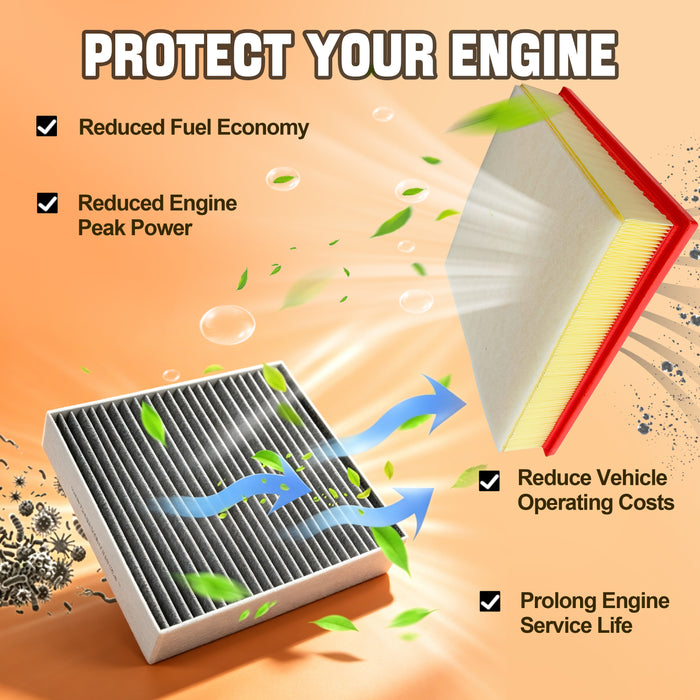
Engine air filter (A3231C / A3257C replacement) — high-efficiency synthetic media with an integrated top metal-mesh reinforcement that prevents pleat collapse under high-boost intake vacuum. Direct drop-in for the factory L5P airbox. A continuous molded polyurethane perimeter seal eliminates unfiltered bypass.
-
Cabin air filter (23281440 / CP809 replacement) — multi-layer filtration with an activated-carbon layer that adsorbs diesel exhaust fumes, industrial odors, and seasonal pollen. A precision-molded flexible frame creates a gap-free seat inside the factory HVAC housing.
-
Free shipping — one box, one tracking number, no separate orders.
The metal-mesh detail matters more than it sounds:
When the L5P’s Garrett VGT pulls hard during towing or passing, the intake vacuum tries to deform the pleats. A filter without reinforcement can collapse against the airflow and leave a gap — and the compressor wheel is the first thing downstream. That’s the difference between a filter that just “fits” and one that holds up under load.
What Makes a Good Filter — and How to Spot a Bad One
The price difference between filter options almost always comes down to what’s inside the filter, how well it seals, and how consistently it performs on your L5P. Here’s the checklist that separates a filter that actually protects your truck from one that just looks like it fits.
The Five Things a Quality Filter Has
-
It reports an efficiency number, not just a size. A listing that only says “fits 2017–2019 Duramax” is dodging the question that actually matters: how well does it filter? A quality filter states its filtration efficiency — the cheap ones can’t, because there’s nothing to brag about.
-
A real perimeter seal. The continuous polyurethane gasket on the engine filter, and the precision-molded frame on the cabin filter, are what stop unfiltered air from bypassing the media at the edges. Cheap filters use thin rubber or foam that can’t hold a gap-free seat under heat and vibration — and a gap at any corner sends dirty air straight past the filter.
-
Enough pleats and media area. More pleats means more surface area, which means the filter flows well and lasts longer before it restricts. The cheapest filters save money by using fewer pleats — which is exactly why they load up faster.
-
Reinforcement where the platform demands it. On the 2017–2019 L5P, the engine filter’s top metal-mesh layer is what keeps the pleats from collapsing when the Garrett VGT pulls hard under boost. A filter without it can deform and open a gap under load — and the compressor wheel is the first thing downstream.
-
Correct generation match. A3141C, A3231C, and A3248C are three different filters for three different airboxes. A listing that claims to span all of them is a red flag, not a convenience.
For the Cabin Filter: The Activated-Carbon Difference
The cabin filter has its own quality split, and it’s the reason the kit beats the base dealer part.
A standard cabin filter traps particulate — dust, pollen, mold spores, roughly down to 5 microns. An activated-carbon filter does that and adsorbs gases the particulate layer can’t touch.
The numbers, from independent air-quality research (including a 2025 University of Birmingham study on in-vehicle NO2):
| Capability | Standard Filter | Activated-Carbon Filter |
|---|---|---|
| Dust / pollen / mold spores | ✅ | ✅ |
| NO2 (diesel exhaust) reduction | Minimal | 64–67% |
| VOC / chemical odor removal | ❌ | 82–87% |
| Odor neutralization | ❌ | ~94% |
| Airflow resistance | Lower | Slightly higher |
The one legitimate downside is slightly higher airflow resistance from the carbon layer — in practice a non-issue on a fresh filter, and it only becomes meaningful if the filter is overdue, which is true of any filter type.
Why It Matters More In An HD Diesel:
These trucks spend their lives in demanding environments — construction sites, gravel roads, farm fields, and stop-and-go traffic where the truck in front of you is spewing diesel exhaust. A particulate-only filter lets those fumes pass straight through. The carbon layer is what actually cleans them. And it’s worth noting: the base GM dealer cabin filter is particulate-only — no carbon layer.
Signs Both Filters Are Overdue: You should Change Your Filters
Neither filter trips a warning light. Here’s what to watch for instead.
Engine Air Filter Symptoms
- Reduced throttle response when towing — the turbo works harder to pull air through a loaded filter, and the first place you feel it is sustained boost with a trailer attached.
- Slight turbo lag — a restricted filter increases intake vacuum, so the turbo takes longer to spool to target boost.
- More turbo whistle under acceleration — as the compressor fights the restriction, the audible spool changes; owners describe it as louder or higher-pitched.
- Lower fuel economy under load — reduced airflow efficiency shows up when towing or running sustained highway speeds.
- The sunlight test — hold the filter up to bright light. If light can’t pass through the pleats, it’s done. Gray-brown dust packed into the pleat valleys isn’t surface dirt; it’s saturation.
Cabin Air Filter Symptoms
- Musty smell when the A/C first kicks on — the most common complaint. Bacteria feed on organic debris trapped in a saturated filter.
- Weak airflow from the vents — a loaded cabin filter restricts the blower motor; you find yourself turning the fan higher for the same cooling.
- Dust settling inside the cabin — a filter so loaded it’s bypassing around the edges lets fine dust coat the dash.
- More noticeable diesel exhaust smell — a spent carbon layer stops adsorbing, and exhaust fumes pass straight through.
- Windows that won’t defog — restricted HVAC airflow reduces the system’s ability to clear condensation.
A Duramax can still run, and the A/C can still blow cold, with both filters restricted — the problem is that both systems are working harder than they need to. The entire combo kit costs less than a single dealer engine air filter, and turbocharger repair costs dramatically more than routine filter maintenance.
Why the Oiled “Performance” Filter Is a Trap on the L5P
You’ll see washable oiled-cotton filters marketed as “more airflow, more horsepower.” Independent dyno and filtration testing tells a different story — and it’s a story worth knowing before you put one on a stock-tuned L5P.
Here’s what the testing actually shows:
Flow The Most air — But Filter The Worst
In side-by-side filtration tests, the oiled-cotton filters let the most particles through (in one test, thousands of particles versus near-zero for the best dry media). The oil wicks contaminants instead of trapping them.
The Oil Migrates to The MAF Sensor
Oiled filters can shed micro oil droplets that coat the Mass Air Flow sensor’s hot wire, causing erratic readings and check-engine lights. A Toyota TSB even warns that MAF failure from oiled filters isn’t warranty-covered.
The Dyno Gains Are Negligible On A Stock L5P
On a stock-tuned truck, the factory intake already flows enough air. The difference between a quality dry filter and a “high-flow” oiled filter is single-digit horsepower at best — and you’re trading that for measurably worse filtration and a real MAF-contamination risk.
The Bottom Line: on a stock-tuned 2017–2019 L5P, a dry synthetic filter like the A3231C provides the airflow without the oil-migration problem. If the truck is a daily driver, a tow rig, or anything that spends time in dust, the dry filter is the smarter choice every time.
The Cost Math: One Box vs. Buying Separate vs. Going Cheap
As of late 2026, here’s what the market looks like for a 2017–2019 L5P air + cabin pair:
| TruckTok Kit | Buy Separately | ACDelco Dealer | Generic Marketplace | |
|---|---|---|---|---|
| Engine air filter | Included | $25.99 | $30–$45 | $12–$22 |
| Cabin air filter | Included | $22.99 | $25–$35 | $8–$18 |
| Total | $44.08 | $48.98 | $55–$80 | $20–$40 |
| Carbon cabin layer | ✅ | ✅ | ❌ | ❓ Often not stated |
| Perimeter seal | Polyurethane | Polyurethane | OEM rubber | ❓ Unknown |
| Free shipping | ✅ | Two orders | Dealer pickup | Varies |
| Orders to track | 1 SKU | 2 SKUs | 2 part numbers | 2 listings |
What you’re actually paying for is the combination of correct fitment, filtration performance, sealing quality, and long-term protection. The $20–$40 generic pair looks cheaper — until you realize the “engine air filter” has no stated filtration spec, no reinforcement, and an unknown perimeter seal material. A filter that doesn’t seal at the edges is a filter that lets unfiltered air bypass straight into the turbo.
The $44.08 kit costs less than one dealer engine air filter alone, and it includes a carbon cabin filter the dealer doesn’t even offer at the base price point.
Installation: Two Filters, About Fifteen Minutes Each
Both swaps are genuinely beginner-level — zero mechanical experience needed. Here’s the full walkthrough for each. Not only do we offer high-quality products, but we will also provide you with complete and well-illustrated detailed installation instructions.
Engine Air Filter (10–15 minutes)
Location: passenger side of the engine bay — the black plastic airbox between the fender and the engine, with the accordion intake tube feeding into it.
Tools: 10mm socket and ratchet, clean rag, compressed air or shop vac (recommended).
-
Disconnect the MAF sensor. One or two connectors plug into the top of the airbox lid. Grip the connector body, never the wires, and pull straight out. Pulling the wires can break the internal connections.
-
Remove the weather stripping along the fender. The rubber strip near the airbox pulls out of its channel without tools — it’s hiding a mounting bolt underneath.
-
Remove the 10mm bolt on the intake tube bracket. Set it somewhere you won’t lose it.
-
Flex the accordion tube out of the way. It has enough give to push toward the front of the truck and lift up over the airbox — you’re not removing the whole intake, just flexing it clear.
-
Open the airbox and pull the old filter. Release the spring clips and lift the lid; the old filter lifts straight out.
-
Clean the airbox. Bugs, leaves, sand, and fine dust collect in the bottom tray. Blast or vacuum it out before the new filter goes in — otherwise that junk gets pulled into the clean side on first startup.
-
Install the new filter, bottom edge first. Drop it in with the polyurethane gasket facing up. Make sure the bottom edge engages the groove in the lower housing — if it doesn’t seat, the lid won’t seal.
-
Reassemble. Lower the tube, reinstall the 10mm bolt, press the weather stripping back in, and reconnect the sensor plugs until they click.
Cabin Air Filter (10–15 minutes)
Location: behind the glove box. This applies to the full 2014–2019 platform.
Tools: T15 Torx driver (a compact ratcheting bit driver helps on the tight bottom screws), magnetic pickup tool (recommended).
-
Empty the glove box. Everything comes out — the assembly is removed fully, not just dropped past stops.
-
Remove the four T15 Torx screws. Two on top, two on the bottom. The bottom two are tight; the bottom-left is the hardest to reach. Use a magnet so you don’t lose a screw into the dash.
-
Pull the glove box assembly out. Two metal push clips on the sides and alignment pins at the top hold it. A firm pull releases it with a click.
-
Remove the cabin filter access cover. Behind the glove box is a rectangular cover with clips along the top and bottom edges, and a hinge point at the bottom. Press the tabs and pull it off — a wiring harness runs in front of the housing, so push it aside carefully so you don’t break the bottom hinge.
-
Remove the old filter — note the orientation. The arrow printed on the frame points down toward the blower motor (the blower sits below the filter). Before tossing the old one, check which way the arrow points.
-
Install the new filter, arrow down. Match the old filter’s orientation. It’s slightly wider than tall — if it resists, it may be rotated 90 degrees.
-
Reinstall the cover. Seat the bottom hinge points first, then push the top tabs in until they click.
-
Reinstall the glove box. Line up the alignment pins, push the metal clips into their slots until they click, then reinstall the four screws — top two first, then bottom two. Hand-tighten; they thread into plastic and over-torquing strips the hole.
The Mistakes That Quietly Cost L5P Owners Money
Mistake 1 — Assuming the air filter is fine because the truck “feels fine.” Turbocharged engines compensate for intake restriction by working the VGT harder to maintain target boost. The truck still makes power; the turbo is just working overtime. Replace by mileage, not by feel.
Mistake 2 — Skipping the airbox clean-out. A new filter dropped into a dirty airbox gets its clean side contaminated on first startup. Thirty seconds of vacuuming is worth more than it costs.
Mistake 3 — Installing an oiled performance filter. The MAF-contamination risk and worse filtration aren’t worth the negligible gains on a stock L5P. Stick with a dry synthetic filter.
Mistake 4 — Never replacing the cabin filter because the A/C still blows cold. The refrigerant system doesn’t care what the filter looks like. Your lungs do.
Mistake 5 — Buying a cabin filter without confirming it’s the carbon version. If the listing doesn’t say “activated carbon,” assume it’s particulate-only.
Mistake 6 — Installing the cabin filter upside down. The arrow must point down toward the blower. Upside-down installation reduces filtration and can deform the media over time. (One installer on a 2017 2500HD found the previous owner had it in backwards — the “clean” side was the dirty one.)
Mistake 7 — Vacuuming and reusing a cabin filter. Vacuuming removes loose surface debris but not the particulates embedded in the media or the bacteria colonizing the fibers. A vacuumed filter is a dirty filter that looks cleaner.
After the Swap: How to Keep the Filters Working Longer
Installing them is half the job. The other half is the habits that stretch each filter to the end of its interval.
-
Write the date and mileage on each filter in Sharpie before it goes in. It’s the cheapest way to kill the “when did I change this?” question.
-
Stop pulling the air filter out to “check” it. Repeated removal flexes the seal and gives dust a chance to get in. Trust the restriction indicator (the filter minder) on the airbox — it reads red when the filter is actually restricting airflow.
-
Keep the airbox and intake path clean. A clean housing means the new filter only ever sees what it’s supposed to.
-
Feed it clean driving conditions where you can. Trucks that spend 500 hours idling on a job site have moved as much air through the filter as one driven 10,000 highway miles. Don’t assume low odometer mileage means a clean filter.
-
Recheck the seal after a few hundred miles. New gaskets settle; a quick look at the airbox lid and cabin cover costs nothing and catches a poor seat early.
-
Inspect before towing season. If the truck’s main job is pulling, check both filters before the season starts — the filters are cheap, and the turbo and your lungs aren’t.
The Bottom Line
The 2017–2019 6.6L L5P Duramax breathes through two filters most owners forget about until the symptoms show up — a musty A/C smell, or turbo response that’s just not what it used to be. Both fail silently, both protect something expensive, and both hit the same 15,000-mile checkpoint.
If you’re still buying the engine air filter and cabin filter separately at the parts counter, you’re paying more and tracking more part numbers than you need to. The TruckTok filter kit gives you both in one box at $44.08 with free shipping — a carbon-activated cabin filter the base dealer part doesn’t include, a synthetic-media engine air filter with metal-mesh reinforcement, and zero time hunting two part numbers.
Need more? The combo scales. Add the oil filter with the Air, Cabin & Oil Kit, or cover everything — air, cabin, oil, and fuel — with the Full Maintenance Kit . Every step up consolidates more part numbers into fewer orders.
At TruckTok, we carry the filters, delete kits, and maintenance parts for the trucks you actually drive — Powerstroke, Cummins, and Duramax, matched to the exact year and configuration. Questions about fitment? The TruckTok forum has a growing community of L5P owners working through the same maintenance schedule, and we’re here to make sure you get the right part the first time.
Frequently Asked Questions
Q: Can I use a 2020+ A3248C engine air filter in my 2017–2019 truck?
A: No. The 2020 model year got a redesigned airbox with different internal dimensions. The A3248C won’t seat properly and leaves a gap at the perimeter seal, letting unfiltered air bypass into the intake. Match the generation: A3231C/A3257C for 2017–2019.
Q: I tow a fifth-wheel 8,000 miles a year. How often should I change the engine air filter?
A: Inspect at 10,000 miles. Sustained towing means sustained high-boost operation, which loads the filter faster than highway cruising. Expect replacement by 15,000–20,000 miles under those conditions.
Q: Can I run the cabin filter longer if I rarely use the A/C?
A: The cabin filter processes all outside air entering the cabin, whether the A/C is on or not. In “fresh air” mode every cubic foot of ventilation air passes through it. Replace annually regardless of A/C usage.
Q: Does the combo include the seals or O-rings for the filter housings?
A: The engine air filter has a built-in polyurethane perimeter gasket — no separate seals to install. The cabin filter frame is molded to factory dimensions and seats directly into the housing. Everything you need is on the filter itself.
Q: Can I buy these filters individually if I only need one?
A: Yes. The engine air filter (FI-G-19-03, $25.99) and cabin air filter (FI-G-19-04, $22.99) are available separately. The combo saves about $5 and ships as one package.
Q: Are these filters compatible with the gasoline 6.6L L8T engine?
A: No. These are engineered for the 6.6L L5P Duramax turbo-diesel. The L8T gas engine uses a different airbox, intake tract, and HVAC housing. The 2500/3500 HD was available with both engines, so verify yours before ordering.
Q: Will using aftermarket filters void my warranty?
A: Generally, no. Under the Magnuson-Moss Warranty Act, a manufacturer can’t void your warranty just for using quality aftermarket filters for routine maintenance. Coverage may be denied only if a failure is caused directly by improper installation or a defective filter.
Q: How do I tell if my engine air filter needs replacing between scheduled intervals?
A: Hold the panel up to bright light. If light can’t pass through the pleats, or heavy dirt is packed into the pleat valleys, it’s time to replace.