
Home > News > 2016-2019 6.7L Powerstroke CCV Filter: The $112 Part That Saves Your Turbo



2016-2019 6.7L Powerstroke CCV Filter: The $112 Part That Saves Your Turbo
The crankcase ventilation filter is the part nobody thinks about until the engine bay starts sweating oil. It sits on top of the valve cover, does its job in silence for tens of thousands of miles, and then — somewhere past the service interval — it quietly stops doing its job. When that happens on a 6.7L Powerstroke, the bill isn’t a filter. It’s a turbo, or a rear main seal, or a bed plate seal that requires pulling the transmission.
That’s the whole story in one line: a $112 filter is standing guard over a $4,000 repair. Here’s how it works, how to know it’s failing, when to swap it, and why the 2016–2019 trucks are in a uniquely confusing spot when you go to order the part.
What a CCV Filter Actually Does: Why Diesels Need One More Than Gas Engines
Blow-By, and Why the Crankcase Has to Breathe
Every engine has blow-by. During combustion, a small amount of gas sneaks past the piston rings and into the crankcase. That gas isn’t clean — it’s carrying oil vapor, unburned fuel, moisture, and combustion byproducts. On a gas engine, a PCV valve handles this. On a diesel, the job falls to the CCV — Crankcase Ventilation — system.
The crankcase has to breathe. If that blow-by pressure has nowhere to go, it builds, and it always finds the weakest exit: a seal, a gasket, a hose connection. Picture shaking a soda can and cracking the lid. That’s positive crankcase pressure with nowhere to vent.
How the CCV Filter Works
The CCV system’s job is to let that pressure out safely — but here’s the catch. You can’t just vent it to the atmosphere, because emissions regulations route it back into the intake. And you can’t route raw, oily blow-by straight into the intake either, because then you’re feeding oil vapor into your turbo and intercooler.
It’s the barrier in the middle:
It strips the oil mist and carbon out of the blow-by gas before that gas is recirculated, then lets the separated oil drain back to the crankcase. Clean-ish gas goes to the intake; oil stays where it belongs.
Oil Vapor Is the Glue
There’s a phrase that sums up why this matters more than it sounds: oil vapor is the glue. On its own, the dry soot that a diesel’s EGR system pumps into the intake would mostly blow through. But mix that soot with oil vapor, and it turns into sticky sludge that coats the turbo compressor wheel, the intercooler walls, the charge pipes, and the MAP sensor. The CCV filter is the component that keeps that glue out of the system.
The 6.7L Powerstroke CCV Has a Generation Problem — Know Which One You Have
The Four Generations at A Glance
This is where 6.7L owners get tripped up, and it’s the single most important thing to understand before you order anything. Ford changed the CCV design across the 6.7L’s run, and the differences determine whether you’re buying a filter or a whole box.
| Model Years | CCV Configuration | Serviceable Filter? | What You Replace |
|---|---|---|---|
| 2011–2019 | Replaceable filter element (FL2077-class) | ✅ Yes | Filter element |
| 2020–2022 | Sealed baffle-style box | ❌ No | Entire box |
| 2023+ | Revised, smaller box | ❌ No | Entire box |
The Early Trucks (2011–2017): A Replaceable Filter Element
The early trucks — call it 2011 through roughly 2017 — used a larger CCV box with an actual, replaceable filter element inside. That element is the Motorcraft FL2077, and it’s what the 2016–2019 replacement you’ll find on the shelf is built to interchange with. This is the version with the filter that wears out and gets swapped.
The Later Trucks (2019+): A Sealed Baffle Box
Later trucks moved to a sealed baffle-style box with no serviceable filter at all. Open one up and there’s no media — just molded passages and baffles designed to slow the oil vapor down so it condenses and drains back. The owner’s manual for those trucks effectively tells you the box “doesn’t require replacement,” and the real-world guidance is to swap the whole box around 100,000 miles.
Why The 2016–2019 Window Is Tricky
Why does this matter to you? Because the 2016–2019 window straddles the changeover. If you own a 2016–2019 F-250 or F-350, or a 2016–2019 F-450/F-550, and you’re hunting for a “CCV filter,” you need the serviceable element. Match the part to your year, and check the cross-reference number before you click buy.
The Failure Chain: How a $112 Filter Turns Into a $4,000 Bill
The scary part about the CCV filter isn’t what it does when it’s working — it’s how quietly it fails, and how far the damage travels once it does. The chain runs like this:
1. The Filter Saturates
Over tens of thousands of miles, the microfiber media loads up with oil mist, carbon, and — in cold climates especially — a thick condensate-and-oil emulsion. Freezing winter conditions accelerate this dramatically, because condensation builds faster in a cold crankcase and turns the media into a soggy, restrictive block.
2. Crankcase Pressure Climbs
A saturated filter can’t pass blow-by gas freely anymore. The ventilation path narrows, and the pressure that used to escape now has to push harder to get out. The math is simple: as the filter loads, the pressure drop across it rises, and the crankcase side sees more and more of that pressure before anything vents.
3. Oil Finds The Weak Points
High crankcase pressure doesn’t just sit there — it pushes. The first casualties are usually the valve cover gasket and the front crankshaft seal, which show up as oil weeping you can see. That’s your early warning.
4. The Big Seals Blow
Keep ignoring it, and the pressure reaches the two seals that are genuinely expensive to fix: the rear main seal and the bed plate seal (the upper oil pan seal). On the 6.7L Powerstroke, the bed plate seal is the one that’ll really hurt — when it lets go, the fix involves pulling the transmission, and the labor alone dwarfs the price of any filter.
5. The Turbo Eats Oil Vapor The Whole Time
Parallel to all of this, a failing CCV filter stops doing its primary job: separating oil mist. More oil vapor reaches the intake, coats the compressor wheel and intercooler walls, and turns into the sludge that eventually kills efficiency, spikes intake temps, and shortens the turbo’s life.
The punchline is brutal in its symmetry: the filter that was supposed to protect the turbo and the seals is the very thing that, left too long, destroys both. One owner’s story that floats around the diesel forums puts a number on it — ignore the crankcase filter warning for 10,000 extra miles, blow the rear main seal, and a sub-$100 filter becomes a $1,500+ repair.
How to Know Your CCV Filter Is Failing (Before the Oil Shows Up)
The CCV filter usually announces itself visually before it causes a drivability complaint, which is exactly why so many owners miss it. Here’s what to look for, in rough order of how early you’ll catch it:
The Oil Cap Bounce Test (zero tools):
With the engine idling and warm, loosen the oil fill cap but don’t remove it — let it rest on the opening. On a healthy engine, the cap should sit still or wobble gently, maybe even be held lightly by suction. If the cap is visibly pushed up, “dances,” or chuffs, you’ve got elevated crankcase pressure, and a saturated CCV filter is the prime suspect.
Oil Weeping Around The Valve Covers:
Fresh, unexplained oil residue around the valve cover, the front crank seal, or the CCV housing itself is the classic first sign. It shows up before any check-engine light, and it’s your signal to inspect the ventilation path.
Oily Residue In The Intake:
Pull a charge pipe or intercooler boot and look inside. An oil film there means oil vapor is getting past the filter and into the induction path. On a clean-running system, those walls should be relatively dry.
Burning-oil Smell Under The Hood:
When oil weeps onto a hot exhaust manifold or turbo housing, you’ll smell it after a hard pull or a long idle. It’s not subtle.
The Dashboard Code:
On the 6.7L, a crankcase-pressure or CCV-related fault can surface as a P04DB code (and related plausibility codes like P0106 or P0299 can appear indirectly when oil contamination or boost leaks throw off the sensors). Some trucks also have a box-disconnect sensor that’ll trip a malfunction lamp if the ventilation hose blows off.
A Swelling CCV Box (Early Trucks):
On the filter-equipped early boxes, a badly saturated filter can actually cause the top of the plastic housing to swell. If yours looks puffy, it’s done.
The takeaway: don’t wait for the code.
By the time the dashboard lights up, the oil has usually already been weeping for a while. The oil cap test and a quick look at the valve covers will catch it earlier, cheaper, and before it reaches the expensive seals.
How Often Should You Actually Change It?
Here’s the honest answer, because the official number and the real-world number aren’t the same thing.
Ford’s owner’s manual — the maintenance chapter, where the job is actually spelled out — calls for the CCV filter element to be replaced every 100,000 miles (160,000 km) on the 6.7L Powerstroke. The aftermarket replacement guidance — is typically more conservative, at 60,000 to 80,000 miles. Both are fine as a baseline. But the interval that matters is the one your truck actually needs, and that depends on how you use it:
| Use Case | When to Inspect | Notes |
|---|---|---|
| Highway, light loads | 80,000–100,000 miles | Closest to the factory number |
| Frequent towing / heavy loads | 50,000–60,000 miles | Blow-by rises under sustained boost |
| Idling, dusty, or cold-climate work | 40,000–50,000 miles | Condensate and sludge load the media fast |
| Any sign of oil weeping | Immediately | Don’t wait for the interval |
Two things shorten the life of this filter more than anything else: heavy towing (which raises blow-by) and cold-weather idling (which builds condensate that saturates the media into an emulsion). If your truck does either on the regular, check it earlier than the book says. The filter is cheap; the seals it protects are not.
The 6.4L Comparison: Why the Older Engine Makes This Filter Look Like a Bargain
If you’ve spent any time around the 6.4L Powerstroke, the CCV filter on the 6.7L will feel like a gift. It’s worth a quick comparison, because it puts the $112 in perspective.
Fuel Dilution: The 6.4L’s Crankcase Problem
The 6.4L’s crankcase has a problem the 6.7L mostly solved: fuel dilution. During active DPF regeneration, the 6.4L injects extra fuel on the exhaust stroke — and a meaningful amount of it washes past the rings and ends up in the oil. The result is thinning oil, reduced lubrication, and a crankcase that’s more prone to blow-by and vapor than it should be. That, in turn, loads the ventilation system harder and faster. The 6.4L also runs a single Garrett VGT turbo and a Siemens K16 high-pressure fuel pump (not the CP4.2 the 6.7L carries), and its whole emissions strategy is more aggressive on the aftertreatment side.
What That Means for the 6.7L
The point isn’t to relitigate the 6.4L’s sins — it’s this: the 6.7L inherited a cleaner crankcase, but it still relies on the exact same CCV principle. A neglected ventilation filter will punish a 6.7L owner just as thoroughly as it would a 6.4L owner, just with different seals on the chopping block. If you’ve seen what a fuel-diluted, over-pressurized crankcase does to a 6.4L’s gaskets, you already understand why a $112 CCV filter on the 6.7L is the cheapest insurance you can buy.
2016-2019 6.7L Ford Powerstroke CCV Filter
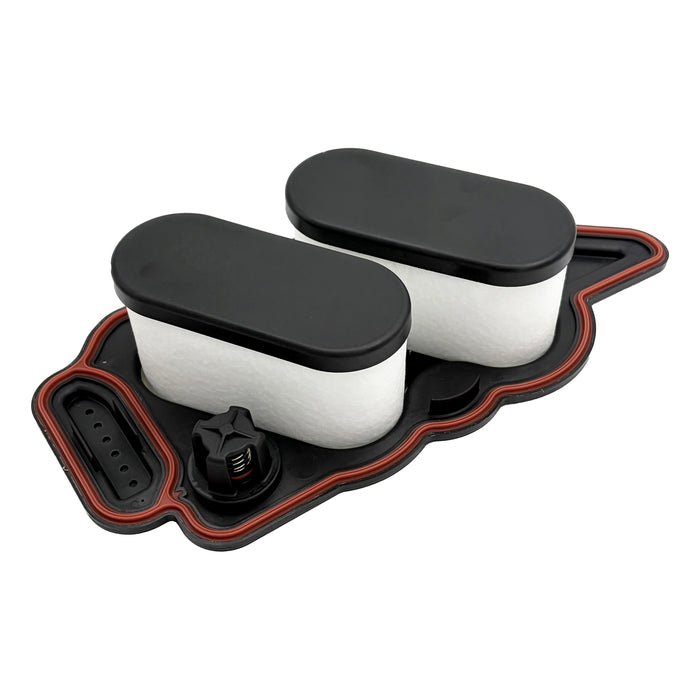
This is the part that the whole article has been circling. The TruckTok 2016–2019 6.7L Powerstroke CCV Filter is a direct drop-in replacement for the Motorcraft FL2077, and it’s the serviceable element you need if you own a filter-equipped 2016–2019 truck.
- Price: $111.99 (free shipping, in stock)
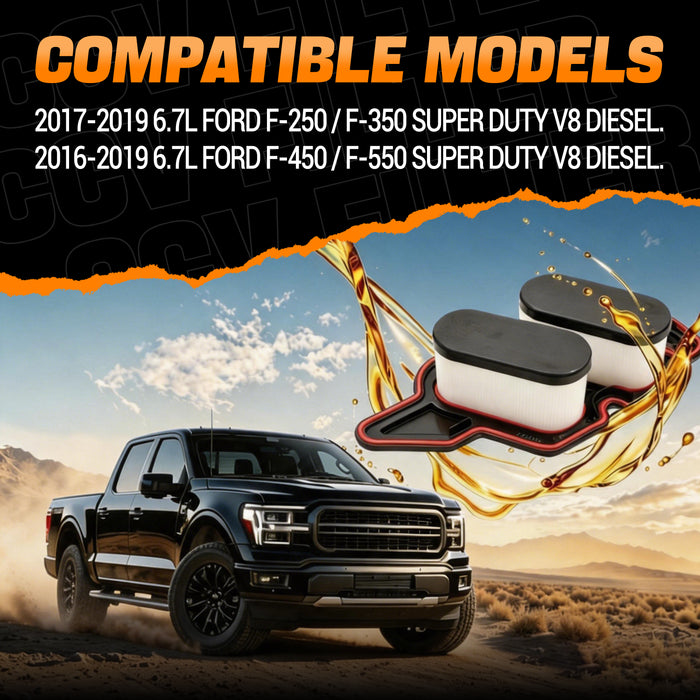
- Fitment: 2017–2019 F-250 / F-350 Super Duty 6.7L, and 2016–2019 F-450 / F-550 Super Duty 6.7L
- Cross-reference: Motorcraft FL2077
The Adventages:
- It uses multi-layer microfiber media to strip heavy oil mist and carbon out of the blow-by before it ever reaches the intake, and
- A heat-resistant polymer frame that holds up to the vibration and thermal cycling of a towing truck instead of cracking.
- Keep crankcase pressure controlled (so the rear main and bed plate seals stay intact) and
- Keep oil vapor out of the intake (so the turbo and intercooler stay clean).
If you’re doing the CCV filter, your fuel, oil, air, and cabin filters are probably due on the same schedule. TruckTok bundles all of them into a single 2017–2019 6.7L Complete Filter Kit, so you can knock out the full service in one session instead of chasing four separate filters.
How to Replace the CCV Filter on a 2016–2019 6.7L
The filter itself is a drop-in element, but getting to it is the real job — the box sits tucked back under the cowl, and the fuel filter and fuel lines are directly in your way. Here’s the straight version, if you want to access the complete installation with accompanying pictures and text, you can visit our forum.
Tools You’ll Need:
- An 8mm socket with a 1/4" ratchet and a short socket for the tight spots (all seven cover bolts are 8mm)
- A pick or small flathead (for the fuel line fitting tabs)
- Clean rags or a spill pad (for the fuel drip and the small amount of oil that’ll drain)
- Gloves (diesel smell sticks)
The Job, Step By Step:
-
Start cold and clean the top of the housing. Let the engine cool, then wipe the dust and road grime off the CCV cover so nothing falls into the crankcase when you open it. A clean work area here is cheap insurance.
-
Disconnect the fuel line fitting. The intake fuel line fitting sits right in your way. There are two plastic tabs — press them in and push down, then pull the line free and set it aside. Keep a rag or spill pad underneath, because a little diesel will drip. This buys you the room to reach the bolts and lift the cover. (You do not need to disconnect the actual fuel lines or pull the fuel filter — the element comes out with plenty of room.)
-
Remove the seven cover bolts. They’re all 8mm, and they’re captive — they stay captured in the cover, so you won’t drop one into the engine bay. A 1/4" ratchet with a short socket is all you need, and there’s enough room to swing it. Loosen all seven and lift the cover off.
-
Lift the old element out. The silver filter element just sits in the housing. Grab it and pull it straight out — it comes free without any wrestling. On a truck that’s never had it changed, expect the old one to be the factory original.
-
Compare old and new before you install. Set the new filter next to the old one and confirm they’re the same shape, the same profile, the same index points. They should be identical — if something’s off, stop and double-check the part number before you proceed.
-
Wipe the housing clean. Wipe the edges of the housing where the gasket seats — but don’t wipe inside the housing, where the air flows. You want the sealing surface clean so the new gasket seats properly, without pushing dirt into the engine.
-
Drop the new filter in. It goes in with one side facing the firewall, following the profile of the housing. Make sure it seats all the way down. Wipe any oil off the cover before you set it back on.
-
Reinstall the cover and torque in a spiral. Set the cover in place, start all seven bolts finger-tight, then tighten them to 3–4 ft-lbs in a spiral sequence — one, two, three, four, working your way around — so the gasket pressure distributes evenly and it seals properly. This is finger-tight-plus-a-little; leaning into the ratchet is how you crack the housing.
-
Reconnect the fuel line and start it. Push the fuel line back on with the clip down until it clicks and locks — give it a tug to confirm it’s seated. Fire the truck up, let it idle, and check for leaks or a loose line. That’s it.
The honest truth about this job: on the 2016–2019 trucks, it’s about as straightforward as maintenance gets. The element drops right out with the cover off, the bolts are captive so nothing gets lost, and the whole thing takes longer to clean than to actually swap.
Where DIY Installers Get It Wrong: How to Avoid It
The job is doable in a driveway, but it has a handful of traps that turn a one-hour filter swap into a tow to the shop. These are the ones that come up over and over:
1. Overtightening the plastic fasteners.
These are low-torque bolts threading into a plastic housing — the housing cracks long before the bolt strips. The spec is 3–4 ft-lbs, which is barely past finger-tight. If you’re leaning into a ratchet, you’ve already gone too far. A cracked cover is a whole new part, not a fixable mistake.
2. Skipping the spiral torque sequence.
The cover has to seal evenly, and tightening the bolts in a random order — or cranking one fully before touching the others — leaves the gasket pressure lopsided. Follow the spiral: one, two, three, four, working your way around the cover, so the seal sits flat and the gasket compresses uniformly.
3. Installing the element backward.
The filter has a specific orientation — one side faces the firewall and it has to follow the profile of the housing. Get it flipped and it won’t seat fully or seal right, and you’ve just put a new filter in that behaves like a dirty one. Check the orientation against the old element before you drop it in.
4. Wiping inside the housing.
Clean the sealing edge, yes — but don’t wipe inside the housing where the air flows. That just pushes dust and grit deeper toward the engine. Wipe the rim where the gasket seats, and leave the interior alone.
5. Not seating the gasket flat.
The rubber gasket has to sit flat against the housing or you’ll get an oil weep or a vacuum leak that mimics the exact problem you just paid to fix. Take a second to make sure the element is fully seated and the gasket isn’t pinched before the cover goes back on.
6. Skipping the old-vs-new comparison.
Before you install anything, set the new filter next to the one you pulled and confirm they match — same shape, same profile, same index points. It takes ten seconds and catches a wrong part number before it’s bolted in. Never assume the box shipped you the right thing.
7. Not clicking the fuel line fitting fully home.
The fuel line fitting you pulled has to click back on and lock — red clip down, then a tug to confirm it’s seated. A fitting that looks connected but isn’t locked will leak diesel, and you won’t always see it until the truck’s been running a while.
8. Working hot.
Everything about this job is easier cold, and hotter is genuinely dangerous — you’re handling diesel fuel and residual oil near exhaust and turbo surfaces. Let the engine cool before you open the fuel fitting or the CCV cover, and the plastic will thank you too.
None of these are exotic; they’re the ordinary mistakes that separate a clean 45-minute job from an expensive do-over. Read them once before you start, and you’ll skip most of them by reflex.
Should You Delete or Reroute Instead?
Every CCV conversation eventually drifts to the delete question, so let’s address it head-on. A CCV reroute (or delete) removes the factory filter from the equation — either venting the crankcase to atmosphere or routing it into a catch can — so you never buy another filter and oil vapor never reaches the turbo.
There’s a real case for it on a dedicated off-road or competition truck. No filter to maintain, no oil mist in the intake, cleaner charge pipes and intercooler for the life of the build. A well-baffled catch can setup is especially practical for a towing truck that wants clean intake plumbing without an open vent.
But the trade-offs are just as real, and they’re not small:
- It’s not street-legal. Modifying or defeating the emissions-related CCV system violates federal and state emissions rules in most jurisdictions, and it’ll fail inspection in strict states. This is an off-road-only proposition.
- It smells. An open vent dumps oily vapor under the truck, and you’ll notice it at idle. A catch can is cleaner but has to be drained and inspected on a schedule.
- It can void warranty. Touching a federally regulated emissions component is a fast way to void a powertrain warranty.
For a stock, street-driven 6.7L, the honest recommendation is to keep the factory filter and replace it on schedule. The reroute is a legitimate tool for the right build — just understand that “right build” usually means the truck doesn’t see public roads.
Conclusion
The CCV filter is the definition of a part that’s easy to ignore and expensive to ignore. It doesn’t make noise when it fails, doesn’t throw a code until the oil’s already been weeping, and doesn’t demand attention the way a fuel filter or an oil change does. It just quietly stands between your crankcase and a four-figure seal job — and between your oil vapor and your turbo.
For 2016–2019 6.7L Powerstroke owners, the math is simple: a $112 drop-in filter, swapped on schedule, versus a rear main or bed plate seal that requires pulling the transmission when it lets go. The filter wins every time.
If you’ve got a 2016–2019 Super Duty and you’re not sure when the CCV filter was last done, now’s the time to check it. Grab the 2016–2019 6.7L Powerstroke CCV Filter and get it done — and while you’re in there, TruckTok carries the full range of Powerstroke, Cummins, and Duramax maintenance filters and performance parts, so you can knock out the whole service in one order instead of hunting down parts piece by piece. Your turbo, your seals, and your wallet will all thank you.
Frequently Asked Questions
Q1: Does a dirty CCV filter actually affect the turbo?
A1: Yes, in two ways. A saturated filter stops separating oil mist, so more oil vapor reaches the compressor wheel and intercooler, where it turns into sludge that kills efficiency. At the same time, the rising crankcase pressure pushes oil through the turbo’s seals. The filter is the turbo’s first line of defense, and when it fails, the turbo eats the consequences.
Q2: Can a clogged CCV filter cause oil leaks?
A2: It’s one of the leading causes. A restricted filter builds crankcase pressure, and that pressure forces oil past the weakest seals — valve cover gasket, front crank seal, rear main seal, and bed plate seal. Fresh, unexplained oil weeping around the engine is a classic clogged-CCV signature.
Q3: Can I drive with a clogged CCV filter?
A3: You technically can, but it’s a gamble you shouldn’t take. The pressure keeps building, and the failure you’re risking — a rear main or bed plate seal — is exactly the kind of repair that costs ten times the filter and can strand you on the side of the road.
Q4: Can I clean the CCV filter instead of replacing it?
A4: No. The media traps contaminants permanently, and blasting it with compressed air or solvents tears the fine filtration apart and makes it worse. It’s a disposable element — when it’s done, it gets replaced, not revived.
Q5: How do I know which CCV part my 2016–2019 truck needs?
A5: Check whether your truck has a filter-equipped box or a sealed baffle box. The 2011–2017 trucks (and much of the 2016–2019 F-450/F-550 range) use a serviceable filter element — the FL2077-class part. Later trucks moved to a sealed box you swap whole. Match the year and the cross-reference number before ordering.
Q6: Will replacing the CCV filter improve performance or MPG?
A6: If the old filter was restricted, yes — restoring proper ventilation reduces oil carryover, helps the engine hold consistent air-fuel metering, and can smooth out idle and throttle response. It’s a maintenance restore, not a power mod, but a clogged filter is a real drag on drivability.
Q7: What’s the oil cap bounce test?
A7: With the engine idling warm, loosen the oil fill cap and let it rest on the opening. If it sits still or wobbles gently, pressure is normal. If it’s pushed up or dances, you’ve got elevated crankcase pressure — and a clogged CCV filter is the prime suspect. Zero tools, five seconds.
Q8: Does the 6.4L Powerstroke have the same CCV problem?
A8: The principle is identical, and the 6.4L is arguably worse off — its DPF regen strategy causes fuel dilution that thins the oil and raises blow-by, loading the ventilation system harder. If anything, the 6.4L is a cautionary tale for why a $112 CCV filter on the 6.7L is cheap insurance.
Q9: Is a CCV delete or reroute legal?
A9: On public roads, generally no. Modifying the emissions-related CCV system violates federal and state rules and will fail inspection in strict states. Reroute and delete kits are for off-road and competition builds, not daily drivers.
Q10: Why does the 2020+ truck not have a replaceable filter?
A10: Ford redesigned the CCV into a sealed baffle-style box with no serviceable media — just molded passages that slow the oil vapor so it condenses and drains back. Those boxes get swapped whole around 100,000 miles, rather than having a filter element changed.