
Home > News > 2020-2026 Duramax Fuel + Oil Filter: 98% of Water Stripped Before Injectors


2020-2026 Duramax Fuel + Oil Filter: 98% of Water Stripped Before Injectors
Your 6.6L Duramax L5P will forgive a lot. The one thing it won’t forgive is water. Not water in the coolant. Not water on the ground. Water in the fuel.
The high-pressure common-rail injection system on the 2020–2026 L5P pushes diesel through injectors with clearances measured in microns — tighter than a human hair — at pressures north of 2,500 bar (roughly 36,000 psi). At those pressures, a single droplet of water becomes a high-velocity abrasive. It erodes the injector nozzle, corrodes the precision-machined internals of the high-pressure pump, and the repair bill starts at four figures and climbs fast.
That’s why the number in the headline matters: 98%. And it’s half of a two-part job. Because while the fuel filter is guarding your injectors, the oil filter is doing the same job for your turbo and your bearings. Change both at the same time, from the same box, and you’ve covered the two most expensive fluid failures a diesel can suffer in one trip under the truck.
Why Water Is the One Thing Your L5P Can’t Tolerate
To understand why the 98% figure matters, you have to understand what water does inside a common-rail diesel.
Modern ultra-low-sulfur diesel (ULSD) actually holds water in suspension — some of it dissolves in, some of it stays emulsified. That’s the dangerous kind, because it doesn’t pool at the bottom of your tank where a water separator could catch it. It rides along with the fuel, all the way to the injection system. When that emulsified water hits the high-pressure pump, two things happen:
First, The Pump Loses Its Lubrication
Diesel fuel is the lubricant for the high-pressure pump’s internals. Water doesn’t lubricate — it displaces. A pump running on wet fuel is a pump running metal-on-metal. The 2011–2016 LML generation made the Bosch CP4.2 pump infamous for exactly this kind of water-related failure. GM switched the L5P to a more robust Denso HP4 pump, which is a genuine improvement — but no common-rail pump is immune to water.
Second, The Water Erodes The Injector Itself
At 2,500 bar, a water droplet hitting an injector nozzle is a pressure washer aimed at a pinhole. It wears the spray pattern, widens the orifices, and eventually the injector either dribbles (washing down a cylinder wall) or sticks (over-fueling one hole). Either way, the fix is a new injector — and on a late-model Duramax, injectors are not cheap, and they’re not a driveway job.
What “98% Water Separation” Actually Means
Not all fuel filters separate water. A cheap filter — the kind you see for $10 on a marketplace listing — is essentially a particulate strainer. It catches dirt, and that’s about it. The result looks like a filter, threads on like a filter, and does almost nothing a diesel actually needs.
A real water-separating filter works on a different physical principle: coalescing.
Here’s The Mechanism, Step By Step:
-
Fuel enters the filter and passes through the media. The media catches solid particulates — rust, dirt, the micro-debris that rides in every tank of fuel.
-
The coalescing layer does the heavy lifting. Emulsified water droplets are too small to settle out on their own. The coalescing media forces those micro-droplets to collide and merge — they “coalesce” into larger and larger droplets. Once a droplet gets big enough, it can no longer stay suspended.
-
Gravity takes over. Water is denser than diesel. The now-large water droplets sink, separate from the fuel, and collect in the bowl at the bottom of the filter housing.
-
The water stays down there — below the clean-fuel outlet — until you drain it through the plug on the bottom of the housing. There’s a sensor in the bowl that trips the “WATER IN FUEL” warning if the level rises, telling you it’s time to drain.
The “98% Water Separation”
The 98% figure — separating over 98% of both emulsified water (the suspended kind) and free water (the pooled kind) — is the spec that actually matters for a common-rail diesel. A filter that only catches free water is solving half the problem, because the emulsified water is the part that never settles out on its own.
Distinguish The Genuine Fuel Filter
It’s worth being direct here: you can’t tell a good fuel filter from a bad one by looking at the outside. The micron rating printed on the box is often marketing — one retailer’s “2 micron” filter tested out as an older-generation media with no verifiable spec behind it.
What separates a real filter from a knockoff is what’s inside:
The coalescing layer, the water-retention media, the internal screen that blocks water from reaching the clean-fuel outlet. That’s the part you can’t see, and the part that’s missing from the $10 filter.
Where the Fuel Filter Lives on the 2020–2026 L5P
Before installation, we first need to figure out exactly where it is located. On the 2001–2016 trucks — LB7, LLY, LBZ, LMM, and LML — the fuel filter lived up top, on the passenger side of the engine bay near the firewall. On the 2017-and-newer L5P, GM moved it underneath the truck, on the driver’s side, inside the frame rail — sitting just in front of the fuel tank, tucked between the DEF tank and the fuel tank.
| Model Years | Engine | Fuel Filter Location | Filter Type |
|---|---|---|---|
| 2001–2004 | LB7 / LLY | Passenger side, near firewall | Spin-on |
| 2004.5–2007 | LLY / LBZ / LMM | Engine bay, passenger side | Spin-on |
| 2011–2016 | LML | Engine bay, passenger side | Spin-on |
| 2017–2026 | L5P | Driver side, inside frame rail | Cartridge |
Type And Model of Fuel Filter
It’s a cartridge-style filter, not a spin-on. You don’t throw the whole thing away and thread on a new one. The element lives inside a plastic housing, and you unscrew the housing cap, pull the old cartridge out, drop the new one in, and replace the O-rings. The element itself is the part number to remember — on the factory side, that’s the TP1015, with GM cross-references 22937279, 23456595, 23304096, and 13539108, and the Wix number WF10451.
Type And Model of Oil Filter
The oil filter, by contrast, stays a conventional spin-on canister — the factory part is the PF26, with cross-references PF26F, 12684038, 19419485, and the Wix number WL10454. Two different filter styles, two different jobs, and they get changed on two different schedules — but the smart move is to buy them together and do them together.
The Oil Filter’s Job: Keeping Soot Out of the Turbo
It’s easy to treat the oil filter as an afterthought — spin it on, forget it until the next oil change. But on a diesel, the oil filter is doing a specific job that matters more than it does on a gas engine: it’s catching soot.
Why Soot Matters:
-
That soot is abrasive. Left in suspension, it grinds against the bearings, the cam, and — critically — the turbo’s journal bearings.
-
A turbo bearing spins at over 100,000 rpm and rides on a film of oil only microns thick. It doesn’t need a big chunk of metal to fail — just a steady diet of microscopic abrasives, and over tens of thousands of miles, that’s exactly what dirty oil delivers.
What A Good Filter Does About It:
This is why the oil filter’s media quality matters as much as the fuel filter’s. A filter with synthetic-blend media — the kind engineered for modern full-synthetic diesel oils — holds more dirt before it plugs, flows better when the oil is cold and thick, and keeps holding pressure when you’re pulling hard.
It also has a precision-calibrated bypass valve, which you only notice when you need it: if the filter ever plugs completely, the bypass valve opens and lets unfiltered oil flow rather than starving the engine. Unfiltered oil is better than no oil.
Do You Need “Upgrade” Filtration?
The world of “upgrade” filtration — bypass filters, centrifugal separators, 1-micron “polishing” filters that claim to make oil cleaner than new — is real, and the science behind it (SAE papers going back decades) genuinely shows reduced wear and longer oil life.
But that’s a different conversation for a different owner. It’s a bolt-on modification, not a maintenance item, and it costs real money and real installation effort. The foundation — the thing that keeps your turbo alive day to day — is a good oil filter and a good oil.
How Often Should You Really Change These?
This is where the internet gives you five different answers, and they’re all sort of right. Let’s sort it out honestly.
The Fuel Filter
Two Camps:
-
GM guidance + the on-dash “Fuel Filter Life” monitor are the most generous — they can push you toward 20,000 miles or more, and some owners report running 30,000 miles or two years on a single element.
-
The aftermarket consensus — the advice you’ll hear from people who cut open used filters and show you what’s inside — lands much lower: every 10,000 to 15,000 miles, or every other oil change, whichever comes first.
Why Go Early:
The fuel filter isn’t protecting something you can inspect. It’s protecting injectors and a high-pressure pump that give you zero warning before they fail. A filter that’s “only 70% loaded” is still catching water and dirt, but it’s also building restriction — and a restricted filter makes the lift pump work harder and can starve the engine under full load.
The guys who cut filters open at 50,000 miles and find the media half-discolored aren’t proving the filter was fine; they’re proving it was doing its job and should have been swapped sooner.
The “Seasoned Filter” Myth:
It’s technically true that a filter’s effective pore size shrinks slightly as it loads, so a partially-loaded filter catches slightly finer particles. But restriction rises at the same time, and on a common-rail diesel, the downside of restriction (fuel starvation under load) outweighs any marginal gain in capture efficiency. Don’t romanticize a dirty filter. Change it early.
Bottom line:
change the fuel filter every 10,000–15,000 miles. Severe service — heavy towing, dusty conditions, questionable fuel, biodiesel blends, or a lot of cold-weather running — pulls that down to the shorter end. It’s a $20-something part protecting a system that costs thousands to repair. That’s not a maintenance decision; it’s arithmetic.
The Oil Filter
This one is simpler, because it rides on the oil change. Change the oil filter at every oil change — 7,500 miles under normal operation, or 5,000 miles under heavy towing, running a full-synthetic diesel oil. There’s no world where you change the oil and reuse the filter. Throwing fresh oil into a loaded filter is throwing away half the value of the change.
| Filter | Normal Interval | Severe / Towing | What It Protects |
|---|---|---|---|
| Fuel filter (TP1015) | 15,000–20,000 miles | 10,000–15,000 miles | Injectors, high-pressure pump |
| Oil filter (PF26) | Every oil change, ~7,500 miles | ~5,000 miles | Turbo bearings, main/rod bearings, cam |
Buy Them Together
The fuel filter and the oil filter live on different schedules, but they’re both “fluid insurance,” and buying a two-filter kit in one box means you never get to the oil change and realize you forgot to order the fuel filter. It also usually costs less than buying the two separately.
Symptoms: What a Loaded Filter Feels Like
The Overload of The Fuel Filter Is A Gradual Process
A fuel filter rarely fails with a bang. It fails by getting worse gradually, and by the time you feel it, it’s been robbing you for a while. Here’s what to watch for:
-
Hard starting, especially after sitting. A restricted fuel filter makes the engine crank longer before it lights, because the system can’t build pressure fast enough. This is one of the earliest signs.
-
Rough idle or stumbling under load. As the filter loads, fuel flow can’t keep up with demand. The engine feels flat, hesitates, or surges when you put your foot down.
-
Loss of power, especially towing uphill. This is the classic “I thought I had more truck than this” moment. It’s often a fuel filter that’s been overdue for 5,000 miles.
-
A “WATER IN FUEL” warning. This is the sensor in the filter bowl telling you water has collected. It’s not a request — it’s an instruction to drain the filter, and a sign you’re getting water from somewhere (bad fuel, condensation, a cracked cap).
-
The “CHANGE FUEL FILTER” or low filter-life message. The on-dash monitor is a guide, not gospel, but if it’s nagging you and you can’t remember the last time you changed the filter, that’s your answer.
On The Oil Side, The Signs Are More Subtle
The oil that turns black fast, oil pressure that drops a little at idle, or an engine that just sounds tired. But the oil filter’s real enemy is time and miles, not drama. By the time an oil filter causes a symptom, the damage is already done. That’s why it gets changed on schedule, not on feeling.
The Cost Math: One Box vs Buying Separate vs Going Cheap
Let’s put actual numbers on this, because the “cheap filter” decision is where a lot of owners talk themselves into trouble.
What Good Filters Cost:
A quality fuel filter for the L5P runs roughly $20–$30, and a quality oil filter another $15–$25, depending on where you buy and what brand you trust. Buy them as a two-filter kit in one box, and you’re looking at around $54 for both — which is about what you’d pay for a single “premium” filter from a name-brand dealer markup, and less than buying the two separately at full retail.
What The $10 Filter Costs You:
The $10 marketplace fuel filter — the one with the loose water-separation screen and no internal coalescing media — saves you maybe $10–$15 up front. But it’s protecting a high-pressure pump and a set of injectors that cost thousands to replace. The math on that trade is not close.
Same Logic On The Oil Side:
The difference between a quality oil filter and a bottom-shelf one is a few dollars. The difference in outcome — a turbo that lives to 300,000 miles versus one that eats itself on dirty oil — is measured in thousands.
| Option | Approx. Cost | Water Separation | Verdict |
|---|---|---|---|
| Two-filter kit (one box) | ~$54 | Yes, coalescing media | Best value, both covered |
| Quality filters, bought separately | $40–$55 | Yes | Fine, but two orders |
| Cheap marketplace filter | $10–$15 | Often none / loose screen | False economy |
The point isn’t to spend more for the sake of it. It’s that filtration is the single highest-leverage dollar you can spend on a diesel. Nothing else costs so little and protects so much.
2020-2026 6.6L Silverado Sierra Duramax Fuel & Oil Filters Maintenance Kit
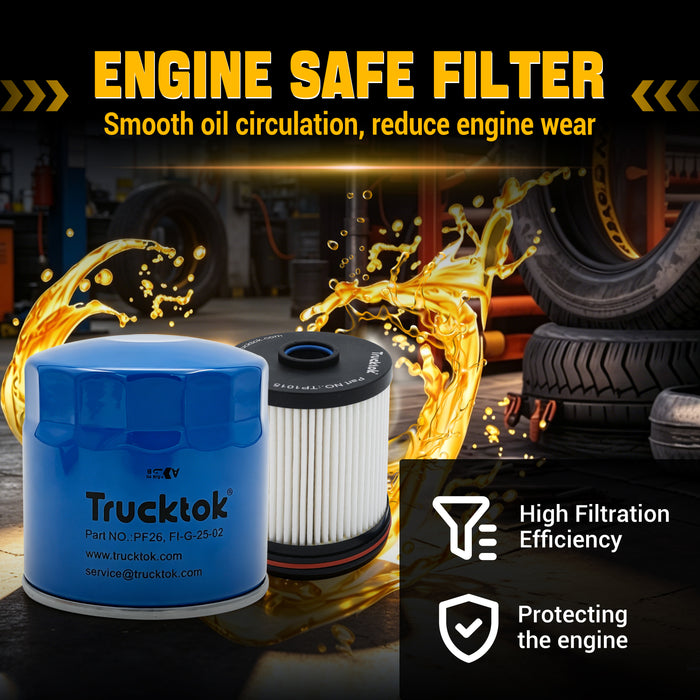
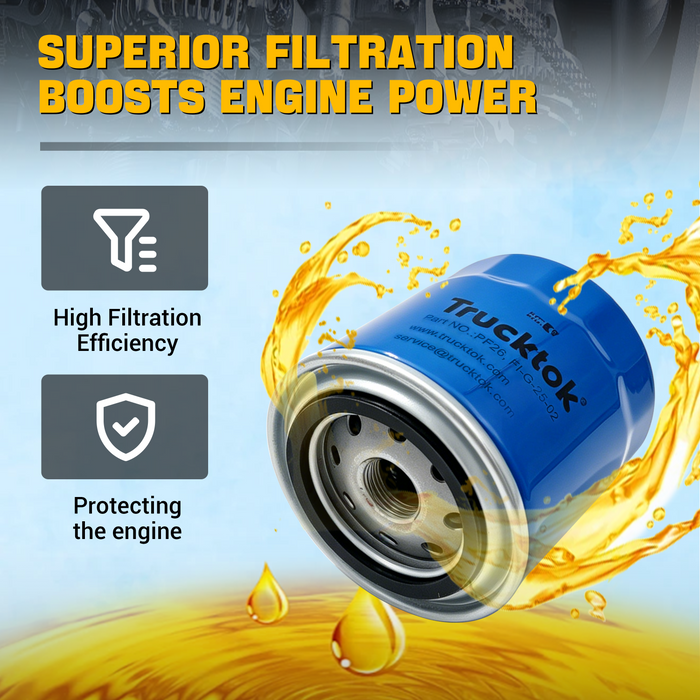
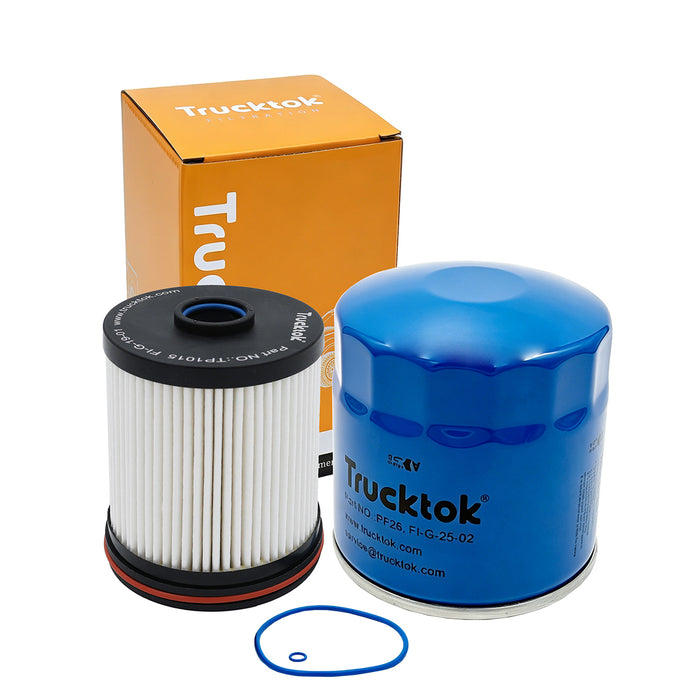
Here’s the part where we stop talking in generalities. If you’re maintaining a 2020–2026 6.6L Silverado or Sierra 2500/3500 HD, the kit that matches this article is the TruckTok 2020–2026 6.6L Duramax Fuel & Oil Filters Maintenance Kit — a two-in-one set that swaps directly for the factory TP1015 fuel filter and PF26 oil filter.
What’s Actually In The Box:
-
A cartridge-style fuel filter with multi-layer coalescing media engineered to separate over 98% of emulsified water and free moisture from the fuel — the exact spec that protects high-pressure common-rail injectors from erosion and corrosion. It drops into the factory housing on the driver-side frame rail, no special tools, no adapters.
-
A heavy-duty spin-on oil filter with synthetic-blend media for higher dirt-holding capacity and better flow, a precision-calibrated bypass valve for stable pressure on cold starts and under heavy towing, and a corrosion-resistant steel canister built to take road abuse.
It ships free and it’s in stock, and it costs $53.98 for both filters — which, as the math above shows, is the cheapest turbo-and-injector insurance you can bolt onto the truck.
Installation: Fuel & Oil Filters — Step by Step
Both of these are driveway jobs. The fuel filter takes the most care because it’s on a plastic housing and it’s full of diesel, but neither one needs a lift or a shop. Here’s the honest walkthrough. If you want to view the complete installation process with accompanying pictures and text, you can visit the Trucktokforum.
Part 1: The Fuel Filter (Driver-Side Frame Rail)
Tools: a 1-7/16" socket (a 36mm works too), a 3/8" ratchet with an extension, a T40 Torx bit, a drain bucket, and nitrile gloves. Diesel sticks and stinks — you want the gloves.
-
Do it cold and put the bucket under the housing. The filter sits under the driver’s side, inside the frame rail, in front of the fuel tank. Slide a drain pan or bucket underneath before you touch anything, because it will drip.
-
Drain it first with the T40 Torx bit. There’s a small drain plug on the bottom of the housing. Back it out with the T40 and let the fuel drain into the bucket. This is the step that keeps you from making a mess — skip it, and the moment you crack the housing cap, diesel runs down your arm and all over the frame.
-
Unscrew the housing cap. Get the 1-7/16" or 36mm socket on the cap and back it off slowly. More fuel will drain as it comes loose — let it, then finish removing the cap by hand.
-
Pull the old cartridge out. The element sits on a center stem. It separates from the housing with a firm pull — don’t be afraid to give it a real tug. On a filter that’s overdue, expect the old element to be visibly dirty and the diesel coming off it to be brown.
-
Clean the housing. The inside of the housing collects dirt that the filter has been stopping. Wipe the interior clean before the new element goes in — you don’t want to drop the old element’s dirt back into the clean side.
-
Replace the O-rings. There are two to watch: the large gasket on the cap, and the smaller O-ring on the center stem (on some trucks it’s a blue ring on the spout). Pop the old ones off and seat the new ones from the kit. Lubricate them with a little clean diesel — this is what prevents the O-ring from rolling and letting water or fuel bypass the seal.
-
Drop in the new element. The new filter has a specific orientation — the side with the smaller opening seats down onto the stem. Push firmly until it clicks into place. If it doesn’t click, it’s not seated.
-
Reinstall the cap. Thread the cap back on by hand as far as it’ll go, then finish with the socket. This is a plastic housing — snug is enough. Tighten until the gasket is no longer visible, but do not lean into it; overtightening a plastic fuel filter housing is how you crack it and turn a $20 filter job into a new housing.
-
Prime the system. This is the step everyone forgets and the one that determines whether the truck starts. On a push-button L5P: with your foot off the brake, press and hold the start button. The dash lights up and the fuel pump runs. Let it run three to five minutes — this purges the air out of the freshly-opened fuel system. Then, foot on the brake, start it normally and let it idle five to ten minutes while you watch for leaks.
-
Reset the filter-life monitor. Scroll to the “Fuel Filter Life” screen, press and hold the reset button, confirm “Yes,” and cycle the key. It should return to 100%.
-
Check for leaks. Get back underneath and verify nothing’s seeping at the cap or the drain plug before you call it done.
Part 2: The Oil Filter (Spin-On)
Tools: an oil-filter wrench (a cap-style wrench that fits the PF26’s fluted base is cleaner than a strap wrench), a socket for the drain plug, a drain pan that holds at least 10–11 quarts, a funnel, gloves, and a fresh jug of full-synthetic diesel oil — 5W-40 or 15W-40, meeting the CK-4 / dexos2 spec.
-
Warm it up first. Run the engine for a few minutes so the oil thins out and drains fully — warm oil carries more of the suspended soot out with it. But let it cool enough that you won’t burn yourself on the exhaust or the oil stream; a warm-to-the-touch engine, not a hot one, is the sweet spot.
-
Get it up safely. You need room underneath. Ramps or jack stands — never just a floor jack. The oil filter and drain plug live under the engine, and you’ll be reaching up into a tight spot.
-
Position the pan and pull the drain plug. Slide the drain pan under the oil pan, crack the drain plug loose with the socket, then unscrew it by hand the last few turns while holding light pressure on it. When it lets go, the oil comes fast — keep the plug from dropping into the pan. Let it drain completely until it’s a slow drip, then thread the plug back in and snug it to spec.
-
Spin off the old filter. Move the drain pan under the filter, get the wrench on the canister, and break it loose. It’s usually tighter than you expect, especially if it was overtightened last time — that’s the cap wrench earning its keep. Once it’s loose, spin it off by hand, keeping the open end up so the oil inside doesn’t dump on you.
-
Check for the old gasket. This is the step that separates a clean job from an oil-soaked driveway: look at the old filter and make sure its rubber gasket came off with it. If it stuck to the engine’s mounting surface, you’ll end up with two gaskets on the new filter, and that double seal will leak the moment the engine builds oil pressure. Peel the old one off if it’s stuck.
-
Clean the mounting surface. Wipe the sealing surface on the engine with a clean rag so the new gasket seats against clean metal, not old oil and grit.
-
Prep the new filter. Smear a film of clean oil around the new filter’s rubber gasket. This isn’t optional — a dry gasket grabs, tears, and leaks. A few drops of the fresh oil on your fingertip is all it takes.
-
Spin it on by hand. Thread the new filter on until the gasket just touches the sealing surface, then go another three-quarters of a turn by hand. That’s the spec for a spin-on filter. Do not crank it down with the wrench — overtightening is the number-one reason it won’t come off next time.
-
Refill with oil. Pour in the full-synthetic diesel oil, using the funnel. Fill to the spec on the dipstick — on the 6.6L L5P that’s roughly 10 quarts with the filter — then recheck the level after the engine has run and settled.
-
Start it and check. Fire it up, watch the oil pressure gauge come up, and let it idle for a minute while you look under the truck for any seepage at the filter base or the drain plug. Shut it off, let it sit a minute, then recheck the dipstick and top off if needed.
The whole job — both filters — is about half an hour in the driveway, and most of that is waiting for the fuel to drain and the prime cycle to finish.
The Install Mistakes That Cost You
Most of the ways this job goes wrong are fast, cheap, and completely avoidable. The five that come up again and again:
1. Skipping the drain step. Crack the fuel filter housing without draining it first and you’ll wear a pint of diesel. Use the T40 drain plug — it’s there for exactly this reason.
2. Overtightening the plastic housing. The fuel filter housing is plastic. It cracks before the threads strip. Snug is correct; leaning into the socket is a new-housing bill.
3. Rolling an O-ring. If you don’t lubricate the O-rings with a little diesel before seating them, they can roll and pinch — and a rolled O-ring means water or fuel bypasses the seal, which is the exact failure you’re changing the filter to prevent.
4. Forgetting to prime. Open the fuel system, bolt it back together, and crank without priming, and you’ll get a long crank, a no-start, or a truck that stumbles and dies. Foot off the brake, hold the start button, let the pump run three to five minutes.
5. Not reseating the new element. If the new cartridge doesn’t click onto the stem, it’s not in. A filter that’s half-seated lets fuel bypass the media entirely — which means your brand-new filter is filtering nothing.
6. Over-torquing the spin-on oil filter. Hand-tight plus three-quarters of a turn is the spec. Wrench it down and you’ll be fighting it — or cutting it off — at the next change.
Conclusion
Here’s the whole thing in one paragraph: water is the one thing your L5P can’t tolerate, and a $54 box of two filters is the one purchase that stops it. The fuel filter’s coalescing media strips 98% of the water out of your diesel before it can erode a single injector. The oil filter catches the soot that would otherwise grind down your turbo bearings. Change them on schedule — fuel filter every 10,000–15,000 miles, oil filter at every oil change — and the two most expensive fluid failures a diesel can suffer simply don’t happen to you.
If you’re doing your own maintenance on a 2020–2026 Silverado or Sierra HD, grab the TruckTok Fuel & Oil Filters Maintenance Kit — direct fit for the 6.6L Duramax, replaces the TP1015 and PF26, ships free, $53.98. And if you’re already under the truck, it’s the same labor to do the whole fluid-and-filter refresh: TruckTok carries the complete line of maintenance kits for the 6.6L Duramax — including the four-filter Full Maintenance Kit that adds the engine air and cabin air filters to the fuel and oil pair, and the three-filter Air, Fuel & Oil Kit for when you want to skip the cabin filter. One order, every filter the truck needs, one afternoon of work.
FAQ About 2020-2026 Duramax Fuel + Oil Filter
Q1: Does the fuel filter really separate 98% of the water?
A1: The cartridge uses multi-layer coalescing media that merges tiny emulsified water droplets into larger ones, then lets them settle out by gravity into the housing bowl. That’s how it separates over 98% of both emulsified and free water before it can reach the injectors.
Q2: How many fuel filters does a 2020–2026 6.6L Duramax have?
A2: One factory-serviceable fuel filter, on the driver’s side inside the frame rail near the fuel tank. Trucks with an aftermarket lift pump may add a second primary filter near the tank.
Q3: Do I need to prime after changing the fuel filter?
A3: Yes. On a push-button L5P, hold the start button with your foot off the brake to run the fuel pump for three to five minutes, then start normally and idle until the air is purged.
Q4: How often should I actually change the fuel filter?
A4: Every 10,000–15,000 miles, or every other oil change, is the smart consensus. Severe towing, dust, or questionable fuel pulls it toward the shorter end.
Q5: What does “WATER IN FUEL” mean on a Duramax?
A5: Water has collected in the filter bowl. Drain it promptly through the drain plug. If the warning persists or appears right after refueling, stop driving until the contaminated fuel is dealt with.
Q6: Can I run a cheap $10 fuel filter?
A6: You can, but many cheap filters lack a proper coalescing layer or have a loose water-separation screen — meaning they let water through to the pump and injectors. The savings isn’t worth the four-figure downside.
Q7: Is the oil filter really protecting the turbo?
A7: Yes. Diesel oil carries combustion soot, which is abrasive. The oil filter catches that soot before it grinds the turbo’s journal bearings, which spin at over 100,000 rpm on a micron-thin oil film.
Q8: Does this kit fit both the 2500 and 3500?
A8: Yes. It’s a direct fit for 2020–2026 Chevrolet Silverado 2500/3500 HD and GMC Sierra 2500/3500 HD with the 6.6L Duramax.
Q9: What’s the difference between a “seasoned” filter and a new one?
A9: A partially-loaded filter’s media catches slightly finer particles, but it also builds restriction that starves the engine under load. The downside outweighs the marginal gain — change it early, don’t romanticize a dirty filter.
Q10: Should I buy the fuel and oil filter together?
A10: Yes. They’re both “fluid insurance” on different schedules, a two-filter kit costs less than buying separately, and you won’t get to an oil change and realize you forgot the fuel filter.